Article 19 — The Recovery Layer
from the Application-Aware Networking series
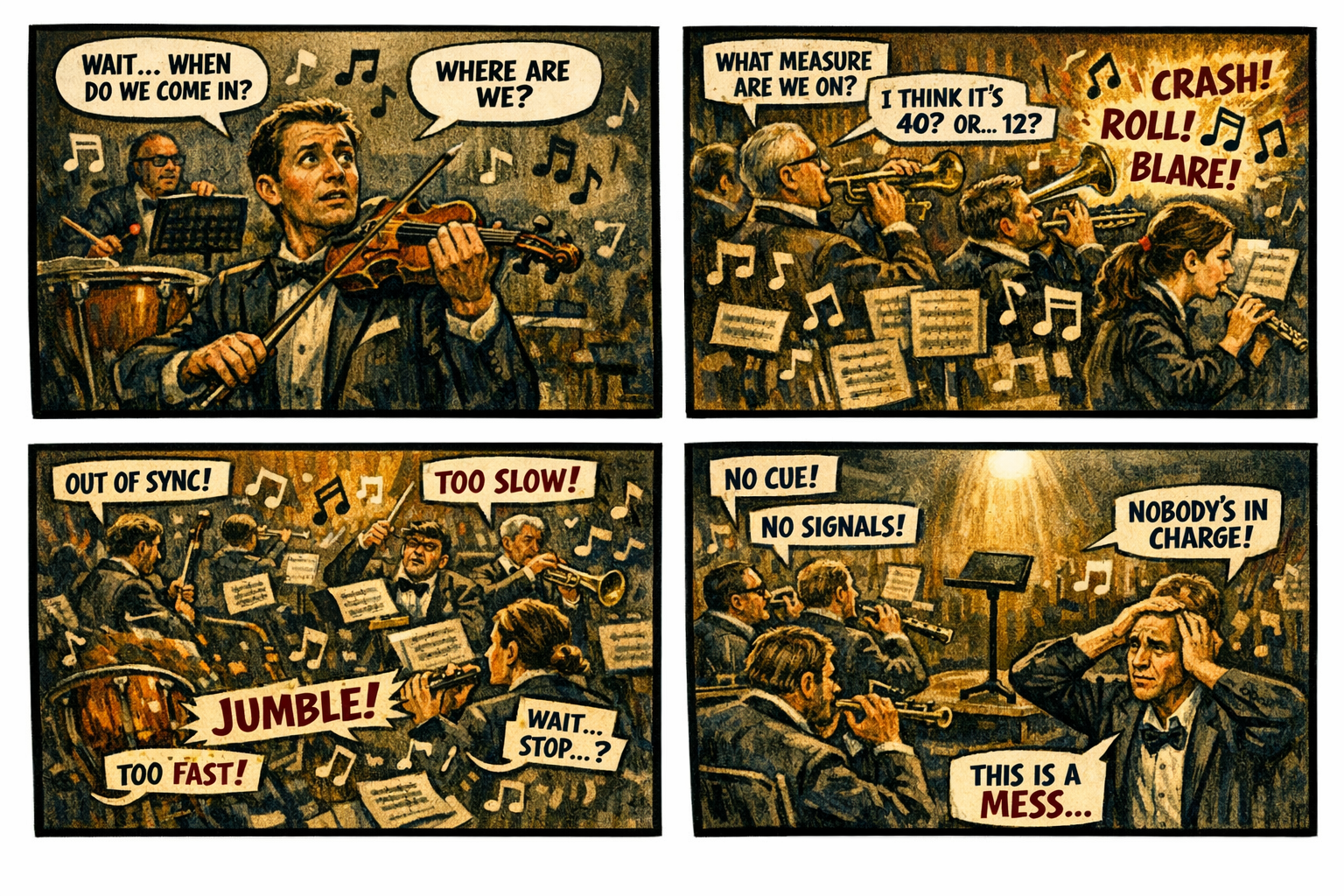
The Orchestra With No Conductor
You’re sitting in a concert hall. The orchestra begins to play. The violins start confidently. The brass hesitates. The percussion comes in early. The woodwinds restart the opening phrase. The cellos slow down. The trumpets speed up. No one is wrong, but no one is together. A violinist looks up, confused. A percussionist taps the stand, waiting for a cue. The brass section whispers, “Are we on measure twelve or forty?” The flutes restart again. The timpani rolls at the wrong moment. The entire orchestra is trying to recover, but without a conductor, without a shared tempo, without a stable reference.
The music isn’t bad. The musicians aren’t unskilled. The instruments aren’t broken. The system has lost its ability to recover.
That is the Recovery Problem — not the “bad failover” kind, but the architectural kind. The kind that appears when cloud systems attempt to re‑establish trust, posture, and session state using partial truth, delayed signals, and contradictory context. The kind that turns a coordinated ensemble into a room full of talented people playing different versions of the same song.
Recovery Is the Ninth Layer of Modernization
Visibility shows what is happening. Continuity stabilizes identity across transitions. Control determines what the system is allowed to do. Signals carry the truth. Evaluation interprets the truth. Decision enforces the truth. Automation scales the enforcement. Remediation repairs the damage. But recovery restores coherence — the moment the system tries to get everyone back on the same measure, the same tempo, the same key, the same truth.
When recovery is grounded in truth, the system regains harmony. When recovery is grounded in uncertainty, the system produces noise. A system that cannot recover predictably cannot modernize safely.
Why GCC‑Moderate Breaks Recovery
The FedRAMP Moderate boundary was built for static resets, not dynamic recovery. It filters the signals, delays the timing, distorts the context, mislabels the location, and fragments the truth. Recovery engines receive posture without session context, location without risk, device state without refresh signals, and user identity without compliance state. Recovery doesn’t wait for clarity or pause for alignment. It resets, re‑authenticates, re‑evaluates, and loops. The system isn’t punishing the user — it is trying to recover from uncertainty using uncertainty.
Headquarters and Field Offices Experience Recovery Differently
At headquarters, recovery behaves like a well‑rehearsed ensemble. Signals arrive intact, context is preserved, and the system finds its tempo again. In field offices, recovery behaves like a rehearsal without a conductor. Signals arrive late, context is distorted, and sections restart independently. The same user, same device, same request — different recovery outcome. The architecture creates two realities, and recovery enforces both.
Why Recovery Failures Are Misdiagnosed
When recovery collapses, every team hears a different part of the noise. Security hears repeated re‑authentication. Identity hears session loops. Network hears latency spikes. Operations hears region drift. Users hear random resets. Everyone is correct, and everyone is wrong. The failure is architectural. Recovery is reacting to the uncertainty created by the boundary.
Modernization Stalls Without Recovery
Without reliable recovery, sessions reset unpredictably, posture re‑evaluates inconsistently, trust loops emerge, access contradicts itself, enforcement becomes unstable, users lose confidence, and teams chase phantom resets. This is not a failover problem. It is architectural instability in restoration.
The Root of the Recovery Problem
The recovery problem is not caused by bad scripts, misconfigured triggers, incorrect thresholds, or user error. It is caused by an architecture that cannot reliably deliver the truth required for dynamic restoration. The boundary filters the truth, the WAN delays the truth, the inspection layers distort the truth, the region model mislabels the truth, and the identity platform receives partial truth. Recovery cannot function on partial truth. Recovery cannot restore inside a fog.
The Only Way Forward
Recovery integrity must be restored. The boundary must allow identity‑critical signals. Timing must be preserved. Region awareness must be accurate. Device posture must be current. Risk evaluation must be complete. Session context must be intact. Policy logic must receive the full truth. Recovery must operate on stable, consistent inputs. Only then can trust be restored, enforcement become predictable, and modernization move forward without contradiction.
Disclaimer
Not all agencies will experience the issues described in this article. These behaviors occur primarily in architectures where cloud identity, Conditional Access, and real‑time policy evaluation depend on signals that traverse GCC‑Moderate boundaries, WAN inspection layers, or region‑variable paths. Agencies that rely on direct Active Directory authentication, maintain on‑premises identity controllers, or operate with short, stable network paths may see different outcomes. These observations reflect common patterns in GCC‑Moderate cloud environments, not universal conditions.
Back to top