Federal Modernization — Case Study
End-to-end federal agency modernization governance
Federal Modernization — Case Study
This page is the canonical engagement pattern for an end-to-end federal-agency modernization case study. Specific agency identifiers, metrics, and timelines are intentionally absent until real engagement material is reviewed and cleared for external release.
Engagement archetype
A federal agency executes a multi-quarter modernization program spanning identity, cloud boundary, telemetry, and zero-trust controls. The program touches every concern in the Executive Governance Series: fragmented identity, uncorrelated telemetry, point-in-time evidence, boundary opacity. The Federal Modernization Program’s intervention is structural — adopting the substrate as the governance layer underneath the existing tool stack rather than replacing tools individually.
This is the engagement archetype the substrate is designed for: an agency at the scale where per-tool governance has become structurally infeasible.
Starting state (typical)
- Multi-cloud tenancy (M365 GCC-Moderate primary, named-exception workloads).
- AD environment in active migration to Entra ID.
- ZT program running per-pillar with limited cross-pillar correlation.
- ATO package authored manually against a control catalog; per-cycle re-engineering.
- Telemetry from 20+ tools, normalized partially in a SIEM.
- Compliance findings backlog with multi-year tail.
The Federal Modernization Program intervention pattern
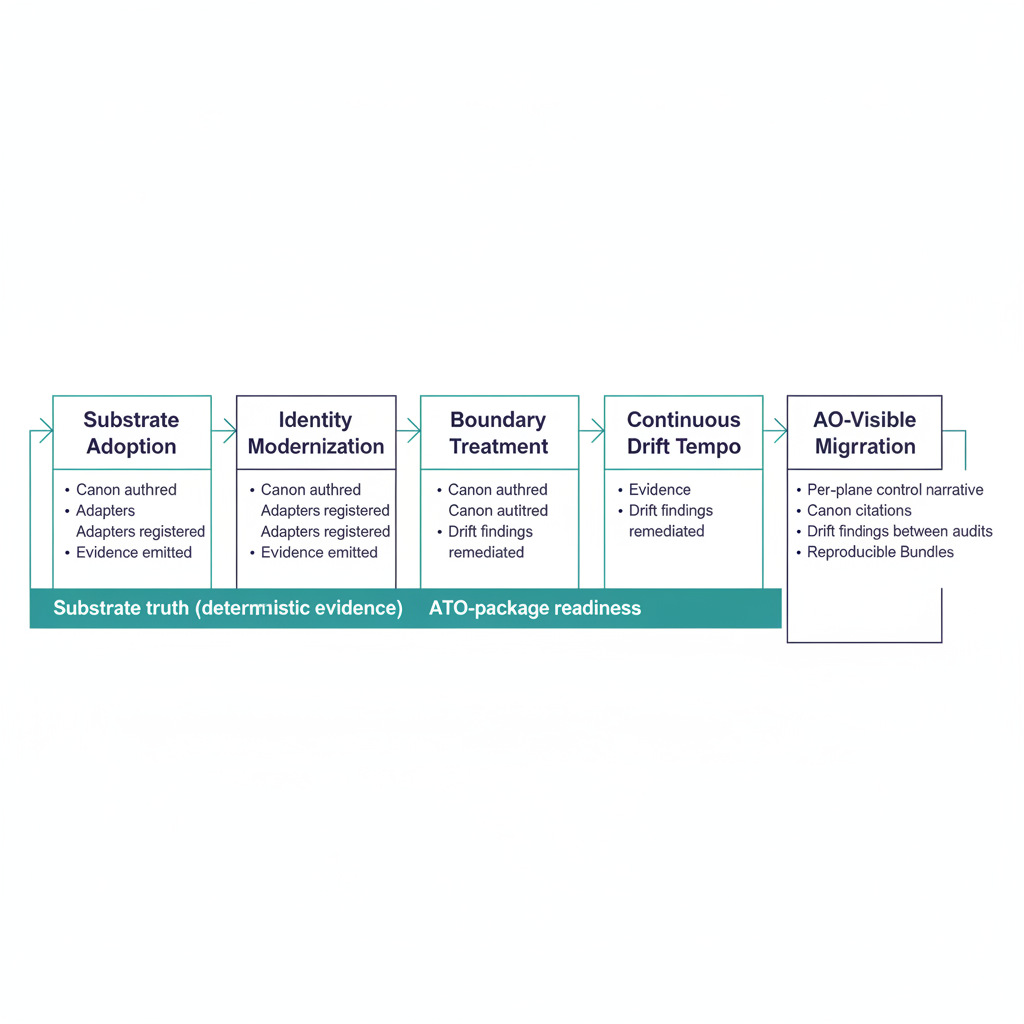
Phase 1 — substrate adoption
Install the fmp package; run fmp substrate walk against the agency’s tree; author a substrate manifest naming the agency’s modules. Schema-validation gates land in CI for canon edits. Net effect: structural drift becomes visible.
Phase 2 — identity modernization
Apply the identity-modernization pattern (see Identity Case Study and Modernization Governance Whitepaper): canon-first attributes, modernization adapters, drift-driven cleanup, cutover, post-cutover.
Phase 3 — boundary treatment
Apply the cloud-boundary pattern (see Cloud Boundary Case Study): boundary probe, in-boundary telemetry, compensating enforcement, ATO documentation surface.
Phase 4 — continuous drift tempo
Operationalize the canonical SLA tempo (P1 immediate / P2 1hr / P3 24hr / P4 72hr). Auto-remediation handles deterministic findings; escalations land at named roles per the drift standard.
Phase 5 — ATO package migration
Migrate the ATO package from attestation-anchored to substrate- anchored. SSP, POA&M, KSI dashboards, and Component Definitions emit deterministically from canon plus telemetry. Attestations remain in the package as the human accountability wrapper but are no longer the primary verification surface.
Substrate behaviors observed (pattern)
A real engagement would document:
- Drift findings rate over time — by class and severity, across the program.
- SLA adherence — fraction of findings remediated within canonical SLA per tier.
- Canon-change ADR cadence — how often the program produces canon-change ADRs vs. operational PRs (a measure of substrate maturity).
- ATO package regeneration time — wall-clock time from “decide to regenerate” to “bundle hash matches expected”.
- 3PAO re-execution outcome — independent verifiability of evidence months after assembly.
- Net tool count change — substrate adoption typically reduces tool count by retiring parallel governance machinery.
These are the metrics a credible federal modernization case study needs.
Why this engagement is structurally different
Three properties distinguish a substrate-anchored modernization from a tool-stack modernization:
- Canon survives the modernization. Tools change, vendors change, platforms change. Canon does not — or, when it changes, it changes through a governed ADR process. The agency’s investment in canon authoring compounds.
- Evidence is regenerable. The agency does not have to keep point-in-time bundles indefinitely; they regenerate from canon plus archived inputs. Cost of long-term audit retention drops.
- Drift is the operational signal. The substrate’s findings replace the agency’s pre-existing patchwork of audit-cycle gap discovery. SOC and governance operations move to the same canonical taxonomy.
Lessons that propagate back into canon
A real engagement typically yields the most diverse lesson set of any case-study pattern:
- Canonical attribute refinements (identity).
- Boundary capability disposition updates (cloud).
- New compensating-enforcement adapters (ZT, M365 features).
- Operational-tempo tuning (canonical SLA tiers vs. agency staffing).
- ATO-package emission improvements (OSCAL fidelity).
Each lesson lands as an ADR, canon-document update, or adapter-registry change. The case study, when complete, becomes a provenance source for all five.
Promotion to “real engagement”
Same posture as the identity and cloud-boundary case studies: requires reviewed, externally releasable material; canon-change traceability for cited lessons; sponsor-side review and approval.
End-to-end engagements are the most demanding case studies to externalize because the lesson set is broad and the engagement material is sensitive. The substrate’s case study posture is honest about this — the pattern is documented now; the engagement is documented when reviewed material is available.