Next Generation DDI
Governing DNS, DHCP and IPAM as the hybrid multi-cloud control plane
Next Generation DDI
Governing DNS, DHCP and IPAM as the hybrid multi-cloud control plane
How DNS evolved from a name-lookup service into the application surface, the security enforcement plane and the identity substrate of the hybrid multi-cloud enterprise, and what federal agencies must do to govern it.
Michael Stratton · Updated October 2026
next-generation-ddi-bundle.docx: every chapter in one Word document, with its figures. Each chapter page also has its own download. Regenerated on every site deploy.
Why this book exists
DNS was designed to answer one question: what is the address for this name? In a hybrid multi-cloud agency it now does far more. It publishes private endpoints, selects SaaS front doors, enforces security policy, anchors certificate validation and defines the application surface that Zero Trust policy is written against. Most agencies still run it as a commodity utility spread across five independent platforms: Active Directory DNS or an on-premises DDI grid, AWS Route 53, Azure DNS, Google Cloud DNS and VMware NSX.
The result is split-brain DNS that breaks private connectivity, certificate trust and Layer 7 policy at once, and that shows up as certificate errors and access denials rather than DNS errors. This book makes the case for one authoritative DDI policy plane, and walks through what it takes to get there and run it.
The arc
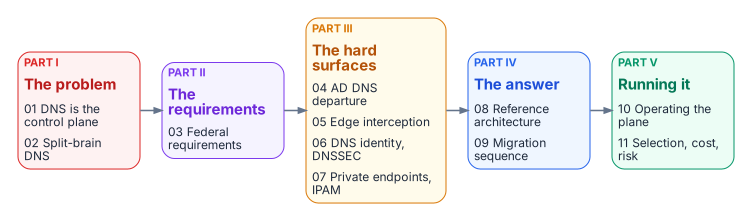
Start with Applicability if you work in GCC High, DoD or an air-gapped environment. It sets out which statements in later chapters change at higher impact levels.
Part I · The problem
- 01 — DNS Is Now the Control Plane: problem, solution and ask; the three DNS perspectives; IPAM and DHCP as the address layer of the inventory.
- 02 — Split-Brain DNS: The Structural Problem: private-IP, security-policy and SaaS-endpoint split-brain, and what fragmented DDI costs.
Part II · The requirements
- 03 — Federal Requirements: FedRAMP Moderate, NIST SP 800-81 Rev. 3, OMB M-22-09 and the control mapping.
Part III · The hard surfaces
- 04 — The Active Directory DNS Departure: the records AD maintains, and what the Entra ID transition does not carry over.
- 05 — Edge Interception, Encrypted DNS and Rogue DHCP: where queries escape the governed resolver path.
- 06 — DNS Identity, Certificates and DNSSEC: the name layer as the first link in the trust chain.
- 07 — Cloud Private Endpoints, SDN and IPAM Consistency: Azure Private Endpoints, cloud IPAM, VMware NSX and dual-stack.
Part IV · The answer
- 08 — Reference Architecture and the Five Critical Decisions: one authoritative policy plane and the decisions that carry the operational risk.
- 09 — The Migration Sequence: six phases from AD-integrated DNS/DHCP to a unified policy plane.
Part V · Running it
- 10 — Operating the Control Plane: delegated administration, ITSM and certificate automation, and compliance evidence.
- 11 — Platform Selection, Cost and Residual Risk: how to choose, how to measure success, and what risk remains.
Reference
- Appendix A — DNS Record Types and Ecosystem Integrations: the record-type catalog, ecosystem integrations and glossary.
- Appendix B — Requirements Mapping and Sources: each federal requirement mapped to the chapters and evidence, and every source cited, primary and third-party listed separately.
The canonical sequence
Every chapter aligns to one sequence. It is the order in which the work is done, and the order in which evidence accumulates:
Inventory → Coexist → Migrate authority → Federate clouds → Decommission AD DNS and DHCP → Harden and evidence
Five configuration decisions carry most of the risk along the way. Each is owned by one chapter and checked in Chapter 10:
| Decision | Settled in | Phase |
|---|---|---|
| 1. redirect-dns targets a network-addressable agency resolver | Ch 05, Ch 08 | Migrate authority |
| 2. The agency resolver is the first hop; other resolvers are its forwarders | Ch 05, Ch 08 | Migrate authority |
| 3. The policy plane holds every per-cloud conditional forwarding rule | Ch 07, Ch 08 | Federate clouds |
| 4. AD DNS is inventoried and reprovisioned before any domain controller goes | Ch 04, Ch 09 | Inventory, Decommission |
| 5. OCSP and CRL endpoints resolve from every origin | Ch 06, Ch 08 | Federate clouds, Harden |
How to read this book
| Audience | Recommended path |
|---|---|
| CIO / CISO / authorizing official | 01 → 03 → 08 → 11 |
| Enterprise or network architect | 01 → 02 → 07 → 08 → 09 |
| Identity architect | 04 → 06 → 10 |
| Network or security engineer | 05 → 06 → 07 → 09 |
| Program manager | 01 → 09 → 10 → 11 |
| GCC High, DoD or air-gapped reader | Applicability → 03 → 05 → 07 → 11 |
Chapters
| Title | Subtitle |
|---|---|
| Applicability | Which parts of this book apply in commercial cloud, GCC-Moderate, GCC High, DoD and air-gapped environments |
| DNS Is Now the Control Plane | Why DNS, DHCP and IPAM can no longer be run as a commodity utility |
| Split-Brain DNS: The Structural Problem | Same name, different answers — and why process discipline cannot fix it |
| Federal Requirements: NIST SP 800-81 Rev. 3, FedRAMP and Zero Trust | What the federal mandates actually require of the name layer |
| The Active Directory DNS Departure | What AD-integrated DNS does today, and what must be reprovisioned before it leaves |
| Edge Interception, Encrypted DNS and Rogue DHCP | Where queries escape the governed resolver path |
| DNS Identity, Certificates and DNSSEC | The name layer as the first link in the trust chain |
| Cloud Private Endpoints, SDN and IPAM Consistency | Keeping names and addresses consistent across Azure, AWS, Google Cloud and VMware |
| Reference Architecture and the Five Critical Decisions | One authoritative policy plane, and the decisions that carry the operational risk |
| The Migration Sequence | Six phases from AD-integrated DNS/DHCP to a unified control plane |
| Operating the Control Plane: Delegation, Automation and Evidence | Divisional autonomy, ITSM integration, certificate automation and compliance evidence |
| Platform Selection, Cost and Residual Risk | How to choose, what it costs to run, and what risk remains |
| Appendix A — DNS Record Types and Ecosystem Integrations | Record-type catalog, ecosystem integrations, glossary and source note |
| Appendix B — Requirements Mapping and Sources | Each federal requirement, where the book addresses it, the evidence it calls for, and every source cited |
Source note
This book restructures the October 2026 Next Generation DDI whitepaper (Word edition) into chapters. Platform-specific examples are illustrative; evaluate every option against the architectural requirement of a single authoritative policy plane. Footnotes cite primary sources (federal documents, IETF standards and the cloud providers’ own documentation) wherever one exists; the few third-party sources are labeled as such, and Appendix B lists both groups separately.