The Governed Path — Token-Bound Transport and the Application-Aware Overlay
Why an efficient edge device needs an identity-anchored fabric, and how the path itself becomes governed evidence
The Governed Path — Token-Bound Transport and the Application-Aware Overlay
This chapter rests on the program decision (Application-Aware Networking and Token-Bound Transport Plane), whose status is Proposed. Unlike the Accepted decisions that anchor the rest of this paper (the program decision, the program decision), the transport-plane model here is canon direction with implementing specifications — FMP_122 (Token-Based Transport Authorization), FMP_123 (Application-Aware Overlay Fabric Model), FMP_124 (Transport Plane Telemetry Contract) — still open. Read it as where the architecture is going, not where it has arrived.
The other half of “identity is the new boundary”
Chapter 2 established the keystone of consolidation: token-based security lets one logical store serve many trust domains because the trust boundary travels with the request. That argument was about the data plane — who may touch the data. This chapter applies the identical principle to the transport plane — the network path the request rides on — and shows that the two are the same idea wearing different clothes.
The Federal Modernization Program’s own doctrine names the gap precisely. Identity has become the root of trust and the addressing model, but, in the program decision’s words, “identity is the new boundary, but only halfway”: the transport that carries identity-derived claims is still session-based — “a TLS connection establishes once, then rides for minutes-to-hours carrying intent the issuer can no longer attest to” (the program decision §Context #2). The data plane re-proves identity on every call; the transport plane proves it once and coasts. That asymmetry is the subject of this chapter.
“Identity is the new boundary” must hold on both planes. Chapter 2 anchored the data plane with token-bound access — a fresh, scoped credential per call. This chapter anchors the transport plane with token-bound transport — a fresh, scoped credential per path. A centralized source of truth reached over an ungoverned, session-trusted network is only half-secured: the front door is identity-checked while the hallway is not.
The efficient edge device is necessary but not sufficient
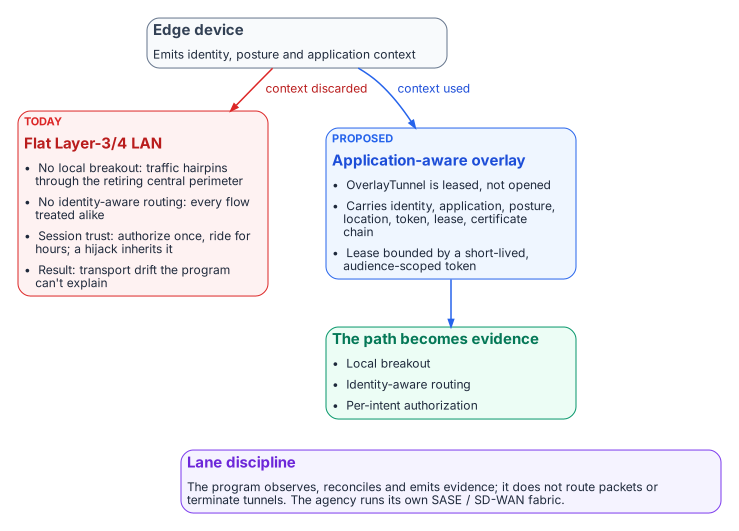
Consider a perfectly tuned edge device: identity-anchored, telemetry-emitting, policy-compliant — everything the endpoint control plane asks for (control-planes.yml, Endpoint plane). Land it on a flat, non–application-aware datacenter LAN and its efficiency is bounded by the fabric it lands on. The device is optimized in isolation while its traffic is undermined in three concrete ways.
| # | What the flat LAN lacks | Canon | Consequence for the edge device |
|---|---|---|---|
| 1 | Local breakout / Cloud OnRamp — app-aware path selection, local_breakout, optimal_path_selection |
control-planes.yml (Network plane, cloud_onramp) |
Traffic is backhauled/hairpinned through a central perimeter — the TIC3 / F5 choke-point being retired. The device’s efficiency is spent on the detour. |
| 2 | INR — Identity-aware Routing — the convergence point where identity, telemetry, and routing unify; requires: [telemetry_plane, ipam_plane] |
control-planes.yml (INR) |
A flat LAN treats every flow identically. It cannot do per-user / per-app path selection or zero-trust segmentation, so the device’s identity signals have nowhere to land. |
| 3 | Per-call authorization — trust scoped to a single intent | the program decision §Context #2 | Trust collapses into a long-lived session: authorize once, ride for hours. Hijacking the session inherits its trust — exactly the antipattern the program decision exists to retire. |
The pattern is the same each time: the edge device emits high-quality identity, posture, and application context, and a flat Layer-3/4 LAN throws it all away. The substrate is left able to govern what runs and who runs it, but not how it gets there — and that blind spot surfaces as DRIFT-AUTHZ findings the substrate cannot explain, because the transport context is invisible (the program decision §Context).
What the device actually needs: an application-aware overlay
The requirement is not “a faster LAN.” It is an application-aware overlay fabric in which the path is a typed, identity-anchored, governed object. the program decision promotes FMP_001’s tunnel abstraction from concept to schema as the OverlayTunnel:
OverlayTunnel (the program decision §Decision #3)
An OverlayTunnel carries {identity, application, posture, location, token, lease, certificate-chain}. Tunnels are leased, not opened — the lease is bounded by token lifetime, and the canonical record is provenance-anchored to SSOT. The authorizing token is short-lived and audience-scoped, bound to caller identity + target application + device posture + organizationally derived location (the program decision §Decision #2). A “session” — any long-lived authorization context that survives a single authorized intent — ceases to be a canonical concept.
This is precisely the data-plane move of Chapter 2, transposed onto the network. There, the database password was replaced by a freshly-minted, audience-scoped token per connection. Here, the open session is replaced by a freshly-leased, audience-scoped tunnel per path. In both cases the durable, hijackable artifact — the stored password, the long-lived session — is removed, and authorization becomes a per-event, identity-bound act.
The “SD-WAN / SDN” part is only the mechanism — vManage/vSmart/vBond and WAN edges (overlays/cisco/sd-wan.yml), SASE/ZTNA from the TIC3 retirement roadmap. The requirement is application-awareness plus token-bound transport. On that fabric the edge device’s efficiency is finally realized, and the path itself becomes governed evidence rather than an invisible Layer-3/4 detail.
A flat LAN is a drift generator, not neutral ground
The sharpest consequence for a governance substrate: a non-optimized LAN that stays flat does not merely run slower — it manufactures drift. the program decision proposes a sixth drift class, DRIFT-TRANSPORT, joining the substrate’s existing five (DRIFT-SCHEMA, DRIFT-SEMANTIC, DRIFT-PROVENANCE, DRIFT-AUTHZ, DRIFT-IDENTITY). Under it, an OverlayTunnel or flow observed without an issuing token is a finding (P2), as is path-policy variance between the canonical organizational/location binding and the observed flow (P4). The flat LAN is therefore not a neutral substrate the edge device merely fails to exploit — from the substrate’s point of view it is an active source of transport drift.
This closes the loop with Chapter 1’s deepest claim: drift is born where the governed path is the path of most resistance and an ungoverned shortcut exists. A flat, session-trusted LAN is that ungoverned shortcut, one layer down from the shadow-copy problem — the network equivalent of an unofficial local database nobody blessed.
Lane discipline: The Federal Modernization Program governs the fabric, it does not become it
One boundary must be stated as plainly here as the speed-of-light floor was in Chapter 3. The Federal Modernization Program’s stake in “land the device on an application-aware overlay” is governance, not packet-forwarding. Per the program decision’s lane discipline (§“what the Federal Modernization Program does NOT become”), transport adapters observe, reconcile, and emit evidence — they do not route packets or terminate tunnels. The decision is explicitly doctrinal, not implementation-prescriptive: it picks no token format (SPIFFE vs PASETO), no SD-WAN vendor, and does not put the Federal Modernization Program in the data plane. The agency operates whatever SASE/SD-WAN fabric it likes; the Federal Modernization Program requires only that the fabric be application-aware and token-bound, so the edge device’s identity / application / posture / location can drive routing and per-call authorization — and so the path becomes auditable evidence.
The relationship is exactly that of an identity to Conditional Access. Without the governed overlay, the efficient edge device is optimized in isolation, its traffic backhauled through a perimeter being retired, and its trust riding a long-lived session the substrate cannot see.
Summary
- “Identity is the new boundary” must hold on the transport plane as well as the data plane; today it holds “only halfway” (the program decision §Context #2).
- An efficient edge device is necessary but not sufficient — its efficiency is bounded by the fabric it lands on. A flat LAN undermines it three ways: no local breakout / Cloud OnRamp, no identity-aware routing (INR), and trust that collapses into a long-lived session.
- The requirement is an application-aware overlay where the path is a typed
OverlayTunnel— leased, not opened, bounded by a short-lived, audience-scoped token (the program decision §Decision #2–3). SD-WAN/SASE is the mechanism; application-awareness + token-bound transport is the requirement. - A flat LAN is a
DRIFT-TRANSPORTgenerator (P2/P4), not neutral ground. - The Federal Modernization Program governs the fabric and emits evidence; it does not route packets. The whole model is Proposed (the program decision), with FMP_122/123/124 as the open verification items.