The Migration Sequence
Six phases from AD-integrated DNS/DHCP to a unified control plane
Chapter 09 — The Migration Sequence
Six phases from AD-integrated DNS/DHCP to a unified policy plane.
next-generation-ddi-ch09-bundle.docx: this chapter as a Word document, with its figures. The whole book is also available.
Phased Migration and Cutover Sequence
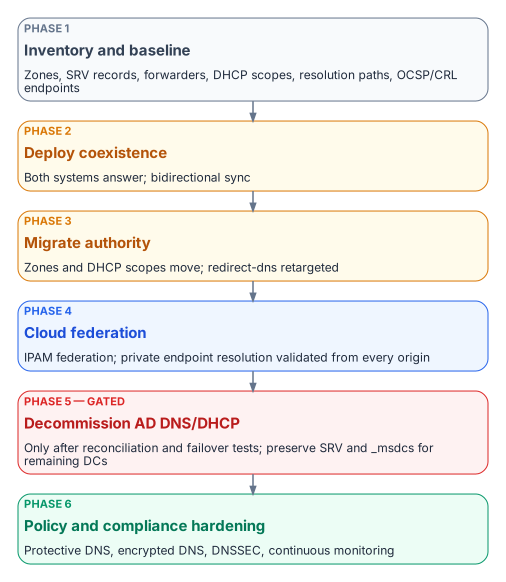
This is the book’s canonical sequence (Inventory → Coexist → Migrate authority → Federate clouds → Decommission AD DNS and DHCP → Harden and evidence), applied to the move from AD-integrated DNS and DHCP plus independent cloud DNS to a unified DDI plane while keeping services running:
- Phase 1 — Inventory and baseline. Export every AD DNS zone, SRV record, conditional forwarder and DHCP scope. Document current resolution paths, including SD-WAN redirect-dns targets, and the OCSP and CRL endpoints in use.
- Phase 2 — Deploy coexistence. Stand up the DDI platform’s resolvers and its Microsoft DNS and DHCP synchronization. Establish conditional forwarding so that both systems can answer during the transition.
- Phase 3 — Migrate authority. Move authoritative zones and DHCP scopes to the DDI platform, zone by zone. Retarget SD-WAN redirect-dns to network-addressable agency resolvers (Chapter 08, Decision 1).
- Phase 4 — Cloud federation. Enable cloud discovery and IPAM federation with AWS, Azure and Google Cloud, and VMware where it applies. Validate private endpoint resolution end to end from every origin.
- Phase 5 — Decommission AD DNS and DHCP. Only after full inventory reconciliation and successful failover testing. Preserve the SRV and
_msdcsrecords that remaining domain controllers and domain-joined systems still need. - Phase 6 — Policy and compliance hardening. Enable Protective DNS forwarding, encrypted DNS, DNSSEC signing and validation where required, and continuous monitoring dashboards, and assemble the evidence in Chapter 10.
Each phase should end with a rollback point and a resolution-path consistency test (Chapter 11), not with a calendar date.
- The migration runs in six phases: inventory, coexistence, authority, cloud federation, AD DNS decommissioning, hardening.
- AD DNS and DHCP are decommissioned only after reconciliation and failover testing.
- Each phase ends with a rollback point and a consistency test, not a date.
Previous: Chapter 08 — Reference Architecture and the Five Critical Decisions
Next: Chapter 10 — Operating the Control Plane: Delegation, Automation and Evidence