Executive Summary — The Centralization Question
The pendulum, the three forces, and the wall that does not move
Executive Summary — The Centralization Question
The question
For a decade the default answer to “where should the data live?” has been spread it out: every microservice owns its own database, every region gets its own store, and a single large SQL server is treated as a legacy embarrassment. That instinct is now worth re-examining. With wide-area networking that is both fast and application-aware, and with token-based security that travels identity with every request, is it more efficient to consolidate onto large, centralized database servers — to fight data drift and stay close to a single source of truth?
This white paper’s answer is a qualified yes, with one hard boundary set by physics. The qualification matters as much as the answer.
The three forces pushing toward consolidation
| Force | What it removes | Consequence for data topology |
|---|---|---|
| Fat, application-aware WAN | The latency penalty that forced data to sit physically next to compute | You can centralize the system of record without the old performance tax — at least within a region. |
| Token-based (zero-trust) security | The need to fragment data behind network perimeters for isolation | One logical store can safely serve many trust domains; you no longer shard for security. |
| SSOT discipline | The reconciliation cost of many divergent copies | Fewer authoritative copies means less drift, fewer “which number is correct?” incidents, and a model one engineer can hold. |
Each force is real, and together they justify pulling authority back toward the center. The microservices-era fragmentation created drift that the original gospel never budgeted for; consolidating the truth is a defensible, and increasingly common, correction.
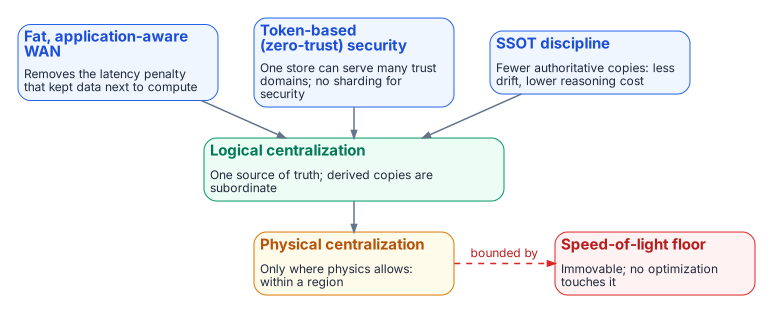
The distinction that prevents the trap
The single most important idea in this paper is the separation of two things that the word “centralize” carelessly fuses:
Centralize the truth — one authoritative source of record. Distribute the copies — read replicas, caches, edge stores — and keep them explicitly subordinate, derived, and disposable. A convenience copy must never be allowed to quietly promote itself to a source of truth. That promotion is where drift is born.
Physical centralization — one big server in one place — still runs into walls that no amount of clever networking removes:
- The speed of light. WAN got fast in bandwidth; it did not get fast in latency. Strong consistency across continents is a latency problem, and the propagation floor is fixed by distance.
- Blast radius. One central server is one outage, one bad migration, one noisy tenant away from taking everything down. Distribution is partly a failure-domain strategy, not only a performance one.
- Data residency and sovereignty. Some data legally cannot sit in one central place, regardless of how good the network is. This veto is political, not technical, so no technology removes it.
The wall, and the way around it
Chapters 3 and 4 confront the speed-of-light tax directly and ask what modern networking — specifically SD-WAN differentiated transport, which can steer latency-critical traffic onto a lean low-latency path while pushing bulk traffic onto a fat slower one — can actually do for keeping large databases in sync.
The honest finding: SD-WAN attacks the (usually large) gap between the latency you observe and the physical floor, and that gap is where most real-world sync pain lives. It cannot move the floor itself. The architecturally correct response, therefore, is not to make global synchronization fast — it is to need less of it: keep strong consistency inside a region where it is nearly free, and let everything that crosses a continent be asynchronous, eventually-consistent, or merge-friendly by design.
The Federal Modernization Program reference example
The Federal Modernization Program’s own SaaS data plane already embodies this doctrine, and the paper uses it as the worked example throughout:
- One shared, single-region PostgreSQL store is the tenant registry and system of record — logical centralization (the program decision).
- Passwordless, token-based authentication (an Entra access token used as the database password) makes that shared store safe to operate and removes the highest-value secret in the deployment (the program decision) — the enabler force made concrete.
- A control-plane “stamp” provisions dedicated, physically-isolated resources only for customers whose compliance posture requires it — the distribute-where-you-must escape hatch, kept as an exception rather than the default (the program decision).
- No global synchronous write path exists, on purpose — the Federal Modernization Program’s answer to the speed-of-light tax is to not span it synchronously in the first place.
How to read this paper
Chapter 1 makes the case for logical centralization and SSOT. Chapter 2 shows why token-based security is the keystone that makes consolidation safe on the data plane. Chapter 3 establishes the physics floor. Chapter 4 details what SD-WAN can and cannot buy a database tier. Chapter 5 — forward-looking, on the proposed the program decision transport plane — extends token-based security from data access to the network path itself, so “identity is the new boundary” holds on both planes. Chapter 6 unifies the data and network layers into a single design rule. Chapter 7 walks the Federal Modernization Program implementation end to end and names the one risk this whole bet imports.