SD-WAN and Differentiated Transport
Path classes, tail-latency reduction, FEC, and clock distribution for keeping large databases in sync
SD-WAN and Differentiated Transport
The question, stated precisely
Software-defined WAN can select among multiple underlay paths per traffic class: it can steer latency-sensitive traffic onto a lean, low-latency, low-jitter path while pushing bulk traffic onto a fatter but slower or cheaper one. Can this help large databases stay in sync, and can it assist with the speed-of-light problem through optimization?
The answer, grounded in Chapter 3: yes, meaningfully — but only inside the gap between observed latency and the physical floor. SD-WAN never moves the floor. Because the gap is usually large and disproportionately damages distributed databases (it inflates the commit-latency tail), operating there is high-value. Overstating it as “beating the speed of light” is the error to avoid.
SD-WAN as the network mirror of consistency classes
The instinct to split traffic into a low-latency class and a bulk class is exactly right, because it maps one-to-one onto what a database actually emits:
| Traffic class | Database traffic it carries | Wants | Best path |
|---|---|---|---|
| Lean / low-latency | Consensus heartbeats, leader election, synchronous-commit quorum acknowledgements, clock synchronization | Minimum RTT, minimum jitter | Shortest, least-congested path; small packets |
| Fat / bulk | Base snapshots, backups, re-sync after a partition, analytics replication, asynchronous log shipping | Maximum throughput, cost efficiency | High-bandwidth path; latency-tolerant |
This is differentiated transport per traffic class, and it is the network layer’s reflection of a decision the data layer is already making — what must be strongly consistent versus what can be eventually consistent (Chapter 6). When the two agree, you get the best synchronization physics permits.
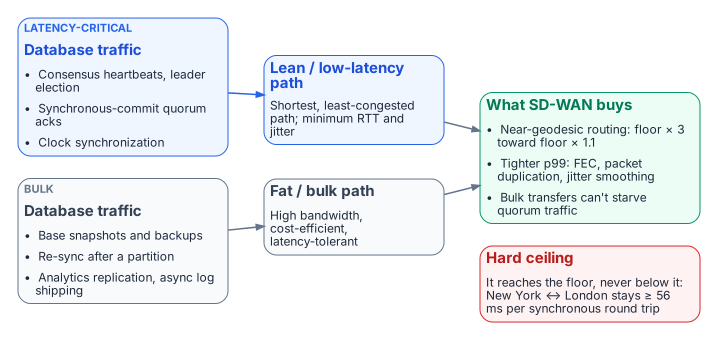
What SD-WAN genuinely buys a database tier
1. Steering and near-geodesic routing
Internet paths routinely run 1.5×–3× the great-circle distance. SD-WAN, by choosing a better underlay (or a premium backbone) and steering the latency-critical class onto it, reclaims much of that routing excess — moving observed propagation from “floor × 3” toward “floor × 1.1.” That is a pure win against the addressable part of latency, with no consistency trade-off.
2. Crushing the tail, not just the average
This is the underrated, highest-leverage effect. Recall from Chapter 3 that a quorum commit waits for the slowest member it must hear from, so commit latency is a tail (p99) statistic — and the tail is inflated by loss, congestion, and jitter, not by propagation. SD-WAN targets the tail directly:
- Forward error correction (FEC): send redundant repair data so a lost packet is reconstructed at the receiver without waiting for a retransmit. This trades bandwidth for latency — and for a quorum gated by the unluckiest packet, eliminating retransmit waits can cut p99 commit latency far more than shaving the mean ever could.
- Packet duplication across two paths: send the latency-critical packet on two diverse paths and take whichever arrives first; the slow or lossy path no longer determines the tail.
- Jitter smoothing and sub-second path failover: move traffic off a browning-out path before TCP’s own loss detection reacts.
Distributed-database performance is a tail problem; SD-WAN’s loss/jitter mitigations are tail tools. The match is exact. A path can go from “floor × 3 with an ugly tail” to “floor × 1.1 with a tight tail” — a large, real improvement in how well replicas stay in sync — without anyone violating physics.
3. Protecting sync traffic from bulk traffic
A re-sync or a backup can saturate a link and inflict queueing delay on the small, latency-critical consensus packets sharing it — self-inflicted tail latency. Class separation ensures the bulk transfer cannot starve or delay the heartbeats and commit acks. The database stays in sync during exactly the heavy-transfer events that would otherwise destabilize it.
The clock angle: optimization that assists physics directly
There is a second, independent way networking helps — and it is the closest thing to genuinely assisting the speed-of-light problem rather than merely approaching the floor. It runs through time, not distance.
A low-latency, low-jitter path is also the best path to distribute a clock. Precision time protocols degrade with path asymmetry and jitter, not with raw distance, so the same lean class that carries consensus traffic also carries high-quality clock synchronization. And tight clock sync enables an architecture that replaces network round trips:
Google Spanner’s TrueTime orders transactions using globally synchronized clocks (GPS and atomic references) with a small, bounded uncertainty. Instead of an extra cross-continent round trip to agree on transaction order, Spanner waits out a short “commit-wait” interval sized to its clock uncertainty. The latency bound becomes clock error, not network RTT — and clock error is kept tiny. (Source: Corbett et al., “Spanner: Google’s Globally-Distributed Database,” OSDI 2012.)
This is the deepest version of the user’s question. You cannot make light faster, but you can make the database need fewer trips through it by spending clock certainty instead of network round trips. The lean SD-WAN class is what makes the clock certain enough to do so — so SD-WAN assists the speed-of-light problem not by reducing propagation, but by enabling a design that propagates less often.
The hard ceiling, restated
For all of that, one boundary is immovable and must be stated plainly:
A synchronous, strongly-consistent commit across continents pays at least one round trip, every time — ~56 ms for New York ↔︎ London, no matter how clever the network. SD-WAN removes the excess over that floor and tames the tail; the floor itself is the speed-of-light tax on strong consistency, and it is non-negotiable.
Therefore SD-WAN does not change the correct architectural conclusion from Chapter 3 — it enables it. The right move remains “need less global sync,” and SD-WAN’s contribution is to make the synchronization you do keep cheaper, more reliable, and tighter in the tail, while making asynchronous bulk replication efficient on its own dedicated path.
SD-WAN supplies the path; it does not, by itself, govern the path. Chapter 5 (forward-looking) takes the next step — making the chosen path identity-anchored and token-bound, so the network carrying the data is held to the same per-call standard as access to the data itself.
Summary
- SD-WAN’s low-latency / bulk path split is the network-layer mirror of the data layer’s strong-vs-eventual consistency split; align them.
- It buys three things: near-geodesic routing, tail-latency reduction (FEC, packet duplication, jitter smoothing — which match the database’s tail-gated commit behavior), and protection of sync traffic from bulk transfers.
- The lean path also distributes high-quality time, enabling clock-based concurrency (Spanner/TrueTime) that replaces network round trips with bounded clock-wait — the one technique that genuinely sidesteps propagation.
- It cannot move the floor: a cross-continent synchronous commit still pays at least one RTT. SD-WAN takes you to the floor with a tight tail, never below.
- Net: it enables the “need less global sync” architecture rather than overturning it.