Matching Consistency Classes to Network Classes
The synthesis: aligning the data layer’s consistency model with the network layer’s transport tiers
Matching Consistency Classes to Network Classes
The single design rule
The previous chapters converge on one rule that ties the data layer and the network layer together:
The data layer’s question — what must be strongly consistent versus what can be eventually consistent — is the same question, viewed from the other side, as the network layer’s — what rides the lean low-latency path versus the fat bulk path. When those two decisions agree, you get the best synchronization physics permits. When they disagree, you pay for it.
A mismatch is expensive in both directions. Putting strong-consistency traffic on the bulk path inflicts the bulk path’s latency and tail on your commits. Putting trivial asynchronous replication on the premium low-latency path wastes the scarce resource that your consensus quorum actually needs. The architecture works when each class of data rides the class of transport built for it.
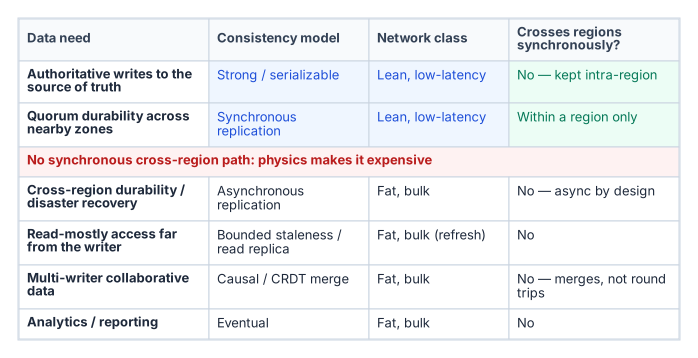
The mapping
| Data need | Consistency model | Network class | Crosses regions synchronously? |
|---|---|---|---|
| Authoritative writes to the source of truth | Strong / serializable | Lean, low-latency | No — kept intra-region |
| Quorum durability across nearby zones | Synchronous replication | Lean, low-latency | Within a region only |
| Cross-region durability / disaster recovery | Asynchronous replication | Fat, bulk | No — async by design |
| Read-mostly access far from the writer | Bounded staleness / read replica | Fat, bulk (refresh) | No |
| Multi-writer collaborative data | Causal / CRDT merge | Fat, bulk | No — merges, not round trips |
| Analytics / reporting | Eventual | Fat, bulk | No |
The pattern is stark: only the top two rows ride the lean path, and neither of them crosses a region synchronously. Everything that spans distance is asynchronous and rides the bulk path. That is the physics of Chapter 3 made into a layout.
Techniques for needing less global synchronization
Chapter 3 concluded that the architectural goal across regions is to need fewer synchronous crossings. These are the concrete techniques, each of which moves a workload off the lean cross-region path it cannot afford:
- Strong within a region, asynchronous across regions. At metro and intra-continental distances the propagation floor is sub-millisecond to a few milliseconds, so synchronous consistency is effectively free. Confine the single-writer source of truth and its quorum to one region; replicate to other regions asynchronously. This is the default for the overwhelming majority of systems, and it is the Federal Modernization Program’s choice (Chapter 7).
- Bounded staleness instead of strict global serializability. Where the business tolerates reads that are a known, small interval behind, you replace a cross-region read round trip with a local read from a slightly-stale replica. The staleness bound is a contract, not an accident.
- Causal consistency. Preserve cause-and-effect ordering without paying for total global ordering — far cheaper across distance, and sufficient for a large class of application semantics.
- Conflict-free replicated data types (CRDTs). For genuinely multi-writer data, CRDTs let independent replicas accept writes locally and merge deterministically, so cross-region traffic becomes a mergeable bulk-path update rather than a coordination round trip. (Source: Shapiro et al., “Conflict-free Replicated Data Types,” 2011.) Distance stops being a per-operation latency tax.
- Witness / learner replicas placed by path. Put voting quorum members on the lean, low-latency links so quorum is decided by your fastest paths, while non-voting learner replicas on the bulk path provide cross-region durability and read scale without dragging the quorum across a continent.
- Clock-based concurrency (Spanner/TrueTime). Where strong cross-region semantics are genuinely required, spend bounded clock uncertainty instead of network round trips (Chapter 4), and carry the clock on the lean class.
A decision procedure
For any given dataset, the layout falls out of three questions answered in order:
- Does this data have one source of truth? It should (Chapter 1). Identify the single authoritative writer. Everything else is a derived copy.
- What is the weakest consistency the business actually tolerates for each reader and writer? Not the strongest you can imagine needing — the weakest that is still correct. Strong only where required; bounded-stale, causal, or eventual everywhere it suffices.
- For each flow, which transport class matches? Strong/synchronous flows take the lean path and stay intra-region. Everything that crosses a region takes the bulk path and is asynchronous or merge-based.
The output is a data-and-network layout in which the lean path carries a small volume of latency-critical, intra-region consensus and clock traffic, and the bulk path carries everything that spans distance — which is, by design, latency-tolerant.
The risk this synthesis imports
Aligning the layers this way concentrates correctness into a small number of places, and honesty requires naming the cost. When you centralize the source of truth and enforce tenant or domain isolation in code (per-request identity scoping, Chapter 2) rather than by physical separation, the blast radius moves into that code path. A bug in tenant resolution or namespace scoping is no longer a contained, single-tenant fault — it is a potential cross-tenant data exposure. This is the unavoidable trade of the whole consolidation bet: you exchange the failure-domain isolation of many physical stores for the simplicity and drift-resistance of one logical store, and in return you owe that shared correctness path disproportionate engineering rigor — small, heavily tested, and fail-closed. Chapter 7 shows where exactly that path lives in the Federal Modernization Program.
A parallel obligation applies to the network classes themselves: the lean and bulk paths are not merely selected but must be governed — token-bound and auditable — or the transport layer becomes its own drift surface. Chapter 5 (forward-looking) develops that requirement.
Summary
- One rule unifies the paper: align the data layer’s consistency class with the network layer’s transport class.
- Only authoritative writes and intra-region quorum durability ride the lean path; everything that crosses a region is asynchronous on the bulk path.
- The toolkit for “needing less global sync” is concrete: strong-local/ async-remote, bounded staleness, causal consistency, CRDTs, path-placed witnesses, and clock-based concurrency.
- A three-question decision procedure (one source of truth → weakest tolerable consistency → matching transport) produces the layout.
- The bet concentrates correctness into the shared isolation path; that path must be small, tested, and fail-closed — examined next in the Federal Modernization Program.