The Physics of a Single Source of Truth
Eight-chapter white paper on logical centralization, token-based security, the speed-of-light tax, SD-WAN differentiated transport, and token-bound transport governance — and how the Federal Modernization Program resolves them.
The Physics of a Single Source of Truth
ssot-network-physics-bundle.docx — every chapter in this white paper concatenated into one Word document. Regenerated on every site deploy.
Thesis in one paragraph
The fashionable architecture of the last decade — fragment data into many small, service-owned databases — overcorrected, and the fragmentation it created became the largest single source of governance drift. Three forces now push the pendulum back toward logical centralization: wide-area networks that are fat and application-aware, token-based (zero-trust) security that lets one logical store safely serve many trust domains, and the discipline of a single source of truth (SSOT) as the cheapest thing to reason about. This white paper argues that the era of small SQL servers as sources of truth is over — but that small databases survive, repurposed as disposable caches, read replicas, and compliance-stamped exceptions. It then confronts the one wall none of this moves: the speed of light. Network optimization (SD-WAN differentiated transport, forward error correction, clock distribution) can take you to the physical latency floor with a tight tail, but never below it — so the correct architectural move is not “make global sync fast” but “need less global sync.” the Federal Modernization Program’s own SaaS data plane (the program decision) is the worked reference example throughout.
Who this is for
- Architects and platform engineers weighing centralized vs. distributed data topologies for a multi-tenant or multi-region service.
- CISOs and zero-trust practitioners evaluating how identity-based security changes the data-isolation calculus.
- Network engineers deciding what SD-WAN path differentiation can and cannot buy a database tier.
- Governance and compliance teams mapping data-residency and blast-radius constraints onto a consolidation strategy.
Chapters
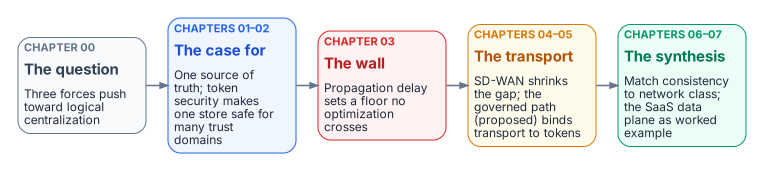
- 00 — Executive Summary — The Centralization Question
- The pendulum, the three forces, and the wall that does not move
- Audience: Executive stakeholders · architects · CISO
- 01 — Logical Centralization and the Single Source of Truth
- Why fewer authoritative copies beats more, and how hardware ate the scaling objection
- Audience: Architects · platform engineers · data owners
- 02 — Token-Based Security as the Enabler
- How zero-trust identity removes the historical reason to fragment data
- Audience: CISO · zero-trust practitioners · platform engineers
- 03 — The Speed-of-Light Tax
- Propagation delay vs. everything else, and why strong consistency is a latency problem
- Audience: Architects · network engineers · SRE
- 04 — SD-WAN and Differentiated Transport
- Path classes, tail-latency reduction, FEC, and clock distribution for keeping large databases in sync
- Audience: Network engineers · platform engineers · SRE
- 05 — The Governed Path — Token-Bound Transport and the Application-Aware Overlay
- Forward-looking (Proposed, the program decision). Why an efficient edge device needs an identity-anchored fabric, and how the path becomes governed evidence
- Audience: Network architects · zero-trust practitioners · platform engineers
- 06 — Matching Consistency Classes to Network Classes
- The synthesis: aligning the data layer’s consistency model with the network layer’s transport tiers
- Audience: Architects · platform engineers · network engineers
- 07 — Reference Architecture — the Federal Modernization Program SaaS Data Plane
- How the program decision and the program decision implement centralize-the-truth / distribute-the-copies in practice
- Audience: Architects · platform engineers · governance teams
Provenance
This white paper is an analysis document. Its FMP-specific claims trace to the canonical decision records they cite — principally the program decision (Azure SaaS architecture), the program decision (passwordless Entra Postgres auth), the program decision (GCC-Moderate boundary), and the program decision (diagram source-of-truth doctrine) under src/fmp/canon/adr/ — and, for the forward-looking Chapter 5, the Proposed the program decision (Application-Aware Networking and Token-Bound Transport) — and to the substrate operating principle of SSOT recorded in AGENTS.md and the program decision. Per the Federal Modernization Program provenance doctrine, external facts (networking physics, vendor behavior) are authoritative only where this document cites their source directly; where a claim rests on a Federal Modernization Program decision, the ADR is named inline.
A note on figures
This white paper uses no generative-AI raster figures and no inline Mermaid. Each figure is generated from a committed source in docs/images/diagrams/ssot-network-physics/ with the site’s shared diagram renderer (scripts/diagrams/render.py): SVG for the web, a 2x PNG for the Word edition.