The Speed-of-Light Tax
Propagation delay vs. everything else, and why strong consistency is a latency problem
The Speed-of-Light Tax
The wall that does not move
Everything in the preceding chapters pushes toward consolidation, and within a single region the case is close to unanswerable. Stretch the same store across continents to keep a globally-synchronous source of truth, and you hit a wall that no networking technology, present or future, moves: the speed of light.
This chapter establishes that floor precisely, because the rest of the paper — and any honest claim about what SD-WAN can do — depends on separating the part of latency that is negotiable from the part that is not.
Two latencies, added together
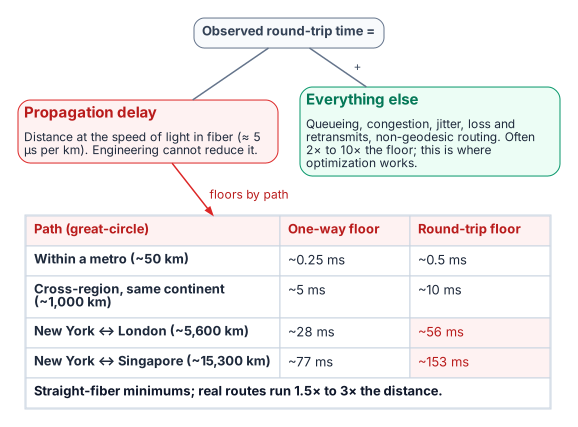
Wide-area round-trip time is the sum of two components with completely different physics:
| Component | What it is | Can engineering reduce it? |
|---|---|---|
| Propagation delay | Time for the signal to physically travel the distance, at the speed of light in fiber | No. Fixed by distance on the chosen path. |
| Everything else | Queueing, congestion, jitter, packet loss → retransmits, and circuitous (non-geodesic) routing | Yes — often dramatically. This is the entire addressable surface. |
The first component is a tax levied by physics. The second is the gap between the latency you observe and that physical floor — and on a congested or badly-routed path that gap is frequently 2× to 10× the floor itself. The single most important framing in this paper is:
Every networking technique discussed in Chapter 4 — SD-WAN path selection, forward error correction, jitter smoothing, clock distribution — operates on the “everything else” component. None of them reduces propagation delay by a single microsecond. The wins are real because the gap is usually large, but the floor stays exactly where distance puts it.
The numbers
Light in optical fiber travels at roughly two-thirds of its vacuum speed — about 200,000 km/s, or ≈ 5 microseconds per kilometer, or roughly 1 millisecond per 200 km, one way. That yields hard floors that no optimization can beat:
| Path (approx. great-circle) | One-way propagation floor | Round-trip floor |
|---|---|---|
| Within a metro (~50 km) | ~0.25 ms | ~0.5 ms |
| Cross-region, same continent (~1,000 km) | ~5 ms | ~10 ms |
| New York ↔︎ London (~5,600 km) | ~28 ms | ~56 ms |
| New York ↔︎ Singapore (~15,300 km) | ~77 ms | ~153 ms |
These are minimums assuming a perfectly straight fiber path. Real paths are longer — internet routes commonly run 1.5× to 3× the great-circle distance — so observed propagation alone is typically well above these figures before any congestion is added. Optimization can claw back the routing excess (Chapter 4); it cannot go below the straight-line floor.
Why strong consistency is a latency problem, not a bandwidth one
The crucial insight for database architecture is that strong consistency spends round trips, and round trips are priced in latency, not bandwidth.
WAN bandwidth has grown enormously — moving terabytes between continents is routine. But a strongly-consistent, synchronous commit does not need bandwidth; it needs agreement, and agreement requires messages to travel to other nodes and back:
- A synchronous commit that must be durable on a remote replica pays at least one round trip before it can acknowledge — every time.
- A consensus protocol (Paxos, Raft) committing through a quorum typically pays one to two round trips to the quorum members, and is gated by the slowest member it must hear from.
Across New York and London, that is a floor of ~56 ms per synchronous commit, multiplied by every dependent operation in a transaction. No amount of fat pipe changes it, because the limiting resource is the time for light to make the trip, not the volume of data in flight.
Tail latency: the part that actually hurts
There is a subtler reason distributed consistency suffers, and it sharpens what Chapter 4 must target. Because a quorum commit waits for the slowest response it needs, commit latency is governed by a tail statistic — the p99, not the average. A path can have an excellent mean and still inflict terrible commit latency if its tail is ugly, because every so often the one packet the quorum is waiting on is the one that got queued, dropped, and retransmitted.
This matters because the “everything else” component — congestion, loss, jitter — is precisely what inflates the tail, while propagation delay is constant and therefore tail-neutral. So the addressable part of WAN latency is also the part that disproportionately damages distributed databases. That is the opening Chapter 4 exploits.
What follows for architecture
Two conclusions fall directly out of the physics, and the rest of the paper builds on them:
- Keep strong consistency inside a region. At metro and intra-continental distances the propagation floor is sub-millisecond to a few milliseconds — synchronous consistency is effectively free there. This is why the Federal Modernization Program’s single-region writer (Chapter 7) is not a limitation but a deliberate exploitation of the physics.
- Across regions, stop spending round trips. The win is not a faster synchronous path — physics caps that — but an architecture that requires fewer synchronous crossings: asynchronous replication, bounded staleness, and merge-friendly data types (Chapter 6).
SD-WAN, the subject of the next chapter, lives entirely inside the gap between observed latency and the floor. Understanding that it operates there — and only there — is what lets us state precisely what it can and cannot do for keeping large databases in sync.
Summary
- WAN latency is propagation delay (fixed by distance, ~5 µs/km) plus everything else (congestion, loss, jitter, routing excess).
- Optimization addresses only the second component; the propagation floor is immovable. NY↔︎London is ~56 ms round-trip, minimum, forever.
- Strong consistency spends round trips, so it is a latency problem; fat bandwidth does not help it.
- Commit latency in a quorum is a tail statistic, and the tail is inflated by exactly the addressable (non-propagation) component — which is why network optimization can still help meaningfully.
- The architectural response: keep strong consistency intra-region; minimize synchronous crossings between regions.