Zero-Trust Overview
Executive Brief — Zero-Trust Identity Anchoring
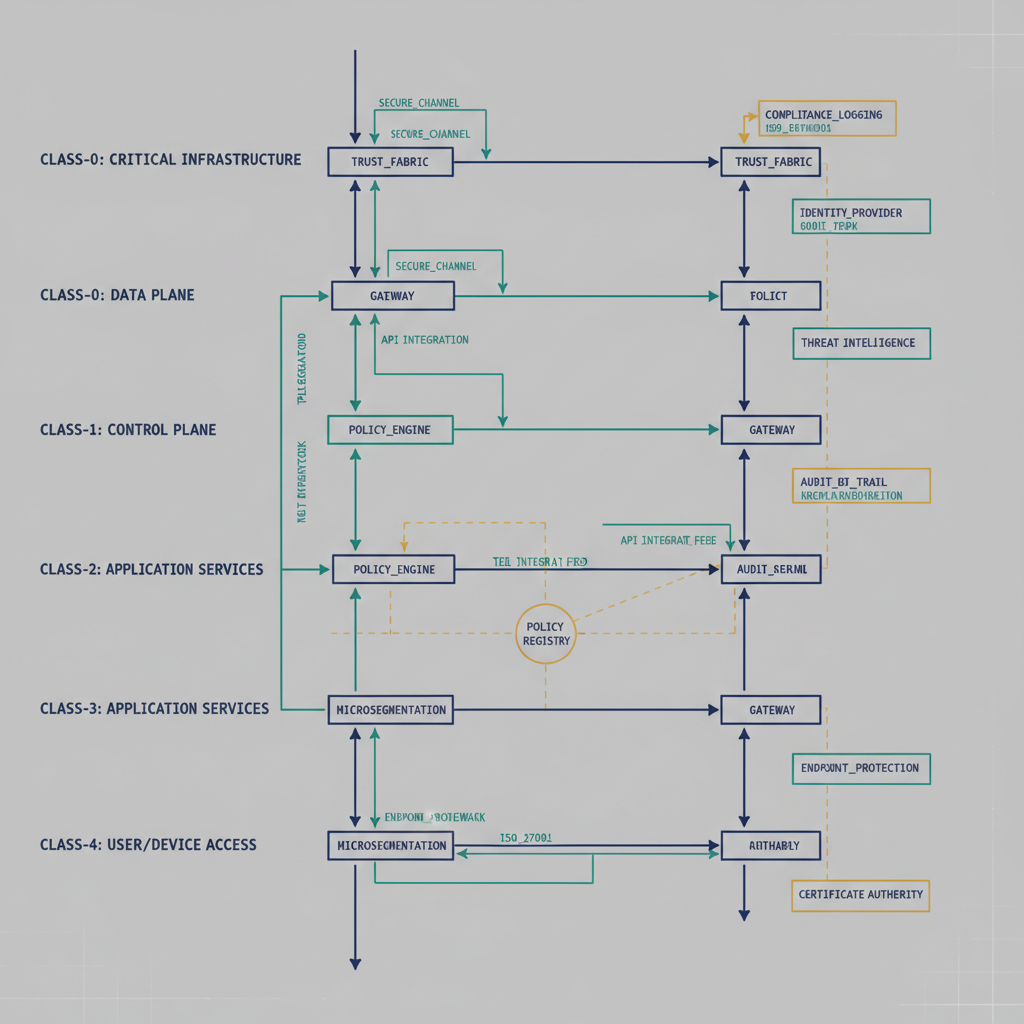
The Federal Modernization Program applies zero trust by anchoring every claim, certificate event, and governance decision to an identity that is verified, not assumed. Per the program decision, anchor bindings are untrusted by default and must be backed by cryptographic proof, independent corroboration, or explicit governance authorization.
What this means for your existing stack
The Federal Modernization Program is an overlay, not a replacement identity platform. It is designed to sit above systems you already run (for example Entra ID, Cisco ISE, and Palo Alto), normalize their identity-linked signals, and enforce traceable policy outcomes across them.
Mission-class placement for zero-trust policy
| Mission class | How zero-trust policy lands |
|---|---|
| Identity | Establishes identity truth and binding confidence before trust decisions are made. |
| Telemetry | Continuously ingests identity-linked events and detects drift or anomalous behavior. |
| Policy | Encodes conditional-access, separation, and compliance rules as auditable decisions. |
| Enforcement | Pushes approved decisions into control points (session revocation, network/device controls). |
| Integration | Coordinates execution across incumbent tools so controls are applied consistently end-to-end. |
Leaver killswitch maturity (honest status)
The Federal Modernization Program canon sets a target of under 120 seconds for leaver revocation latency across identity and dependent access surfaces. This is a TARGET-state objective and should not be read as shipped production performance.
Executive takeaway
If your agency already has identity, network, and endpoint controls in place, The Federal Modernization Program provides the missing correlation and governance layer: identity-anchored, cross-system, and evidence-ready zero-trust execution without forcing a rip-and- replace of your existing stack.
Where to go deeper
- Zero-Trust Governance whitepaper — the long-form pattern, anchored to the program decision.
- Adapter Ecosystem Overview — the identity, telemetry, policy, enforcement, and integration adapters that land these decisions in incumbent tools.