Executive Brief — Modernization Overview
FMP-anchored end-to-end modernization program arc for federal leadership
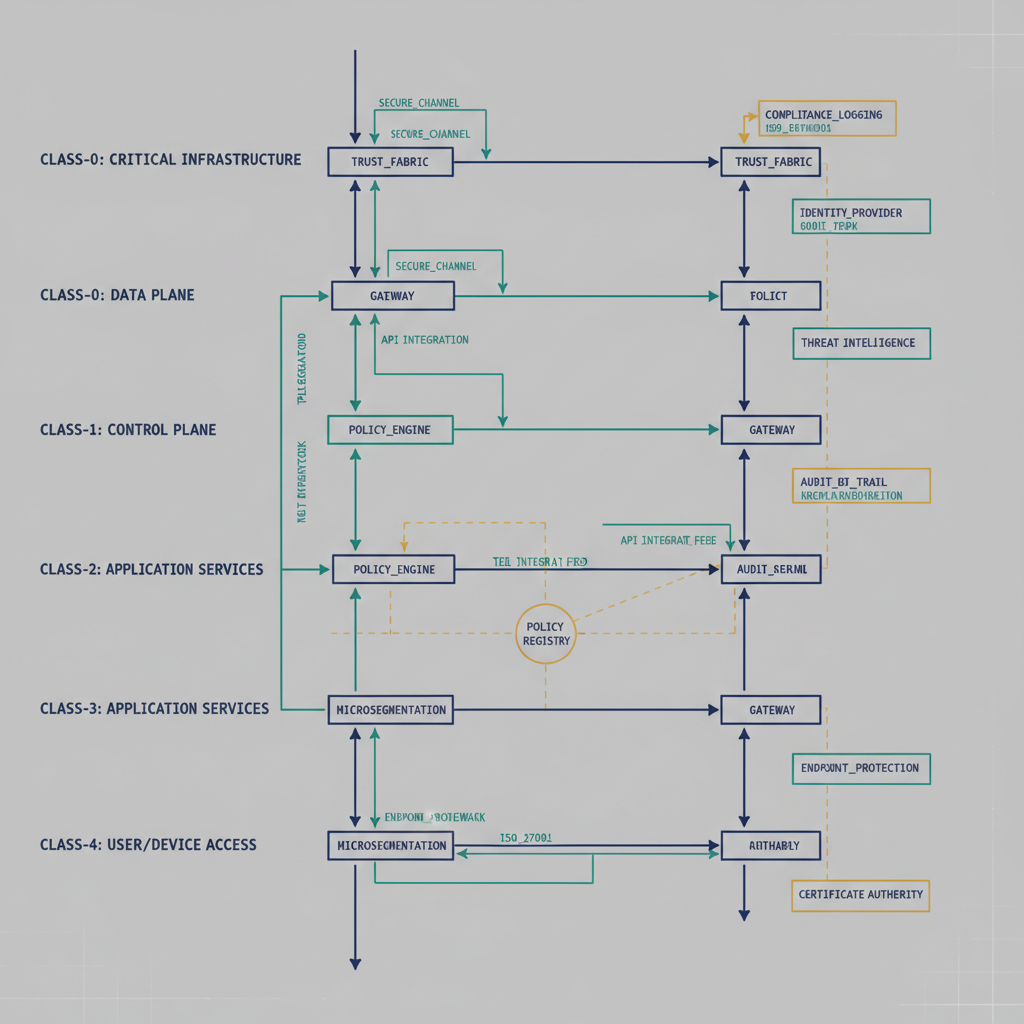
This executive brief summarizes what a FMP-anchored modernization program looks like end to end for a federal CIO/CISO audience, and the expected delivery arc from foundation to governance.
Executive summary
The Federal Modernization Program modernization is an incremental, dependency-aware transformation that starts with identity trust, extends into deterministic addressing and overlay controls, and matures into telemetry-driven management and governance. The program is structured to deliver mission value early while reducing long-tail authorization and drift risk.
The canonical modernization adapter inventory is governed in src/fmp/canon/modernization-registry.yaml. Treat that registry as the authoritative source for the active modernization adapter set (with one reserved planning entry) rather than maintaining per-brief adapter lists.
The modernization arc (what changes first, and why)
The Federal Modernization Program sequencing is intentional:
- Identity-first — establish authoritative identity context and policy enforcement anchors.
- Addressing modernization — bind identity to deterministic network addressing and service location.
- Overlay activation — enforce certificate-anchored, policy-aware paths without requiring rip-and-replace of incumbent platforms.
- Telemetry integration — convert telemetry from passive reporting into a live control input for routing, security, and compliance decisions.
- Management automation — operationalize drift detection, CMDB reconciliation, and policy execution through repeatable workflows.
- Governance at runtime — continuously generate evidence and maintain authorization posture as an ongoing operating function.
This arc aligns with the program vision of a drop-in overlay that restores cross-service telemetry and deterministic identity correlation in FedRAMP Moderate environments.
Program model: from discovery to enterprise operation
The program executes in three leadership-facing phases:
Phase A — Pre-overlay discovery and design
- Baseline identity, network, addressing, and telemetry posture.
- Confirm control-plane dependencies and authoritative data sources.
- Approve high-level and low-level designs for identity, addressing, overlay, telemetry, and governance workstreams.
- Define objective readiness gates for pilot entry.
Phase B — Pilot implementation
- Stand up identity and network pilots first, then attach deterministic addressing and telemetry ingestion.
- Validate conversation-level correlation and policy determinism with limited blast radius.
- Exercise change and rollback paths through governance workflows before broad rollout.
- Produce early evidence artifacts to validate control intent and operational feasibility.
Phase C — Enterprise rollout and continuous operations
- Expand proven patterns across domains and mission systems.
- Shift from milestone-only reviews to continuous telemetry/evidence cycles.
- Institutionalize drift detection and remediation as normal operations.
- Maintain modernization momentum without disruptive “big-bang” cutovers.
Maturity and delivery expectation
Most modernization components in this program are currently TARGET or DESIGN-ONLY maturity. Leadership should treat the roadmap as a governed delivery arc with active build-out, not as a claim of full operational completion across every workstream today.
Accordingly, this brief is marked aspirational: true to reflect current program maturity and avoid overstating implementation status.
Leadership implications
- Fund and govern the program as a sequence, not as independent projects.
- Hold phase gates on evidence quality and operational determinism, not only on schedule milestones.
- Use the modernization registry and canon documents as the single source of truth for scope and maturity decisions.
- Start Phase 2 architecture-series deep dives immediately after this Phase 1 executive-brief set is complete.
Where to go deeper
- Governance through Modernization whitepaper — the long-form program treatment.
- Operational Guide — the Federal Modernization Program Modernization Program — the chapter-by-chapter delivery playbook.
- Adapter Ecosystem Overview — the modernization adapter set that executes the arc.