Logical Centralization and the Single Source of Truth
Why fewer authoritative copies beats more, and how hardware ate the scaling objection
Logical Centralization and the Single Source of Truth
The objection that no longer holds
The original case for fragmenting data into many small databases rested on two loadbearing claims: that a single server could not scale to the workload, and that independent services needed independent stores to deploy and fail independently. Both claims have weakened to the point of reversal.
Hardware ate the scaling objection. A single commodity server today carries dozens of cores, hundreds of gigabytes to multiple terabytes of RAM, and NVMe storage delivering millions of IOPS. A workload that demanded a sharded cluster a decade ago now fits comfortably on one node with headroom to spare. The overwhelming majority of organizations never outgrow a single well-provisioned database. Vertical scaling is now the correct first move, and frequently the only move ever needed.
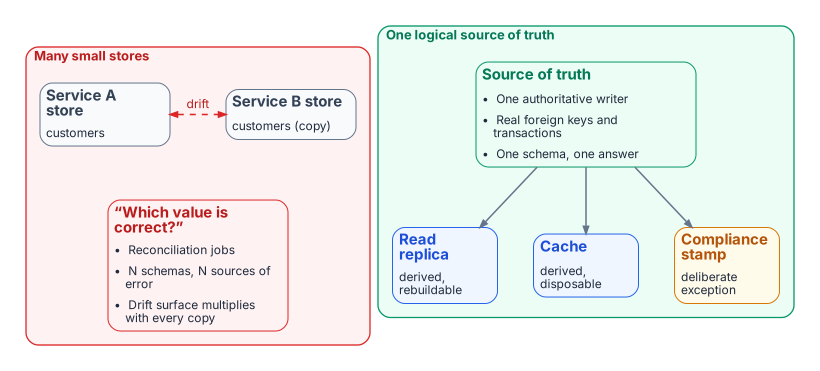
The independence claim quietly imported a cost nobody priced. Every independent store is an independent copy of some shared truth — a customer record, a price, an entitlement — and every copy is a liability: a place to go stale, to diverge, to silently disagree. The microservices era treated those copies as free. They are not. They are paid for later, in reconciliation jobs, in eventual-consistency archaeology, and in incidents that begin with the sentence “which system has the right number?”
What a single source of truth actually buys
A single authoritative source of record is not merely tidier — it is cheaper to reason about, which is the scarcest resource in any large system.
| Property | Many small stores | One logical source of truth |
|---|---|---|
| Cross-entity invariants | Enforced by application code and reconciliation, eventually | Enforced by the database — real foreign keys, real transactions |
| Joins across the data | Distributed query, fan-out, or duplicated data | A local JOIN |
| “Which value is correct?” | A judgment call, often an incident | Defined — there is exactly one |
| Drift surface | One per copy, multiplied by every replication path | Minimized to the derived copies you explicitly create |
| Mental model | N schemas and their interactions | One schema and its invariants |
This is the heart of the Federal Modernization Program’s own operating doctrine. The substrate’s first operating principle is unambiguous: every claim has exactly one canonical source; all other representations are provenance-anchored pointers (see AGENTS.md operating principles and the program decision). Drift is not an accident to be mopped up; it is a named, first-class failure mode the architecture is built to prevent. Fewer authoritative copies is the most direct lever on that goal.
Logical vs. physical: the distinction that does the work
“Centralize” hides two very different decisions, and conflating them is the single most common architectural error in this debate.
- Logical centralization — one source of truth. One place that is authoritative for a given fact; everything else derives from it. This is almost always good.
- Physical centralization — one server, one location. One machine that holds and serves all the data. This is sometimes good and often constrained by physics, blast radius, and law.
The goal is the first. The second is an implementation choice you make only as far as it is safe and cheap, and back away from the moment physics, failure domains, or data-residency law push back (Chapters 3 and 7). You can have one logical source of truth that is physically replicated across three regions for durability — that is still SSOT, because exactly one of those copies is authoritative for writes and the others are explicitly subordinate.
Small databases are not dead — they are repurposed
The provocative framing — “the era of small SQL servers is over” — is precise only when narrowed: it is the era of small SQL servers as sources of truth that is ending. Small databases are flourishing in two repurposed roles:
- As disposable accelerators. Read replicas, caches, materialized edge stores. These are derived and rebuildable — explicitly not authoritative — so they cannot drift authoritatively. You can blow one away and regenerate it from the source of truth. (How to keep them current across distance is exactly the SD-WAN question of Chapter 4.)
- As compliance-stamped exceptions. Where a customer’s regulatory posture demands hard physical isolation, a dedicated small store is provisioned for that tenant. The Federal Modernization Program implements precisely this as the control-plane “stamp” pattern (Chapter 7, the program decision) — the exception, not the default.
Meanwhile the small-database movement is expanding, not contracting: SQLite-at-the-edge patterns push SQL smaller and closer to the application than ever — but as derived, near-cache copies, which is the opposite of a distributed source of truth. The direction of travel confirms the thesis rather than refuting it: truth consolidates; convenience copies proliferate.
Where drift is actually born
The deepest reason to centralize the truth is behavioral, not technical. Drift rarely originates in the database engine. It originates when a team, finding the central store too slow or too restricted to reach, creates an unofficial local copy “just for performance” — and that copy slowly diverges into a shadow source of truth nobody blessed.
This reframes the whole problem. The way to stay near SSOT is to remove the incentive to fragment: make the central source of truth fast enough and frictionless enough to reach that no one is tempted to fork it. That is exactly what the next two forces deliver — token-based security removes the access friction (Chapter 2), and application-aware networking removes the latency friction (Chapter 4). Centralization of truth is sustained not by policy but by making the centered path the path of least resistance.
Summary
- Hardware has removed the scaling objection for the vast majority of workloads; scale up before you scale out.
- A single source of truth is cheapest where it counts most — in the cost of reasoning about the system and the absence of drift.
- Separate logical centralization (one truth — almost always right) from physical centralization (one server — sometimes constrained).
- Small databases survive as disposable caches and compliance-stamped exceptions, not as competing sources of truth.
- Drift is born from unofficial convenience copies; the cure is to make the central truth the path of least resistance — the job of Chapters 2 and 4.