Reference Architecture — the Federal Modernization Program SaaS Data Plane
How the program decision and the program decision implement centralize-the-truth / distribute-the-copies in practice
Reference Architecture — the Federal Modernization Program SaaS Data Plane
Why the Federal Modernization Program is the worked example
The preceding chapters argued a doctrine: centralize the truth, distribute the copies, let token security make centralization safe, and refuse to span the speed of light synchronously. The Federal Modernization Program’s multi-tenant SaaS data plane was designed to that doctrine before this paper named it. Reading the decision record back through the framework shows the abstractions landing as concrete components — and, importantly, shows where the one residual risk lives.
The authoritative sources for everything in this chapter are the program decision (Azure SaaS architecture), the program decision (passwordless Entra Postgres auth), and the program decision (the GCC-Moderate boundary) under src/fmp/canon/adr/.
The decision, in the paper’s terms
The Federal Modernization Program offers governance-as-a-service: many customer Microsoft Entra tenants are governed by one operated service. the program decision had to answer the central question of this paper — one shared store or many — and chose, deliberately:
One shared, elastically-scaled data plane with strong per-tenant data-namespace isolation, plus a control plane that can stamp dedicated resources where a customer’s compliance posture requires it. The durable tenant registry and per-tenant state live in a single PostgreSQL Flexible Server; the data_namespace derived from each tenant’s GUID is the isolation handle.
That is logical centralization (Chapter 1) with a deliberate physical-isolation escape hatch (Chapters 1 and 2), expressed as an accepted decision.
Mapping the architecture to the doctrine
| Paper concept | the Federal Modernization Program realization | Source |
|---|---|---|
| One logical source of truth | Single PostgreSQL Flexible Server holds the saas_tenants registry and per-tenant state |
the program decision, Decision 3 |
| Token security, inbound | Per-request tid-claim verification against the issuing tenant’s JWKS (RS256); non-onboarded / non-active tenants rejected with 403 |
the program decision, Security |
| Token security, outbound | Passwordless auth — a short-lived Entra token used as the Postgres password; no long-lived DB secret exists | the program decision; fmp.saas.pg_auth |
| Distribute the copies | Evidence bundles in Blob Storage; per-tenant secrets in Key Vault — derived, subordinate stores keyed by the same namespace | the program decision, Decision 3 |
| Compliance-stamped exception | Control-plane ProvisioningService stamps dedicated DB schema / Blob prefix / Key Vault scope for hard-isolation customers |
the program decision, Decision 2 |
| Refuse to span light synchronously | Single-region writer; no global synchronous multi-master commit path exists | the program decision (single Flexible Server) |
| Sovereign-cloud readiness | OSSRDBMS token audience and issuer/Graph/ARM resolution already branch per cloud (US Gov vs. commercial) | the program decision, the program decision |
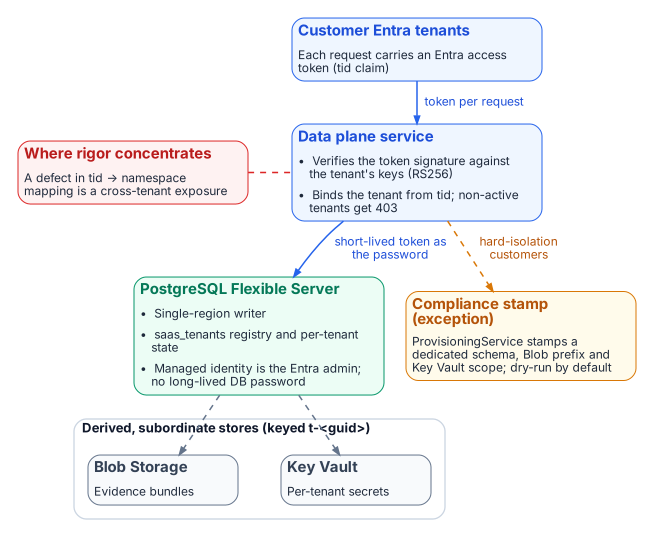
The source of truth: one registry, one writer
The tenant registry is the system of record for who is onboarded and in what state. A tenant is identified by its Entra directory GUID and carries an explicit lifecycle state machine — PENDING → ACTIVE → SUSPENDED → ACTIVE / → DEPROVISIONED — with illegal transitions rejected at the model boundary (fmp.saas.tenant). There is exactly one authoritative copy of this truth. Every other representation — evidence in Blob, secrets in Key Vault — is keyed by the data_namespace derived deterministically from the tenant GUID (t-<guid>), so the derived stores are subordinate pointers to the registry’s truth, never independent sources of it. This is Chapter 1’s SSOT discipline as running code.
Because the writer is single-region, the strong-consistency path never crosses a continent. Per Chapter 3, that is not a limitation to be engineered away — it is the deliberate exploitation of the physics: at single-region distances, strong consistency is nearly free, so the Federal Modernization Program takes it.
Token security: the secret that does not exist
Chapter 2’s keystone is visible on both sides of every connection:
- Inbound, the trust boundary travels in the request. The data plane does not assume a caller is trustworthy because of where it connects from; it verifies the Entra token’s signature against the issuing tenant’s published keys and binds the tenant context from the
tidclaim, per request. One shared plane safely serves all tenants because identity is proven every time. - Outbound, under the program decision, the application authenticates to PostgreSQL with a freshly-minted Entra access token used as the connection password — its managed identity is the database’s Entra administrator. The token provider caches and refreshes the token off the connection hot path and never presents a near-expired one. There is no long-lived database password anywhere in the deployment — the single highest-value secret is removed, not guarded. The same connection seam serves an AWS RDS-IAM token provider, so passwordless auth is cloud-portable.
This is precisely why the shared store is safe to centralize: the security model lives in identity, not in a perimeter or a stored credential.
The escape hatch: distribute only where compliance demands it
The Federal Modernization Program does not pretend physical centralization is universally acceptable. the program decision keeps the option to fragment as a deliberate, provisioned exception rather than the default:
- The control plane’s
ProvisioningServicecan stamp dedicated resources — a dedicated DB schema, Blob prefix, and Key Vault scope — for a customer whose compliance posture cannot accept shared-plane, in-code isolation. - Provisioning is dry-run by default (a no-op stamp executor only plans), so the control plane is safe to exercise in CI and locally; a concrete executor is injected only in production.
- The
GOVtenant plan and the sovereign-cloud token audiences exist for customers under stricter boundaries, with sovereign SaaS itself listed as a future decision and explicit review trigger.
This is Chapter 1’s “small databases survive as compliance-stamped exceptions” realized exactly: the default is one shared source of truth; the dedicated small store is the exception, requested by compliance, not the architecture’s resting state.
Centralize until you measurably cannot
the program decision even encodes the discipline of Chapter 1 — scale up before you scale out — into its own expiry conditions. Among the decision’s stated review triggers is “the tenant registry outgrows a single PostgreSQL Flexible Server.” The architecture is centralized-until-evidence: it stays on one node until a measured limit forces a change, rather than pre-emptively sharding against a hypothetical. That is the correct posture this paper has argued for throughout.
Where SD-WAN would enter — and where it would not
Applying Chapters 3–4 to the Federal Modernization Program sharpens what networking does and does not buy here. Because the data plane is single-region with one writer, there is no global synchronous commit path for SD-WAN to optimize — the Federal Modernization Program has already removed the workload that would need it. Differentiated transport would matter in exactly two latency-tolerant, bulk-class places:
- Cross-region disaster-recovery replication of the Postgres registry — asynchronous by design, riding the fat bulk path; SD-WAN would improve its lag and resilience, not its correctness.
- Read-replica and evidence-bundle freshness for tenants far from the home region — bounded-staleness reads on the bulk path.
The day a sovereign-cloud stamp (a listed review trigger) requires a second region that must stay in sync, the full Chapter 4 toolkit — path classes, FEC for the commit tail, clock distribution for TrueTime-style coordination — becomes load-bearing. Until then, the Federal Modernization Program’s answer to the speed-of-light tax is the cheapest one available: do not span it synchronously in the first place.
The proposed next frontier is orthogonal to the data topology: governing the path itself. the program decision (Proposed) would promote the transport plane to a first-class governed concern — token-bound OverlayTunnels and a DRIFT-TRANSPORT class — holding the network that carries the Federal Modernization Program’s claims to the same per-call, identity-anchored standard as the data plane (Chapter 5).
The one risk, named plainly
The whole bet has a cost, and the decision record states it without flinching. Because tenant isolation on the shared plane is enforced in code — TenantResolutionMiddleware plus data_namespace scoping — rather than by physical separation, the blast radius lives in that code path. A defect in tenant resolution or namespace scoping is not a contained single-tenant fault; it is a potential cross-tenant data exposure. the program decision lists this explicitly as a negative trade-off.
The database topology is not where this architecture can quietly fail — the tenant-resolution and namespace-scoping path is. That path must be small, exhaustively tested, and fail-closed (the auth layer already rejects unsigned, non-onboarded, and non-active tenants by default). The single highest-value verification for this whole design is to confirm there is no code path by which a validated tid for tenant A can address tenant B’s data_namespace. That is the concentrated correctness obligation you accept in exchange for one shared source of truth.
Summary
- the program decision chose one shared, single-region PostgreSQL source of truth with per-tenant in-code isolation, plus a stamped escape hatch — the paper’s doctrine as an accepted decision.
- Token security appears on both sides: inbound per-request
tidverification, outbound passwordless Postgres auth (the program decision) that removes the highest-value secret entirely. - Derived stores (Blob, Key Vault) are subordinate, namespace-keyed pointers to the registry’s truth — never independent sources.
- The single-region writer is a deliberate refusal to span the speed of light synchronously; SD-WAN would help only the async DR and read-replica paths until a second region is required.
- The architecture concentrates correctness into the tenant-resolution path; that path — not the database topology — is where rigor and verification must go.