Token-Based Security as the Enabler
How zero-trust identity removes the historical reason to fragment data
Token-Based Security as the Enabler
Why this is the keystone
Chapter 1 made the case for consolidating the source of truth. But there is a reason the industry fragmented data in the first place that had nothing to do with scale: isolation by perimeter. When the only way to enforce “who may touch this data” was network segmentation, the safest way to separate two trust domains was to give them separate databases behind separate network boundaries. Security, not performance, drove a great deal of the fragmentation — and no hardware advance addresses it.
Token-based, identity-centric (zero-trust) security is what dissolves that reason. It is the keystone of the whole consolidation argument: without it, you are forced back into per-domain physical isolation for safety, and the single-source-of-truth story collapses. With it, one logical store can serve many trust domains safely, because the trust boundary travels with the request rather than living in the network.
The shift: from perimeter to identity
| Dimension | Perimeter model | Token / zero-trust model |
|---|---|---|
| Where trust lives | In the network location of the caller | In a signed, verifiable claim the caller presents |
| Unit of isolation | A network segment (and often a separate datastore) | A verified identity, scoped per request |
| Default posture | Trust inside the perimeter | Trust nothing; verify every request |
| Effect on data layout | Encourages a store per trust domain | Permits one store across many trust domains |
| Highest-value secret | Long-lived credentials guarding the perimeter and the database | None — short-lived tokens, minted on demand |
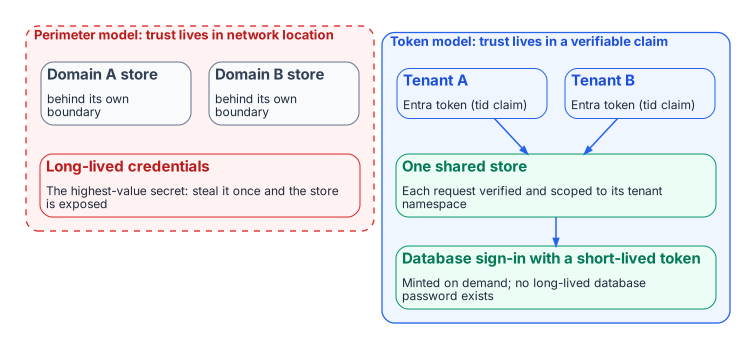
The consequence for data architecture is direct: you no longer shard for security. Two customers, two business units, two classification levels can share a logical store when every request carries a cryptographically verifiable statement of who is asking and what they are entitled to, and the store enforces scoping on that statement.
How the Federal Modernization Program makes this concrete
The Federal Modernization Program’s SaaS plane is a working instance of this principle on both sides of the connection — inbound (who is calling the service) and outbound (how the service authenticates to its own database).
Inbound: identity travels with the request
Many different customer Microsoft Entra tenants are governed by one operated The Federal Modernization Program service. Requests arrive bearing Entra access tokens minted by different tenants. The data plane verifies each token’s signature against the issuing tenant’s published keys (JWKS, RS256), reads the tenant identity from the token’s tid claim, and binds a tenant context for the life of the request (the program decision). One shared, elastically-scaled data plane serves every customer — and the isolation is enforced because the identity of the tenant is proven on every single call, not assumed from a network location.
Outbound: the database password disappears
The sharper demonstration is how the service authenticates to its own PostgreSQL store. Under the program decision, the Federal Modernization Program uses passwordless authentication: Azure Database for PostgreSQL Flexible Server accepts a short-lived Entra access token as the connection password. The service’s managed identity is bound as the database’s Entra administrator, so the application connects with no long-lived database password at all.
A stored database password is the single most valuable secret in a typical deployment — steal it once and the central store is exposed. Token-based auth does not guard that secret better; it eliminates it. The connection is authorized by a token that is minted on demand, scoped to the database audience, cached only briefly, and refreshed before expiry. There is nothing durable to steal. (The Federal Modernization Program: fmp.saas.pg_auth, the program decision.)
Mechanically, a token provider acquires an access token scoped to the OSSRDBMS audience for the correct sovereign cloud, caches it, and refreshes it shortly before expiry so token acquisition stays off the hot path of every connection while a near-expired token is never presented. The same connection seam is provider-agnostic: an Entra token provider on Azure and an RDS-IAM token provider on AWS both satisfy it, so passwordless auth works identically across clouds.
Why this makes centralization safe, not merely possible
The combination of inbound token verification and outbound passwordless auth changes the risk calculus that originally justified fragmentation:
- No perimeter to breach into a shared trust zone. Every request re-proves identity; there is no “inside the firewall” where a single foothold yields ambient access to all tenants’ data.
- No long-lived database credential to exfiltrate. The classic “one leaked connection string compromises everything” failure mode is designed out.
- Per-request scoping replaces per-store isolation. A tenant’s reach is bounded by its verified identity on each call, so one store can hold many tenants without that being a security downgrade relative to many stores.
This is the precise sense in which token security earns the right to centralize. The shared source of truth is not safe despite being shared; it is safe because the security model moved from the network to the identity.
That same move — a credential minted per event rather than a durable secret or a standing session — applies one layer down, to the network path the request rides on. Chapter 5 (forward-looking, on the proposed the program decision transport plane) carries token-based security from data access onto the transport plane, so “identity is the new boundary” holds end to end rather than only at the store.
The friction it removes — and the drift that follows
Chapter 1 argued that drift is born when teams create unofficial local copies because the central store is too hard to reach. Token-based security attacks the “too restricted to reach” half of that friction directly. When access is a matter of presenting the right scoped identity — rather than being granted a network path, a firewall exception, and a shared secret — the central store becomes easier to reach than standing up a private copy. Removing access friction removes the incentive to fork, which removes the drift at its source. Security, counter-intuitively, becomes a centralization enabler rather than a fragmentation driver.
The residual constraint
Token security removes the security reason to fragment. It does not remove the legal one. Data-residency and sovereignty rules can still require that certain data physically reside in a certain place or boundary, and no identity model overrides a regulator. The Federal Modernization Program handles this not by fragmenting the default plane but by provisioning a dedicated, physically-isolated stamp for the customers who require it (Chapter 7, the program decision), and by carrying sovereign-cloud token audiences explicitly in the auth layer (the OSSRDBMS scope differs for US Government clouds; the program decision, the program decision). The default stays centralized and safe; the exception is provisioned deliberately, with its own boundary.
Summary
- Much historical data fragmentation was driven by security through perimeter, which no hardware advance addresses.
- Token-based, zero-trust security moves the trust boundary from the network into a verifiable, per-request identity, so one store can serve many trust domains.
- The Federal Modernization Program realizes this on both sides: inbound
tid-claim verification per request (the program decision) and outbound passwordless Postgres auth that removes the highest-value secret entirely (the program decision). - This makes centralization safe, not merely possible — and it removes the access friction that drives teams to create drift-prone shadow copies.
- The one reason to fragment that survives is legal residency, handled as a deliberate stamped exception rather than as the default.