Cloud Boundary — Case Study
Governing GCC Moderate compliance gaps with the Federal Modernization Program
Cloud Boundary — Case Study
This page is the canonical engagement pattern for a GCC-Moderate boundary case study. Specific agency identifiers and metrics are intentionally absent until real engagement material is reviewed.
Engagement archetype
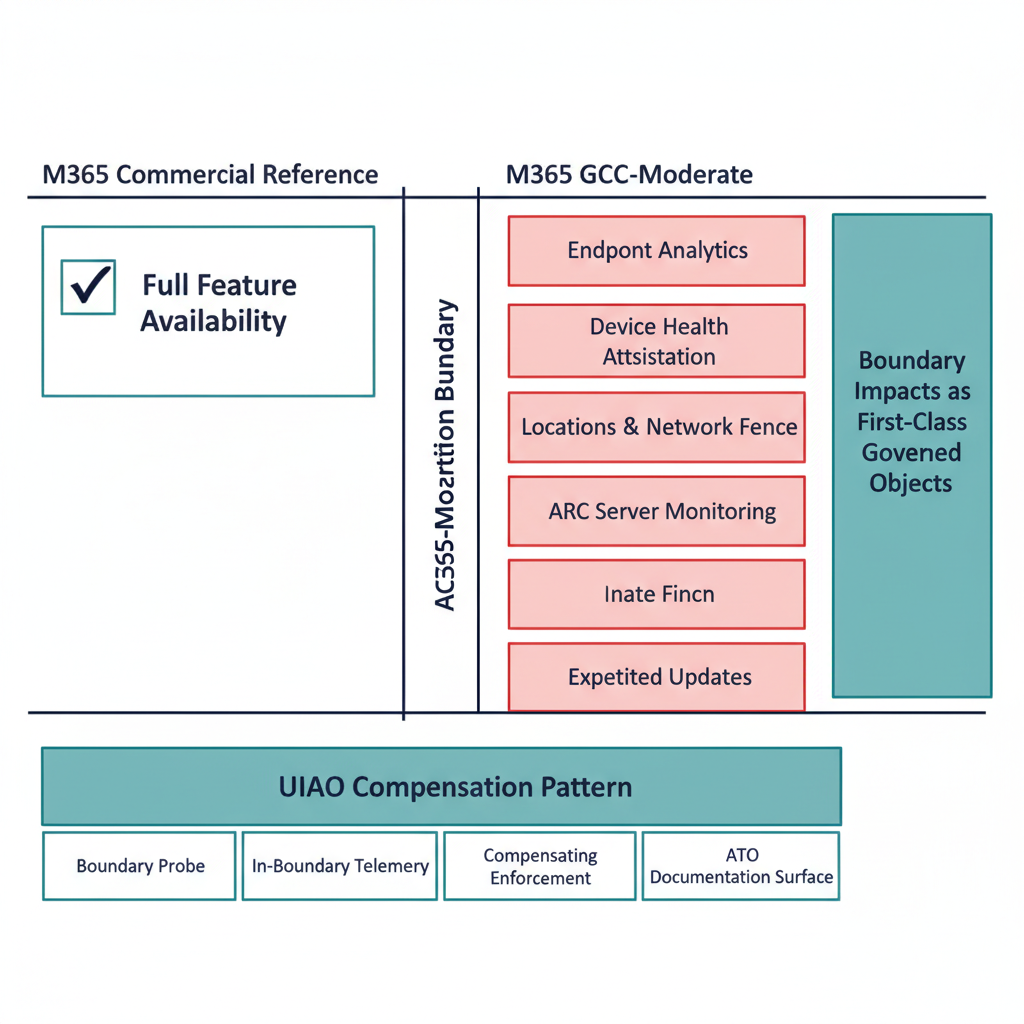
A federal agency operating M365 in GCC-Moderate discovers — typically late in an ATO cycle or during ZT analytics rollout — that a cluster of features advertised in admin portals and referenced in the SSP do not function as documented. The pattern matches the GCC-Moderate Boundary Problem Statement: features appear available, are described in commercial documentation, and are referenced in migration plans, but silently produce no data, emit no errors, and have no documented resolution path.
The agency’s challenge is structural, not configuration: the authorization boundary itself attenuates outbound telemetry that drives many of the platform’s higher-order analytics, and Microsoft does not clearly document which features behave this way.
Starting state (typical)
- M365 GCC-Moderate tenant in production.
- SSP and migration plans reference features whose live behavior is inconsistent with documentation.
- ZT analytics, anomaly detection, and insider-risk programs partially blocked by silent telemetry gaps.
- Compliance posture nominally compliant; substrate observability structurally below commercial peers.
The Federal Modernization Program intervention pattern
The substrate addresses each impact dimension via in-boundary mechanisms (per gcc-boundary-solution-architecture.qmd):
1. Boundary probe
A programmatic test of which features actually function on each side of the boundary, producing structured capability disposition data rather than relying on portal screenshots.
2. In-boundary telemetry
Adapters operating inside GCC-Moderate emit canonical claims with explicit source_classification: derived for signals substituting for unavailable commercial features. The provenance envelope makes the substitution explicit; downstream consumers can see what is authoritative vs. derived.
3. Compensating enforcement
Agency-side enforcement adapters for controls that platform features cannot deliver in-boundary. Their evidence flows through the same canonical evidence chain.
4. ATO documentation surface
Boundary impact is captured as a first-class artifact that the SSP, POA&M, and Component Definition all reference. Specific feature gaps become named, modeled, and drift-monitored objects rather than implicit footnotes.
Substrate behaviors observed (pattern)
A real engagement would document:
- Capability disposition matrix — for each cited M365 feature in the SSP, the actual in-boundary disposition (functional / partial / silent / blocked).
- Telemetry-fidelity gap closure — what percent of unavailable signals are now substituted via in-boundary adapters with derived classification.
- Compensating-enforcement coverage — which ZT controls are agency-enforced via FMP-anchored adapters where platform features are unavailable.
- ATO package change — net SSP/POA&M edit volume to bring the package into alignment with substrate truth.
- 3PAO re-execution outcome — does the assessor’s independent rerun produce a byte-identical bundle?
Why this is different from “remediating findings”
Two distinctions matter:
- The substrate names the boundary as a first-class object. A conventional remediation cycle treats each missing feature as an isolated gap. The substrate treats the boundary itself as the governed object, with the four impact dimensions as its structured properties.
- Compensating mechanisms become canonical, not bespoke. Each compensating adapter is registered, schema-validated, drift- monitored, and OSCAL-emitted. The pattern survives staff transitions and vendor changes.
Lessons that propagate back into canon
A real engagement typically yields:
- New entries in the boundary capability disposition data (
src/fmp/canon/data/gcc-moderate-telemetry-gaps.yaml). - Refinements to the boundary impact model where new dimensions emerge (rare, but possible — would require an ADR).
- Compensating-enforcement adapter additions to
modernization-registry.yaml.
Promotion to “real engagement”
Same posture as the identity case study: requires reviewed, externally releasable material; canon-change traceability for cited lessons; sponsor-side review and approval.