Boundary Impact Model
Modeling authorization boundaries and their governance implications
Boundary Impact Model
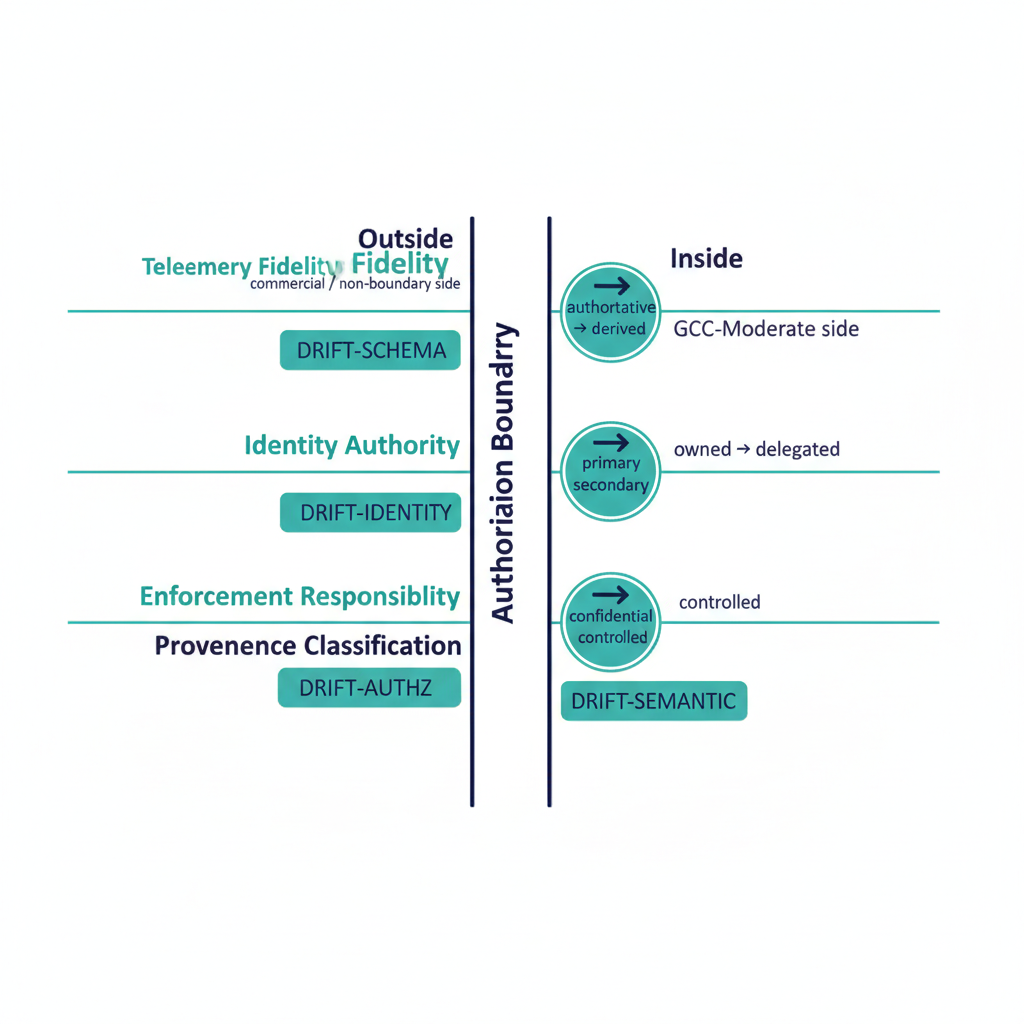
The boundary impact model is FMP’s architectural treatment of what happens when authorization boundaries cut across the substrate — most notably the GCC-Moderate boundary that constrains telemetry, identity, and enforcement surfaces inside Microsoft 365 GCC-Moderate tenants.
The original ROADMAP cited docs/docs/authorization-boundary.qmd, which does not exist. This page anchors instead on the existing GCC-Moderate boundary canon (gcc-boundary-problem-statement.qmd, gcc-boundary-solution-architecture.qmd, drift-detection-boundary-amendment.qmd) and the customer-facing leaf B.1 GCC-Moderate Boundary Model. A canon-change ADR may later promote a generalized authorization-boundary canon document; until then, this model is GCC-Moderate-anchored.
What the model captures
A boundary in FMP is not just a network or tenant edge — it is any surface across which:
- Telemetry fidelity changes (e.g. commercial → GCC-Moderate causes silent loss of Endpoint Analytics, Device Health Attestation, etc.).
- Identity authority changes (e.g. a federated trust crosses from one IdP’s namespace to another).
- Enforcement responsibility changes (e.g. a control that was platform- enforced becomes agency-enforced, or vice versa).
- Provenance classification changes (e.g. a claim that was
authoritativefrom system X becomesderivedafter crossing the boundary).
Each of these axes contributes an impact dimension that the model quantifies independently.
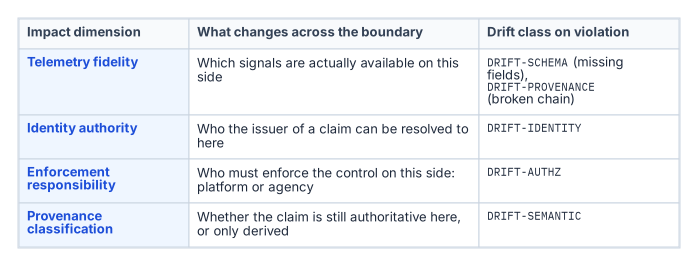
The four impact dimensions
| Dimension | Question | Drift class on violation |
|---|---|---|
| Telemetry fidelity | What signals are actually available on this side of the boundary? | DRIFT-SCHEMA (missing fields), DRIFT-PROVENANCE (broken chain) |
| Identity authority | Who can the issuer of a claim be resolved to here? | DRIFT-IDENTITY |
| Enforcement responsibility | Who must enforce this control on this side? | DRIFT-AUTHZ (out-of-envelope action) |
| Provenance classification | Is the claim still authoritative on this side, or only derived? | DRIFT-SEMANTIC |
The model deliberately maps onto the Drift Engine’s five-class taxonomy. Boundary crossings are the most common source of multi-class drift, and treating boundary modeling as a drift problem (rather than a separate compliance concern) keeps both surfaces in one operational language.
The invisible-boundary problem (worked example)
The structural example for this model is the GCC-Moderate invisible boundary, documented in gcc-boundary-problem-statement.qmd:
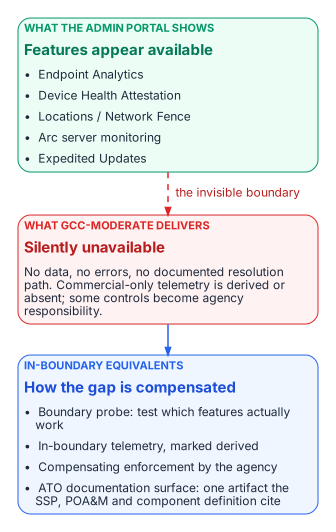
Microsoft 365 GCC-Moderate provides the same nominal product set as M365 commercial, but the FedRAMP Moderate authorization boundary materially constrains the outbound telemetry that drives many of the platform’s higher-order analytics. Features appear available in administrative portals, are described in commercial documentation, and may be referenced in SSPs and migration plans, but silently produce no data, emit no errors, and have no documented resolution path in the GCC-Moderate context.
Mapped onto the four-dimension model:
- Telemetry fidelity: Endpoint Analytics, Device Health Attestation, Locations / Network Fence, ARC Server Monitoring, and Expedited Updates are unavailable in GCC-Moderate despite UI presence. The boundary silently attenuates telemetry.
- Identity authority: federated trusts from commercial IdPs cross into GCC-Moderate scope; resolution rules differ on each side.
- Enforcement responsibility: controls that commercial customers consume as platform features (e.g. some ZT analytics) become agency responsibility in GCC-Moderate.
- Provenance classification: an
authoritativeclaim sourced from a commercial-only telemetry path isderived(or absent) in GCC-Moderate.
Treating these as a single boundary impact rather than four unrelated issues is what allows the B.1 GCC-Moderate Boundary Model leaf to produce a single coherent SSP narrative instead of four disjoint ones.
How FMP compensates: in-boundary equivalents
Per gcc-boundary-solution-architecture.qmd, FMP addresses each impact dimension through in-boundary mechanisms rather than waiting for Microsoft to fix the platform:
- Boundary probe — programmatically tests which features actually function on each side, producing a structured capability disposition instead of a portal screenshot.
- In-boundary telemetry — adapters that operate inside the GCC-Moderate boundary and emit canonical claims with explicit
source_classification: derivedwhen they substitute for an unavailable commercial signal. - Compensating enforcement — agency-side enforcement adapters for controls that platform features cannot provide, with their evidence flowing through the same Evidence Chain.
- ATO documentation surface — the boundary impact is captured as a first-class artifact that the SSP, POA&M, and Component Definition all reference, rather than as a series of footnotes.
Why this is an architectural concern, not a compliance concern
Two reasons the boundary impact model lives in the Architecture Series and not in the Compliance section:
- It changes the topology of the substrate. A boundary crossing redefines which plane is authoritative for which claim. That is a structural property of the architecture, not a control mapping.
- It is the same problem on every boundary. GCC-Moderate is the worked example, but identity-federation boundaries, classified-network boundaries, and agency-to-agency boundaries all instantiate the same four-dimension model. Solving it once architecturally is cheaper than re-solving it per compliance regime.
What this means for an ATO package
An FMP-anchored ATO package treats every authorization boundary as a named, modeled, drift-monitored surface:
- The boundary itself appears in the SSP, with disposition data per the four impact dimensions.
- Compensating mechanisms are documented per impact dimension, not as generic mitigations.
- Drift findings cite the boundary they crossed (e.g.
DRIFT-PROVENANCE @ gcc-moderate-edge), making remediation scope explicit.
This is what makes the GCC-Moderate boundary tractable: the substrate treats the boundary itself as a first-class governed object, not as an implicit assumption embedded in every control narrative.