Drift Engine
How FMP detects and remediates canonical drift
Drift Engine
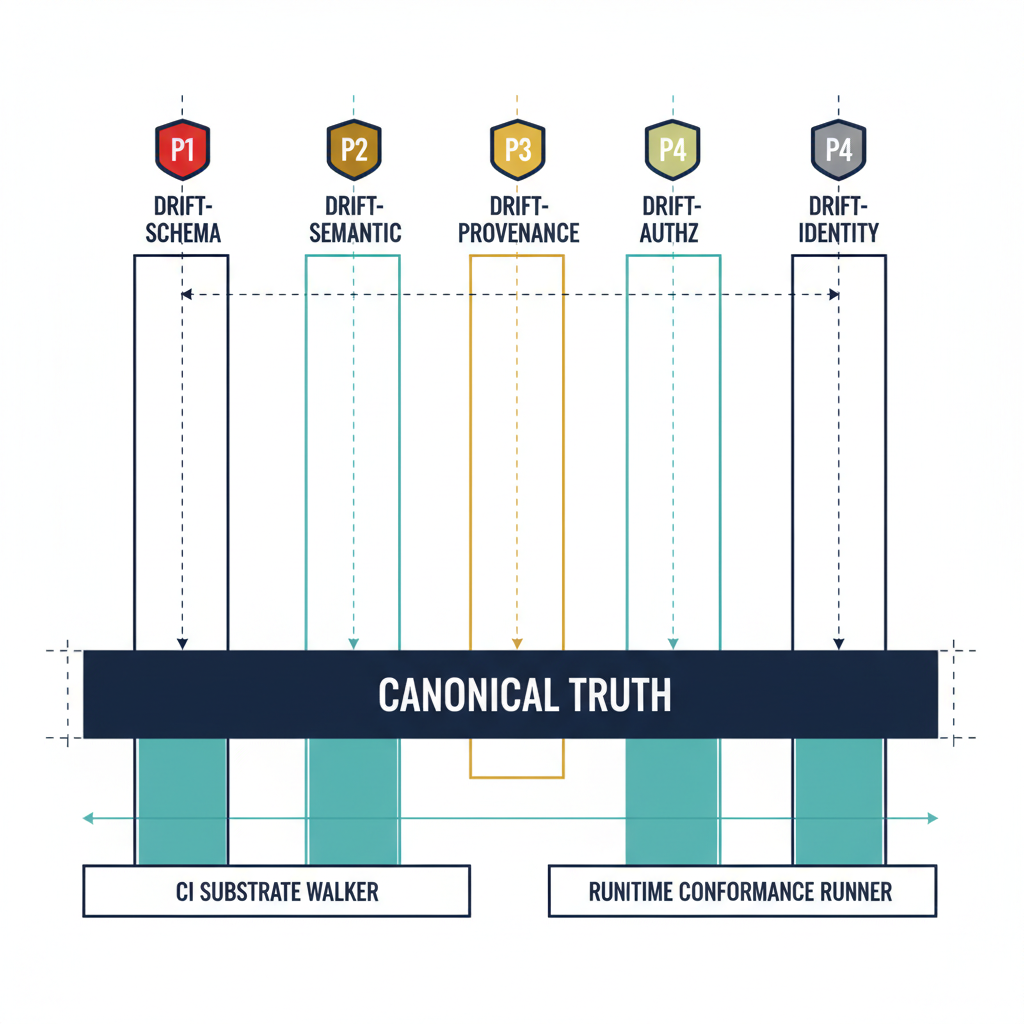
FMP treats drift as a first-class operational signal, not as an exception. The Drift Engine is the substrate-wide subsystem that classifies, prioritizes, and remediates the gap between declared canonical state and observed runtime reality.
The companion executive brief is Drift Engine Overview. This page is the architectural depth: how the engine is structured, what it catches today, and what is reserved for runtime maturity.
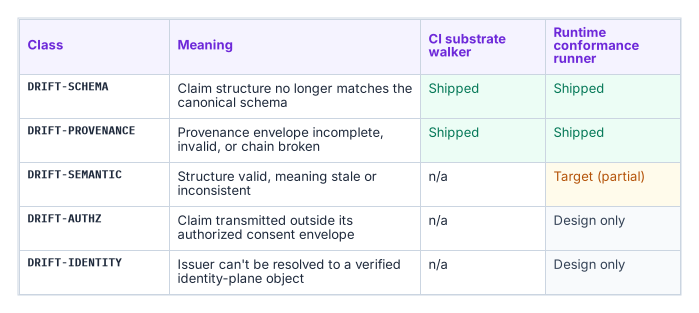
Five-class taxonomy
FMP defines exactly five drift classes, declared in 16_DriftDetectionStandard.qmd §2:
| Class | Meaning | Detection surface |
|---|---|---|
DRIFT-SCHEMA |
Claim structure no longer matches canonical schema | CI substrate walker |
DRIFT-SEMANTIC |
Structure valid, meaning stale or inconsistent | Runtime conformance runner |
DRIFT-PROVENANCE |
Provenance envelope incomplete, invalid, or chain broken | CI substrate walker + runtime |
DRIFT-AUTHZ |
Claim transmitted outside authorized consent envelope | Runtime conformance runner |
DRIFT-IDENTITY |
Issuer cannot be resolved to a verified identity-plane object | Runtime conformance runner |
Five is the right number because each class corresponds to a distinct failure mode that requires a distinct remediation contract. Collapsing them (e.g. calling everything “configuration drift”) loses the ability to assign severity and SLA deterministically.
Severity model
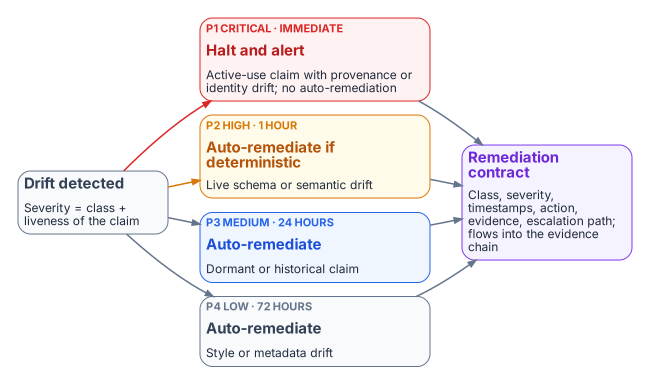
Every drift finding carries a severity, also canonically defined:
| Severity | When | Auto-remediate? | SLA |
|---|---|---|---|
P1 (critical) |
Active-use claim with provenance or identity drift | No — halt + alert | Immediate |
P2 (high) |
Live schema or semantic drift | Yes, if deterministic | 1 hour |
P3 (medium) |
Drift in dormant or historical claim | Yes | 24 hours |
P4 (low) |
Style or metadata drift, no semantic impact | Yes | 72 hours |
Severity is computed deterministically from the drift class plus the liveness of the affected claim — it is not a judgment call.
Detection surfaces
CI substrate walker (shipped today)
fmp substrate walk and fmp substrate drift (source) emit two drift classes on every PR via substrate-drift.yml:
DRIFT-SCHEMA— verifies module paths declared insubstrate-manifest.yaml(FMP_200) actually exist in the tree.DRIFT-PROVENANCE— verifies that every registry document referenced from a manifest, ADR, or registry resolves to a real canon artifact.
fmp substrate drift is the CI-friendly entry point: exit code 0 = clean, non-zero = drift detected. The full structured report is available via fmp substrate walk --json.
Runtime conformance runner (target / partial)
The runtime detection surface — semantic, authorization, identity — is defined in canon and partially implemented. Adapters that pass the runtime conformance runner emit a remediation contract for every drift event:
remediation_contract:
  drift_class: "DRIFT-*"
  severity: "P1|P2|P3|P4"
  detection_timestamp: ISO8601
  detected_by: "{adapter_id | workflow_id}"
  auto_remediated: true | false
  remediation_action: "halt | fix | flag | log"
  remediation_timestamp: ISO8601
  remediation_evidence: "{commit_sha | audit_record_id}"
  escalation_path: "Canon Steward | Architecture Lead | CISO"
Source: 16_DriftDetectionStandard.qmd §4.
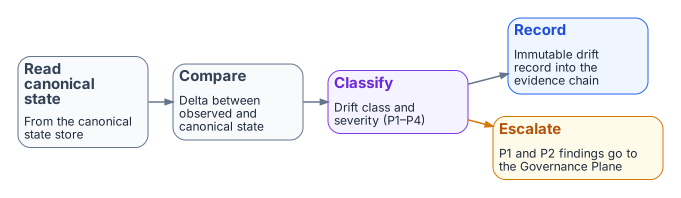
The Drift Fabric view ties the detection surfaces above into a single pipeline — canonical state read, delta comparison, classification, and the HIGH/CRITICAL escalation arrow into the Governance Plane:
Maturity matrix
| Drift class | CI surface | Runtime surface |
|---|---|---|
DRIFT-SCHEMA |
SHIPPED | SHIPPED |
DRIFT-PROVENANCE |
SHIPPED | SHIPPED |
DRIFT-SEMANTIC |
n/a | TARGET (partial) |
DRIFT-AUTHZ |
n/a | DESIGN-ONLY |
DRIFT-IDENTITY |
n/a | DESIGN-ONLY |
For an authoritative shipped-vs-target snapshot, see Substrate Status.
Why this is different from a config-drift tool
Three properties distinguish the FMP Drift Engine from generic configuration-drift tooling:
- Canon-anchored, not snapshot-anchored. Drift is measured against a numbered canon document with a version, not against an arbitrary “last-known-good” snapshot. Reproducibility is built in: the same canon version always yields the same expected state.
- Five-class taxonomy with deterministic severity. Operators do not triage drift findings; severity is a pure function of class plus liveness. This collapses the “is this serious?” debate into “did the classifier run correctly?”
- Remediation contracts are first-class evidence. Every remediation — auto or human — emits an evidence record that flows back through the Evidence Chain into OSCAL artifacts. There is no parallel “drift log” disconnected from the SSP.
What this means for an ATO package
A drift finding in an FMP-anchored system carries:
- A canonical class (
DRIFT-*) traceable to FMP_200 / canon-numbered drift standard. - A severity computed deterministically.
- A remediation contract with timestamps, action, and signed evidence.
- An escalation path that lands at a named role, not a generic distribution list.
3PAOs assessing such a system can verify the drift posture by running fmp substrate walk themselves rather than trusting a snapshot — the engine is designed for independent re-execution.