Modernization Canon
Microsoft-Driven Identity & Infrastructure Migration Framework
reference-architecture-bundle.docx — every page in this section concatenated into one Word document, figures embedded. Regenerated on every site deploy.
The Problem
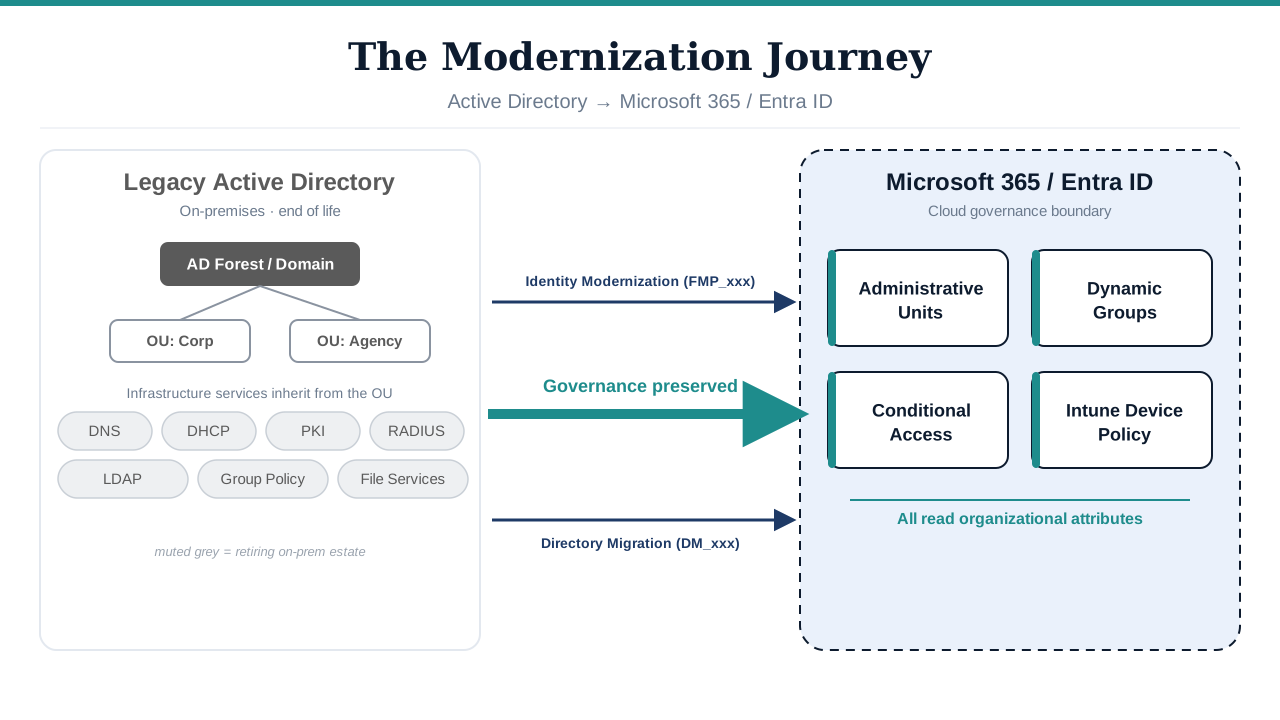
Federal agencies — and most enterprises — are frozen in 2003.
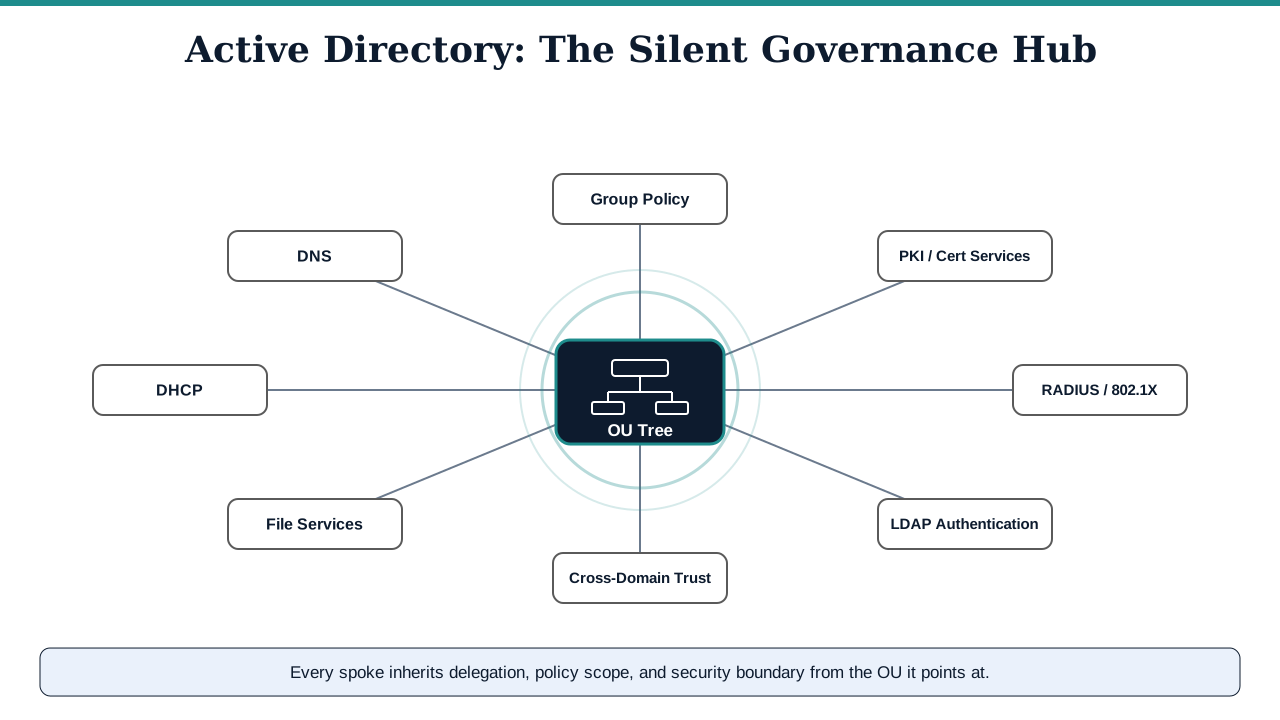
Active Directory was never just an identity store. It was the implicit governance model for every network service in the enterprise: DNS, DHCP, PKI, RADIUS, LDAP authentication, GPO-based device policy, file services, and cross-domain trust relationships. When an administrator created an OU, they were not just organizing users — they were defining delegation boundaries, security policy scope, group policy inheritance, and operational accountability. The OU tree was the governance model.
Microsoft is now deprecating the entire Client/Server stack. Entra ID replaces Active Directory. Intune replaces Group Policy. Conditional Access replaces network-perimeter enforcement. But Microsoft gave agencies the tools — nobody gave them the framework for what decisions to make with those tools.
The result: agencies migrate users into Entra ID’s flat directory and lose every governance relationship that the OU hierarchy encoded. Delegation boundaries vanish. Policy inheritance breaks. Group membership becomes a manual spreadsheet exercise. Security groups proliferate without governance. And the infrastructure services that depended on AD — DNS, PKI, RADIUS, LDAP — lose their governance anchor entirely.
The Solution
The Federal Modernization Program Modernization Canon is that missing framework.
It provides the complete, deterministic, drift-resistant architecture for governing the AD-to-Entra ID transition — not just user migration, but the full governance surface that Active Directory was silently holding together. Two complementary canons cover the entire migration surface:
| Domain | Namespace | Scope | Documents |
|---|---|---|---|
| Identity Modernization | FMP_xxx (formerly MOD_xxx; retired by [the program decision]) | User hierarchy, extension attributes, dynamic groups, AUs, HR-driven lifecycle, delegation, Conditional Access | 27 files (FMP_150 + the A–Z series FMP_151–FMP_176) |
| Directory Migration | DM_xxx | DNS, DHCP, PKI, RADIUS, LDAP, sync engines, device management, NTP, DFS | 12 files (DM_000–DM_090): 8 adapter interfaces + 4 framework docs |
Both canons share a universal design principle:
fmp-gos is a universal enterprise product. It is NOT government-specific. Federal compliance (FedRAMP, OSCAL, KSI) is one vertical adapter on top of the universal core. Never frame the core engine as federal-only.
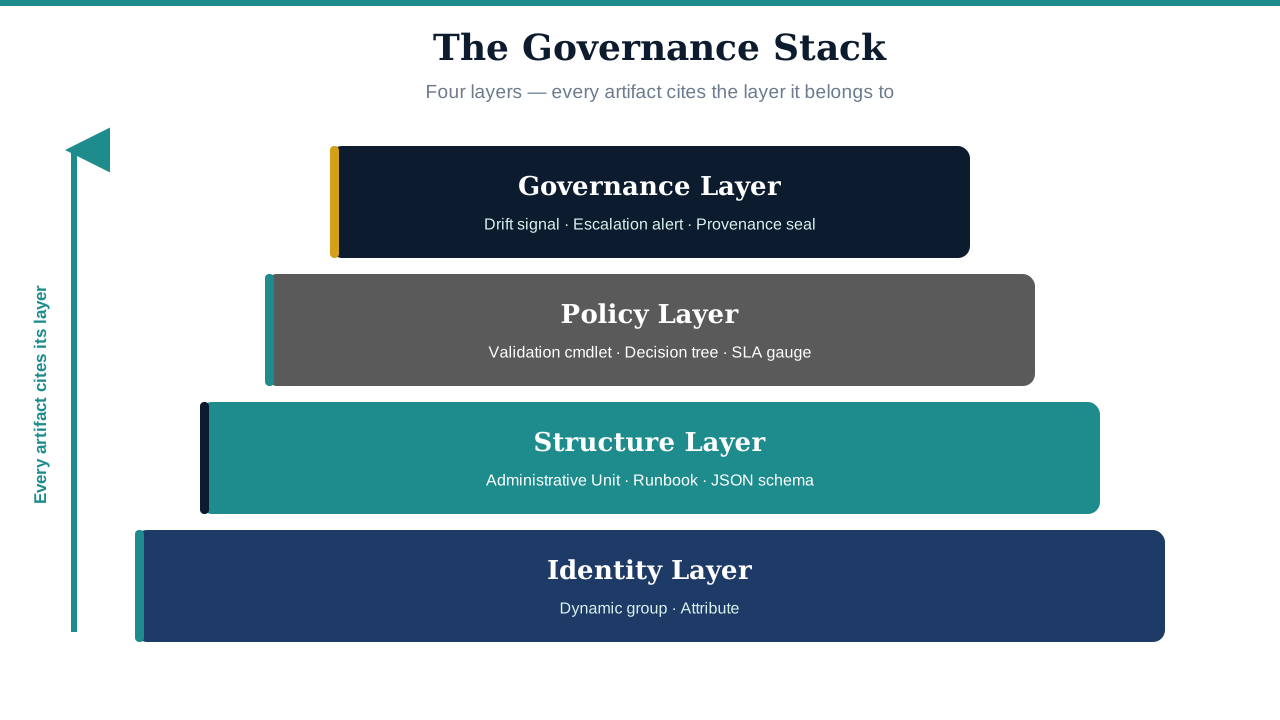
Architecture: The Four-Layer Governance Stack
The architecture is a four-layer governance stack. Each layer has a defined responsibility, explicit dependency relationships, and canonical artifacts.
| Layer | Responsibility | Key Artifacts |
|---|---|---|
| Governance Layer | Drift detection, telemetry, escalation, boundary impact, provenance, error taxonomy | FMP_163 (Drift Engine); FMP_167 (SLA Escalation Playbooks); FMP_174 (Telemetry) |
| Policy Layer | Validation cmdlets, enforcement test suite, decision trees, SLA tracking | FMP_159 (PowerShell Validation); FMP_161 (Decision Trees); FMP_162 (SLA Heatmap) |
| Structure Layer | Administrative-Unit delegation, workflow catalog, migration runbook | FMP_154 (Delegation Matrix); FMP_156 (Migration Runbook) |
| Identity Layer | Dynamic-group library, attribute mapping, extension attributes | FMP_150 (Executive Summary); FMP_152 (Dynamic Groups); FMP_153 (Attribute Mapping) |
Governance Principles — 3 Universal + 3 Tier-Specific
Per [the program decision], the Federal Modernization Program ships 6 governance principles in two scopes, declared canonically in [src/fmp/canon/substrate-manifest.yaml] (FMP_200). The substrate manifest is the code SSOT for principles; the descriptions below mirror it verbatim.
3 Universal Substrate Principles
These apply at all 5 conformance tiers per [the program decision]. Every the Federal Modernization Program deployment honors all three.
Single Source of Truth (SSOT). Canonical governance artifacts under
src/fmp/canon/define structure, policy intent, and registry authority exactly once. Downstream systems consume those artifacts viaimportlib.resourcesrather than duplicating policy logic.Canon-Anchored Evidence. Every artifact the substrate produces — SSP, POA&M, KSI dashboards, component definitions — cites the canon document ID and version it derives from. Reviewers trace findings back to requirements deterministically.
Drift Is Explicit. Five-class taxonomy (
DRIFT-SCHEMA,DRIFT-SEMANTIC,DRIFT-PROVENANCE,DRIFT-AUTHZ,DRIFT-IDENTITY) surfaces structural and provenance mismatch as first-class findings, not exception reports.
3 Tier-Specific Principles
These become operational only at the named the program decision tier (inclusive — apply at that tier and above):
| Principle | Applies at tier | Rationale for tier scope |
|---|---|---|
| Two-Brain Execution — Copilot governs (canonical review, policy enforcement, validation); Execution Substrate executes (PowerShell, Graph API, tenant provisioning); governance logic and execution logic never co-mingle | Tier 3+ (Active Substrate) | At Tiers 1–2 there is no active runtime to split between governance and execution. The principle becomes operational only when the Federal Modernization Program writes agency state. |
| Boundary Enforcement — No governance artifact may extend beyond the M365 GCC-Moderate SaaS boundary. Out-of-scope references are non-canonical and rejected at validation | Tier 4+ (Active Services / Platform Server) | At Tiers 1–3, boundary is a documented scope; at Tier 4 it becomes an enforced runtime contract on agency-deployed the Federal Modernization Program services. |
| Tenant Agnosticism — All artifacts are portable across any M365 GCC-Moderate tenant. No tenant-specific identifiers, UPNs, or GUIDs. All environment values are injected at deployment time | Tier 5 (Embedded Libraries) | At Tiers 1–4, the Federal Modernization Program runs agency-side and may carry tenant-local context. At Tier 5, code shipped to third parties (PyPI, NuGet, adapter SDK) MUST be portable. |
Historical names (“Seven Non-Negotiable Principles”)
Earlier framings of this canon listed seven principles. Per the program decision, four of those names were partial expressions of the universal three and have been collapsed into them:
| Retired narrative name | Collapses into universal principle |
|---|---|
| Deterministic State | SSOT (single canonical state per object) |
| Schema Fixity | SSOT (canon defines structure once) |
| Provenance Traceability | Canon-Anchored Evidence (same property, different label) |
| Drift Resistance | Drift Is Explicit (same property; the 5-class taxonomy is the canonical drift surface) |
The other three names (Boundary Enforcement, Two-Brain Execution, Tenant Agnosticism) remain canonical, now scoped to the tiers where they bind. The “seven principles” phrasing should not be cited in new material; refer to the 3 + 3 split above or to the substrate manifest directly. “Assessment Before Action” is treated as an operational discipline — a corollary of Drift Is Explicit and Canon-Anchored Evidence — not a first-class substrate principle.
Who This Is For
| Audience | What They Get |
|---|---|
| Federal CISOs and CIOs | A governed framework for AD retirement that does not create compliance gaps |
| IT Modernization Program Managers | Step-by-step runbooks with deterministic outcomes, not “it depends” guidance |
| Identity Architects | Dynamic group library, AU delegation matrix |
| Network and Infrastructure Engineers | Adapter interfaces for every AD-dependent service |
| Compliance Officers | Provenance-tracked, drift-resistant artifacts that satisfy FedRAMP continuous monitoring |
| Enterprise Architects (non-federal) | Universal framework — federal compliance is a vertical adapter, not the core |
Source Files
All canonical source files are maintained in the monorepo:
- Directory Migration:
src/fmp/modernization/directory-migration/