Evidence Chain
How FMP turns telemetry into assessor-ready evidence with traceable provenance
Evidence Chain
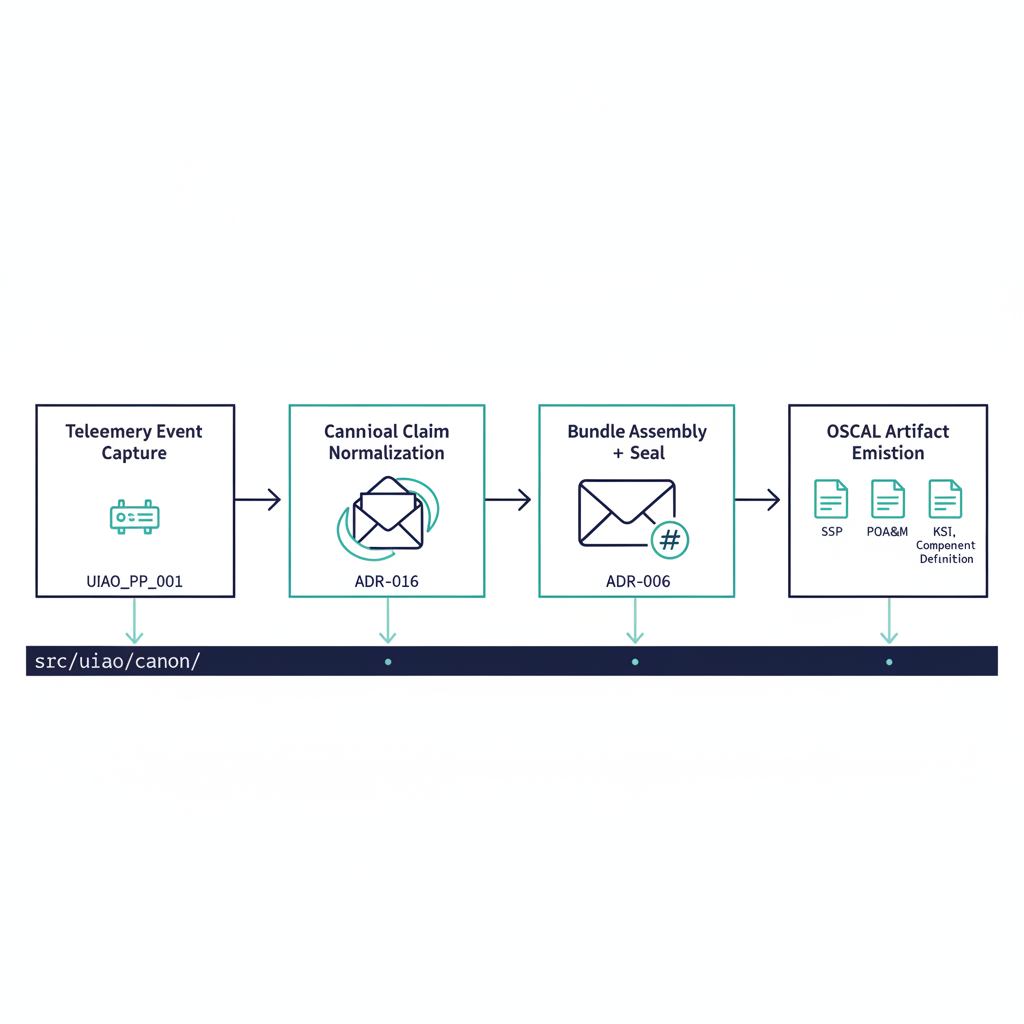
FMP’s evidence chain is the architectural mechanism that turns runtime telemetry into assessor-ready compliance artifacts with traceable provenance at every step. The chain is deterministic: same inputs, same canon version, same evidence bundle.
The companion executive brief is Evidence Fabric Overview. This page is the architectural depth — the four-stage pipeline, the provenance envelope, and the determinism guarantees.
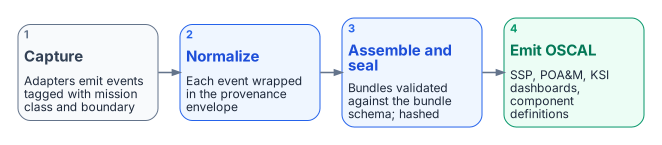
Four-stage pipeline
Stage-by-stage responsibility:
- Telemetry event capture — adapters at the system boundary emit structured events. Each adapter declares its
mission-classandboundaryso the captured event carries authoritative source classification from the moment of emission. - Canonical claim normalization — every event is wrapped in the provenance envelope defined in
15_ProvenanceProfile.qmd§3. This is the chain’s structural backbone (see below). - Evidence bundle assembly + sealing — claims are grouped into bundles per the program decision (assemble → seal → submit → close). Bundles are validated against
evidence-bundle.schema.jsonwhich enforces hash-bearing provenance at item and bundle scope. - OSCAL artifact emission — sealed bundles feed the OSCAL pipeline that emits SSP, POA&M, KSI dashboards, and Component Definitions, with every field traceable back to the originating claim.
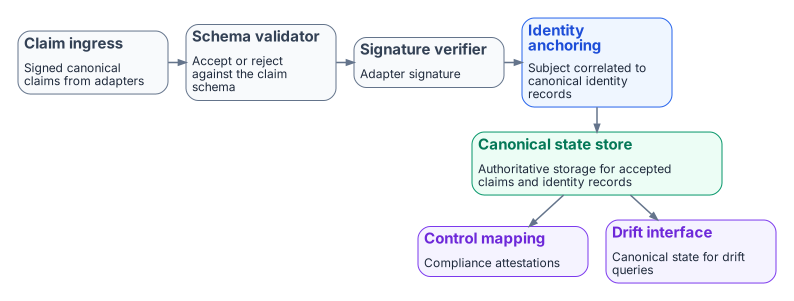
The Truth Fabric view of stages 1–2 is the canonical claim-intake pipeline that turns adapter-signed events into the Canonical State Store the rest of the chain reads from:
Provenance envelope
Every claim emitted into the chain carries this envelope, verbatim from canon:
provenance:
  claim_id: "urn:fmp:claim:{domain}:{claim_type}:{uuid}"
  issuer_identity: "{entra_object_id | agency_issuer_id}"
  source_system: "{system_name}:{version}"
  source_classification: "authoritative | derived | synthesized"
  extraction_timestamp: ISO8601
  extraction_method: "api | batch | stream | manual"
  transformation_chain:
    - step: 1
      transform: "{transform_name}"
      applied_by: "{adapter_id}"
      applied_at: ISO8601
  lineage_hash: "{SHA-256 of source record at extraction}"
  schema_version: "1.0"
  signature: "{mTLS certificate thumbprint}"
Three properties of this envelope matter for assessor review:
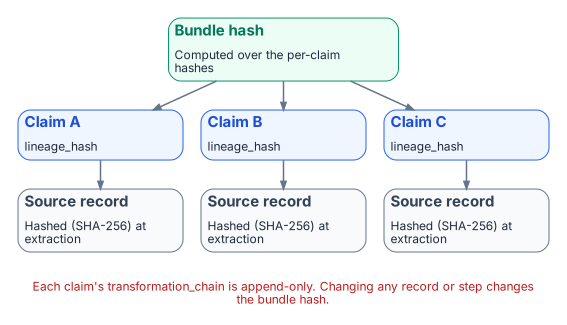
source_classificationis canonical. A claim isauthoritative,derived, orsynthesized— and a 3PAO can verify the classification by re-executing the adapter. There is no “trust me” classification.transformation_chainis append-only. Once a step is recorded and signed, it cannot be removed or reordered. Re-execution that would produce a different chain is itself aDRIFT-PROVENANCEfinding.lineage_hashis per-claim. Every claim hashes its source record at extraction time. The bundle hash is computed over those hashes, giving a tamper-evident tree.
Determinism guarantees (the program decision)
Per the program decision, the evidence chain is built for deterministic regeneration. Concretely:
- No silent drops. Every input event is either accepted, rejected with reason, or queued — never silently lost.
- Append-only writes. Evidence storage is immutable; updates are new records that supersede prior ones with explicit provenance.
- Ordered records. Replays produce identical ordering, not “best-effort” ordering.
- Idempotent ingestion. Re-ingesting the same source record twice yields the same canonical claim, not a duplicate.
The operational consequence: the same canon version processing the same input bundle always produces a byte-identical evidence bundle. A 3PAO can re-run the assembly months later and verify the bundle hash matches the original, without coordinating with the original adapter operator.
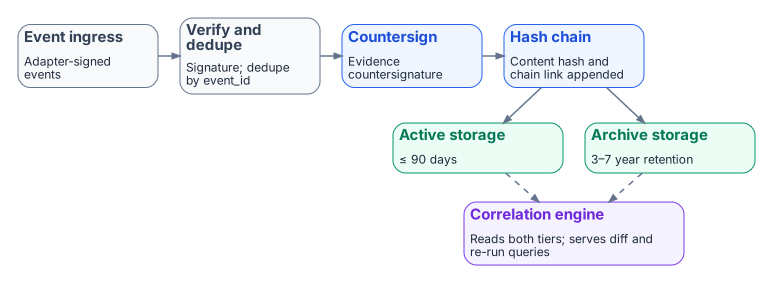
The Evidence Fabric view of stages 3–4 shows the write-side pipeline with the two-tier storage that backs deterministic regeneration — adapter-signed events flow through countersignature and hash-chain anchoring into Active (≤ 90 days) and Archive (3–7 year) storage tiers, both readable by the Correlation Engine that serves diff and re-run queries:
What ships today
| Capability | Maturity |
|---|---|
| Provenance envelope schema (FMP_PP_001 v1.0) | SHIPPED |
| Evidence bundle schema + lifecycle (the program decision) | SHIPPED |
| OSCAL SSP / POA&M / KSI / Component Def generators | SHIPPED |
| Deterministic regeneration (the program decision properties) | SHIPPED for canon-anchored generators |
| Continuous event-time capture across all adapters | TARGET |
| Cryptographic signing with agency-issued certs | DESIGN-ONLY (envelope reserves the field) |
The event-time capture chain is design-defined but not fully wired in current production flow. The structural pieces — provenance envelope, bundle schema, lifecycle, OSCAL emission — all ship today; end-to-end continuous capture across every adapter is target-state.
What this means for an ATO package
An FMP-anchored evidence bundle gives a 3PAO four properties they cannot get from a screenshot-based evidence package:
- Independent re-execution. The bundle can be regenerated from canon and source data without the original operator’s involvement.
- Per-claim source classification. Authoritative claims are distinguished from derived claims at the field level, not in narrative prose.
- Tamper-evident lineage. The hash tree binds every claim to a source record; modification anywhere in the chain breaks the bundle hash.
- Drift-coupled. A
DRIFT-PROVENANCEfinding from the Drift Engine directly identifies the affected claim(s) in the evidence bundle, so remediation is scoped, not rebuild-the-whole-package.
This is what “canon-anchored evidence” means in practice — and is the operational basis for treating FMP evidence as deterministically reviewable rather than periodically attested.