Three-Layer Rule Model
Separating authoritative rules, policy mappings, and runtime enforcement
Rule authoring is separated into three distinct layers so that policy intent, evaluation logic, and runtime enforcement can be reasoned about, versioned, and drift-detected independently. Mixing them — the typical “policy-as-config” failure mode — collapses three different change boundaries into one and loses the ability to assess each layer for its own risk profile.
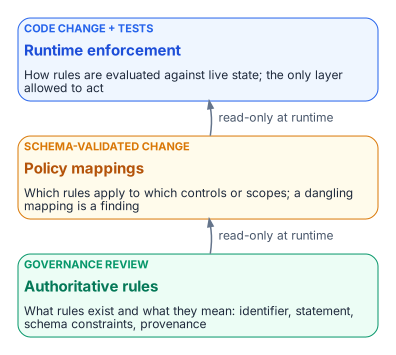
The three layers
| Layer | Authoritative for | Change boundary |
|---|---|---|
| Authoritative rules | What rules exist and what they mean | Governance review |
| Policy mappings | Which rules apply to which controls or scopes | Schema-validated change |
| Runtime enforcement | How rules are evaluated against live state | Code change + tests |
Each layer has its own change cadence, its own review surface, and its own drift class.
Layer 2 — Policy mappings
The mapping between authoritative rules and operational scope. A policy entry says: “Component X applies rule R within scope S.” Schema validation ensures that every policy entry references a rule that actually exists. A dangling policy entry is a provenance finding, not a runtime crash.
Policy changes are higher-cadence than rule changes: a mapping can be added or retired without invoking the full governance-review process. The schema gates ensure mappings stay consistent.
Layer 3 — Runtime enforcement
The evaluation logic that consumes rules and policy mappings against live state. The runtime layer is the only layer allowed to mutate observable state. Authoritative rules and policy mappings are read-only at runtime; only the runtime layer can act.
How drift maps onto the layers
| Drift class | Layer where the mismatch lives |
|---|---|
| Schema | Authoritative rules — declared schema vs. actual claim structure |
| Semantic | Authoritative rules ↔︎ Runtime — meaning has shifted between layers |
| Provenance | Policy — a mapping references a rule that no longer resolves |
| Authorization | Runtime — a component emitted outside its authorized envelope |
| Identity | Runtime — issuer cannot be resolved |
Why three layers and not two
- Cadence mismatch. Rule changes require governance review. Mapping changes do not. Folding mappings into the rule layer either slows mapping work or weakens review discipline.
- Blast radius. A bad mapping is recoverable by a registry edit. A bad rule edit is recoverable only through formal supersession.
- Drift attribution. The drift engine can tell a reviewer whether a finding represents a meaning shift or a mapping mistake. That distinction is lost if both live in the same artifact.