Three-Layer Rule Model
How FMP separates canon, policy, and runtime rule layers
Three-Layer Rule Model
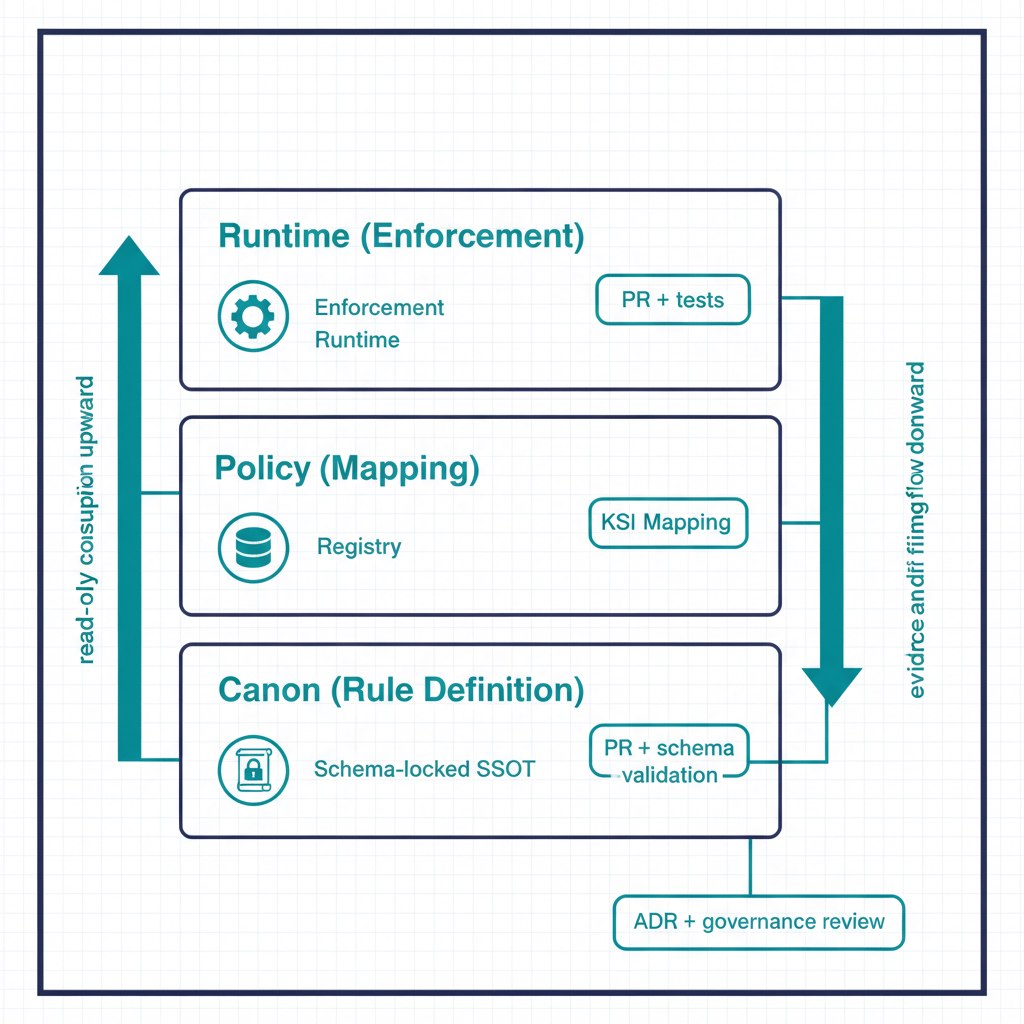
FMP separates rule authoring into three distinct layers so that policy intent, evaluation logic, and runtime enforcement can be reasoned about, versioned, and drift-detected independently. Mixing them — the typical “policy-as-config” failure mode — collapses three different change boundaries into one and loses the ability to assess each layer for its own risk profile.
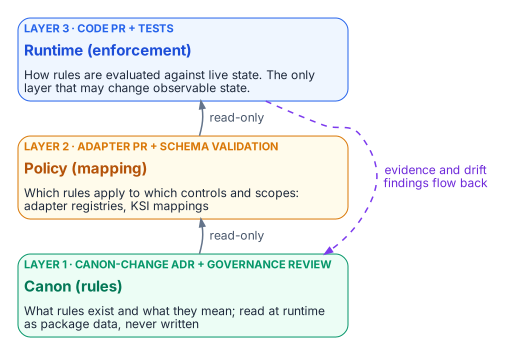
The three layers
| Layer | Lives in | Authoritative for | Change boundary |
|---|---|---|---|
| Canon (rule layer) | src/fmp/rules/ |
What rules exist and what they mean | Canon-change ADR + governance review |
| Policy (mapping layer) | src/fmp/canon/<adapter>-registry.yaml, KSI mappings |
Which rules apply to which controls / scopes | Adapter PR + schema validation |
| Runtime (enforcement layer) | Adapter code under src/fmp/adapters/ and enforcement runtime under src/fmp/enforcement/ |
How rules are evaluated against live state | Code PR + tests |
Each layer has its own change cadence, its own review surface, and its own drift class. This is the architectural reason FMP’s drift engine can distinguish a meaning drift (canon layer changed unexpectedly) from a mapping drift (policy points at a retired rule) from an enforcement drift (runtime code disagrees with canon).
Layer 1 — Canon
The canon layer is the single source of truth for rule existence and semantics. It lives under src/fmp/rules/ and is shipped as package data inside the installable fmp distribution. Canon is read at runtime via importlib.resources per the Canon Consumer rule — never from filesystem paths, never written to.
A canon rule declares:
- Rule identifier (stable, versioned).
- Semantic statement in human-readable form.
- Schema constraints that any concrete instance must satisfy.
- Provenance — the canon document and ADR that authored it.
What canon does not declare: which adapters apply it, which controls it maps to, or how it is enforced at runtime. Those belong to layers 2 and 3.
Layer 2 — Policy
The policy layer is the mapping between canon rules and operational scope. It lives in canon-adjacent registries:
adapter-registry.yaml— conformance adapter mappings.modernization-registry.yaml— modernization adapter mappings.- KSI mapping files under
src/fmp/rules/ksi/— Key Security Indicator to canon-rule bindings.
A policy entry says: “Adapter X (or KSI Y) applies canon rule R within scope S.” Schema validation in schema-validation.yml enforces that every policy entry references a canon rule that actually exists. A dangling policy entry — referencing a retired rule, a renamed scope, or a non-existent adapter — is a DRIFT-PROVENANCE finding, not a runtime crash.
Policy changes are higher-cadence than canon changes: an adapter author can add or retire a mapping in a normal PR without invoking the canon-change process. The schema gates ensure mappings stay consistent.
Layer 3 — Runtime
The runtime layer is the evaluation logic that actually consumes canon rules and policy mappings against live state. It lives in two places:
- Adapter code under
src/fmp/adapters/<adapter>/— each adapter implements the conformance contract for itsmission-classand emits drift findings + evidence per the Evidence Chain. - Enforcement runtime under
src/fmp/enforcement/— library-only today (FMP_111). Policies are Python callables; there is no CLI surface for the enforcement runtime, by design — seecli-reference.qmd §4.1.
The runtime layer is the only layer allowed to mutate observable state. Canon and policy are read-only at runtime; only the runtime layer can act.
How drift maps onto the layers
The five-class drift taxonomy aligns with the three layers in a way that matters operationally:
| Drift class | Layer where the mismatch lives |
|---|---|
DRIFT-SCHEMA |
Canon — declared schema vs. actual claim structure |
DRIFT-SEMANTIC |
Canon ↔︎ Runtime — meaning has shifted between layers |
DRIFT-PROVENANCE |
Policy — a mapping references a rule that no longer resolves |
DRIFT-AUTHZ |
Runtime — an adapter emitted outside its consent envelope |
DRIFT-IDENTITY |
Runtime — issuer cannot be resolved |
This alignment is why FMP can attribute a drift finding to a specific review surface: DRIFT-PROVENANCE findings are policy-layer concerns, auto-resolvable in many cases; DRIFT-SEMANTIC findings cross from canon into runtime and require both governance review and code change.
Why three layers and not two
A common simplification is to fold “policy” into “canon” — declare mappings inside the canon document itself. FMP rejects this because:
- Cadence mismatch. Canon changes require ADRs and governance review. Mapping changes do not. Folding mappings into canon either slows mapping work to canon cadence or weakens canon’s review discipline.
- Blast radius. A bad mapping is recoverable by a registry edit. A bad canon edit is recoverable only through ADR supersession. Different blast radii deserve different change boundaries.
- Drift attribution. The drift engine can tell a 3PAO whether a finding represents a meaning shift or a mapping mistake. That distinction is lost if both live in the same artifact.
The same logic argues against folding “runtime” into “policy” — runtime must execute, mutate, and emit, which policy must not.
What this means for an ATO package
Three operational properties for a 3PAO:
- Per-layer evidence trails. Canon changes carry an ADR; policy changes carry a schema-validated registry diff; runtime changes carry tests and remediation contracts. The package shows three distinct evidence surfaces, not one.
- Independent reviewability. A reviewer can challenge “is this rule’s meaning correct?” (canon) separately from “is this mapping right?” (policy) separately from “does the code do what canon says?” (runtime).
- Targeted remediation. When drift is found, only the affected layer is rebuilt — canon, mapping, or code. The other two layers’ evidence remains valid.