The Four-Class Pattern Applied to SQL-Consuming Applications
Chapter 1 — The Four-Class Pattern Applied to SQL-Consuming Applications
The application is the other half of the authentication chain — and it has its own AD dependency to remove.
Why SQL Server’s authentication transformation is incomplete until the upstream applications that consume it are addressed, how the LDAP-dependent-application migration plan’s four-class taxonomy categorizes those applications by modernization capability, what each class means for both the user-authentication track and the SQL-connection track, and how the application-audit script produces the per-application classification data that drives the triage.
SQL Server does not exist in isolation. In every federal environment of meaningful size, it is the data layer downstream of a middleware tier — web application servers, API backends, reporting services, ETL pipelines, and legacy integration systems. Those middleware applications carry their own authentication architecture, and in many federal environments that architecture includes LDAP binding: the application binds to Active Directory as a directory authority, queries group membership or user attributes, and treats AD as its authorization source.
The same AD dependency that must be removed from SQL Server’s authentication layer must also be removed from those upstream applications, and the removal must be coordinated. An application that has migrated its user authentication to Entra ID OIDC but still uses a SQL Authentication service account to reach SQL Server has not completed its transformation. The application chain must be addressed as a complete authentication path — user to application to database — not as independent layers.
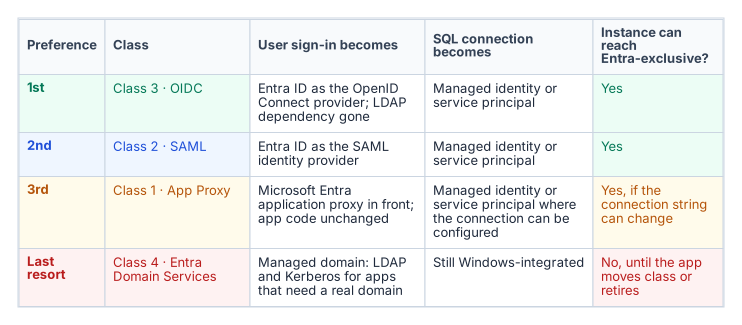
The LDAP-dependent-application migration plan, accepted 2026-05-13, provides the four-class taxonomy for categorizing upstream applications by modernization capability, in a strict preference order: Class 3 (OIDC) preferred, then Class 2 (SAML), then Class 1 (App Proxy), then Class 4 (Entra Domain Services) as the last resort. The application-audit script (Get-LDAPBindAccountInventory.ps1) is the discovery instrument that produces the per-application classification data this chapter depends on.
Two Axes: User Sign-In and the Database Connection
The four classes describe only one axis: how users authenticate to the application. The SQL connection is a second, independent axis, and an application’s place on it is set by evidence, not by its class:
- Driver version and Entra modes. Does the application’s database driver, at the version deployed, support the Entra authentication mode it needs?
- Token acquisition and refresh. Can it be configured to use a managed identity or service principal, or must its code acquire a token and refresh it before expiry?
- Connection pooling. Does pooling keep working when connections use per-identity tokens?
- Vendor support. For commercial software, does the vendor support Entra authentication to SQL Server, and in which release?
- Client platform. Does the operating system or runtime the application runs on offer an Entra-capable driver?
These answers place each application in one of four database-axis columns: A — configuration only (connection-string change); B — code change; C — vendor-dependent; D — no Entra path today. Reading the two axes together gives the outcome for the host instance:
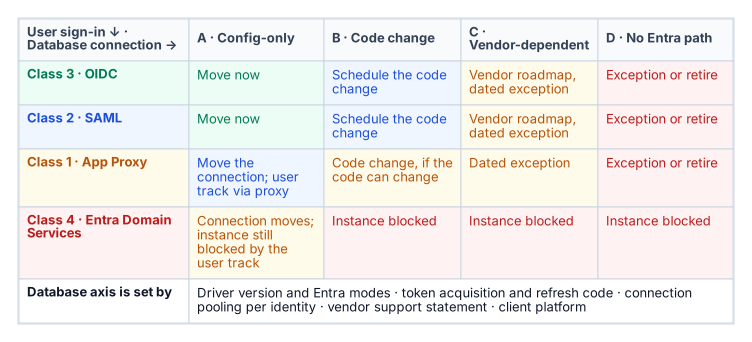
The application audit collects the user-axis data; the database-axis data comes from the driver inventory, the code owner and the vendor. Every cell outside A carries an owner, an effort band and a dated exception in the exception registry.
Class 1 — App Proxy: Cannot Be Modernized Directly
Class 1 applications cannot modify their authentication mechanism. They bind to LDAP for user authentication, and the dependency is architectural — embedded in unmaintainable code, supplied by a vendor with no modern auth option, or frozen by a regulatory certification that prevents code modification. For SQL Server, Class 1 applications typically connect using an AD service-account credential stored in a connection string or configuration file.
The Class 1 migration pattern has two independent tracks. The user-authentication track deploys Entra Application Proxy in front of the application: the App Proxy connector fronts the application’s user authentication behavior without modifying the application itself. The SQL-connection track migrates the application’s database credential from a SQL Authentication service account to a service principal or Managed Identity — a change made in the connection string or configuration, not in code, and independent of the user-authentication track. Both tracks must complete before the application’s contribution to the SQL Server transformation is fulfilled.
Class 2 — SAML: Federated Identity but Not OIDC
Class 2 applications support SAML federation but not OIDC. SAML 2.0 is an XML-based federation protocol that predates OIDC and is common in federal environments because many enterprise applications implemented SAML support before OIDC was standardized. For Class 2 applications, Entra ID becomes the SAML Identity Provider per the SAML identity-provider standard. The user’s authentication is modernized — they authenticate to Entra ID using their Entra credentials, Entra issues a SAML assertion, and the application validates the assertion and grants access — but the protocol is SAML, not OIDC.
The SQL-connection track for Class 2 follows the same pattern as Class 1: the connection string migrates from SQL Authentication or Windows Integrated Security to Managed Identity or service-principal authentication. The user-authentication modernization and the SQL-connection migration are separate tracks and can be sequenced independently. The LDAP-dependent-application migration plan places Class 2 second to Class 3 because SAML eliminates the LDAP dependency rather than proxying through it, yet ranks below OIDC because it does not provide the full capability set of a modern identity protocol.
Class 3 — OIDC: The Preferred Destination
Class 3 is the preferred migration destination in the LDAP-dependent-application migration plan’s ordering. An OIDC-capable application can migrate fully to Entra ID as its identity provider, eliminating the LDAP dependency entirely. The application redirects the user to the Entra ID authorization endpoint, the user authenticates with Entra credentials, Entra issues an ID token and an access token, and the application uses the claims in those tokens for identity and authorization. No LDAP bind occurs, and no AD query occurs.
The application’s SQL Server connection also uses Managed Identity or service-principal authentication, with no stored credential. The end-to-end chain for a Class 3 application reaching SQL Server is direct: the user authenticates to Entra ID via OIDC, the application uses its Managed Identity to authenticate the SQL connection, SQL Server validates the Managed Identity token through the Arc-provided token-validation infrastructure, and the connection is established. There is no AD in this path, no LDAP, no NTLM or Kerberos, and no stored credential. This is the target architecture.
Class 4 — Entra Domain Services: Last Resort
Class 4 applications cannot be modernized to any modern authentication protocol. They require actual LDAP and Kerberos from a domain controller — not a proxy, not a federation, but a real AD-compatible domain with DNS SRV records, LDAP on port 389, and Kerberos on port 88. For these applications, Entra Domain Services provides a Microsoft-managed PaaS domain that presents an AD-compatible interface — LDAP, Kerberos, NTLM — while being backed by Entra ID rather than a customer-managed domain controller. The LDAP-dependent-application migration plan places Class 4 last because it preserves the AD dependency rather than eliminating it.
For SQL Server, Class 4 carries a specific implication. An instance hosting databases for a Class 4 application cannot complete the full authentication transformation until that application is upgraded to a higher class or sunset. An instance that still accepts Windows Authentication logins because a Class 4 application cannot use Entra ID authentication is blocked from the Entra-exclusive posture that the SQL Server authentication transformation requires. Class 4 applications must be inventoried against their SQL Server dependencies, and each instance with a Class 4 upstream application must carry a documented exception with a sunset date.
The Application-Audit Script as the Classification Triage Tool
The application-audit script (Get-LDAPBindAccountInventory.ps1) is the instrument that produces the per-application classification data needed to execute the four-class triage. For each application in its enumeration scope, the script captures the LDAP bind account — the AD service account used for directory queries — and the SQL Server connection target, meaning the instance and database the application connects to.
It also captures the authentication mechanism for that SQL connection (Windows Integrated Security, SQL Authentication, or already-migrated Managed Identity or service principal) and the signals that map to each class: SAML metadata URLs, OIDC discovery-endpoint registration, or vendor documentation indicating modernization capability. The output is a per-application record with a recommended class assignment and the detection signals that support it.
That record is the input to the LDAP-dependent-application migration plan triage and to the instance-level migration planning in Book 05. The two audit scripts must be correlated to produce a complete picture: the authentication-audit script enumerates SQL Server instances, and the application-audit script enumerates the upstream applications. Only when both are joined does each SQL Server instance reveal its full authentication chain — every application that depends on it, and the class each one falls into.
- The transformation is incomplete until each application chain — user to application to database — is addressed.
- Each application is placed on two axes: how users authenticate to it, and how it authenticates to the database.
- The application audit supplies the data for both axes, and an application stuck on Entra Domain Services keeps its host instance off the Entra-exclusive posture.