Assessment Tools vs. Closing BOD-25-01 Findings
Why the order — remediate, then assess — is the difference between a compliance posture and a growing deviation list
Assessment Tools vs. Closing BOD-25-01 Findings
Why the order — remediate, then assess — is the difference between a compliance posture and a growing deviation list
Download this whitepaper as DOCX — a Word copy of this page, regenerated on every site deploy. (Also available from the Other Formats link in the page sidebar.)
Problem. Agencies met BOD 25-01’s early deadlines and now treat “ScubaGear is running and reporting” as the compliance answer. ScubaGear and Microsoft’s Zero Trust Assessment are read-only thermometers; run without an architecture to close what they find, they produce a compliant-looking feed over a growing deviation list — satisfying rows one through four of the directive while quietly failing row five, remediate.
Solution. Reverse the order. Build the layers a finding actually depends on first — DDI/PKI, device and workload identity, phased legacy-auth elimination, governed exceptions — then run the assessors at Validate (phase five of the compliance series’s sequence) as confirmation, and keep running them continuously with every open deviation owned, dated, and aging against an SLA.
Ask. Stop counting scan cadence as remediation. Route every current ScubaGear and Zero Trust Assessment finding to one of three responses — immediate configuration change, architectural work, or documented and dated risk acceptance — and fund the architectural layers in §5 before the next reporting cycle sends the same backlog to CISA.
Executive summary
CISA Binding Operational Directive 25-01, Implementing Secure Practices for Cloud Services, requires federal civilian agencies to identify their Microsoft 365 tenants, implement the SCuBA Secure Configuration Baselines against them, deploy CISA’s ScubaGear assessment tool, integrate with CISA’s continuous-monitoring infrastructure, and remediate deviations from the baselines. Agencies met the directive’s early deadlines — tenant identification by February 21, 2025, and ScubaGear deployment with continuous reporting active by April 25, 2025 — and many now treat “ScubaGear is running and reporting” as the compliance answer itself.
It is not. ScubaGear measures deviation from a baseline; it does not close any of them. Neither does Microsoft’s Zero Trust Assessment — the tool’s actual name, shipped as the ZeroTrustAssessment PowerShell module; “ZTTT” is this series’ internal shorthand and not a Microsoft designation — which many agencies run alongside SCuBA to gauge broader Zero Trust maturity. Both tools are, by design, read-only diagnostic instruments — the same category as a thermometer. A thermometer that reports a fever every day for a year is not a treatment plan, and an agency that runs ScubaGear on a schedule without an architecture to close what it finds is reading the same thermometer on a loop.
This whitepaper makes the case, with the numbers behind it, for a specific sequencing discipline: close the architectural gap first, then assess — and keep assessing continuously afterward, because that continuous reporting loop is itself a BOD-25-01 obligation, not an optional extra. Run in the wrong order, ScubaGear and ZTTT each produce an accurate, growing list of findings with no mechanism to act on them coherently. Run in the right order, the same tools become exactly what the directive intends: confirmation that a built architecture is holding, continuously, in evidence an assessor can trust.
1. What BOD-25-01 actually requires
BOD 25-01 is narrower and more concrete than “improve cloud security.” Its obligations, as issued:
| Obligation | What it requires | Status as of this writing |
|---|---|---|
| Tenant inventory | Report the tenant name and system-owning agency/component for every in-scope cloud tenant — M365 and, since the Google Workspace baselines gained BOD 25-01 Requirement indicators on 10 Jul 2026, Workspace too | First due Feb 21, 2025 — not one-time: agencies refresh the inventory in the first quarter of each year and keep it current through the fiscal year |
| Baseline implementation | Configure each tenant to the published SCuBA Secure Configuration Baselines (SCBs). No longer M365-only: CISA’s Google Workspace baselines have carried BOD 25-01 Requirement indicators since 10 Jul 2026, so an agency with a Workspace tenant is in scope. All mandatory (“shall”) policies from the finalized baselines were due 20 Jun 2025 | Ongoing — baselines revise; agencies must track revisions |
| Tool deployment | Deploy CISA’s assessor against every in-scope tenant — ScubaGear for M365, ScubaGoggles for Google Workspace (v1.0.0 GA 24 Jul 2026; v1.0.1, 28 Jul). ScubaConnect runs both: GearConnect for M365, GogglesConnect for Workspace | Due Apr 25, 2025 |
| Continuous reporting | Integrate assessor output (ScubaGear and/or ScubaGoggles) with CISA’s continuous-monitoring infrastructure on an ongoing basis | Active since Apr 25, 2025 |
| Remediation | Remediate deviations from the SCBs | Open-ended, ongoing obligation — this is the line agencies underweight |
Four of these five rows are administrative or mechanical: report a tenant name, install a PowerShell tool, wire up a feed. The fifth — remediation — is architectural work, and it is the row the directive is actually for. A ScubaGear report that faithfully lists forty deviations against the SCB every week satisfies rows one through four. It does not satisfy row five, and row five is not optional under the directive’s own text.
2. What the assessors measure, and what they don’t
ScubaGear and Microsoft’s Zero Trust Assessment are both, in FMP’s adapter taxonomy, class: conformance instruments — see the ScubaGear Integration whitepaper for the full canonical treatment. Neither writes to a tenant. Both read configuration state and score it against a baseline (SCuBA’s prescriptive SHALL/SHOULD policies) or a maturity model (ZTTT’s pillar-scored checks against Microsoft’s Zero Trust guidance). The Microsoft Zero Trust Assessment and CISA SCuBA whitepaper covers the two tools’ relationship in detail — they overlap almost entirely on one surface (Entra identity) and otherwise cover different ground (SCuBA: Exchange, Defender for Office 365, Teams, Power Platform; ZTTT: Intune devices, Azure networking, Microsoft Purview data).
The distinction this whitepaper turns on is not which tool an agency should run — the answer there is “both, for different questions” — it is what either tool is structurally capable of doing once it runs. Neither can:
- Design the Entra Conditional Access policy set, NTLM elimination sequence, and Arc Managed Identity chain that moves a tenant’s Zero Trust identity pillar from “Traditional” to “Advanced.” ZTTT can score the gap; it cannot close it.
- Design the DDI/IPAM grid that makes DNSSEC and the network-layer controls SCuBA checks for actually enforceable across every environment the agency operates. ScubaGear can tell you DNSSEC is disabled; it cannot build the naming-and-addressing plane underneath it.
- Resolve the GCC-Moderate boundary conflict documented in B.1.1, where TIC 3.0, Zero Trust, and FedRAMP 20x pull in genuinely different directions. Both assessors report symptoms of that conflict as separate findings; neither identifies the conflict as structural, because that is not what a conformance check does.
BOD 25-01’s own “remediate deviations” clause presumes an agency can remediate — that there is an architecture capable of absorbing the fix. Where that architecture does not yet exist, “remediate” collapses into “re-run the scan and file another POA&M line,” which is compliance theater dressed as continuous monitoring.
3. The coverage arithmetic — why “just run the assessor” undercounts the work
The Federal Compliance series quantifies this gap against FedRAMP 20x’s Key Security Indicators, in the section “Why This Series — Not SCuBA, ZTTT, or Any Single-Vendor Assessment Tool” of Book 00. The arithmetic generalizes directly to the BOD-25-01 case:
SCuBA-based rules attest 10 of 29 rules in the series’ internal KSI decomposition (KSI-001 through KSI-010) — exactly the rules that reduce to M365 tenant configuration state, which is exactly the surface ScubaGear measures. The other 19 exist as evaluable rules only because architecture was built underneath them — SBOM/VEX supply-chain evidence, privacy data-flow mapping, training-effectiveness records, incident-response and continuity architecture. No amount of running ScubaGear or the Zero Trust Assessment more often produces evidence for those 19. They are not configuration-drift findings; they are architecture that has not yet been built.
The same shape holds for the BOD-25-01 remediation clause specifically: some SCuBA deviations are one-line configuration flips an administrator can close today. Others — legacy authentication still reachable because no phased NTLM-elimination plan exists, or Conditional Access gaps that trace back to an absent device-identity/NAC layer — are unclosable without the underlying architecture. Treating both classes of finding identically, as “ScubaGear says fix it,” is how a remediation backlog becomes permanent instead of shrinking.
For example, a MS.AAD.1.1v1 (“Legacy authentication SHALL be blocked”) finding flagged in month [N] remained open for [X] months under scan-only operation — repeated re-scans, no remediation owner — before being closed in [Y] weeks once routed through the phased remediate-then-assess sequence in §4.
4. The correct sequence: architecture before assessment
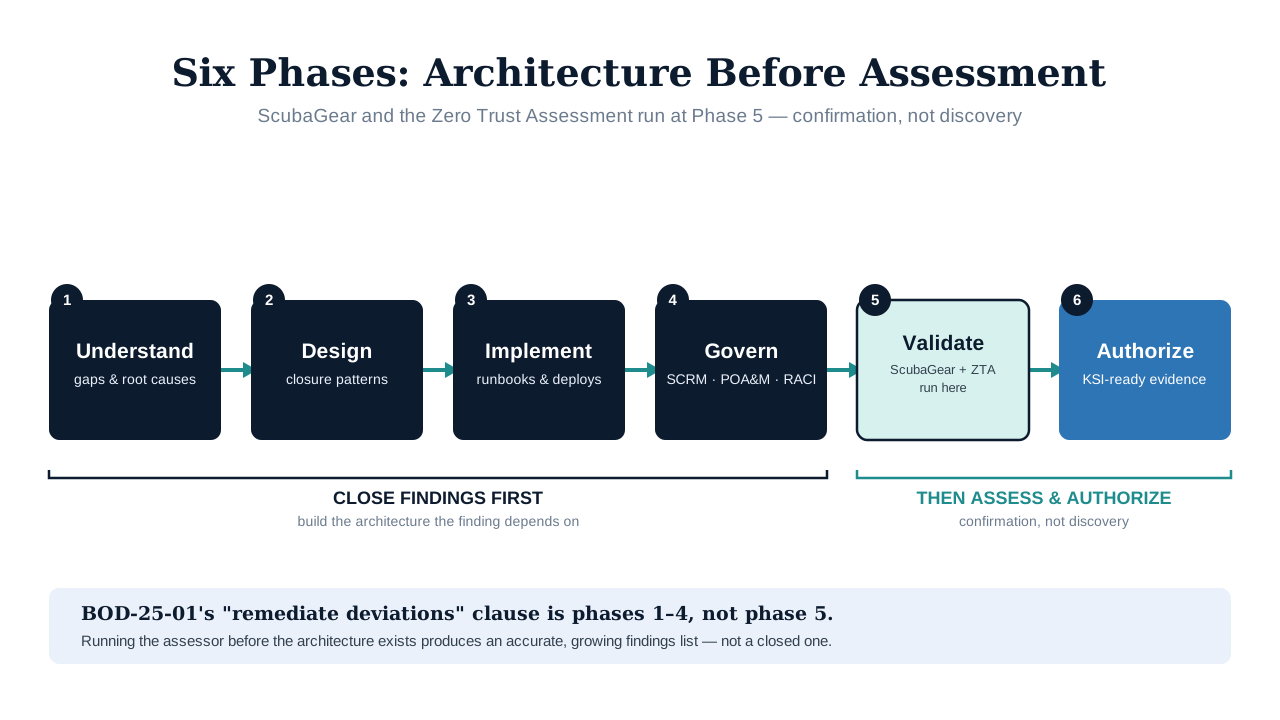
the compliance series’s modernization sequence — Understand, Design, Implement, Govern, Validate, Authorize — deliberately places assessment tools at step five, not step one:
| Phase | What happens | Where assessment tools fit |
|---|---|---|
| 1 — Understand | Identify gaps and root causes against the target control set (including the SCuBA SCBs and Zero Trust pillars) | Not yet run — running an assessor here just produces an unowned findings list |
| 2 — Design | Select the architectural pattern that closes each gap with continuous evidence (DDI/PKI grid, NAC, Entra CBA, Conditional Access design) | Not yet run |
| 3 — Implement | Execute the runbooks, deploy the infrastructure, configure the integrations | Not yet run |
| 4 — Govern | Establish SCRM, POA&M, ISPP, and RACI structures to own what gets built | Not yet run |
| 5 — Validate | Confirm the built architecture produces the compliance state it was designed to produce | ScubaGear and the Zero Trust Assessment run here — as confirmation, not discovery |
| 6 — Authorize | Submit KSI-ready, machine-readable evidence to FedRAMP 20x evaluators | Continuous ScubaGear/ZTTT evidence feeds the OSCAL bundle |
An agency that runs ScubaGear before phase 2 is, in the series’ words, “reading a thermometer before the treatment plan exists.” The findings are accurate. There is no framework yet to act on them coherently, so they accumulate as a list of point fixes that never add up to a defensible, integrated posture — and BOD-25-01’s continuous-reporting feed just reports that accumulation to CISA faithfully, on schedule, forever.
5. Closing findings first — what “architecture” concretely means here
For the specific surface BOD-25-01 governs (M365 / Entra), closing findings before assessing means building, in this order, the layers a SCuBA deviation or a ZTTT maturity gap actually depends on:
- Naming and addressing (DDI/PKI). DNSSEC, certificate issuance, and several SCuBA network-adjacent checks are unenforceable without a functioning DDI/IPAM grid and certificate lifecycle underneath them.
- Device and workload identity (NAC, Entra CBA, managed identity). The Conditional Access policy set SCuBA checks for, and the identity-pillar maturity ZTTT scores, both assume devices and workloads carry verifiable identity — which requires 802.1X/NAC on the network side and certificate-based auth or Arc managed identity on the workload side.
- Legacy-authentication elimination. A phased NTLM/legacy-auth elimination sequence, not a single Conditional Access toggle, is what actually closes the SCuBA and ZTTT findings that reference legacy protocols — flipping the toggle without the elimination plan just breaks access for whatever still depends on the legacy path.
- Governance of exceptions. Not every deviation is closable immediately. BOD-25-01 remediation does not mean zero deviations at all times; it means every open deviation is either being actively remediated or is a documented, dated, owned risk-acceptance — never a silent gap.
Only once these layers exist does “remediate deviations” become a bounded, completable task instead of an open-ended chase.
6. Then assess — continuously, because the directive requires it
BOD-25-01’s continuous-reporting obligation is not satisfied by re-running ScubaGear manually before an audit. It requires exactly what a point-in-time scan cannot provide on its own: a durable run-to-run record, aging of open deviations against a remediation SLA, and a clean signal for “this deviation is newly introduced” versus “this deviation is a known, governed exception.” FMP’s toolkit builds that layer directly on top of the assessors’ output, without reimplementing either assessor:
- ScubaDrift layers drift, exception-lifecycle, and continuous-monitoring gating on top of ScubaGear’s pass/fail policy verdicts.
- ZTTTdrift does the same for Zero Trust maturity-stage assessments (Microsoft ZTTT / CISA ZTMM-style self-assessments): it splits every below-target finding into actionable new drift, lapsed acceptance, or governed exception, flags retirable acceptances, computes run-to-run drift, and gates a continuous-monitoring pipeline — exiting non-zero only when something is genuinely unowned. Both tools are explicit about what they are not: neither is an assessor, a maturity model, or a remediator. They stand on the assessment tool’s output; they do not replace it or guess at its export format.
This is the mechanism that turns BOD-25-01’s “remediate deviations” and “continuous reporting” clauses from a narrative claim into something a 3PAO or CISA can independently verify: a deterministic, re-runnable disposition of every open finding, dated, owned, and aging against an SLA. Vol VII Book 02 of the the compliance series series documents the operating model that turns SCuBA baseline drift specifically into typed remediation tasks with closure evidence — the same pattern this whitepaper argues for at the directive level.
7. Honest limits
- This is not a substitute for the directive’s own deadlines. BOD-25-01’s tenant-inventory and tool-deployment deadlines already passed (Feb 21 and Apr 25, 2025, respectively). Nothing here changes those; the sequencing argument applies to how an agency spends its ongoing remediation effort, not to whether it deploys ScubaGear in the first place.
- Some deviations genuinely are one-line fixes. Not every SCuBA or ZTTT finding requires the architecture described in §5. The point is not “never fix anything until the architecture is done” — it is “don’t mistake the scan for the fix,” and to route findings to the right response (immediate config change vs. architectural work vs. governed exception) rather than treating all deviations as equally actionable.
- ZTTT is not itself a BOD-25-01 requirement. The directive names SCuBA and ScubaGear specifically; ZTTT is a Microsoft-authored maturity assessment many agencies run for broader Zero Trust posture. Conflating the two — or assuming ZTTT coverage substitutes for SCuBA’s federal baseline, or vice versa — reintroduces the gap the ZTA/SCuBA relationship whitepaper exists to close.
- Coverage arithmetic (10 of 29) is the the compliance series series’ internal KSI decomposition, not a FedRAMP-published figure. It is a useful proxy for “how much of the target control set reduces to configuration state a conformance tool can see,” not a claim about any specific agency’s control catalogue, which will vary.
8. Conclusion
BOD-25-01 asks agencies to do two structurally different things: run an assessor, and remediate what it finds. ScubaGear and Microsoft’s Zero Trust Assessment do the first job well — they are accurate, read-only, and increasingly continuous. Neither does, or is designed to do, the second. Confusing “the scan is running” with “the finding is closed” produces a compliant-looking reporting feed sitting on top of an unclosed, growing remediation backlog — technically satisfying rows one through four of the directive while quietly failing row five.
The order that actually satisfies BOD-25-01 — architecture, then assessment, then continuous re-assessment — is the same order the compliance series’s six-phase modernization sequence has argued for since Book 00: build the thing that closes the gap, then measure that it’s closed, then keep measuring. Run in that order, ScubaGear and ZTTT stop being a list of open findings and become what the directive actually intended them to be: continuous, independently verifiable proof that a real architecture is holding.