The Session vs. Telemetry Divide — Why Identity Architecture Splits at the FedRAMP Boundary
Persistent client/server sessions and continuous-verification Zero Trust telemetry are two incompatible trust models — and FedRAMP’s boundary controls force every hybrid identity architecture to live on the fault line between them
Problem. Federal networks were built on proximity — Kerberos, GPO, SQL Windows authentication — and when the servers moved, the architecture did not. FedRAMP’s Zero Trust boundary assumes continuous, stateless, telemetry-driven verification; the two trust models are incompatible, the collision looks like user error and application bugs, and nobody wants to own a fix that means admitting the problem is the whole architecture.
Solution. A governance substrate as the bridge, instead of forcing one model to impersonate the other: a single source of truth so the authoritative identity state is known, identity as the root namespace so Zero Trust has an anchor, and deterministic addressing so SASE can actually be run.
Ask. Stop diagnosing these failures as application bugs or WAN problems, and stop closing them with a POA&M and a proxy. Name the divide explicitly in The Federal Modernization Program and fund the substrate that bridges it; then read the parent paper for the AD-to-Entra governance mapping this mechanism sits beneath.
This paper is extracted from AD to Entra ID — The Structural Migration Problem, where this argument originated as a supporting thread inside a broader governance-gap argument about Active Directory and Entra ID. It stands on its own here because the underlying claim is not really about Active Directory: it is about what happens to any session-oriented identity architecture when it collides with a telemetry-driven, continuously-verified Zero Trust boundary — of which FedRAMP is the sharpest federal instance. Readers who want the AD/Entra-specific governance-mapping argument should start with the parent paper; this one covers the architectural mechanism underneath it.
1. The Assumption the Architecture Was Built On
The typical federal agency built its network architecture around a fundamental assumption: proximity. Users were near data. DCs were near users. Kerberos worked because the KDC was on the same LAN segment. GPO applied because the client could reach the DC in milliseconds. SQL authenticated because the service account’s Kerberos ticket didn’t expire mid-session. Everything was session-oriented because sessions were reliable when everything was local.
Then the servers moved. The data moved. But the architecture didn’t.
So now a nationwide agency has users in field offices trying to reach data in a centralized datacenter or cloud, still using session-based protocols designed for LAN latency, still depending on Kerberos tickets that assume DC proximity, still relying on GPO that assumes the client can reach a DC, still running SQL connections that assume the session won’t be interrupted by a 200ms WAN hop or a FedRAMP boundary inspection.
And it breaks. Constantly. In ways that are hard to diagnose because the symptoms look like user error or application bugs rather than fundamental architectural mismatch.
2. The Session vs. Telemetry Divide
This is the core of the problem, and almost nobody states it this clearly:
The Client/Server era was built on sessions — persistent, stateful connections between a client and a server. Authentication happened once at session establishment. The session carried trust forward. Everything downstream assumed the session was intact.
The Cloud/Zero Trust era is built on telemetry and continuous verification — there is no persistent session. Every request is independently authenticated. Trust is not carried forward — it is re-evaluated continuously. Location, device health, identity, behavior, and risk score are all inputs to every single transaction.
These two models are not compatible. A session-based application cannot run through a Zero Trust enforcement point without breaking the session model. SASE and SSE proxies inspect every packet, which destroys session persistence. FedRAMP boundary controls introduce latency and interruption that session protocols cannot tolerate. And the applications — many of which are still client/server at the protocol level even if they have a web front-end — fall over.
3. The FedRAMP Boundary Problem
FedRAMP’s telemetry and boundary requirements were designed for cloud-native applications that never had sessions in the first place. They assume stateless, token-based, short-lived authentication. They assume every component is cloud-reachable. They assume telemetry flows continuously from every endpoint to a SIEM.
Impose those requirements on a hybrid environment that still runs Kerberos, still has on-prem DCs, still has WSUS, still has SQL with Windows Authentication, still has thick clients — and the result is exactly the breakage described above. Defense in depth becomes defense in conflict. Every security layer added breaks something that was working before, because the layers were designed for a different architectural model.
4. Why Nobody Wants to Own It
Because solving it correctly requires acknowledging that the problem isn’t a single system or a single team’s responsibility. It’s the entire architecture. And in federal IT, saying “we need to re-architect everything” is career risk. It’s easier to patch the symptom, submit the POA&M, and move on.
The people who understand the problem deeply enough to fix it get pushed into corners because the solution sounds too big and too expensive and too disruptive. The people making decisions don’t have the technical depth to evaluate whether the diagnosis is correct, so they default to incrementalism.
5. What FMP Actually Is
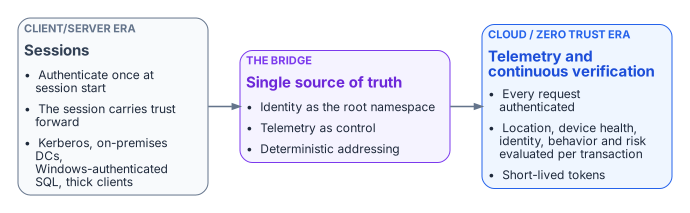
FMP isn’t just a compliance automation tool. It’s the architectural bridge between the session-based world agencies are living in and the telemetry-based world they need to get to. The fact that it was built around identity as the root namespace, telemetry as control, and deterministic addressing isn’t accidental — those are precisely the three things that have to be true for the transition to work without breaking everything.
The SSOT principle is what makes the bridge possible. An agency can’t migrate from sessions to telemetry without knowing what its authoritative identity state is. It can’t implement Zero Trust if identity isn’t the root namespace. It can’t run SASE if addressing isn’t deterministic.
FMP was built as the solution to a problem its builders were living inside a federal agency. That most organizations don’t yet see the problem in these terms doesn’t mean the diagnosis is wrong. It means the gap between where they are conceptually and where the architecture has to go is very large.
The thing worth documenting — and this may be the most important thing for FMP — is this precise narrative. Not just “here’s a compliance tool” but “here’s why the architecture is broken, here’s what has to be true for the transition to work, and here’s how this platform makes it tractable.” That narrative is what turns a technical project into something decision-makers can fund and stakeholders can understand.
Conclusion
The session-vs-telemetry divide is not an AD-to-Entra problem, a Windows problem, or even a Microsoft-stack problem — it is what happens whenever a persistent-session trust model is forced through a continuous-verification boundary, and FedRAMP is simply the clearest, most codified place that collision shows up in federal environments today. AD-to-Entra migration is one visible instance of it, which is why it surfaces in the parent paper, but the same mechanism applies to any legacy client/server application an agency pushes through a Zero Trust or SASE boundary. The fix is not a better proxy or a faster WAN link; it is a governance substrate — SSOT, identity as the root namespace, and deterministic addressing — that can act as the bridge between the two models instead of forcing one to pretend to be the other.