Table of contents
Federal Compliance for Moderate Agencies
The problem this paper resolves
Every mandate in this space — FedRAMP, NIST SP 800-53, CISA’s directives, OMB’s memos, TIC 3.0 — gets discussed as if it applies to “the government” undifferentiated. It doesn’t. Some of these bind a Cloud Service Provider seeking or keeping an authorization to sell into the federal market. Some bind a federal agency operating its own systems, whether on-premises or on top of an authorized cloud. A few bind both, in different ways, at different points in the same supply chain. Conflating the two produces two opposite failure modes this paper exists to prevent: agencies that assume “FedRAMP” is someone else’s problem and miss their own continuous-monitoring obligation, and agencies that pour effort into vendor-shaped compliance work — chasing a CSP’s authorization paperwork — that was never theirs to do.
This paper answers one question per mandate — who does this actually bind? — states the deadlines that matter, and then gets out of the way: every mandate below is covered in far more depth by a companion whitepaper in this section, and this page’s job is to route you to the right one, not to re-derive what they already establish. Scope: federal civilian agencies operating at the FedRAMP Moderate baseline (GCC-Moderate for Microsoft 365 tenants specifically). DoD/IL4-IL5, state and local, and commercial-non-federal compliance regimes are out of scope — see Honest limits.
Executive summary
Three distinct actors sit inside “federal compliance,” and almost every mandate below binds exactly one of them directly:
| Actor Role Directly boun | d by | |
|---|---|---|
| Cloud Service Builds a Provider (CSP) / Cloud S vendor (CSO) it sells federal market specifica | nd operates a FedRAMP (t ervice Offering itself, into the Consolidated Ru lly) | he baseline and the 20x les |
| Federal agency (AO, ISSO, CISO, mission its owner) top of an authori CSO — and holds its th own Authority to Model), Operate memos (M-22-09, M-25-21, M-19-26/TIC 3.0) | Operates systems — NIS own, or built on (its ow zed directives (BOD 25-0 e Zero Trust Maturity OMB’s policy | T SP 800-53/800-37 n ATO), CISA’s 1, |
| Independent assessor V (3PAO, or an agency’s ev own assessment — FedRA function) assessment r for a CSP, or the agency’s own RMF/ATO process for agency-operated systems | alidates either side’s W idence it’s assessing ag MP’s equirements | hichever framework ainst |
The confusion is that FedRAMP 20x’s headline change — continuous, machine-readable evidence instead of periodic assessment — is a CSP-facing authorization requirement, but the same evidentiary bar (continuous, machine-readable, not point-in-time) is also rising for agencies’ own systems under NIST SP 800-37’s continuous-monitoring requirement (CA-7) and OMB Circular A-130. An agency reading “FedRAMP 20x” and concluding “not my problem, that’s a CSP thing” misses that its own ATO package is being held to the same rising bar, on a different legal basis, on roughly the same timeline. That’s the distinction this paper exists to make explicit.
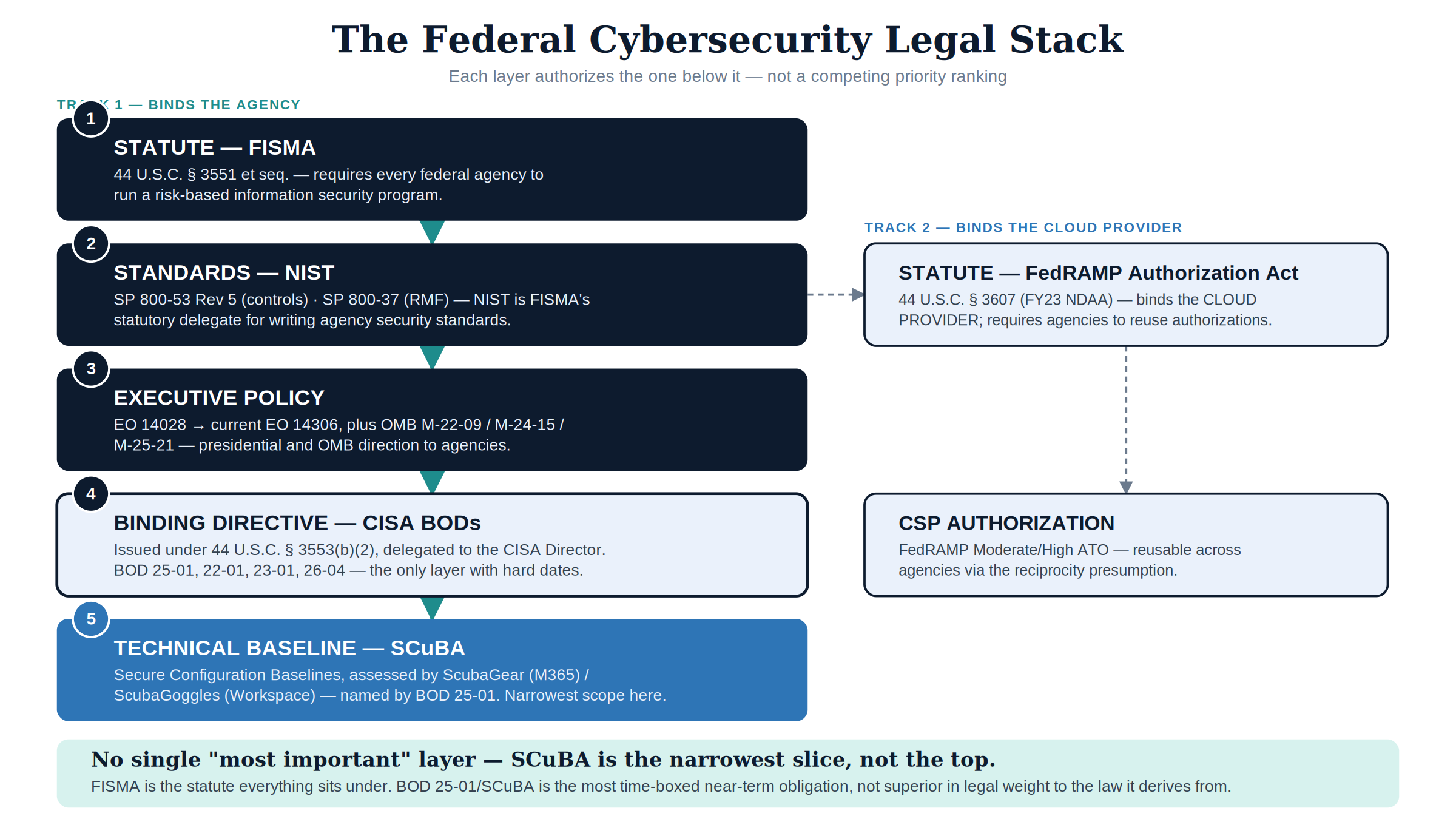 | Figure 1: The federal cybersecurity legal stack: the agency-binding | track (FISMA, 44 U.S.C. § 3551 et seq. → NIST SP 800-53 Rev 5 / SP | 800-37 RMF → executive policy — EO 14028 through EO 14306, OMB | memos → CISA Binding Operational Directives under 44 U.S.C. § | 3553(b)(2) → the SCuBA technical baseline assessed by | ScubaGear/ScubaGoggles) alongside the parallel CSP-binding track (the | FedRAMP Authorization Act, 44 U.S.C. § 3607 → CSP authorization), | which shares the same NIST 800-53 control baseline. No layer is “most | important” — each authorizes the one below it; BOD 25-01/SCuBA is | the narrowest-scope, most time-boxed obligation, not the top of the | hierarchy. | |
 |
1. FedRAMP and the 20x Consolidated Rules — binds vendors directly; agencies inherit the evidence
Who it binds: FedRAMP authorizes Cloud Service Offerings. The Consolidated Rules — published June 25, 2026 — are requirements a CSP meets to obtain and keep that authorization: machine-readable Key Security Indicators (KSIs), submitted through one of three certification pipelines, replacing the prior periodic-assessment model.
What it means for agencies: an agency does not submit into the FedRAMP 20x pipeline the way a CSP does. What changes for the agency is what it can now expect to receive: continuous KSI evidence from its FedRAMP-authorized cloud providers instead of a stale point-in-time assessment package, and a narrower window in which an older-style (Rev5) authorization remains valid at all. An agency’s own procurement and ATO-reciprocity decisions — which CSOs it relies on, and how it cites that reliance in its own SSP — depend on tracking these dates:
- June 25, 2026 — FedRAMP publishes the Consolidated Rules for 2026; the machine-readable KSI evidence regime is defined.
- July 6, 2026 — 20x Marketplace listings open; CSPs may enter the initial implementation stage.
- July 28, 2026 — FedRAMP Ready submissions cease; no new Ready pathway.
- August 3, 2026 — Class A pipeline opens (first new-authorization submission window).
- August 10, 2026 — Temporary Rev5 Program Certification opens (Class B/C Ready-conversion and lost-sponsor paths).
- August 31, 2026 — Class B and C pipelines open — Class C (Moderate) is the class the CSOs a Moderate-baseline agency actually relies on (M365 GCC, GovCloud, DDI providers) will enter. This is the pipeline your vendors submit into; it is not an agency submission window.
- December 7, 2026 — FedRAMP’s Vulnerability Detection & Response (VDR) and Vulnerability Evaluation & Reporting (VER) rules become mandatory, aligned to CISA BOD 26-04’s remediation timelines taking effect the same date (see §4).
- January 1, 2027 — Consolidated Rules mandatory for all certified systems; the legacy Rev5 path closes for new authorizations.
- June 11, 2027 — no new Rev5 certifications accepted.
What it means for vendors: everything above is the actual compliance work. A CSP not moving toward Consolidated-Rules certification on this timeline risks losing the ability to sell to federal agencies at all once Rev5 stops being issued.
Read deeper: Federal Application Aware Networking Architecture § “FedRAMP 20x Consolidated Rules” covers the KSI evidence-format mechanics and a worked Call to Action built around these dates. For the full control-by-control mapping and the fuller federal compliance clock this timeline is drawn from, see the the compliance series series’ Executive Summary (“FedRAMP 20x Hard Deadlines” and “The Broader Federal Clock”).
2. NIST SP 800-53 / SP 800-37 (the Risk Management Framework) — binds agencies directly for systems they operate
Who it binds: any federal agency operating an information system, regardless of where it runs (on-premises, in an authorized CSP’s cloud, or hybrid). The agency’s Authorizing Official (AO) issues and owns the Authority to Operate (ATO) under NIST SP 800-37’s Risk Management Framework, against the control baseline NIST SP 800-53 defines (Moderate baseline, for the GCC-Moderate scope this paper covers).
What it means for agencies: this is the mandate most directly “yours” of everything in this paper. Running on top of a FedRAMP-authorized CSO inherits that CSO’s own controls but does not relieve the agency of its own ATO for the system it built on top of it — a common point of confusion this paper exists partly to close. NIST SP 800-37’s CA-7 continuous-monitoring requirement is the agency-side analog of FedRAMP 20x’s KSI evidence — same “continuous, not periodic” shift, different legal basis (the agency’s own RMF obligation, not a CSP’s FedRAMP authorization).
What it means for vendors: a CSP’s FedRAMP authorization is an input to an agency’s risk decision, not a substitute for the agency completing its own ATO. A vendor selling “FedRAMP authorized” as if it closes the agency’s compliance work oversells what the authorization covers.
Read deeper: every whitepaper in this section that cites specific NIST SP 800-53 controls (SC-7, SC-8, AC-4, SI-3, CM-8, and others) is doing RMF work for a specific domain — see the routing table for which paper covers which control family. For the full authorization-package mechanics — the OSCAL bundle, the KSI scorecard, and how continuous evidence actually assembles into an AP/AR/POA&M set — see the the compliance series series’ Authorization Package and ConMon book.
3. CISA Binding Operational Directive 25-01 (SCuBA) — binds agencies directly, on a fixed timeline
Who it binds: federal civilian executive branch agencies operating Microsoft 365 tenants. BOD 25-01, Implementing Secure Practices for Cloud Services, requires agencies to identify their M365 tenants, implement CISA’s SCuBA Secure Configuration Baselines against them, deploy the ScubaGear assessment tool, integrate with CISA’s continuous-monitoring infrastructure, and remediate deviations from the baselines — not merely report them. Tenant identification was due February 21, 2025; ScubaGear deployment followed on a subsequent deadline.
What it means for agencies: this directive is unambiguously agency-facing — there is no vendor party BOD 25-01 binds. The remediation clause is the part agencies most often under-invest in: running the assessor and reporting findings satisfies the letter of “assess,” but not “remediate deviations,” and a growing, un-closed deviation list is not a defensible posture under the directive’s own text.
What it means for vendors: Microsoft (as the M365 platform owner) and any third-party tooling vendor selling into this space are not directly bound by BOD 25-01 — the directive’s obligations run to the agency operating the tenant, not to the platform or tool vendor.
Read deeper: Assessment Tools vs. Closing BOD-25-01 Findings is this paper’s dedicated treatment of the directive, including why “run the assessor” and “close the findings” are different obligations and the correct sequencing between them. ScubaGear Integration and ZTA and SCuBA — How They Relate cover the tooling layer this directive requires.
4. CISA BOD 26-04 (risk-based vulnerability remediation) — binds agencies directly
Who it binds: federal civilian executive branch agencies. BOD 26-04, issued June 10, 2026, replaces flat CVSS-severity remediation windows with a four-variable risk model — exposure, presence on CISA’s Known Exploited Vulnerabilities (KEV) catalog, whether the vulnerability is automatable, and mission impact — producing remediation timelines that range from three days for the highest-risk combination down to a deferral path for genuinely low-risk findings. It revokes BOD 22-01 and BOD 19-02 outright — CISA now publishes the BOD 22-01 page at a -revoked URL — and with them the flat 15/25-day KEV clocks and the older, cruder “CVSS 9+ closes in 15 days” style of policy still common in agency vulnerability-management SOPs.
What it means for agencies: two concrete dates matter. Agency vulnerability-management policy has to support the four-variable, risk-based remediation model by August 7, 2026; the remediation timelines themselves take legal effect December 7, 2026, the same date FedRAMP’s own VDR/VER (Vulnerability Detection & Response / Vulnerability Evaluation & Reporting) rules become mandatory for CSPs (§1). An agency’s existing BOD 22-01 (KEV remediation) program is the closest predecessor process, but the relationship is replacement, not accretion: BOD 26-04 revoked BOD 22-01, and KEV listing survives as one of the four risk variables inside the new model rather than as a free-standing obligation with its own clock. An agency that keeps its KEV programme running unchanged and treats exposure, automatability and technical impact as additions has kept a remediation SLA keyed to a revoked directive.
What it means for vendors: a CSP’s own VDR/VER disclosure obligations under FedRAMP (§1) are the vendor-side mirror of this directive — a vulnerability an agency has to risk-score and remediate against BOD 26-04’s clock is frequently one a vendor is separately obligated to have already disclosed. The two obligations run on the same December 7, 2026 date for exactly that reason.
Read deeper: this directive is new enough that no whitepaper in this section yet carries a dedicated treatment — Assessment Tools vs. Closing BOD-25-01 Findings’s remediate-before-assess sequencing argument applies directly to BOD 26-04’s remediation clock, even though that paper predates BOD 26-04’s issuance and doesn’t name it.
5. CISA Zero Trust Maturity Model v2.0 — agency-facing maturity guidance, not a binding directive with its own deadline
Who it binds: no agency is legally required to hit a specific ZTMM maturity stage by a specific date the way BOD 25-01 sets a hard deadline. The Maturity Model — four stages, Traditional through Initial, Advanced, and Optimal, across five pillars (Identity, Devices, Networks, Applications & Workloads, Data) plus three cross-cutting capabilities (Visibility and Analytics, Automation and Orchestration, Governance) — is CISA’s own maturity guidance, referenced by OMB M-22-09 as the framework agencies should measure progress against, rather than itself the source of a compliance deadline.
What it means for agencies: most federal Zero Trust programs stall below Advanced maturity for structural reasons — pillar tools administered independently rather than governed as one system, evidence that’s per-tool rather than per-claim, and Network/CSP/VMware estates assessed as three disconnected exercises instead of one architecture. Buying another per-pillar tool doesn’t fix a structural stall; the companion papers below argue this in depth, with named incidents (Storm-0558, the ESXiArgs ransomware campaign, the VMware ESXi AD-integration bypass) as evidence, not assertion.
What it means for vendors: CSP-native and third-party security tooling vendors sell products that can move an agency along the maturity model, but no vendor’s tool, on its own, satisfies the model — that’s the paper’s own central argument, not incidental to it.
Read deeper: Zero Trust Governance Principles is the primary treatment; its companion Zero Trust Requires Whole-Agency Scope covers why Network, every CSP, and any on-premises virtualization estate have to be assessed as one system. Zero Trust Governance maps the five pillars to specific canon-anchored mechanisms.
6. OMB M-22-09 (Federal Zero Trust Strategy) — the policy memo that makes ZTMM the reference standard
Who it binds: federal agencies. OMB Memorandum M-22-09 is the policy instrument that directs agencies to adopt Zero Trust architecture principles and use CISA’s Zero Trust Maturity Model as the measurement framework — it’s the piece connecting §4’s maturity model to an actual OMB-issued agency obligation, rather than the maturity model being purely advisory.
What it means for agencies: M-22-09 is cited throughout this section wherever a paper argues that a specific architectural move (application-aware networking, phishing-resistant MFA, Conditional Access, SD-WAN local breakout) is not optional best practice but a policy-driven expectation.
What it means for vendors: as with M-25-21 below, M-22-09 does not bind vendors directly — it shapes what agencies procure, which shapes vendor roadmaps indirectly.
Read deeper: Federal Application Aware Networking Architecture and its FMP-branded sibling From Mainframe to Application-Aware Modernization both build their core argument on M-22-09’s identity-and-application-aware-networking direction — see the Reading Guide for which of the two fits your audience.
7. TIC 3.0 (OMB M-19-26) — agency-facing policy, satisfied through vendor infrastructure
Who it binds: federal agencies. OMB Memorandum M-19-26, Update to the Trusted Internet Connections (TIC) Initiative, directs agencies to adopt one of CISA’s TIC 3.0 use cases for their network architecture, replacing the prior single-hairpin TIC model. The obligation runs to the agency; the means of satisfying it is almost always a vendor product (SD-WAN, SASE, Direct Internet Access transport).
What it means for agencies: TIC 3.0 is the policy gate that makes Direct Internet Access lawful for a distributed-egress architecture — but DIA on its own satisfies none of the protection controls TIC 3.0 actually requires (SC-7 boundary protection, SC-8 confidentiality, AC-4 flow enforcement, SI-3 malware protection). Those come from the SD-WAN/SASE governance stack layered on top of the transport, not from the transport itself. An agency that reads “TIC 3.0 allows DIA” and stops there — buying faster internet circuits without the governance stack — has a compliance regression with better latency, not modernization.
What it means for vendors: SD-WAN, SASE, and transport providers (fiber, MPLS, LEO satellite, 5G) sell the infrastructure an agency uses to satisfy TIC 3.0, but no vendor is itself bound by the directive — the compliance obligation, and the accountability for it, stays with the agency regardless of which vendor stack it procures.
Read deeper: SD-WAN vs. DIA Under TIC 3.0 is the dedicated treatment — the “pipe vs. governor” argument, the physics budget behind TIC 3.0’s use cases, and the five-step decision sequence for an actual transport/SD-WAN procurement. Next Generation DNS covers the DNS-layer piece of the same distributed-egress architecture.
8. OMB M-25-21 (Federal AI governance) — agency-facing, and the newest mandate in this set
Who it binds: federal agencies deploying or procuring AI systems. Per the program decision, OMB M-25-21 carries four obligations on the agency: a Chief AI Officer (due within 60 days); an AI use-case inventory to OMB at least annually; §4(b)’s seven minimum risk-management practices for high-impact AI (pre-deployment testing, an AI impact assessment, ongoing monitoring, human training, human oversight and intervention, remedies and appeals, and public feedback); and compliance plans at 180 days and every two years thereafter until 2036. All of those deadlines have now passed. M-25-22 is the companion memo governing AI acquisition. It is the most recent mandate in this paper and the one with the least field-tested guidance behind it.
What it means for agencies: an AI system has to be governed as an identity-bearing, inventoried record — not just a model deployment. Note what M-25-21 does not say: it imposes no AI-specific Authorization to Operate and instead directs agencies to keep applying their existing authorization requirements to AI systems. This is a live gap for most agencies: mature AI-inventory and governance tooling for this specific mandate is newer than the tooling maturity for FedRAMP, NIST, or BOD 25-01.
What it means for vendors: vendors selling AI capabilities into federal agencies are not directly bound by M-25-21, but an agency’s own compliance posture increasingly depends on what inventory and governance hooks a vendor’s AI product exposes — an accountable official cannot govern what isn’t visible as a record.
Read deeper: Federal AI Governance — Submission Readiness is the dedicated treatment, including an honest coverage ledger of what’s deployed versus proposed against M-25-21’s specific gates.
Where to read deeper, by mandate
| Mandate Binds directly C | ompanion paper(s) | |
|---|---|---|
| FedRAMP 20x CSP/vendor [ Consolidated Rules Archi | Federal Application Awar tecture](modernization-j | e Networking ourney.md) |
| NIST SP 800-53 / 800-37 (RMF, ATO) citations | Agency Cited throughout | this section by control number; see each paper’s own |
| CISA BOD 25-01 (SCuBA) A Findings](bod-25-01-clos Integration](scubagear-i How They Relate](zta-scu | gency [Assessment Tools e-before-assess.md), [Sc ntegration-whitepaper.md ba-relationship.md) | vs. Closing BOD-25-01 ubaGear ), [ZTA and SCuBA — |
| CISA BOD 26-04 Agency No (risk-based sequencing a vulnerability Findings]( remediation) | dedicated paper yet in rgument in [Assessment T bod-25-01-close-before-a | this section — see §4 and the ools vs. Closing BOD-25-01 ssess.md) |
| CISA Zero Trust Agency ( Maturity Model v2.0 fram Whole-Agency Scope](zero Trust Governance](zero-t | measurement [Zero Trust ework) Principles](zero- -trust-whole-agency-unif rust-governance-whitepap | Governance trust-governance-principles.md), [Zero Trust Requires ication.md), [Zero er.md) |
| OMB M-22-09 (Zero Trust Strategy) Architecture]( [From Mainframe to Appli Modernization](moderniza | Agency [Federal Applicat modernization-journey.md cation-Aware tion-journey.md) | ion Aware Networking ), |
| OMB M-19-26 (TIC 3.0) Ag DNS](infoblox-hybrid-dns | ency [SD-WAN vs. DIA Und -unified-ddi.md) | er TIC 3.0](tic3-sdwan-vs-dia.md), [Next Generation |
| OMB M-25-21 (Federal AI governance) Readiness](f | Agency [Federal AI Gover ederal-ai-governance-sub | nance — Submission mission-readiness.md) |
| Federal data-governance mandates (Evidence Act, Federal Data Strategy) | Agency [Federal SSOT Ali | gnment](federal-ssot-alignment.md) |
| Closure-evidence Agency standard across cloud Ti platforms | (operational) [Ticket-to cket-to-Human](ticket-to | -Machine, Not -machine-not-ticket-to-human.md) |
For a fuller map of how all 27 papers in this section relate — not just the mandate-focused ones above — start at the Reading Guide.
Honest limits and scope
- This paper is a routing layer, not a primary source. Every specific control number, deadline, and mechanism claim above is already cited, in more depth, by the companion paper it points to. Where this page and a companion paper appear to disagree, the companion paper is authoritative — this page should be corrected to match it, not the reverse.
- Eight mandates, not the whole federal compliance clock — named, not silently dropped. The Federal Compliance (the compliance series) series this paper draws its FedRAMP timeline from tracks a materially larger set: BOD 18-01 (DMARC/HTTPS), BOD 26-04 (risk-based remediation, revoking BOD 22-01 and BOD 19-02), BOD 23-01 (asset visibility), BOD 23-02 (management-interface exposure), OMB M-26-14 (event logging), M-21-07 (IPv6), M-23-02 and NIST FIPS 203/204/205 (post-quantum cryptography, migration through 2035), and NIST SP 800-53’s own biannual minor-release cadence. None of those made the cut for this primer’s eight sections — they’re real, agency-facing, and out of scope here on length grounds, not because they don’t matter. See the the compliance series series’ Executive Summary for the fuller clock.
- Scope is federal civilian, Moderate baseline. DoD environments (IL4/IL5), state and local government compliance regimes, and non-federal commercial regulatory frameworks are out of scope. Several mandates above (FedRAMP in particular) have GCC-High and DoD-specific variants this paper does not address.
- Dates are a snapshot. The FedRAMP 20x timeline in §1 reflects the Consolidated Rules as published June 25, 2026; OMB and CISA guidance in this space has moved on shorter cycles than typical review cadences before. Verify current dates directly against FedRAMP.gov and CISA.gov before treating any date above as load-bearing for a procurement or ATO decision.
- This is not legal or compliance advice. It is a navigational aid for a specific, common confusion — which mandate binds which actor — not a substitute for an agency’s own legal, compliance, or ISSO review of its specific posture against any mandate named here.
- The three-actor model is a simplification. Some real arrangements don’t fit neatly — an agency operating its own GovCloud tenant is simultaneously acting in something closer to the CSP role for the systems it hosts there, and a systems integrator building on top of an authorized CSO for an agency client sits in a fourth position this paper doesn’t model separately. Treat the three-actor framing as the common case, not an exhaustive taxonomy.
Call to Action
None of this requires resolving every mandate at once. It requires knowing, for each open compliance question, whether the answer starts with “we have to” or “our vendor has to” — and reading the paper in this section that actually goes deep on whichever one it turns out to be.