Federal AI Governance — Submission Readiness Brief
M-25-21 §4(b) coverage, deployed-vs-proposed honesty ledger, and the moves that raise win probability
Problem. Every M-25-21 deadline has passed — the seven §4(b) practices, the annual use-case inventory, the compliance plans, the Chief AI Officer — and an earlier revision of this brief built FMP’s differentiator on an AI-specific ATO the memo never created. Today’s demonstrable surface is Microsoft/Entra plus read-only assessment plus drift, and FMP carries no platform-level FedRAMP authorization of its own.
Solution. Reframe M-25-21 obligations as IAM obligations, with agentic AI governed as an L4 actuator; lead with what is deployed (provenance-anchored, schema-enforced, drift-detected canon behind blocking CI gates) and label everything else proposed, reserved, or pre-activation in a coverage ledger the evaluator can check.
Ask. The three moves in this brief, none of which needs new doctrine: demo the deployed core and stage the rest honestly; state the ATO-inheritance posture up front (FMP runs inside the customer’s boundary; SailPoint NERM carries its own FedRAMP Moderate ATO); and activate one non-Microsoft target — Keycloak — end to end before submission.
Purpose
A candid read on how FMP competes if submitted against a federal AI-governance solicitation, grounded in what is actually in the repository today — not the roadmap. It pairs the M-25-21 requirement coverage with an honesty ledger of deployed vs. proposed, names the gaps a federal evaluator will find, and lists the three moves that most raise win probability.
What M-25-21 actually requires
Per the program decision and Book 21 Chapter 2:
- Seven minimum risk-management practices for high-impact AI, set by §4(b): pre-deployment testing; an AI impact assessment; ongoing monitoring; human training; human oversight and intervention; remedies and appeals; and public feedback. Independent review is a component inside the impact assessment, not an eighth practice. These were due 3 April 2026.
- An AI use-case inventory to OMB, at least annually — the machine-readable artifact this paper’s mechanism reads.
- Compliance plans at 180 days and every two years thereafter, until 2036 — a second cadence, distinct from the inventory, and the one most often missed.
- A Chief AI Officer, due within 60 days of the memo. Every M-25-21 deadline has now passed.
What M-25-21 does not impose is an AI-specific Authorization to Operate. It directs agencies to continue applying their existing authorization requirements to AI systems. The inventory’s have_ato field reports that existing posture; it is not a gate the memo created. An earlier revision of this brief read it as one and built the product differentiator on top of it — which is the single most damaging thing a submission can do in front of an evaluator who knows the memo, because it reads as inventing the test you pass.
M-25-21 rescinded M-24-10. M-25-22 governs how an agency acquires AI and is the memo a contracting officer actually works from — directly relevant to a solicitation response. M-26-04 (11 December 2025) adds unbiased-AI principles and self-sunsets on 11 December 2027.
The differentiator, re-based on something true
The wedge survives the correction and gets sharper. Read as IAM obligations, contact_email is an owner anchor and agency_bureau is an organizational node — both still hold. have_ato is not a credential-issuance gate mandated by the memo, but it is an external ATO enumeration source: an inventoried deployed system with have_ato = No is a drift finding against the agency’s own authorization policy, and one with a system_name_ato absent from the known ATO registry is a reciprocity-lookup candidate (the program decision). That claim is defensible because it describes what FMP does, not what the memo requires.
The stronger claim is one the invented gate was obscuring. The inventory’s six hi_* fields cannot evidence all seven §4(b) practices — human training and public feedback have no inventory field at all. Any vendor whose story is “we read the inventory” is structurally unable to close two of the seven. Naming that gap, and saying which practices need evidence from outside the inventory, is a more credible differentiator than claiming to satisfy a gate that does not exist.
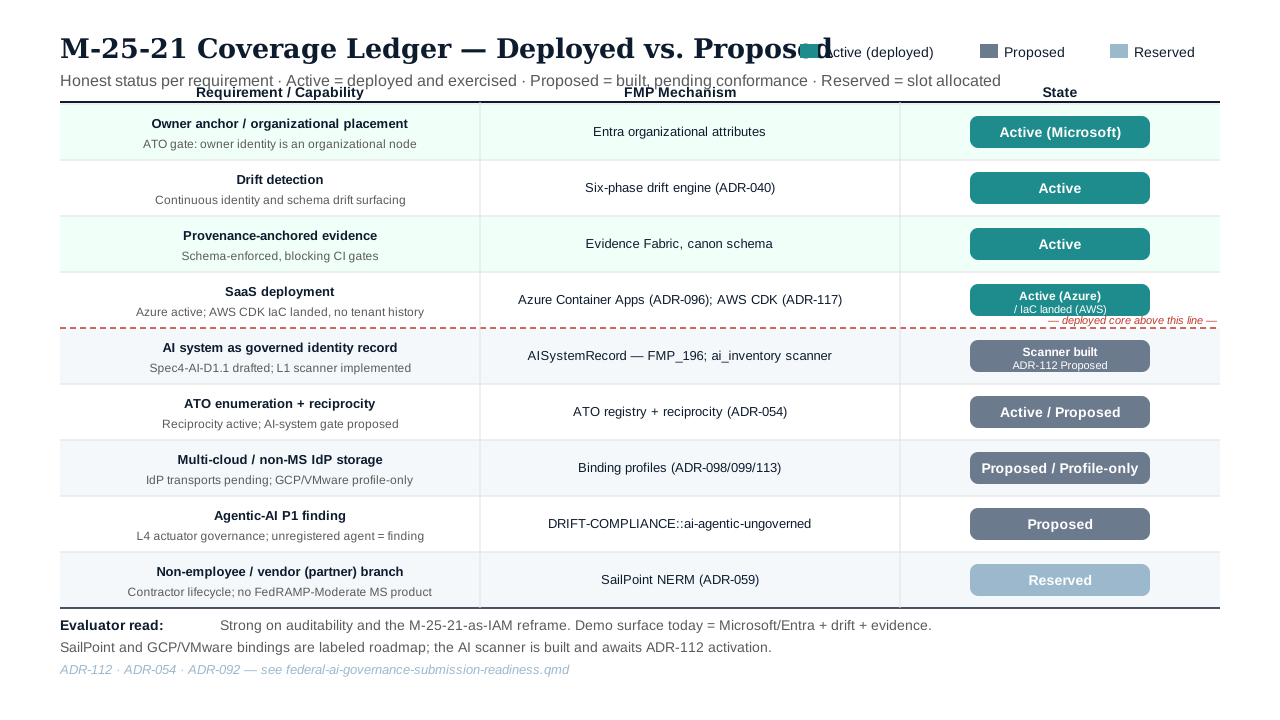
Coverage ledger — deployed vs. proposed
| Requirement / capability | FMP mechanism | State | Caveat |
|---|---|---|---|
| AI system as governed identity record | AISystemRecord (FMP_196) | Spec drafted (Spec4-AI-D1.1); L1 scanner implemented (src/fmp/governance/ai_inventory/); the program decision still Proposed |
Scanner is built but has nothing to gate yet — the program decision activation is the remaining step |
| ATO enumeration + reciprocity reconciliation | ATO registry + reciprocity (the program decision), reading the inventory’s have_ato / system_name_ato |
Active (reciprocity) / Proposed (AI reconciliation) | Reciprocity is live in production; the AI-inventory reconciliation on top of it is not yet wired. This is enumeration against agency authorization policy — M-25-21 mandates no AI-specific ATO gate |
| Agentic-AI P1 finding | DRIFT-COMPLIANCE::ai-agentic-ungoverned |
Proposed | Doctrine only — no detector implementation yet |
| Owner anchor / organizational placement | Entra organizational attributes | Active (Microsoft estate) | Proven inside the Microsoft/Entra estate only |
| Drift detection | Six-phase drift engine (the program decision) | Active | — |
| Non-employee / vendor (partner) branch | SailPoint NERM (the program decision) | Reserved | Pre-activation; no live tenant exercises this branch yet |
| Multi-cloud / non-MS IdP storage | Binding profiles (the program decision/099/113) | Proposed (IdP) / Profile-only (GCP, VMware) | Design-level profiles only; no non-Microsoft IdP has been run end to end |
| Provenance-anchored evidence | Evidence Fabric, schema-enforced canon | Active | — |
| SaaS deployment | Azure Container Apps (the program decision); AWS CDK (the program decision — ECS Fargate + ALB + RDS + S3) | Active (Azure) / IaC landed (AWS) | Azure has operational tenant history; the AWS surface has none yet, and there is no GCP IaC — FMP reaches non-Azure clouds as an API client, not yet as a proven host |
The compliance series holds the same object from the registry side: the agency AI use-case inventory is a designated SSOT object class with a full joiner/mover/leaver lifecycle in the Federal Compliance series’ SSOT Registry (Vol 0 Book 00).
Where we are strong
- The reframe is genuinely novel. “M-25-21 obligations are IAM obligations, and agentic AI is an L4 actuator” is a sharper, more operational story than the inventory dashboards most vendors ship.
- Auditability is real and mechanized. Provenance-anchored, schema-enforced, drift-detected canon with blocking CI gates is exactly what federal evaluators weight — and it is deployed, not aspirational.
- Open and lock-in-resistant. Apache-2.0 substrate, an open-source IdP path (Keycloak + generic LDAP), and a vendor-neutral attribute model blunt the single-vendor-dependency objection.
Where an evaluator will find gaps
- The demo surface today is essentially Microsoft/Entra + read-only assessment + drift. The coverage ledger’s Caveat column marks exactly which rows are proposed, reserved, or pre-activation — that column is the gap map, not a separate list.
- No platform-level FedRAMP authorization of FMP itself. FMP rides inside customer boundaries / GCC-Moderate; SailPoint NERM carries its own ATO on AWS GovCloud as a named carve-out. A solicitation requiring the platform to be FedRAMP-authorized exposes a gap.
- The agentic-AI P1 finding (
DRIFT-COMPLIANCE::ai-agentic-ungoverned, above) is doctrine-only. The Federal AI Identity Governance operational guide is the kit that will operationalize it; it is proposed, not yet deployed.
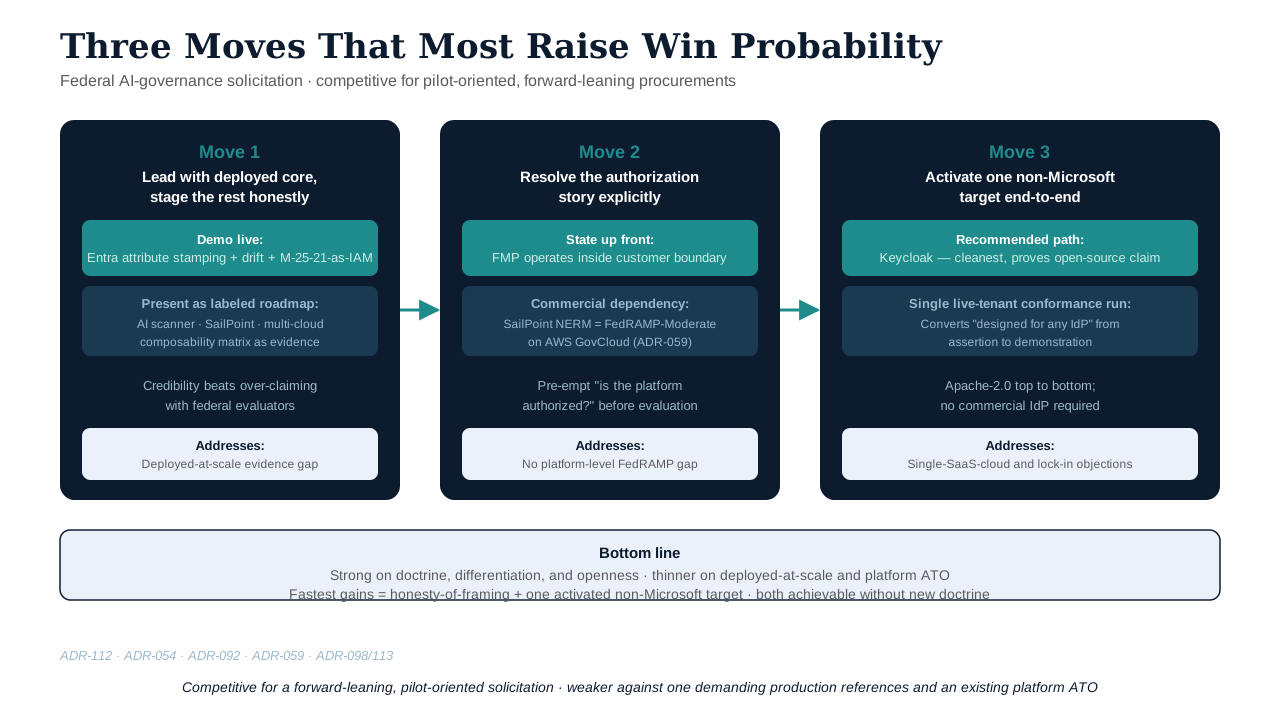
The three moves that most raise win probability
- Lead with the deployed core, stage the rest honestly. Demo Entra attribute stamping + drift + the M-25-21-as-IAM reframe live; present AI scanner / SailPoint / multi-cloud as a labeled roadmap with the composability matrix. Credibility beats over-claiming with federal evaluators.
- Resolve the authorization story explicitly. State the ATO-inheritance posture up front: FMP operates inside the customer’s existing boundary, and the one commercial dependency (SailPoint NERM) is itself FedRAMP-Moderate. Pre-empt the “is the platform authorized” question rather than letting it surface in evaluation.
- Activate one non-Microsoft target end-to-end. A single live-tenant conformance run (Keycloak is the cleanest, and proves the open-source claim) converts “designed for any IdP” from assertion to demonstration.
Bottom line
Strong on doctrine, differentiation, and openness; thinner on deployed-at-scale evidence and platform-level authorization. Competitive for a forward-leaning, pilot-oriented solicitation; weaker against one demanding production references and an existing platform ATO. The fastest gains are honesty-of-framing plus one activated non-Microsoft target — both achievable without new doctrine.
References
- the program decision — Federal AI Use Case Governance
- the program decision — Single-ATO Reciprocity
- the compliance series Vol I Book 03 — Machine and Workload Identity