Chapter 02 — Why HR Is the Source of Authority
Chapter 02 — Why HR Is the Source of Authority
A token proves that an assertion was signed. It can’t prove the assertion describes a real, current employee with a real, current role.
Where identity truth lives today and why it contradicts itself. Why accurate employee data matters more under Zero Trust and SASE than it ever did. Why orphaned accounts are the guaranteed output of that design rather than an operational lapse. The federal policy and guidance that support authoritative sources and governed lineage. Why cleanup, directory mastery, and reviews can’t substitute for one. What HR provides and what identity architecture has to add.
What the claims in a token assert
An access token carries claims: an identifier, group memberships, role assignments. Those claims are projections of upstream facts. This person is employed; this person holds this position; this person reports to this supervisor; this person’s affiliation ended on this date. If the upstream facts are stale, scattered, or unrecorded, the whole cryptographic apparatus notarizes fiction.
The fragmented truth problem
Where identity truth lives today
Ask a federal estate three questions — who works here, what do they do, and who do they report to — and no single system answers. The answers are distributed across:
- Regional Active Directory OU trees, each built when compute was regional, each drifted through decades of reorganizations, ad-hoc container moves, and administrator judgment calls. The OU estate was originally a downstream projection of organizational truth; nobody maintained the projection, and the source it projected was never machine-readable to begin with.
- Per-system account stores. Every application old enough to predate federation keeps its own user table: database logins, mainframe RACF profiles, contact-center agent rosters, badge systems. Each is a private, unsynchronized opinion about who exists.
- Spreadsheets and email. The onboarding tracker, the contractor roster, the separation checklist — operational documents that carry authoritative-grade decisions (who gets an account, when access ends) with none of the properties of an authoritative source: no schema, no lineage, no events, no audit.
- Drawings. The organizational chart itself lives in Visio and briefing slides. It is read by humans, cited in memos, and queryable by absolutely no policy engine anywhere in the enterprise.
Each fragment is locally maintained and globally wrong. The regional OU tree knows an account exists but not whether its owner is still employed. The application user table knows a login works but not what position justified it. The spreadsheet knows a contractor started but is a copy the moment it is saved. Fragmented truth is not partial truth — it is contradiction with no arbiter, because no fragment is designated to win.
The visible symptom: orphaned accounts
The measurable consequence is the orphaned account: an enabled credential whose human justification has ended. Every audit finds them; every remediation sweep removes a batch; every year they return — because sweeps treat the symptom. An orphaned account is not an administrator’s mistake. It is the structurally guaranteed output of an architecture in which the system that knows a person left (HR) and the systems that must act on it (directory, applications, badge, VPN, database) share no event channel. The information exists on day zero; it arrives — by ticket, by email, by quarterly review, or by audit finding — days to months later, or never. No amount of process discipline closes a gap whose cause is the absence of a wire.
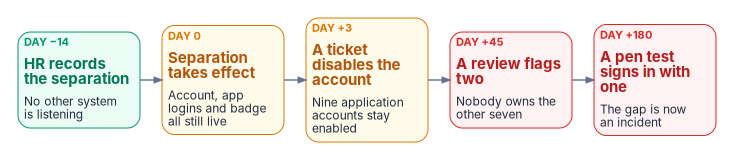
The anatomy is worth one concrete timeline, because it shows where the information is at every point during the gap:
| Day | What the HR System Knows | What the Fragments Know | Exposure |
|---|---|---|---|
| −14 | Separation recorded, effective day 0 | Nothing — no fragment subscribes to HR events | None yet; the fact exists and is actionable |
| 0 | Separation effective | Directory: account enabled. Applications: logins valid. Badge: active | Credentials of a former worker are fully live |
| +3 | Unchanged | Supervisor emails a ticket; the directory account is disabled; nine application accounts are not | Partial: the fragments deprovision independently, in whatever order tickets are worked |
| +45 | Unchanged | A quarterly review flags two of the nine; nobody is sure who owns the rest | The finding is now aging toward an audit |
| +180 | Unchanged | A penetration test authenticates to a case system with an orphaned service-desk account | The gap is now an incident narrative |
Nothing in that timeline is a failure of diligence. It is the wiring diagram working as built: a system that records the truth, five systems that need it, and no channel between them. The same anatomy produces the quieter failures: the transferred employee who keeps the old division’s access for years (the access-accretion problem that NIST SP 800-53 control PS-5, Personnel Transfer, exists to stop1), the contractor converted to staff who now has two identities, the rehired annuitant with three.
Why the agency needs HR-driven ICAM now
For most of the directory era, the network decided access: a user inside the perimeter reached what the perimeter allowed, and a wrong department or a stale manager produced a wrong phone-book entry. Federal direction has moved the decision off the network and onto identity, in three layers:
- Zero Trust is the strategy. OMB M-22-09 sets the federal Zero Trust strategy: centralized identity management for agency staff, phishing-resistant multifactor authentication, and authorization in which “every request for access should be evaluated,” because no network is implicitly trusted.2 NIST SP 800-207 describes the architecture — access granted per session by a policy engine, using dynamic policy that includes the client’s identity and “any associated attributes assigned by the enterprise” to its account3 — and CISA’s Zero Trust Maturity Model makes identity its first pillar, defining an identity as “an attribute or set of attributes that uniquely describes an agency user or entity.”4
- SASE delivers it. In this book’s design, Secure Access Service Edge (SASE) is the delivery model that implements Zero Trust at the network edge: security services, including Zero Trust network access, delivered from a cloud edge close to the user instead of the agency perimeter. TIC 3.0, under OMB M-19-26, is what opens that path for agencies: it ended the requirement that agency traffic flow through a physical TIC access point and replaced it with use cases for cloud, branch office and remote users.56
- ICAM drives SASE. Every SASE and Zero Trust access decision consumes the identity, the token and the attributes that ICAM supplies. Neither can be more accurate than the identity data behind it.
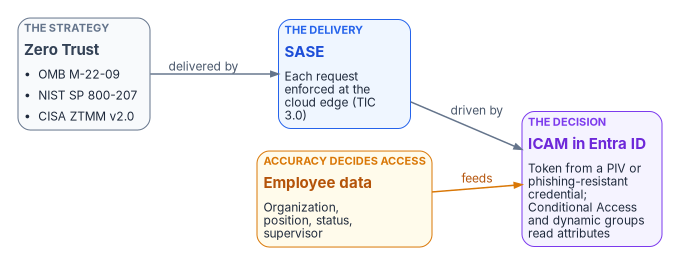
In Entra ID that direction has a concrete shape. The user signs in with a PIV card or another phishing-resistant method and receives a token. Conditional Access and application roles decide what the token can reach, and the groups they read are dynamic groups computed from attributes (Chapter 10).7 The attributes are employee data: organization, position, status and supervisor.
| Perimeter era | Zero Trust, delivered through SASE | |
|---|---|---|
| What decides access | Network location, then static groups | A token evaluated at the cloud edge against attributes and dynamic groups, per session |
| Where the user’s facts live | Typed into the directory by IT | Projected from the HR record |
| Cost of a wrong department | A wrong phone-book entry | The wrong dynamic groups, and therefore the wrong access |
| Cost of a stale status | An orphaned account: a standing security violation that can enable a breach | A valid token for a separated person, usable from anywhere |
That is the case for HR-driven identity in one line: when access decisions depend on authoritative identity attributes, the accuracy of employee data drives the accuracy of access — and only the HR system of record originates those facts.
The federal policy frame
Federal policy and guidance point the same way, though none of it names a product or mandates this architecture. OMB M-19-17 sets the enterprise ICAM policy framework.8 The FICAM Identity Lifecycle Management Playbook — best practice, not policy — recommends that agencies “designate HR systems as the authoritative source of truth for identity creation and termination,”9 and the FICAM Architecture describes identity management as how an agency collects, verifies and manages attributes held in authoritative sources.10 NIST SP 800-53 asks the same of account management, which is to be aligned “with personnel termination and transfer processes” (AC-2 l).11 The Evidence Act (the Foundations for Evidence-Based Policymaking Act of 2018, enacted January 2019) and the Federal Data Strategy push agencies toward reliable, governed data with documented quality and provenance;1213 they don’t require one system of record for every data type, and this book doesn’t cite them that way. None of this is achieved by cleaning the fragments. It takes designating the source — and for facts about people and organizational placement, the only candidate system that records hire, position, reporting line, and separation as a matter of business authority is the human capital system.
Why this can’t be patched
Three remediation strategies are regularly proposed to fix fragmented identity truth without designating a source. Each fails for a structural reason:
- “Clean up the directory.” A directory-hygiene project produces a correct snapshot with no event source behind it. Drift resumes the day the project ends, because hires, transfers, and separations keep happening in a system the directory still cannot hear. Cleanup is a measurement, not a source.
- “Make the directory the master.” Elevating the directory to authority inverts causation. Employment facts would then have to be entered into the directory by administrators — that is, by tickets — which re-creates the ticket queue as the source of truth, now with a grander title and still with no effective dating, no positions, no supervisory hierarchy, and no business authority behind any entry. Nothing that happens inside a directory is a hire or a separation. The directory can hold truth; it cannot originate it.
- “Review our way to correctness.” Quarterly access reviews sample state; they cannot observe transitions. A review that runs ninety days after a separation certifies an orphan for a quarter, and a reviewer confronted with four hundred entitlements approves them in bulk — the rubber-stamp failure mode every assessor recognizes. Reviews are the verification layer of AC-2 j14 and this architecture keeps them, sharper (Chapter 10); but a detective control needs a truth to detect drift from, and reviews cannot manufacture the truth they check against.
Every patch preserves the premise — that identity truth can be maintained where it is consumed rather than where it originates — and the premise is the defect. The remediation is not a cleaner copy; it is a designated origin with an event feed.
What HR-driven provisioning means
Microsoft’s name for the fix is HR-driven provisioning: “the process of creating digital identities based on a human resources system,” in which the HR systems “become the source of authority” and are the starting point for the provisioning processes that follow. A hire in HR creates the account; a change in HR updates it; a termination in HR disables it; a rehire reactivates or reprovisions it.15 In an agency where none of that happens today — where every one of those steps is a ticket — starting HR-driven provisioning is the single largest change to identity risk available, and the two migrations of Chapter 01 are when it costs least.
What HR provides, and what identity architecture must add
The HR system of record supplies the authoritative origin:
- Authoritative employment status (joiner, mover, leaver)
- Organizational attributes (department, division, location, employee type)
- For federal employees, a consistent feed shape across agencies once Federal HR 2.0 consolidation completes, expressed in OPM’s standard data elements and personnel actions (Chapter 06). Contractors and vendors are outside HRIT and need a designated source of their own.
Identity architecture supplies everything that turns that origin into access:
- A governed workforce identity model that normalizes authoritative facts for downstream lifecycle and policy use (Chapter 06)
- Joiner/mover/leaver workflows that act only on HR events (Chapter 08)
- Credential and certificate lifecycle tied to the same events (Chapter 09)
- Population of the attributes policy reads, so that targeting stays deterministic (Chapter 10)
- Drift detection between HR state and directory state, and evidence that account-management controls can be continuously verified (Chapter 11)
The identity architecture doesn’t depend on the platform being Oracle Fusion Cloud HCM. It depends on the HR system remaining the authoritative source and on the records being normalizable to the governed workforce identity model. Neither half is sufficient alone.
National Institute of Standards and Technology, SP 800-53 Rev. 5, Security and Privacy Controls for Information Systems and Organizations, AC-2 Account Management (items j and l) and PS-5 Personnel Transfer, https://nvlpubs.nist.gov/nistpubs/SpecialPublications/NIST.SP.800-53r5.pdf (accessed Oct 20, 2026).↩︎
Office of Management and Budget, M-22-09, Moving the U.S. Government Toward Zero Trust Cybersecurity Principles, January 26, 2022, https://www.whitehouse.gov/wp-content/uploads/2022/01/M-22-09.pdf (accessed Oct 20, 2026). Identity actions (§III.A): centralized identity management systems for agency users and phishing-resistant MFA for agency staff, contractors and partners; per-request authorization is discussed in the same section.↩︎
National Institute of Standards and Technology, SP 800-207, Zero Trust Architecture, August 2020, §2.1 (tenets 3 and 4), https://csrc.nist.gov/pubs/sp/800/207/final (accessed Oct 20, 2026).↩︎
Cybersecurity and Infrastructure Security Agency, Zero Trust Maturity Model, Version 2.0, April 2023, §5.1 Identity, https://www.cisa.gov/sites/default/files/2023-04/CISA_Zero_Trust_Maturity_Model_Version_2_508c.pdf (accessed Oct 20, 2026).↩︎
Office of Management and Budget, M-19-26, Update to the Trusted Internet Connections (TIC) Initiative, September 12, 2019, https://www.whitehouse.gov/wp-content/uploads/2019/09/M-19-26.pdf (accessed Oct 20, 2026).↩︎
Cybersecurity and Infrastructure Security Agency, “Trusted Internet Connections (TIC)” (TIC 3.0 core guidance and the remote user, branch office and cloud use cases), https://www.cisa.gov/resources-tools/programs/trusted-internet-connections-tic (accessed Oct 20, 2026).↩︎
Microsoft Learn, “Manage rules for dynamic membership groups in Microsoft Entra ID,” https://learn.microsoft.com/en-us/entra/identity/users/groups-dynamic-membership (accessed Oct 20, 2026).↩︎
Office of Management and Budget, M-19-17, Enabling Mission Delivery through Improved Identity, Credential, and Access Management, May 21, 2019, https://www.whitehouse.gov/wp-content/uploads/2019/05/M-19-17.pdf (accessed Oct 20, 2026).↩︎
General Services Administration, IDManagement.gov, Identity Lifecycle Management Playbook (Executive Summary; the disclaimer states it “is not official policy”), https://www.idmanagement.gov/playbooks/ilm/ (accessed Oct 20, 2026).↩︎
General Services Administration, IDManagement.gov, “FICAM Architecture” (Services Framework: Identity Management; authoritative sources), https://www.idmanagement.gov/arch/ (accessed Oct 20, 2026).↩︎
National Institute of Standards and Technology, SP 800-53 Rev. 5, Security and Privacy Controls for Information Systems and Organizations, AC-2 Account Management (items j and l) and PS-5 Personnel Transfer, https://nvlpubs.nist.gov/nistpubs/SpecialPublications/NIST.SP.800-53r5.pdf (accessed Oct 20, 2026).↩︎
Foundations for Evidence-Based Policymaking Act of 2018, Pub. L. 115-435, 132 Stat. 5529 (January 14, 2019), https://www.govinfo.gov/content/pkg/PLAW-115publ435/html/PLAW-115publ435.htm (accessed Oct 20, 2026).↩︎
Office of Management and Budget, M-19-18, Federal Data Strategy — A Framework for Consistency, June 4, 2019 (principles on data quality, documentation and provenance), https://www.whitehouse.gov/wp-content/uploads/2019/06/M-19-18.pdf (accessed Oct 20, 2026).↩︎
National Institute of Standards and Technology, SP 800-53 Rev. 5, Security and Privacy Controls for Information Systems and Organizations, AC-2 Account Management (items j and l) and PS-5 Personnel Transfer, https://nvlpubs.nist.gov/nistpubs/SpecialPublications/NIST.SP.800-53r5.pdf (accessed Oct 20, 2026).↩︎
Microsoft Learn, “What is HR-driven provisioning?” (definition; enabled scenarios for hiring, updates, terminations and rehires), https://learn.microsoft.com/en-us/entra/identity/app-provisioning/what-is-hr-driven-provisioning (accessed Oct 20, 2026).↩︎