Chapter 12 — What the Engine-Authentication Decision Settles
Chapter 12 — What the Engine-Authentication Decision Settles
Five governance positions turn the migration pattern into enforceable canon.
The five decisions the engine-authentication decision records: that consolidation gates authentication migration, that the parallel-run sequence is required, that SQL Authentication is eliminated and sa disabled and renamed, that pre-2022 instances are upgrade-or-except with a certificate-based authentication interim posture, and that the per-instance compliance record is the closure artifact.
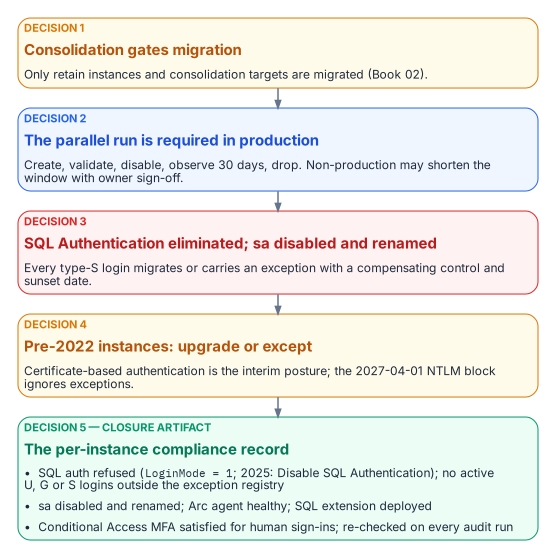
Chapter 11’s pattern covers the engineering case, Windows logins migrated through FROM EXTERNAL PROVIDER,1 but leaves governance positions that need a decision, not a narrative. The SQL Server engine-authentication decision (currently proposed) is the engine-layer companion to the Kerberos/NTLM-elimination program (protocol layer) and the Arc non-domain-join requirement (server and OS layer). It answers all five positions, in operational order.
Decision 1: consolidation precedes and gates authentication migration
Every instance is classified retain, consolidate-into-target or retire before any migration work; Arc-eligibility Categories 1–3 (Chapter 07) are layered on top.
The decision makes that assessment the normative prerequisite for this part of the book. Only retain instances and consolidation targets are migrated; migrating logins on instances about to be retired or collapsed is wasted effort. Consolidating into fewer SQL Server 2022 or later targets, Azure SQL Managed Instance, or Arc-enabled SQL Server is also the natural moment to retire cross-domain login sprawl, orphaned SPNs and shared service accounts.
Decision 2: the parallel-run sequence is required
On every retain or target instance, Windows logins (type U users, type G groups) and SQL Authentication logins (type S) migrate to Entra external-provider logins through Chapter 11’s parallel run, which is required for production. The letters are the values of sys.server_principals.type, not mnemonics: S SQL login, U Windows login, G Windows group, E external (Entra) login or application, X external (Entra) group.2 There’s no type W: a discovery query written against one returns zero rows and reports a clean instance, which is how a typo becomes a false attestation of closure.
Non-production instances may compress the 30-day observation window only with documented owner sign-off. Disable-and-observe keeps every cutover reversible inside the window, so a wrong mapping locks no one out.
Decision 3: SQL Authentication eliminated; sa disabled and renamed
Every active type-S login on a retain or target instance migrates to a service-principal or managed-identity login, or carries a documented exception with a named compensating control and a sunset date. Open-ended retention isn’t an option. A SQL Authentication login is checked against a password in master and never reaches Microsoft Entra ID or a domain controller, so Conditional Access can’t evaluate it3 and Microsoft Defender for Identity, whose sensors run on domain controllers and other identity servers, never sees it.4
sa is disabled and renamed on every production instance. Any retained emergency recovery is a documented, monitored break-glass procedure, not an active sa. An enabled sa with a non-rotated password is the authentication audit’s highest-priority finding. On SQL Server 2025 enabled by Azure Arc, the Disable SQL Authentication setting closes the door for sa and every other SQL login together.5
Decision 4: pre-2022 instances are upgrade-or-except
External-provider logins require SQL Server 2022 or later; on the program’s path, that means the Azure extension for SQL Server on an Arc-enabled host. A pre-2022 Category 3 instance can’t accept them regardless of Arc status, and neither can a failover cluster instance on any version.6 A Category 3 retain instance either upgrades and follows the Category 2-to-1 pathway or files a sunset-dated exception, though most Category 3 instances should be retire or consolidation candidates. An exception records the reason, the compensating control (for example, an identity-protection product that applies MFA or block policies to NTLM authentication),7 the maximum duration, and acknowledgement that the program’s 2027-04-01 NTLM block is applied in the operating system’s security layer and ignores engine-layer exceptions. That date is the program’s own backstop, not a Microsoft deadline (Chapter 02).
Connections that can’t reach Kerberos or Entra authentication by that date use certificate-based authentication, the authorized interim posture, which makes the AD CS-to-Cloud-PKI transformation (Not Yet Defined in the transformation inventory) a hard dependency for the exception long tail (Chapter 09, Chapter 22).
Decision 5: the per-instance compliance record is the closure artifact
An instance is closed when its compliance record simultaneously shows:
- SQL authentication refused:
LoginMode = 1(SERVERPROPERTY('IsIntegratedSecurityOnly') = 1), and on SQL Server 2025 the Disable SQL Authentication setting on (SERVERPROPERTY('IsExternalAuthenticationOnly') = 1)89 - zero active type-S logins outside the exception registry, and zero active type-U or type-G logins
sadisabled and renamed- the Arc Connected Machine agent connected and healthy, and the Azure extension for SQL Server deployed with Entra authentication configured10
- for human principals, Conditional Access MFA enforcement satisfied for SQL Server resource sign-ins over a defined validation period
“Done” becomes a queryable posture instead of a claim. Because Windows Authentication is always available and no engine setting disables it,11 the record evidences the Entra-exclusive posture through the absence of Windows logins rather than by reading a mode switch (Chapter 20). Closure is continuously verified: the authentication audit runs on a schedule, and drift (LoginMode reverting, a new type-S, U or G login, the Arc agent going offline) is a violation that triggers remediation.
- Consolidation gates migration, and the parallel run is required in production.
- SQL Authentication is eliminated and
sadisabled and renamed; pre-2022 instances and failover cluster instances upgrade, re-platform or carry a sunset-dated exception. - The per-instance compliance record is the continuously re-verified closure artifact.
Microsoft Learn, “CREATE LOGIN (Transact-SQL),” https://learn.microsoft.com/sql/t-sql/statements/create-login-transact-sql (accessed Oct 20, 2026).↩︎
Microsoft Learn, “sys.server_principals (Transact-SQL),” https://learn.microsoft.com/sql/relational-databases/system-catalog-views/sys-server-principals-transact-sql (accessed Oct 20, 2026).↩︎
Microsoft Learn, “What is Conditional Access?,” https://learn.microsoft.com/entra/identity/conditional-access/overview (accessed Oct 20, 2026).↩︎
Microsoft Learn, “Microsoft Defender for Identity sensor v2.x prerequisites,” server requirements, https://learn.microsoft.com/defender-for-identity/deploy/prerequisites-sensor-version-2 (accessed Oct 20, 2026).↩︎
Microsoft Learn, “Disable SQL authentication for SQL Server enabled by Azure Arc,” https://learn.microsoft.com/sql/sql-server/azure-arc/disable-sql-authentication (accessed Oct 20, 2026).↩︎
Microsoft Learn, “Microsoft Entra authentication for SQL Server,” https://learn.microsoft.com/sql/relational-databases/security/authentication-access/azure-ad-authentication-sql-server-overview (accessed Oct 20, 2026).↩︎
Third-party source (vendor case study), Silverfort, “Customer case study: preventing NTLM-based lateral movement with Silverfort,” https://www.silverfort.com/blog/customer-case-study-preventing-ntlm-based-lateral-movement-with-silverfort/ (accessed Oct 20, 2026). Cited as an example of the control category, not an endorsement.↩︎
Microsoft Learn, “Change server authentication mode,” https://learn.microsoft.com/sql/database-engine/configure-windows/change-server-authentication-mode (accessed Oct 20, 2026).↩︎
Microsoft Learn, “Disable SQL authentication for SQL Server enabled by Azure Arc,” https://learn.microsoft.com/sql/sql-server/azure-arc/disable-sql-authentication (accessed Oct 20, 2026).↩︎
Microsoft Learn, “What is Azure Arc-enabled servers?,” agent status, https://learn.microsoft.com/azure/azure-arc/servers/overview (accessed Oct 20, 2026).↩︎
Microsoft Learn, “Choose an authentication mode,” https://learn.microsoft.com/sql/relational-databases/security/choose-an-authentication-mode (accessed Oct 20, 2026).↩︎