Chapter 05 — Provisioning Services
Chapter 05 — Provisioning Services
One door into the directory, so there is exactly one door to instrument.
The logical architecture and its Microsoft realization: where provisioning sits between the governed identity model and the directories, and why API-driven inbound provisioning is the Microsoft implementation. The Oracle HCM source surfaces. What the middleware must do for every event, including reconciliation. The bulkUpload contract and its limits. The two landing zones and what each one does with structure. Native connectors and writeback.
Logical architecture and Microsoft realization
The logical architecture is stable:
Authoritative workforce source → boundary transformation → governed workforce identity model → provisioning service → target services
The governed workforce identity model (Chapter 06) is the stable center: everything to its left is source-specific, everything to its right is delivery.
The Microsoft realization is replaceable:
Oracle Core HCM → integration middleware (Azure Functions or Logic Apps) → Microsoft Graph
/bulkUpload→ Entra provisioning service → Entra ID or on-premises Active Directory
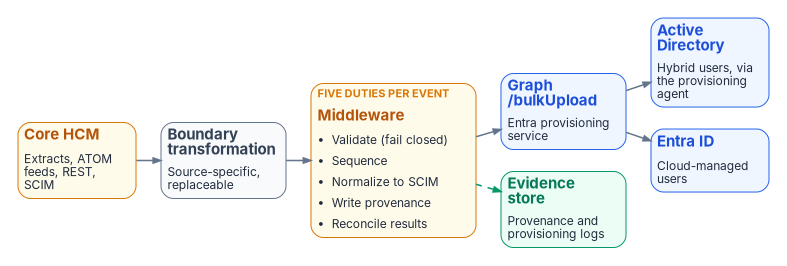
The API client reads identity data from the authoritative source and posts it to the provisioning app’s /bulkUpload endpoint as a SCIM bulk request. It doesn’t compare source and target values to decide whether to create, update, enable or disable; the provisioning service does that, applies the attribute mappings the administrator configured, and writes the user to on-premises AD (hybrid users) or to Entra ID (cloud-only users). The endpoint answers 202 Accepted and processes asynchronously; the client reads the provisioning logs API for the per-record result and applies bounded, idempotent retry for transient failures. Permanent failures become reconciled exceptions with an owner and alternate completion path.1
Why API-driven inbound provisioning
- Oracle Fusion Cloud HCM has no native Entra connector. Entra’s prebuilt HR connectors are for Workday and SAP SuccessFactors.2 Microsoft’s own Oracle HCM integration guidance is the API-driven pattern: CSV extracts for the initial load, ATOM feeds or HCM Extracts for deltas (or Oracle Integration Cloud where the agency subscribes to it), and optional writeback through Oracle’s SCIM APIs.3
- The governed identity model is source-independent; each deployed source has an explicit contract and transformation. The middleware normalizes any HR export into the same SCIM payload, so the
/bulkUploadcall is identical whatever the source. If the source changes, the source contract and boundary transformation change; the governed identity model and downstream lifecycle policy remain stable. - One entry point gives one provenance stream. All inbound identity writes pass through a single provisioning surface, which is what makes lineage and drift detection tractable (Chapter 11).
- The procurement points the same way. As Chapter 03 records from the solicitation, the Core HCM requirements checklist asks for SCIM 2.0 near-real-time provisioning, the protocol this pattern uses.
If Microsoft later ships a native Oracle HCM connector, it becomes an optimization inside this architecture, not a replacement for it.
The source: Oracle Fusion Cloud HCM
| Sync | Mechanism | Notes |
|---|---|---|
| Initial / full | HCM Extracts (or BI Publisher) to CSV4 | Full worker population, scoped by the filter rules of Chapter 12, Phase 1 |
| Delta | ATOM feeds: newhire, empassignment, empupdate, termination, cancelworkrelship, workrelshipupdate5 |
Turn on immediately after the initial sync; a gap loses changes6 |
| Delta (alternative) | Periodic HCM Extract deltas | Simpler; latency equals the extract cadence |
| Enrichment | workers REST resource |
When a feed event doesn’t carry an attribute the payload needs. Microsoft’s guide also names the employees (emps) resource, but Oracle marks it for future deprecation and advises the workers resource for new integrations7 |
Source correlation key: Oracle PersonNumber to employeeId in Entra ID and AD, subject to the enterprise identifier decision in Chapter 04. The employee ID must be populated on existing accounts before the first full sync; matching is what prevents duplicate identities at go-live.
The middleware: five duties per event
Azure Functions or Logic Apps, inside the agency’s authorization boundary, doing five things for every event:
- Validate. Required attributes present; unknown worker types refused. Fail closed.
- Sequence and retry. Apply feed events in order and handle failures explicitly. An out-of-order mover/leaver pair is a correctness bug and a dropped event is a silent drift source. A failed transform retries and is recorded, never skipped.
- Normalize to SCIM. Build the bulk request (
urn:ietf:params:scim:api:messages:2.0:BulkRequest) with the core and enterprise user schemas, plus a schema extension for any attribute the core schemas don’t carry.89 The canonical payload is defined in Chapter 06. - Write provenance. One record per event (source event ID, payload hash, derivation inputs, outcome) to the agency’s evidence store, before the Graph call returns. No record, no verifiable outcome.
- Reconcile. Read the provisioning logs for each submitted record and match the result to the source event. Transient failures retry with bounded, idempotent backoff; permanent failures become exceptions with an owner and an alternate completion path, and stay open until the directory reflects the source. A scheduled comparison of the HR population with the directories catches anything the per-event check missed (Chapter 11).
The middleware never writes back to the HR system’s HR-mastered facts. Send the complete user record in every request, for full and delta syncs alike: if clearing attribute values (a preview feature) is enabled, an omitted or null mapped attribute can clear the target value.10
The /bulkUpload contract
| Property | Value |
|---|---|
| Endpoint | Microsoft Graph, worldwide endpoint graph.microsoft.com (Microsoft 365 GCC tenants use the worldwide endpoints)12 |
| Payload | SCIM bulk request; up to 50 operations per call |
| Throttling | 40 calls in any 5-second window, HTTP 429 beyond it, per the Entra concepts page; the Graph API reference states 40 requests per second.13 The two Microsoft pages disagree, so pace the client to the stricter figure and handle 429 responses |
| Tenant daily cap | 2,000 calls per 24 hours with Entra ID P1/P2; 6,000 with Entra ID Governance |
| Graph permissions for the client | SynchronizationData-User.Upload (Microsoft’s standard setup) or the least-privileged SynchronizationData-User.Upload.OwnedBy, which limits uploads to provisioning apps the client’s identity owns;1415 ProvisioningLog.Read.All for the component that reads per-record results |
| Licensing floor | Entra ID P1; Entra ID Governance for Lifecycle Workflows |
Each endpoint belongs to one provisioning app, and an agency with several sources (HR for employees, a contractor system, a badging system that only updates attributes) creates one app per source.1617
Two landing zones
The same HR feed can land in two places, separately or at the same time — and which one a population uses changes as the agency moves from Active Directory to Entra ID:
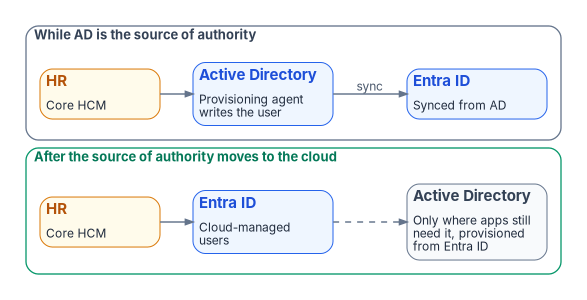
- API-driven inbound provisioning to Microsoft Entra ID creates cloud-only users directly.
- API-driven inbound provisioning to on-premises Active Directory delivers the same payloads through the Microsoft Entra provisioning agent, which writes to AD DS from inside the agency network; Entra Connect Sync or Cloud Sync then projects the user to the cloud.1819
Landing in Active Directory
- The OU is computed, not hand-picked. An expression mapping on
parentDistinguishedNamederives the destination domain and OU from HR attributes.20 - The reporting line becomes a reference. The provisioning service writes AD’s
managerattribute as a DN reference to the already-provisioned supervisor; for managers in another domain, Microsoft’s topologies either enable referral chasing on the provisioning agent (one app for the forest) or add a separate app that updates onlymanager(one app per domain).21 - High availability. Deploy at least two provisioning agents, on servers with line of sight to the domain controllers;22 Microsoft’s Cloud Sync prerequisites now recommend three active agents, on servers hardened as Tier 0 (control plane) assets.23 The agent service runs as a group managed service account (gMSA); Domain or Enterprise Administrator credentials are needed once, to create it, not to run the agent.24 Delegate the gMSA rights to the target OUs only.
- Termination reaches the domain controller. The SCIM
activevalue maps to AD’saccountDisabled, so an HR termination disables the AD account, and the sync client carries that state to the cloud.2526
The caveat: AD stores structure as place. An OU is a container, and Group Policy that reads OU position inherits every reorganization. HR-driven provisioning keeps AD correct; it can’t make AD attribute-native.
Landing in Entra ID
Entra ID has no OUs. The worker record lands as attributes, and structure becomes data: manager (a directory relationship that drives the org chart in Teams and Outlook27 and approval routing), department, jobTitle, employeeId, employeeType, employeeHireDate, employeeLeaveDateTime, and employeeOrgData (division, costCenter).28 Chapter 06 fixes which of these the agency uses and for what; Chapter 10 shows how they become access.
| Dimension | Active Directory | Entra ID |
|---|---|---|
| Structural container | OU tree: structure as place, which GPO reads | None: structure as attributes, which policy reads through groups |
| Reporting line | manager DN reference |
manager relationship |
| Org placement | OU computed at provisioning (parentDistinguishedName) |
department, employeeOrgData, stamped |
| Membership | Static groups, manual or scripted | Rules for dynamic membership, evaluated by the service |
| Delegated admin | OU ACL delegation | Administrative units (flat; they can’t be nested)29 |
| Reorganization cost | OU restructure and GPO re-link: a project | Attribute re-stamp and rule re-evaluation: a data change |
During coexistence, provision both zones, read structure from attributes, and retire OU-bound policy deliberately (Chapter 12, Phase 5).
Over the Entra ID migration
Microsoft’s path to the cloud moves users’ source of authority from Active Directory to Entra ID, after which the user lifecycle is governed in the cloud with Entra ID Governance; for users who still need on-premises access, provisioning from Entra ID to Active Directory maintains the AD account while Entra ID remains the source of authority.30 Microsoft’s migration guidance makes the same split for HR: new employees who use only Entra-integrated applications can be provisioned as cloud-only accounts, and hybrid accounts are provisioned only where applications still depend on AD.31 HR-driven provisioning and the directory migration therefore converge on one design, population by population: HR is the source of authority, Entra ID is the identity platform it drives, and Active Directory becomes a downstream target that shrinks as applications move.
Native connectors
Where an HR source has a native connector (Workday, SAP SuccessFactors), it’s an acceptable accelerator. The API-driven pattern stays the reference implementation because it works for any source and because its middleware is where validation, provenance and reconciliation happen before the identity platform sees the record. A native connector bypasses that middleware, so those duties have to be supplied another way.
Writeback: optional and one-way per attribute
Once inbound provisioning is proven, an optional outbound job can write identity-platform-mastered attributes the HR system wants to display (username, work email, work phone) back to Oracle HCM through its SCIM APIs.3233 Microsoft’s guide builds that job on the Oracle Fusion ERP gallery connector, limited to the Update action, with every attribute the agency doesn’t intend to write back removed from the mapping.34 Two rules keep it safe: no attribute is writable in both directions (Chapter 04), and nothing in the plan depends on writeback.
Microsoft Learn, “API-driven inbound provisioning concepts,” https://learn.microsoft.com/en-us/entra/identity/app-provisioning/inbound-provisioning-api-concepts (accessed Oct 20, 2026).↩︎
Microsoft Learn, “Plan cloud HR application to Microsoft Entra user provisioning,” https://learn.microsoft.com/en-us/entra/identity/app-provisioning/plan-cloud-hr-provision (accessed Oct 20, 2026).↩︎
Microsoft Learn, “Configure Oracle Human Capital Management (HCM) for automatic user provisioning,” https://learn.microsoft.com/en-us/entra/identity/saas-apps/oracle-hcm-provisioning-tutorial (accessed Oct 20, 2026).↩︎
Oracle, Oracle Fusion Cloud HCM: HCM Extracts, “Introduction to HCM Extracts” (the main way to retrieve data in bulk; CSV among the output formats), https://docs.oracle.com/en/cloud/saas/human-resources/fahex/introduction-to-hcm-extracts.html (accessed Oct 20, 2026).↩︎
Oracle, REST API for Oracle Fusion Cloud HCM, “Employee Feeds,” https://docs.oracle.com/en/cloud/saas/human-resources/farws/Employee_Atom_Feeds.html (accessed Oct 20, 2026).↩︎
Microsoft Learn, “Configure Oracle Human Capital Management (HCM) for automatic user provisioning,” https://learn.microsoft.com/en-us/entra/identity/saas-apps/oracle-hcm-provisioning-tutorial (accessed Oct 20, 2026).↩︎
Oracle, REST API for Oracle Fusion Cloud HCM, “Employees REST Endpoints” (deprecation notice) and “Workers REST Endpoints” (employee, contingent worker and pending worker types), https://docs.oracle.com/en/cloud/saas/human-resources/farws/api-employees.html and https://docs.oracle.com/en/cloud/saas/human-resources/farws/api-workers.html (accessed Oct 20, 2026).↩︎
Microsoft Learn, “API-driven inbound provisioning concepts,” https://learn.microsoft.com/en-us/entra/identity/app-provisioning/inbound-provisioning-api-concepts (accessed Oct 20, 2026).↩︎
Internet Engineering Task Force, RFC 7644, System for Cross-domain Identity Management: Protocol, September 2015, §3.7 (bulk operations), https://www.rfc-editor.org/rfc/rfc7644; and RFC 7643, SCIM: Core Schema, September 2015, §4.3 (enterprise user extension), https://www.rfc-editor.org/rfc/rfc7643 (accessed Oct 20, 2026).↩︎
Microsoft Learn, “API-driven inbound provisioning concepts,” https://learn.microsoft.com/en-us/entra/identity/app-provisioning/inbound-provisioning-api-concepts (accessed Oct 20, 2026).↩︎
Microsoft Learn, “API-driven inbound provisioning concepts,” https://learn.microsoft.com/en-us/entra/identity/app-provisioning/inbound-provisioning-api-concepts (accessed Oct 20, 2026).↩︎
Microsoft Learn, “National cloud deployments” (Microsoft Graph): “If you’re working in a Microsoft 365 GCC environment, continue using the worldwide endpoints,” https://learn.microsoft.com/en-us/graph/deployments (accessed Oct 20, 2026).↩︎
Microsoft Learn, “Perform bulkUpload” (Microsoft Graph v1.0 API reference: rate limit and permissions), https://learn.microsoft.com/en-us/graph/api/synchronization-synchronizationjob-post-bulkupload (accessed Oct 20, 2026).↩︎
Microsoft Learn, “Perform bulkUpload” (Microsoft Graph v1.0 API reference: rate limit and permissions), https://learn.microsoft.com/en-us/graph/api/synchronization-synchronizationjob-post-bulkupload (accessed Oct 20, 2026).↩︎
Microsoft Learn, “Grant access to the inbound provisioning API,” https://learn.microsoft.com/en-us/entra/identity/app-provisioning/inbound-provisioning-api-grant-access (accessed Oct 20, 2026).↩︎
Microsoft Learn, “API-driven inbound provisioning concepts,” https://learn.microsoft.com/en-us/entra/identity/app-provisioning/inbound-provisioning-api-concepts (accessed Oct 20, 2026).↩︎
Microsoft Learn, “Frequently asked questions about API-driven inbound provisioning,” https://learn.microsoft.com/en-us/entra/identity/app-provisioning/inbound-provisioning-api-faqs (accessed Oct 20, 2026).↩︎
Microsoft Learn, “API-driven inbound provisioning concepts,” https://learn.microsoft.com/en-us/entra/identity/app-provisioning/inbound-provisioning-api-concepts (accessed Oct 20, 2026).↩︎
Microsoft Learn, “Configure Oracle Human Capital Management (HCM) for automatic user provisioning,” https://learn.microsoft.com/en-us/entra/identity/saas-apps/oracle-hcm-provisioning-tutorial (accessed Oct 20, 2026).↩︎
Microsoft Learn, “Plan cloud HR application to Microsoft Entra user provisioning,” https://learn.microsoft.com/en-us/entra/identity/app-provisioning/plan-cloud-hr-provision (accessed Oct 20, 2026).↩︎
Microsoft Learn, “Plan cloud HR application to Microsoft Entra user provisioning,” https://learn.microsoft.com/en-us/entra/identity/app-provisioning/plan-cloud-hr-provision (accessed Oct 20, 2026).↩︎
Microsoft Learn, “Plan cloud HR application to Microsoft Entra user provisioning,” https://learn.microsoft.com/en-us/entra/identity/app-provisioning/plan-cloud-hr-provision (accessed Oct 20, 2026).↩︎
Microsoft Learn, “Prerequisites for Microsoft Entra Cloud Sync” (gMSA requirements; three active agents recommended; Tier 0 hardening), https://learn.microsoft.com/en-us/entra/identity/hybrid/cloud-sync/how-to-prerequisites (accessed Oct 20, 2026).↩︎
Microsoft Learn, “Prerequisites for Microsoft Entra Cloud Sync” (gMSA requirements; three active agents recommended; Tier 0 hardening), https://learn.microsoft.com/en-us/entra/identity/hybrid/cloud-sync/how-to-prerequisites (accessed Oct 20, 2026).↩︎
Microsoft Learn, “Configure Oracle Human Capital Management (HCM) for automatic user provisioning,” https://learn.microsoft.com/en-us/entra/identity/saas-apps/oracle-hcm-provisioning-tutorial (accessed Oct 20, 2026).↩︎
Microsoft Learn, “Plan cloud HR application to Microsoft Entra user provisioning,” https://learn.microsoft.com/en-us/entra/identity/app-provisioning/plan-cloud-hr-provision (accessed Oct 20, 2026).↩︎
Microsoft Learn, “Introducing Org Explorer” (available in Teams and Outlook; org information comes from Microsoft Entra ID and needs the manager relationship), https://learn.microsoft.com/en-us/viva/people-in-viva/introducing-org-explorer (accessed Oct 20, 2026).↩︎
Microsoft Learn, “user resource type” (Microsoft Graph v1.0:
employeeType,employeeHireDate,employeeLeaveDateTime,employeeOrgData), https://learn.microsoft.com/en-us/graph/api/resources/user (accessed Oct 20, 2026).↩︎Microsoft Learn, “Administrative units in Microsoft Entra ID,” https://learn.microsoft.com/en-us/entra/identity/role-based-access-control/administrative-units (accessed Oct 20, 2026).↩︎
Microsoft Learn, “Transfer user Source of Authority (SOA) to Microsoft Entra ID,” https://learn.microsoft.com/en-us/entra/identity/hybrid/user-source-of-authority-overview (accessed Oct 20, 2026).↩︎
Microsoft Learn, “Transition to the cloud” (Move to cloud HR provisioning), https://learn.microsoft.com/en-us/entra/architecture/road-to-the-cloud-migrate (accessed Oct 20, 2026).↩︎
Microsoft Learn, “Configure Oracle Human Capital Management (HCM) for automatic user provisioning,” https://learn.microsoft.com/en-us/entra/identity/saas-apps/oracle-hcm-provisioning-tutorial (accessed Oct 20, 2026).↩︎
Oracle, REST API for Common Features in Oracle Fusion Cloud Applications, “Get all users” (
/hcmRestApi/scim/Users), https://docs.oracle.com/en/cloud/saas/applications-common/25d/farca/op-hcmrestapi-scim-users-get.html (accessed Oct 20, 2026).↩︎Microsoft Learn, “Configure Oracle Human Capital Management (HCM) for automatic user provisioning,” https://learn.microsoft.com/en-us/entra/identity/saas-apps/oracle-hcm-provisioning-tutorial (accessed Oct 20, 2026).↩︎