Federal Modernization Workbook · Book 09 · What
Chapter 05 — SD-WAN, SASE and Governed-Path Transport
SD-WAN can take a path down to the floor physics sets and SASE can make the traffic on it lawful, but neither one governs the path itself, and the device that does the governing is the newest thing an adversary will aim at.
What SD-WAN’s differentiated transport buys: path classes, route-inflation recovery, tail-latency tools such as forward error correction and packet duplication, and protection of latency-critical traffic from bulk transfers, with the hard ceiling it can’t pass. How SASE security services sit above SD-WAN in CISA’s model and in the TIC 3.0 Branch Office Use Case, and why a SASE or VPN path must not break Teams emergency calling. Microsoft’s Global Secure Access as one SASE candidate, with its government-cloud and licensing gates first: Private Access as the VPN and DirectAccess replacement, deployment, remote networks, Internet Access policy and coexistence with other vendors. The bridge from those TIC 3.0 and SASE capabilities to identity-aware access (compliant network, secure web gateway, private application segmentation, traffic steering, coexistence and bypass governance), with the architecture decision and pilot exit criteria. The program’s proposed governed-path model, in which the path is leased per intent and bound to a short-lived token. The decision records the fabric must emit, and the controls the controller and edges need before they’re credited with closing anything.
Chapter 02 separated the pipe from the governor: transport is a physics decision, and control is a compliance decision. This chapter is about the governor. It has three layers, and each answers a different question. SD-WAN decides which traffic takes which path and measures how each path is doing. SASE decides whether a flow is allowed and inspects it at a policy enforcement point (PEP). The governed path, which is still a proposal in the program, decides whether the path itself was authorized for this caller and this intent, and records the answer as evidence. Sitting over all three is a question the sources answered only briefly: who protects the governor?
SD-WAN as differentiated transport
Software-defined WAN selects among several underlay paths per traffic class. It can put latency-sensitive traffic on a short, low-jitter path and push bulk traffic onto a larger, slower or cheaper one. The question worth asking precisely is whether that helps systems that must stay in sync over distance, and whether it helps with the speed-of-light problem Chapter 01 describes.
The answer is yes, meaningfully, but only inside the gap between observed latency and the physical floor. SD-WAN never moves the floor. The gap is usually large, and it hurts distributed systems disproportionately because it inflates the latency tail, so working inside it is valuable. Describing that as “beating the speed of light” is the error to avoid.
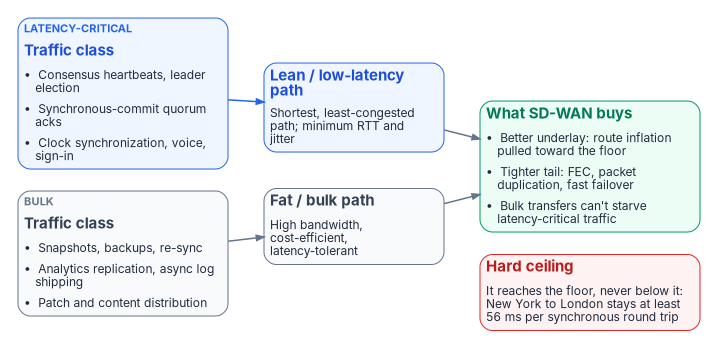
The split into a lean class and a bulk class maps onto what a distributed database, and most branch traffic, actually emits:
| Traffic class | What it carries | Wants | Best path |
|---|---|---|---|
| Lean, low-latency | Consensus heartbeats, leader election, synchronous-commit quorum acknowledgements, clock synchronization; at a branch, voice, interactive sessions and sign-in | Minimum round-trip time (RTT) and jitter | Shortest, least-congested path; small packets |
| Fat, bulk | Base snapshots, backups, re-sync after a partition, analytics replication, asynchronous log shipping; at a branch, patch and content distribution | Throughput and cost efficiency | High-bandwidth path; latency-tolerant |
This is differentiated transport per traffic class. It is the network layer’s reflection of a decision the data layer already makes: what must be strongly consistent and what can be eventually consistent (Chapter 04). When the two decisions agree, a design gets the best synchronization physics allows. Chapter 08 turns that agreement into a reference architecture.
Recovering route inflation
Real paths are longer than the great-circle distance and slower than light in fiber. Measurements across the public internet found minimum ping times about three times (3.1 times in the median) the vacuum speed-of-light bound between the same endpoints.1 Light in fiber accounts for roughly a factor of 1.5 of that on its own (it travels about 200 km per millisecond), so the rest is route length, peering and queueing: the part a better path can recover.
A premium backbone shows how much is recoverable. Microsoft publishes median round-trip times between its regions measured by continuous probes; in the dataset ending July 30, 2026, traffic from UK South to East US took a median 78 ms.2 As worked arithmetic: London to the East US region in southern Virginia is about 6,150 km great-circle, so the fiber floor for a round trip is about 2 × 6,150 ÷ 200 ≈ 62 ms. A managed backbone runs about 1.3 times the floor on that pair. That ratio, not a vendor claim, is the ceiling on what path selection can do for a cross-ocean flow: SD-WAN that steers the latency-critical class onto a premium underlay recovers the difference between an internet path and a backbone path, and nothing below the floor.
Shrinking the tail
This is the underrated effect, and the most valuable one for synchronization. A quorum commit waits for the slowest member it must hear from, so commit latency is a tail (p99) statistic, and the tail is inflated by loss, congestion and jitter rather than by propagation. SD-WAN’s loss tools act on the tail directly:
- Forward error correction (FEC). The edge sends redundant parity data so a lost packet can be rebuilt at the receiver without waiting for a retransmission. Cisco Catalyst SD-WAN, as one documented example, sends a parity packet for every group of four, which recovers up to one lost packet per group, and can send parity always or only when measured loss crosses a threshold.3 FEC trades bandwidth for latency. For a quorum gated by its unluckiest packet, removing retransmission waits can cut p99 commit latency far more than any reduction in the mean.
- Packet duplication across two paths. The edge sends a copy of each latency-critical packet on an alternate tunnel and the receiver keeps the first to arrive, so a lossy path stops setting the tail. Cisco positions the feature for voice and video on noisy links and requires multiple WAN links.4
- Fast path failover. Continuous path-quality measurement moves a class off a degrading link before the transport protocol’s own loss detection reacts.
Distributed-database performance is a tail problem, and SD-WAN’s loss and jitter tools are tail tools. A path can go from three times the floor with a ragged tail to close to the floor with a tight one, a large improvement in how well replicas stay in sync, without anyone violating physics.
Keeping bulk traffic off the commit path
A re-sync or backup can saturate a link and queue the small, latency-critical consensus packets behind it: self-inflicted tail latency. Class separation means a bulk transfer can’t starve or delay heartbeats and commit acknowledgements, so the database stays in sync during exactly the heavy-transfer events that would otherwise destabilize it. At a branch the same separation keeps a patch wave from degrading a voice call.
The clock angle
A second way networking helps runs through time rather than distance. Google’s Spanner orders transactions with TrueTime, an interface that exposes clock uncertainty explicitly. Google’s implementation keeps that uncertainty generally under 10 ms by using GPS and atomic clock references, and a coordinator makes a commit visible only after its timestamp is certain to be in the past, a step the paper calls commit wait.5 Ordering then costs bounded clock uncertainty instead of an extra round trip across a continent.
You can’t make light faster, but you can make a system need fewer trips through it by spending clock certainty instead of round trips. The program’s design position is that clock synchronization traffic belongs in the lean class, alongside consensus traffic, because the same short, quiet path that serves a quorum is the one a time service wants. SD-WAN assists the speed-of-light problem here not by reducing propagation but by supporting a design that propagates less often.
The hard ceiling
A synchronous, strongly consistent commit across continents pays at least one round trip every time. Microsoft’s own worked figure for New York to London is 5,585 km straight-line, 28 ms one way and 56 ms round trip at 200 km per millisecond (Chapter 01 gives 5,570 km from its own great-circle calculation; Microsoft’s figure differs slightly and gives the same 56 ms), before any route is longer than a straight line.6 SD-WAN removes the excess over that floor and tames the tail; the floor is the speed-of-light tax on strong consistency, and it doesn’t negotiate.
So SD-WAN doesn’t change the architectural conclusion of Chapter 01: need less global synchronization. It makes that conclusion cheaper to live with. The synchronization a design keeps becomes more reliable and tighter in the tail, and asynchronous bulk replication runs efficiently on its own path.
What the branch edge adds, and what TIC 3.0 asks of it
At a field office the same capabilities answer a governance question rather than a database one. Chapter 02 explains why a direct internet access (DIA) circuit and a SASE service together leave the stretch between the user and the PoP ungoverned. The branch-edge layer is what governs it: application-aware steering, queue management where traffic enters the constrained link, concurrent use of two circuits, continuous path-health measurement with failover, and per-application path telemetry. That telemetry is the piece that matters most for evidence. Interface counters say a link was busy; they don’t say which application saw which latency over which path, which is what a monitoring assertion about branch transport needs (Chapter 13).
The TIC 3.0 Branch Office Use Case, Version 3.0 (September 2026), anticipates multiple paths and puts one requirement on them. Its policy enforcement parity capability says that when branch locations connect directly to cloud and web services, their protections should match those enforced at the agency campus so that an attacker can’t evade security by steering traffic onto a path with less rigor, and that where multiple means of conveyance such as redundant links or SD-WAN are used, path priorities, the order security functions execute in and policy enforcement should keep security parity on every path.7 The same document’s networking guidance asks agencies to verify that flows go to the right destinations and that the points making that decision can’t easily be bypassed or manipulated.8 Read together, those two sentences are a requirement on the SD-WAN policy itself: every path class has to land on enforcement of equal strength, and the steering decision is a security control.
SASE above SD-WAN
SD-WAN governs paths. It doesn’t inspect content, enforce web or cloud-application policy, or broker access to private applications. Those functions belong to the security services above it, the security service edge. “Above SD-WAN” here means SASE’s security services; CISA’s definition below counts SD-WAN as part of SASE.
CISA’s June 2026 guide on SASE in a TIC 3.0 solution defines SASE as a framework combining networking tools, giving SD-WAN, routing and bandwidth optimization as examples, with security tools such as a secure web gateway (SWG), cloud access security broker (CASB), zero trust network access (ZTNA) and next-generation firewall (NGFW).9 The guide is vendor-agnostic and describes SD-WAN as optimizing wide-area connectivity through policy-driven routing on user, device, network and application context. In its notional reference architecture, SWG, CASB and NGFW capabilities manage traffic to external resources, SD-WAN manages and routes internal agency traffic, ZTNA controls access to private applications, and the SASE solution sends telemetry to CISA’s Comprehensive Log Aggregation Warehouse (CLAW).10 Branch offices reach the service either through agents on devices or through branch firewalls that forward traffic to it.11
Two corrections follow from reading the primary documents rather than earlier summaries of them. CISA does list SD-WAN among SASE’s networking tools, so the program’s earlier statement that CISA’s material on SD-WAN is only procurement-oriented no longer holds. But “for example” is not “required”: neither the SASE guide nor the Branch Office Use Case mandates SD-WAN, and TIC 3.0 stays technology-neutral (Chapter 03). The program’s position is that a branch-edge policy layer is an architecture requirement the agency decides on, stated as such, not a CISA mandate.
| Function | Provided by | Control families it supports |
|---|---|---|
| Path selection, traffic-class separation, failover, multipath | SD-WAN overlay | Availability; traffic-flow policy (SC-7(4)) |
| Encryption across every circuit | SD-WAN overlay tunnels | Transmission confidentiality and integrity (SC-8) |
| Per-application path telemetry | SD-WAN edges and controller | Monitoring (SI-4) and logging |
| Web and cloud-application policy, inspection, malware | SASE: SWG, CASB, NGFW or firewall-as-a-service | Boundary protection (SC-7), malicious code protection |
| Access to private applications | SASE: ZTNA | Remote access (AC-17), access enforcement |
| Telemetry to CISA | SASE solution, per CISA’s guide | CISA telemetry obligations (Chapter 03) |
| Telecommunications diversity | The pipes themselves | CP-8 (Chapter 02) |
SD-WAN alone doesn’t satisfy the Branch Office Use Case’s security capabilities; the boundary, flow and malware protections come from the services above it.
The enforcement point has a location
The physics argument applies to the PEP too. A SASE PoP that is far from the branch, or poorly peered with the cloud the user is reaching, reintroduces the hairpin the agency was trying to delete. Microsoft’s connectivity guidance says this plainly for its own services: routing traffic through a cloud-based network or security provider can hurt connections if the provider isn’t well peered, and agencies should evaluate the number and location of the provider’s PoPs relative to their branch offices and to Microsoft’s peering points, and the cost of backhaul inside the provider’s network.12 Choosing a SASE service is therefore partly a geography decision. Ask for PoP locations near each office cluster, measure branch-to-PoP latency before cutover, and treat a distant PoP as a hairpin with a different name. Microsoft 365 traffic Microsoft classifies as Optimize has its own documented handling (Chapter 12); Microsoft 365 informed network routing isn’t available to GCC Moderate tenants (Book 08 Appendix C), so path selection rests on the SD-WAN’s own measurements. How an SD-WAN edge handles DNS, and why its redirect target decides whether agency DNS policy applies at all, is in Book 08 Chapter 05.
Teams emergency calling constrains the path
A SASE or VPN design also decides whether a Teams caller’s 911 location can be found. Teams dynamic emergency calling matches the client’s network against a map the agency keeps in the Location Information Service: wireless access points, switches, switch ports and subnets, each linked to an emergency address. It tries a subnet match only when the client’s public IP address is on the tenant’s list of trusted IP addresses; access point and switch lookups happen regardless. Microsoft also states that cloud proxy service deployments that modify the source IP addresses from Teams clients don’t support network configuration setting lookups.13 Two design constraints follow.
- Don’t put a source-rewriting cloud proxy in front of Teams clients that depend on network lookups. Where a SASE service carries Teams traffic, confirm with the vendor whether it rewrites the client’s source address. If it does, users behind it lose those lookups, which carry the network-site emergency policies and, through the trusted-address check, the subnet-based location; their calls then depend on an address the user confirms or types, or on the address registered on the number. In the United States a typed address not picked from the address suggestions, and an address registered on the number, are screened by a national call center before the call is transferred.14 Record that as a known gap in the architecture decision, not a surprise found at the first 911 call.
- Leave VPN address pools out of the location map. This is an inference from the trusted-address rule, not a Microsoft statement: a full-tunnel VPN’s exit address is the agency’s and is likely on the trusted list, so if the VPN address pool is mapped to an emergency location, a home worker on the VPN gets that location. Keeping the pool unmapped lets the client fall through to the address the user confirmed for that network. Microsoft’s separate guidance to route Teams media and the other Optimize endpoints around the VPN tunnel is for performance;15 it doesn’t change which address the location lookup sees.
The Location Information Service and the emergency calling policies are operated through the Teams Phone catalog in Book 15, Chapter 05, which also covers the IPv6 case in which a client matches its site but not a location.
Microsoft’s security service edge: Global Secure Access
Many agencies already license part of Microsoft’s security service edge, Global Secure Access, through Microsoft Entra ID, so it is often the first candidate a program evaluates. It has three parts. Microsoft Entra Private Access is the ZTNA function, Microsoft Entra Internet Access is the secure web gateway, and the Microsoft traffic profile carries traffic to Microsoft’s own services. Microsoft states that all three are generally available.22 This section covers what each part does, where the program’s gates are, and how it coexists with the vendors listed above. It assumes the identity design in Book 02 and the access plane in Book 01, Chapter 08.
The gates come first
Government cloud. Learn’s only statement on government availability covers the whole product: “Global Secure Access is available in the US Government Community Cloud (GCC), but isn’t yet supported in the US Government Community Cloud High (GCC-H), Department of Defense cloud, or other government or sovereign cloud environments.”23 The Microsoft Entra feature availability page for Azure Government doesn’t list Global Secure Access at all.24 Learn breaks GCC availability down by feature nowhere, so this section treats each feature as available in GCC only on the strength of that product-wide sentence, and as not yet specified where the feature’s own page says nothing more. For a GCC High or DoD tenant, none of this section applies until Microsoft changes that sentence. Those tenants keep the vendor offerings in the table above, or an existing VPN. Learn also documents installing the private network connector in Azure Government, with ENVIRONMENTNAME="AzureUSGovernment", but that procedure is for Application Proxy, not Private Access.25
Licensing. Private Access and Internet Access are each sold standalone and in Microsoft Entra Suite, and their users also need Microsoft Entra ID P1 or P2. The Microsoft traffic profile is included in P1 or P2. Most Global Secure Access services are licensed per user.26
Authorization. Microsoft’s certifications page for Global Secure Access lists FedRAMP High and DoD SRG Level 2. It doesn’t say which cloud environment that authorization covers, and it lists no higher DoD impact level.27 The agency reads the authorization package before a requirement names the service, as it would for any offering in the table above. Book 10, Chapter 04 records its network and data-handling facts for the boundary.
| Capability | GCC | GCC High | DoD | License | Status on Learn |
|---|---|---|---|---|---|
| Private Access: Quick Access, per-app access, private DNS, application discovery | Available (product-wide statement) | Not yet supported | Not yet supported | Private Access, plus P1 or P2 | Generally available; Intelligent Local Access is labeled preview in the macOS client release notes |
| Microsoft traffic profile, universal tenant restrictions, compliant network check | Available (product-wide statement) | Not yet supported | Not yet supported | P1 or P2 | Generally available |
| Internet Access: web content filtering, threat intelligence, TLS inspection | Available (product-wide statement); feature pages say nothing more | Not yet supported | Not yet supported | Internet Access, plus P1 or P2 | Generally available |
| Cloud firewall for clients; Purview data loss prevention integration; Netskope integration | Not yet specified | Not yet supported | Not yet supported | Internet Access; Purview DLP also needs Microsoft 365 E5 or the Purview DLP add-on | Preview |
| Remote networks (branch IPsec tunnels) | Available (product-wide statement) | Not yet supported | Not yet supported | At least 50 P1 and Internet Access licenses combined | Generally available |
Sources: the known limitations, overview, client and feature pages cited in this section, read November 9, 2026.282930
Private Access as the VPN and DirectAccess replacement
Private Access lets a remote user reach private applications by fully qualified domain name (FQDN) or IP address, without a VPN, on a device running the Global Secure Access client. There are two ways to publish applications. Quick Access is one group of FQDNs, IP addresses and ranges that is always tunneled. Per-app access publishes each application separately, with its own assignment and its own Conditional Access policy. Each becomes an enterprise application, is reached through a private network connector group, and is assigned to users or groups.31
Traffic flows from the user’s device to the client, then to Microsoft’s service edge, then to a private network connector inside the agency’s network, and on to the application. The service edge checks the user’s assignment and Conditional Access before it brokers the connection, and the connector does the DNS lookup and opens the connection to the target.3233 The difference from a VPN is the scope. A VPN puts the device on a network. Private Access gives an assigned user a path to a named application and port, and nothing else.
Start broad, then narrow. Microsoft’s own advice is to treat Quick Access as a migration bridge: “Use Quick Access as a transition state in your Zero Trust journey. After Quick Access has enabled you to replace your VPN, configure per-app access to achieve application segmentation and per-app granular controls.”34 Its VPN-replacement tutorial publishes a whole address range in Quick Access, for example 10.0.0.0/24 on ports 0-52,54-65535 for TCP and UDP. Port 53 is left out because private DNS handles name resolution.35 Application discovery then lists the FQDNs, addresses and ports actually used through Quick Access in the last 30 days, with users and devices, so each can be moved into its own application.36
Microsoft’s deployment guide describes the move as creating a per-app application scoped to the Quick Access users, adding segments to it gradually, and watching the traffic leave Quick Access, “until no app segments appear in Quick Access.” Then Quick Access is turned off.37 Two rules matter during the move:
- Segments may not overlap between Private Access applications. The one exception is between a per-app application and Quick Access, where the per-app segment wins.
- Moving a segment out of Quick Access doesn’t move its assignments, and clients take up to 15 minutes to pick up the change.38
Users must be assigned directly, or through a group assigned to the application, because nested groups aren’t supported.39 The segmentation that results is the program’s least-privilege evidence for remote access: an assignment list for each application, in place of a VPN address pool.
Conditional Access on the application. Policies target each Private Access application. Learn’s example grant requires multifactor authentication and a compliant or hybrid-joined device, starts in report-only mode, and excludes the emergency access and service accounts.40 Learn also lists two limitations. Conditional Access can’t be applied to Private Access traffic as a whole, only at the application level for Quick Access and Global Secure Access apps. And the compliant network check isn’t supported for Private Access applications.41 Microsoft’s VPN-replacement tutorial advises against requiring multifactor authentication with a sign-in frequency on Quick Access, because DNS queries can trigger unexpected prompts.42
Connectors. A private network connector is a lightweight agent on Windows Server that makes only outbound connections (“You don’t have to open inbound ports”). Each connector group should have at least two connectors. Microsoft’s sizing guidance is 8 GiB of memory and 4 cores, with peak CPU and memory kept under 70 percent.43 The connector supports Windows Server 2016 or later, which the program’s standard narrows to 2019 or later (2016 is gone by January 12, 2027). It needs TLS 1.2 enabled before installation, and it shouldn’t share a server with the Microsoft Entra Password Protection proxy. Microsoft says to avoid any inline inspection or termination of the connector’s outbound TLS. The minimum connector version for Private Access is 1.5.3417.0.4445 Its outbound requirements in a commercial or GCC tenant are:46
80   Downloading certificate revocation lists (CRLs) while validating the TLS/SSL certificate
443  All outbound communication with the Application Proxy service
These go to *.msappproxy.net and *.servicebus.windows.net on 443. The certificate revocation and registration endpoints the page lists include crl3.digicert.com, crl4.digicert.com, ocsp.digicert.com, crl.microsoft.com, oneocsp.microsoft.com and ocsp.msocsp.com on 80, and login.windows.net, *.microsoftonline.com and management.azure.com on 443. The full list is on the page and belongs in the firewall request.47 For an unattended installation, install without registering, then register with a token:48
MicrosoftEntraPrivateNetworkConnectorInstaller.exe REGISTERCONNECTOR="false" /q.\RegisterConnector.ps1 `
-modulePath "C:\Program Files\Microsoft Entra private network connector\Modules\" `
-moduleName "MicrosoftEntraPrivateNetworkConnectorPSModule" `
-Authenticationmode Token `
-Token $SecureToken `
-TenantId <tenant GUID> `
-Feature ApplicationProxyMicrosoft warns: “Store the script or code in a secure location as it contains sensitive credential information.”49 After installation, the “Microsoft Entra private network connector” and “Microsoft Entra private network connector updater” services should both be running. The updater updates one connector in each group at a time, and a connector inactive for 10 days is removed.5051 For patching, Microsoft suggests moving a connector into a maintenance group assigned only to a test application, draining it, patching it, and moving it back.52
DNS. Private DNS sends queries for the DNS suffixes added in Quick Access through the service edge to the connector group’s DNS servers, and the client gives the application a synthetic address. Microsoft says to add the Active Directory forest name among the suffixes.5354 Single-label names get a synthetic suffix appended, and Microsoft warns that this “might break Kerberos flow,” so applications that use Kerberos should be published and reached by FQDN.55 Two client limits follow. The client doesn’t support DNS over HTTPS, which has to be disabled for FQDN-based tunneling. And name resolution policy table rules delivered by Group Policy override the client’s own rules and break private DNS.56 Domain-joined devices that still carry a DirectAccess or VPN name resolution policy from Group Policy therefore have to lose it before Private Access works. Kerberos single sign-on through Private Access, which publishes the domain controllers as an application, is in Chapter 06.
Retiring DirectAccess. Microsoft is explicit that “DirectAccess and Microsoft Entra Private Access can’t coexist on the same device.” The migration has four phases:57
- Deploy the client without assigning Private Access. The client shows “Disabled by your organization.”
- Remove DirectAccess from the pilot devices.
- Turn on Private Access forwarding for the pilot users. The tunnel takes 10 to 15 minutes to come up.
- Expand in waves.
Microsoft says not to decommission the DirectAccess servers until every user is confirmed on Private Access.58 For phase 2, remove each device from the security group that filters the DirectAccess client Group Policy object, let replication finish, and then run on the device:59
gpupdate /force
shutdown /r /t 0
Microsoft says to restart twice. Then confirm that no DirectAccess name resolution policy entries remain (DirectAccess-NLS.*) and that ipconfig no longer shows the IP-HTTPS tunnel adapter:60
Get-DnsClientNrptPolicyLocal access. Intelligent Local Access lets a device on the corporate network reach selected Private Access applications directly while Conditional Access still applies. It detects the corporate network with a DNS probe.61 The macOS client’s release notes call it preview, so the program treats it as preview until Learn says otherwise.62
Deployment and proof of concept
The licensing and government-cloud gates above come before any pilot. Microsoft’s deployment guide sets out three scenarios: replace the VPN with ZTNA, secure Microsoft traffic, and secure internet traffic. It budgets “up to seven hours” for a proof of concept and runs the project in initiate, plan, execute, monitor and close phases, with a pilot of “fewer than 20” users before production waves.63 The proof-of-concept guidance asks for a test tenant, a Windows 11 test device that is joined or hybrid-joined and has no direct path to the private network, and a Windows Server 2019 or 2022 connector host that can reach the test applications.64 The guide also gives an emergency path to plan for: “When Global Secure Access is down, users can’t access resources that the Global Secure Access-compliant network check secures.” Microsoft publishes break-glass and recovery scripts that switch those policies to report-only and back.65 The program records that procedure in the identity runbook of the contingency plan (Book 14, Chapter 06).
The sections above say what each part is and where its gates are; the procedures that deploy them are the implementation guide’s, and each step there runs the workbook’s How template (prerequisites, pilot, report-only or audit phase, enforcement, rollback, exclusions, telemetry, evidence and day-two ownership, Book 00, Appendix D) with its own evidence checklist:
| Part, as this chapter describes it | Procedure in the GSA implementation guide |
|---|---|
| The gates: government cloud, licensing, authorization | Step 1: Decision and licensing |
| Client and traffic forwarding profiles | Step 3: Client deployment, Step 4: Microsoft traffic |
| Private Access, connectors and private DNS | Step 6: Private applications |
| Internet Access policy | Step 5: Internet traffic, Step 9: TLS inspection |
| Retiring DirectAccess, coexistence and remote networks | Step 11: Coexistence and migration |
| Logs and evidence | Step 12: Telemetry and evidence |
The DirectAccess retirement above is the one enforcement step this chapter gives in full, so its way back is written here too. The program’s rollback within a wave (program decision, settled as WD-150; Microsoft’s migration page gives the forward steps only) is putting the device back in the security group that filters the DirectAccess client Group Policy object, removing the user from the group assigned to the Private Access traffic forwarding profile, and running the same gpupdate /force and two restarts; it works only while the DirectAccess servers are still running, which is why Microsoft says not to decommission them until every user is confirmed on Private Access.66 Each wave’s exit evidence is the Get-DnsClientNrptPolicy output showing no DirectAccess-NLS.* entries, a Private Access application reached by the pilot user, and the help desk’s ticket count for the wave.
Remote networks for branches
The licensing and government-cloud gates above apply. Remote networks also need at least 50 Microsoft Entra ID P1 and Internet Access licenses combined, and bandwidth grows with the license count.6768 A remote network is a clientless IPsec tunnel from the branch’s customer premises equipment (CPE) to Global Secure Access. It carries the Microsoft traffic and Internet Access profiles, but not Private Access, which needs the client.69 The CPE must support IKEv2 and BGP, must initiate the tunnel, and needs UDP 500, UDP 4500 and TCP 179 open.70 User-aware policy and Conditional Access apply only to devices running the client. Tunnel traffic gets the tenant’s baseline profile.7172 The listed remote network regions include no Azure Government region.73 Chapter 11 applies this to the field offices.
Internet Access policy
The licensing and government-cloud gates above apply. Several Internet Access features are still in preview. Internet Access is an identity-aware secure web gateway. Its web content filtering, threat intelligence filtering, TLS inspection and file and data loss prevention policies are grouped into security profiles, which Conditional Access applies to users. A baseline profile applies to all traffic, even without a policy.74 Microsoft lists the order in which the controls run: “(1) TLS inspection > (2) Web content filtering > (3) Threat intelligence > (4) File type > (5) Data loss prevention > (6) Third-party”.75
- Web content filtering blocks or allows by web category or FQDN. For HTTPS it sees only the server name unless TLS inspection is on.76
- Threat intelligence filtering blocks “high-severity known malicious internet destinations” from Microsoft and third-party feeds.77
- Cloud firewall applies 5-tuple rules to remote network traffic through the baseline profile. For clients it is in preview.78
- Data loss prevention. Basic content policies, which block by file type, don’t need Purview. Inline Purview data loss prevention is in preview, needs TLS inspection, and needs Microsoft 365 E5 or the Purview DLP add-on.79
- TLS inspection decrypts at the service edge with a Microsoft-managed certificate or the agency’s own intermediate. Clients must trust it. Microsoft says to establish and communicate a TLS policy to users first. It creates an editable bypass rule that excludes the Education, Finance, Government, and Health & Medicine categories.80 Chapter 06 covers what inspection breaks.
These controls overlap with the campus web gateway the TIC 3.0 parity requirement compares against. Choosing Internet Access, or a partner’s gateway, is the decision this chapter’s SASE table frames, not a separate one.
Coexistence with Cisco, Zscaler, Palo Alto Networks, Netskope and Infoblox
Microsoft documents splitting traffic between Global Secure Access and another security service edge. The Microsoft traffic, internet traffic and private-application traffic can each go to one or the other.81 The tested combinations include:
- Zscaler: Private Access alongside Zscaler Internet Access, and Microsoft traffic through Global Secure Access with Zscaler Private Access and Internet Access.82
- Palo Alto Networks Prisma Access, in the same four scenarios.83
- Netskope steering configurations.84
- Cisco: Umbrella, Secure Access, and the ASA and Secure Access VPNs in split-include mode.85
- Infoblox Threat Defense, where Global Secure Access handles private applications and Infoblox handles DNS security for internet sites.86
Each scenario needs the same two things. The partner client has to bypass Global Secure Access’s own addresses and names, and Global Secure Access has to bypass the partner’s. The Global Secure Access side, as Microsoft lists it:87
150.171.15.0/24, 150.171.18.0/24, 150.171.19.0/24, 150.171.20.0/24,
13.107.232.0/24, 13.107.233.0/24, 151.206.0.0/16, 6.6.0.0/16
*.globalsecureaccess.microsoft.com
6.6.0.0/16 is the client’s synthetic address range for private DNS. Where Quick Access is used, the partner also bypasses the Quick Access application’s .globalsecureaccess.local name and the private DNS suffixes.8889 Endpoint protection may need the client’s processes excluded if it causes CPU problems, and Microsoft lists those processes.90 None of the coexistence pages mentions a government cloud. Their availability is the product’s: GCC only.91 Coexistence is how a program that already holds a FedRAMP High SSE from the table above can add Private Access for the Kerberos and VPN-replacement cases without giving up its authorized gateway.
| Requirement | What Global Secure Access supports | Evidence |
|---|---|---|
| NIST SP 800-53 AC-17 (remote access) | Private Access per application, with assignment and Conditional Access on each | Application segments and assignments; Conditional Access policies; sign-in logs |
| AC-3, AC-6 (access enforcement, least privilege) | Segmentation from Quick Access to per-app access | Application discovery report; per-app assignment lists |
| SC-7 (boundary protection) | Internet Access policy; remote network baseline profile | Security profiles and policies; traffic logs |
| SI-4 (system monitoring) | Traffic and remote network health logs exported to the SIEM | Diagnostic settings; retained logs |
| TIC 3.0 Branch Office policy enforcement parity | Identical security profiles for client and remote network paths, where the features exist | Profile assignments for each path |
The rows say what the service supports. The agency still sets each control’s parameters and owns its policy and procedures, and the assessor decides whether each is satisfied. Traffic logs and remote network health logs are kept for 30 days and are exported through diagnostic settings.92
From TIC capability to identity-aware access: the bridge
TIC 3.0 and CISA’s SASE guide describe security capabilities and where the policy enforcement points sit. A Zero Trust assessment of the network asks a different question: does the access decision use who the user is, what the device is and which path the request came over, and can the agency show it? This section is the bridge between the two. It maps each capability a TIC 3.0 or SASE architecture already names to the identity-aware control that carries it, says what has to be decided before any of it is enforced, and sets the exit criteria for the pilot. The engineering (client packaging, traffic profiles, connector builds, TLS inspection, telemetry export) belongs to the Global Secure Access & Zero Trust Network Engineering implementation guide, and the Conditional Access policy shapes are Book 04, Chapter 07’s. This section doesn’t repeat either.
Authority: Risk-based recommended (the program’s position, for the risk that a network control which can’t see identity lets a stolen token or an unmanaged device through a permitted path); it builds on TIC 3.0’s policy enforcement parity, which is the federal requirement (What the branch edge adds). Applies: Environment-dependent and License-dependent. Global Secure Access is available in GCC and not yet supported in GCC High or DoD,93 so in those tenants every row below is carried by a FedRAMP-authorized partner service or the existing VPN, and the decision record says which.
The bridge, capability by capability
| TIC 3.0 or SASE capability | Identity-aware control that carries it | With Global Secure Access (GCC) | With another SSE, or none | Evidence |
|---|---|---|---|---|
| Policy enforcement parity across paths | Every path the user can take lands on the same identity-aware policy | Client and remote-network paths given the same security profiles, where the features exist | The partner’s equivalent profile on each path, recorded per path | Profile assignment per path |
| Compliant network | Conditional Access accepts a sign-in only if it came through the agency’s own SSE tenant | Conditional Access signaling on, and the All Compliant Network locations named location used in a block-except policy (guide Step 7);94 Microsoft’s Zero Trust configuration guidance checks that signaling is on95 | Named locations of the SSE’s egress addresses, kept by hand: a weaker signal | Signaling setting; named location; policy in report-only, then on; a blocked test sign-in |
| Secure web gateway | Internet policy chosen per user or group by Conditional Access, not per site | Internet Access security profiles linked through Conditional Access (Internet Access policy; guide Step 5) | The partner gateway’s identity-integrated policy | Profiles; policy assignments; traffic logs |
| Private application segmentation | Each private application reached by an assigned user on a named port, with its own access policy | Per-app access replacing Quick Access (Private Access; guide Step 6) | The partner’s ZTNA per application, or VPN pools narrowed by group | Per-app assignment lists; application discovery report |
| Traffic steering | The client or tunnel decides which traffic is acquired, and the decision is policy, not a local setting | Traffic forwarding profiles (Microsoft, Internet, Private) on for the users in scope (guide Steps 3 and 4)96 | The partner client’s steering configuration | Profile state and assignment |
| Branch and remote-user coexistence | Branches and remote users get equal enforcement through the transition | Remote networks for clientless branch traffic, the client for user-aware policy, and coexistence with a partner (Coexistence; guide Step 11) | The partner’s branch connectors | Coexistence design; per-path profile record |
| Bypass governance | Every path that skips the enforcement point is registered, owned and expires | Bypass governance | Same | Bypass register |
One limit shapes the design: the compliant network check isn’t supported for Private Access applications, and Conditional Access applies to Private Access per application, not to its traffic as a whole.97 Private applications therefore rest on per-app assignment and per-app Conditional Access, and the compliant network check protects Microsoft and internet resources.
Bypass governance
Every SSE design has paths around the enforcement point, and each is a place where parity can fail silently. The program records each one as a governed object, as Appendix A records an Optimize-category exemption. The kinds of bypass to register:
- Traffic not acquired: a traffic forwarding profile left off for some users, or destinations excluded from a profile.
- Inspection bypass: TLS inspection bypass rules, including the category bypass Microsoft creates by default (Internet Access policy).
- Coexistence bypass: the address and name lists each SSE client bypasses for the other (Coexistence).
- Direct paths: Microsoft 365 Optimize traffic sent around the tunnel (Chapter 12), and any split-tunnel VPN route.
- User or device bypass: a client a user can disable, or a device the client isn’t on. This is why the compliant network policy blocks the absence of the signal rather than trusting it.
Each register entry carries the fields below; an entry without an owner or an expiry is a finding.
- id: BYP-<nnn>
  kind: <traffic-not-acquired | inspection | coexistence | direct-path | user-or-device>
  scope: <users, groups, devices or sites>
  destinations: <FQDNs, address ranges or categories>
  reason: <the application or technical cause>
  compensating_control: <what still applies on the bypass path>
  owner: <role, not a person>
  approved_by: <network owner and security office>
  expires: <YYYY-MM-DD>
  telemetry: <the log that shows traffic on the bypass path>
Changes to the register are reviewed weekly, and the whole register each quarter, on Book 15’s operating cadence.
The architecture decision and the pilot exit criteria
The decision record names the option chosen for each row of the bridge table and, for each, the license, cloud availability, prerequisites, the compensating control where a feature isn’t available, and the exit criteria that end the pilot:
decision: identity-aware-network-access
options_considered: [global-secure-access, partner-sse, vpn-with-conditional-access]
chosen: <option, per bridge row>
license: <Entra ID P1/P2; Internet Access; Private Access; partner SKU>
cloud_availability: <GCC available | GCC High and DoD not yet supported; source and date read>
prerequisites: [client packaging, device compliance, source IP restoration, emergency access exclusion tested]
compensating_controls: <where a feature is unavailable or in preview>
pilot_scope: <users, devices, sites>
exit_criteria: <the list below, each with its measured value>
rollback: <the step back and who runs it>
owner: <network owner>
approved_by: <CISO; the authorizing official where the boundary changes>
The pilot ends when every criterion below is measured and met. A missed criterion is a reason to stay in the pilot, not to waive it.
- Every pilot device runs the client and reports healthy, and devices without it are blocked by the compliant network policy, which ran in report-only for the period Book 04, Chapter 07 sets before it was turned on.
- With the client disabled, a fresh sign-in to a protected application is blocked, and with it re-enabled access returns, the validation Microsoft’s tutorial gives.98
- Every private application the pilot uses is reached through per-app access, and the application discovery report shows no remaining Quick Access traffic for those users.
- Every bypass in use is in the register with an owner and an expiry.
- Traffic logs reach the SIEM, and the telemetry-completeness check covers them (Book 15, Chapter 12).
- The emergency access accounts are excluded from the compliant network policy and were tested at the pilot’s start and end, and the break-glass procedure for an SSE outage was rehearsed (Deployment and proof of concept).
- Help desk tickets for blocked access in the pilot were routed by Book 15’s Conditional Access runbook, not resolved with exclusions.
Change safety. The rings are Book 04, Chapter 07’s, with the network owner’s pilot as ring 1. Microsoft cautions that turning off Global Secure Access signaling while compliant network policies are active can block the users they target, so the policies are deleted before signaling is ever turned off.99 That order is a backout rule written into the change, not left to the day.
Control states.
| State | This page | Evidence |
|---|---|---|
| Designed | The architecture decision | Signed decision record |
| Configured | Traffic profiles, signaling, security profiles and per-app applications (the GSA implementation guide, Steps 3 to 7) | Configuration exports |
| Enforced | Compliant network and per-app policies on, after report-only (Book 04, Chapter 07) | Policy state; exclusion register |
| Evidenced | Exit criteria 1, 2 and 5 | Blocked and allowed test sign-ins; traffic log samples |
| Operated | The bypass register on the operating cadence | Register review records; telemetry alerts |
A finding this page addresses is ready for closure when every applicable state has evidence; the authorizing official or assessor decides.
- Microsoft Zero Trust pillar: Networks
- CISA ZTMM pillar: Networks
- Depends on: device compliance (Book 05) and the Conditional Access library (Book 04); emergency access accounts excluded and tested
- Attack chain interrupted: a stolen token replayed from outside the agency’s own path, and an attacker on a permitted path reaching more than the one application assigned (Credential Access, Lateral Movement)
The governed path
This section rests on the program’s decision on application-aware networking and a token-bound transport plane, whose status is Proposed. Its implementing specifications (FMP_122, token-based transport authorization; FMP_123, application-aware overlay fabric model; FMP_124, transport-plane telemetry contract) are still open. Read it as where the architecture is going, not where it has arrived.
Identity is the new boundary, but only halfway
Chapter 04 showed how token-based security lets one logical store serve many trust domains, because the trust boundary travels with the request. That argument was about the data plane: who may touch the data. The same principle applies to the transport plane, the path the request rides on, and there it doesn’t yet hold.
NIST’s zero trust architecture says access to individual enterprise resources is granted per session, with trust in the requester evaluated before access is granted.100 Data-plane tokens meet that rule at the moment of connection and then stop. AWS states the limit for its own token-based database sign-in directly: the token is used only for authentication and doesn’t affect the session after it is established.101 Microsoft documents managed-identity tokens for Azure Database for PostgreSQL as valid for up to 24 hours.102 The program’s proposed decision names the gap in its own words: identity is the new boundary, “but only halfway,” because a TLS connection established once can ride for minutes to hours carrying intent its issuer can no longer vouch for. The data plane re-proves identity on every call; the transport plane proves it once and coasts.
“Identity is the new boundary” has to hold on both planes. The data plane is anchored by token-bound access, a fresh, scoped credential per call. The proposal anchors the transport plane by token-bound transport, a fresh, scoped credential per path. A central source of truth reached over an ungoverned, session-trusted network is half secured: the front door checks identity and the hallway doesn’t.
An efficient edge device is necessary, not sufficient
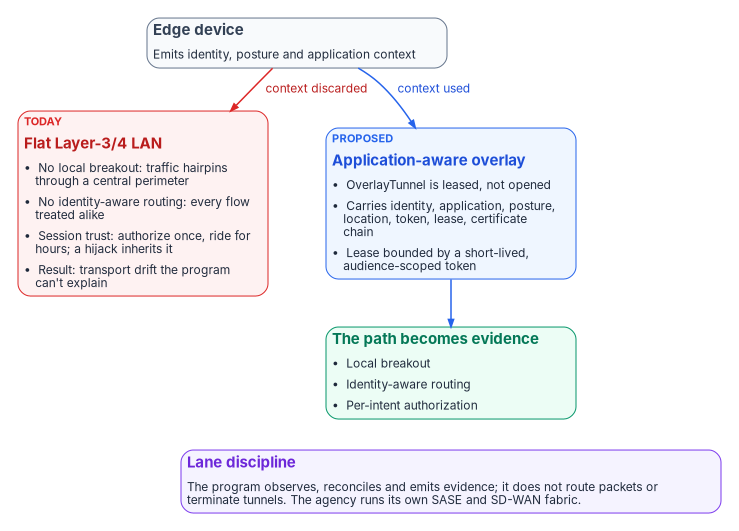
Take a well-tuned edge device: identity-anchored, emitting telemetry, compliant with policy. Put it on a flat datacenter LAN that isn’t application-aware and its value is bounded by the fabric under it, in three ways:
| What the flat LAN lacks | Consequence for the edge device |
|---|---|
| Local breakout with application-aware path selection | Traffic hairpins through a central perimeter; the device’s efficiency is spent on the detour |
| Identity-aware routing, where identity, telemetry and routing meet | Every flow is treated alike; no per-user or per-application path selection or segmentation, so the device’s identity signals have nowhere to land |
| Per-call authorization | Trust collapses into a long-lived session: authorize once, ride for hours, and a hijacked session inherits that trust |
The pattern is the same each time. The edge device emits identity, posture and application context, and a flat Layer-3/4 network discards it. The program can then govern what runs and who runs it, but not how it gets there, and the blind spot surfaces as authorization drift findings nobody can explain, because the transport context is invisible.
Leased, not opened
The requirement isn’t a faster LAN. It is an application-aware overlay in which the path is a typed, identity-anchored, governed object. The proposal defines it as an OverlayTunnel carrying identity, application, posture, location, token, lease and certificate chain. Tunnels are leased, not opened: the lease is bounded by the token’s lifetime, and the record of it is tied to the source of truth. The authorizing token is short-lived and audience-scoped, bound to the caller’s identity, the target application, the device’s posture and an organizationally derived location. A session, meaning any authorization that outlives a single authorized intent, stops being a first-class concept.
This is the data-plane move transposed onto the network. There, a stored database password was replaced by a freshly minted, audience-scoped token per connection. Here, the open session is replaced by a freshly leased, audience-scoped tunnel per path. In both cases the durable, hijackable artifact is removed and authorization becomes a per-event act. Short-lived workload identity of this kind already exists as an open standard: SPIFFE issues short-lived cryptographic identity documents that workloads present to each other to set up TLS or to sign and verify JWTs.103 The proposal deliberately picks no token format. The certificate chain in the lease comes from the agency’s PKI (Book 07 Chapter 06), and the identity and posture claims come from the same Conditional Access model that governs sign-in (Book 04 Chapter 03).
NIST SP 800-53 already has the hooks an assessor would test such a design against: session authenticity (SC-23), session termination (AC-12), network disconnect at the end of a session or after inactivity (SC-10), and a documented traffic-flow policy for each external telecommunications interface (SC-7(4)).104 The proposal doesn’t add a requirement so much as give those controls a mechanism that produces evidence on every path.
A flat LAN is a drift generator
The sharpest consequence for a governance program: a flat LAN doesn’t merely run slower, it manufactures drift. The proposal adds a sixth drift class, DRIFT-TRANSPORT, beside the existing five (DRIFT-SCHEMA, DRIFT-SEMANTIC, DRIFT-PROVENANCE, DRIFT-AUTHZ, DRIFT-IDENTITY). Under it, a tunnel or flow observed without an issuing token is a P2 finding, and variance between the canonical organizational and location binding and the observed path is a P4 finding. Drift is born where the governed path is the path of most resistance and an ungoverned shortcut exists; a flat, session-trusted LAN is that shortcut one layer down, the network equivalent of an unofficial local database nobody blessed.
Lane discipline
The program’s stake in the overlay is governance, not packet forwarding. Under the proposal, transport adapters observe, reconcile and emit evidence; they don’t route packets or terminate tunnels. The decision is doctrinal rather than implementation-prescriptive: it names no SD-WAN vendor and no token format, and it keeps the program out of the data plane. The agency runs whatever SASE and SD-WAN fabric it chooses; the program requires only that the fabric be application-aware and token-bound, so identity, application, posture and location can drive routing and authorization and the path becomes auditable.
The evidence the fabric must emit
Whether or not the governed path is adopted, the program’s modernization specifications for SD-WAN and SASE set the same contract for any adapter that observes them. Both consume identity from the identity plane rather than keeping a parallel identity store; SASE’s overlay binds to certificates issued against identity-plane objects, not to per-device pre-shared keys or location-based trust. And both treat every decision as a record with full provenance, consumed as control input rather than as an after-the-fact report.
The records below are the program’s adapter contract shapes, shown for structure. Field names are design positions, not a vendor API; map them to what a given controller and PEP actually export, and review before relying on them.
sdwan_decision:
  controller_id: "{controller}"
  decision_kind: "path-selection | failover | application-steering | qos"
  source_site: "{site_id}"
  destination: "{site_id | application_id}"
  selected_path: "{transport_id}"
  identity_context: "{issuer_identity | n/a}"
  sla_state: "{sla_class}"
  policy_refs:
    - "{authoritative_policy_id}"
  evaluation_timestamp: "ISO 8601"

sase_decision:
  pdp_id: "{policy_decision_point}"
  decision: "permit | deny | escalate"
  identity_context: "{issuer_identity}"
  resource_scope: "{application_id | url | dns_name}"
  network_overlay: "{overlay_id}"
  certificate_thumbprint: "{cert_id}"
  policy_refs:
    - "{authoritative_policy_id}"
  evaluation_timestamp: "ISO 8601"
Each adapter declares a mission class (enforcement, telemetry or integration), a class (modernization, replacing a legacy WAN or VPN, or conformance, observing state) and a boundary disposition. SD-WAN controllers often sit outside the agency’s cloud boundary, so the disposition must be explicit: in-boundary, a named exception, or a compensating controller. A controller that fits none of those needs an authorizing decision before it’s registered.
The drift the specifications watch for is concrete:
| Drift | SD-WAN example | SASE example |
|---|---|---|
| Schema | Controller policy schema diverges from the canonical shape | Vendor policy schema diverges from the canonical shape |
| Provenance | Telemetry chain breaks between site, controller and program, most often at a boundary crossing | Overlay certificate fails to bind to an identity-plane object |
| Authorization | A policy decision emitted outside its declared scope | A decision recorded outside the consent envelope |
| Semantic or identity | Service-level class means different things to the controller and the canonical model | The PDP receives an identity claim it can’t resolve: halt and alert |
The specifications are candid about limits. Vendor maturity inside government cloud boundaries varies, so an adapter may carry significant compensating logic. Some vendors’ path-quality telemetry is proprietary, and some PDPs don’t emit decision records at all, so records may have to be synthesized from logs and labeled as derived. A controller with no identity-aware policy can’t realize the full specification, and a certificate-anchored overlay depends on an agency PKI that issues certificates bound to identity objects. How these records become evidence for the boundary change is the subject of Chapter 13.
Securing the controller and the edges
A paper that credits the governor with providing controls owes the reader the controls that protect the governor. An SD-WAN deployment replaces a few hardened egress points with a fleet of internet-facing edges, one per office, and adds a management, orchestration and control plane with authority over routing and policy for the whole estate. CISA’s definition of an edge device, any device on the boundary of an agency network that is reachable from the public internet, covers every one of those branch edges.105
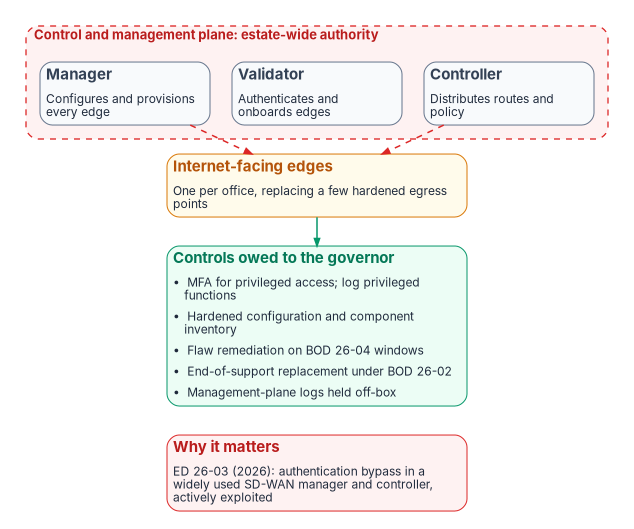
The risk isn’t hypothetical. On February 25, 2026, CISA issued Emergency Directive 26-03 for Cisco Catalyst SD-WAN Manager (formerly vManage) and Controller (formerly vSmart), covering an authentication bypass that lets an unauthenticated remote attacker gain administrative privileges (CVE-2026-20127) and a privilege-escalation flaw (CVE-2022-20775).106 The directive’s sequence is a template for any SD-WAN control plane: inventory every in-scope system, collect logs and forensic images and store logs off the device, patch, hunt for compromise, rebuild the management plane from patched images if root compromise is found and then migrate the edges, harden against the vendor’s guide, and send SD-WAN syslog to CISA through CLAW.107 The exposure didn’t end with the directive. CISA’s Supplemental Direction extends the hunt to CVE-2026-20133 and CVE-2026-20182 and says the malicious activity likely began in 2023;108 Cisco added the Validator (formerly vBond) to the CVE-2026-20127 advisory on June 16, 2026;109 and CISA’s Known Exploited Vulnerabilities (KEV) catalog lists nine Cisco Catalyst SD-WAN CVEs added during 2026, the newest, CVE-2026-76504, on September 30 with a due date of October 3.110 The directive’s sequence is a standing posture, not a one-time event. The point is not that one vendor had a bad year. It’s that an SD-WAN control plane is exactly the kind of high-value, estate-wide target an emergency directive gets written about, and an agency should be ready to execute that sequence before it’s ordered to.
Two standing directives govern the fleet in normal times. BOD 26-02 (February 5, 2026) requires agencies to inventory edge devices on CISA’s end-of-support list, decommission listed devices, and within 24 months maintain continuous discovery of edge devices approaching end of support.111 BOD 26-04 (June 10, 2026), which revokes BOD 22-01 and BOD 19-02, replaces flat remediation clocks with a risk model built on asset exposure, presence in the Known Exploited Vulnerabilities catalog, exploit automation and technical impact; the shortest window is three days.112 An internet-facing SD-WAN edge scores high on exposure by definition, so the program’s working assumption is that its vulnerabilities will land in the shortest windows. An agency that can’t patch a branch appliance inside those windows has a problem to solve before it deploys several hundred of them.
| Exposure | What to require | NIST SP 800-53 anchor113 |
|---|---|---|
| Administrative takeover of the manager or controller | Phishing-resistant MFA for every privileged account; management interfaces reachable only from an administrative network; privileged actions logged | IA-2(1), AC-6(9), SC-7(5) |
| Rogue edges or peers joining the overlay | Certificate-based edge onboarding from the agency PKI; validator allow-list; alert on unexpected peers | IA-3, CM-8 |
| Unpatched or end-of-support edges | Fleet inventory with software versions and support dates; remediation inside BOD 26-04 windows; replacement plan under BOD 26-02 | CM-8, SI-2 |
| Configuration drift across hundreds of edges | Hardened baseline from the vendor’s hardening guide; drift detection against the controller’s intended state | CM-6 |
| Lost forensic trail | Management-plane and edge logs exported off-box to the agency log pipeline and to CISA | AU-6, AU-9 |
| Cloud-hosted control plane | The controller’s own authorization status and boundary disposition recorded in the package | CA-3, SA-9 |
None of this argues against SD-WAN. The branch already has a router with a management plane; the replacement adds telemetry and auditable policy the incumbent lacks. It does mean the order of operations in Chapter 13 has a step zero: bring the governor under vulnerability management, privileged-access control and logging before it carries production traffic, because once it does, it is the most consequential network device the agency owns.
- SD-WAN’s lean and bulk path classes mirror the data layer’s strong and eventual consistency split; aligning them gives the best synchronization physics permits.
- SD-WAN recovers route inflation and, more importantly, shrinks the tail with FEC, packet duplication and fast failover, and keeps bulk transfers off the commit path. It reaches the floor; it never goes below it.
- At the branch, TIC 3.0’s policy enforcement parity makes the steering policy a security control: every path class must land on enforcement of equal strength.
- SASE security services sit above SD-WAN. CISA lists SD-WAN among SASE’s networking tools but mandates neither; the boundary, flow and malware closures come from the services above it, and the PEP’s location is a physics decision too.
- FedRAMP status differs by offering, not by vendor; read it from the Marketplace data when the requirement is written.
- The bridge to identity-aware access maps each TIC 3.0 and SASE capability to a control that reads identity, device and path; every bypass is registered with an owner and an expiry, and the pilot ends on measured exit criteria.
- The proposed governed path extends per-call identity to the transport plane: tunnels leased per intent, bound to a short-lived token, with the path recorded as evidence and the program kept out of the data plane.
- The controller and edges are new, estate-wide attack surface. ED 26-03, BOD 26-02 and BOD 26-04 define what protecting them looks like; that protection comes before production traffic.
I. N. Bozkurt, A. Aguirre, B. Chandrasekaran, P. B. Godfrey, G. Laughlin, B. Maggs and A. Singla, “Why Is the Internet so Slow?!,” Passive and Active Measurement (PAM 2017), LNCS 10176, pp. 173–187, https://doi.org/10.1007/978-3-319-54328-4_13; summarized by the authors in APNIC Blog, June 19, 2017 (minimum ping times about 3.1× the c-latency bound in the median, as the paper reports; median page fetch about 37×), https://blog.apnic.net/2017/06/19/why-is-the-internet-so-slow/ (accessed Oct 21, 2026).↩︎
Microsoft Learn, “Azure network round-trip latency statistics” (P50 of 1-minute probe measurements; dataset for the 30 days ending July 30, 2026; UK South to East US 78 ms), https://learn.microsoft.com/azure/networking/azure-network-latency (accessed Oct 21, 2026). The 6,150 km great-circle distance (London to the East US region’s Virginia location) and the 62 ms floor are the chapter’s own arithmetic at 200 km per millisecond.↩︎
Cisco, Cisco Catalyst SD-WAN Policies Configuration Guide, Cisco IOS XE Catalyst SD-WAN Release 17.x, “Forward Error Correction” (one parity packet per group of four; FEC Adaptive and FEC Always), https://www.cisco.com/c/en/us/td/docs/routers/sdwan/configuration/policies/ios-xe-17/policies-book-xe/forward-error-correction.html (accessed Oct 21, 2026).↩︎
Cisco, Policies Configuration Guide, “Packet Duplication for Noisy Channels” (copies sent on alternate SD-WAN tunnels; receiver discards duplicates; for sites with multiple WAN links; voice and video), https://www.cisco.com/c/en/us/td/docs/routers/sdwan/configuration/policies/vedge/policies-book/packet-duplication.html (accessed Oct 21, 2026).↩︎
J. C. Corbett et al., “Spanner: Google’s Globally-Distributed Database,” OSDI 2012, Secs. 1, 3 and 4.1.2 (TrueTime uncertainty generally under 10 ms using GPS and atomic clocks; commit wait), https://research.google/pubs/spanner-googles-globally-distributed-database-2/ and https://static.googleusercontent.com/media/research.google.com/en//archive/spanner-osdi2012.pdf (accessed Oct 21, 2026).↩︎
Microsoft Learn, “TCP/IP performance tuning for Azure VMs,” section “Common TCP/IP tuning techniques” (New York to London 5,585 km, 28 ms one way, 56 ms RTT; minimum RTT = 2 × distance ÷ 200 km per ms), https://learn.microsoft.com/azure/virtual-network/virtual-network-tcpip-performance-tuning (accessed Oct 21, 2026).↩︎
CISA, Trusted Internet Connections 3.0 Branch Office Use Case, Version 3.0, publication September 2026, Sec. 6 (three security patterns), Universal Security Capabilities (Policy Enforcement Parity) and Sec. 7.2.3 (Networking PEP Security Capabilities), https://www.cisa.gov/sites/default/files/2026-10/tic-3-branch-office-use-september-2026-508c.pdf, linked from https://www.cisa.gov/resources-tools/programs/trusted-internet-connections-tic (accessed Oct 21, 2026).↩︎
CISA, Trusted Internet Connections 3.0 Branch Office Use Case, Version 3.0, publication September 2026, Sec. 6 (three security patterns), Universal Security Capabilities (Policy Enforcement Parity) and Sec. 7.2.3 (Networking PEP Security Capabilities), https://www.cisa.gov/sites/default/files/2026-10/tic-3-branch-office-use-september-2026-508c.pdf, linked from https://www.cisa.gov/resources-tools/programs/trusted-internet-connections-tic (accessed Oct 21, 2026).↩︎
CISA, The Journey to Zero Trust: Using Secure Access Service Edge in a Modern TIC 3.0 Solution, Version 1.0, June 2026, Sec. 4 (definition and key capabilities), Sec. 5 (trust zones; telemetry to CLAW) and Appendix C (notional reference architecture), https://www.cisa.gov/resources-tools/resources/using-sase-modern-tic-30-solution (accessed Oct 21, 2026).↩︎
CISA, The Journey to Zero Trust: Using Secure Access Service Edge in a Modern TIC 3.0 Solution, Version 1.0, June 2026, Sec. 4 (definition and key capabilities), Sec. 5 (trust zones; telemetry to CLAW) and Appendix C (notional reference architecture), https://www.cisa.gov/resources-tools/resources/using-sase-modern-tic-30-solution (accessed Oct 21, 2026).↩︎
CISA, The Journey to Zero Trust: Using Secure Access Service Edge in a Modern TIC 3.0 Solution, Version 1.0, June 2026, Sec. 4 (definition and key capabilities), Sec. 5 (trust zones; telemetry to CLAW) and Appendix C (notional reference architecture), https://www.cisa.gov/resources-tools/resources/using-sase-modern-tic-30-solution (accessed Oct 21, 2026).↩︎
Microsoft Learn, “Microsoft 365 network connectivity principles,” section “Egress network connections locally” and “Avoid network hairpins” (evaluating cloud-based network and security providers’ PoP locations and peering), https://learn.microsoft.com/microsoft-365/enterprise/microsoft-365-network-connectivity-principles (accessed Oct 21, 2026).↩︎
Microsoft Learn, “Plan and configure dynamic emergency calling,” section Configure network settings (trusted IP addresses; cloud proxy services that modify source IP addresses) and section Configure Location Information Service, https://learn.microsoft.com/microsoftteams/configure-dynamic-emergency-calling (accessed Oct 30, 2026).↩︎
Microsoft Learn, “Emergency addresses for remote locations,” sections Location precedence and Emergency address classification and routing, https://learn.microsoft.com/microsoftteams/emergency-calling-dispatchable-location (accessed Oct 30, 2026).↩︎
Microsoft Learn, “Implementing VPN split tunneling for Microsoft 365,” sections Identify the endpoints to optimize and Implementing split tunnel for Microsoft 365 endpoints, https://learn.microsoft.com/microsoft-365/enterprise/microsoft-365-vpn-implement-split-tunnel (accessed Oct 30, 2026).↩︎
FedRAMP Marketplace product data, https://www.fedramp.gov/marketplace/products.json (last change October 21, 2026; accessed Oct 21, 2026): Palo Alto Networks GCS-HIGH (FR2317253567), Palo Alto Networks Government Cloud Services (FR1913470600), Zscaler Internet Access – Government – High (FR2227062482), Zscaler Private Access – Government (FR1719759604), Netskope NewEdge Government (FR2105946715), Cisco Security Cloud for Government (FR2304757473A), Cisco Catalyst SD-WAN for Government (FR2012534927), Cisco Meraki US Government Region (FR2315535023). Product pages at https://www.fedramp.gov/marketplace/products/{id}/.↩︎
Palo Alto Networks, “FedRAMP Moderate and High Support” (“SD-WAN Controller” and “Prisma SD-WAN managed by Strata Cloud Manager” marked supported at Moderate and not at High), https://docs.paloaltonetworks.com/fedramp/prisma-sase/fedramp-moderate-and-high-requirements/fedramp-moderate-and-high-support (accessed Oct 24, 2026).↩︎
Cybersecurity and Infrastructure Security Agency, “V1: ED 26-03: Mitigate Vulnerabilities in Cisco SD-WAN Systems,” March 11, 2026, Required Actions, “If Off-Prem (cloud) deployments” (the agency requests the forensic snapshot and the AWS network logs from Cisco), https://www.cisa.gov/news-events/directives/v1-ed-26-03-mitigate-vulnerabilities-cisco-sd-wan-systems (accessed Oct 24, 2026).↩︎
Cisco, Security Advisory cisco-sa-sdwan-rpa2-v69WY2SW, “Cisco Catalyst SD-WAN Controller Authentication Bypass Vulnerability,” CVE-2026-20182, version 2.0, June 16, 2026 (“This vulnerability affects all deployment types,” including On-Prem and “Cisco SD-WAN for Government (FedRAMP)”; the same deployment-type list appears in the advisories for CVE-2026-20127, CVE-2026-20245 and CVE-2026-20262), https://sec.cloudapps.cisco.com/security/center/content/CiscoSecurityAdvisory/cisco-sa-sdwan-rpa2-v69WY2SW (accessed Oct 24, 2026).↩︎
FedRAMP Marketplace product data, packages FR2227062482, “Zscaler Internet Access - Government (Secure Web Gateway - vTIC) - High” (FedRAMP Certified; Class D; impact level High; JAB path; certified July 2, 2022), and FR1720454205, “Zscaler Internet Access - Government (Secure Web Gateway - vTIC)” (FedRAMP Certified; Class C; impact level Moderate; agency path; certified December 14, 2018), https://www.fedramp.gov/marketplace/products.json (accessed Oct 21, 2026).↩︎
GSA, “Trusted Internet Connections” (solutions for the Branch Office, Remote User, Cloud and other TIC 3.0 use cases “are available from the Enterprise Infrastructure Solutions contract,” including “SD-WAN Service as fully managed, co-managed, or do-it-yourself implementations”), https://www.gsa.gov/technology/it-contract-vehicles-and-purchasing-programs/enterprise-infrastructure-solutions/trusted-internet-connections (accessed Oct 21, 2026).↩︎
Microsoft Learn, “What is Global Secure Access?,” (general availability; licensing; feature comparison; remote network licensing), https://learn.microsoft.com/entra/global-secure-access/overview-what-is-global-secure-access (accessed Nov 9, 2026).↩︎
Microsoft Learn, “Known Limitations for Global Secure Access,” (Government Cloud limitations; Private Access, traffic forwarding, remote network and client limitations), https://learn.microsoft.com/entra/global-secure-access/reference-current-known-limitations (accessed Nov 9, 2026).↩︎
Microsoft Learn, “Microsoft Entra feature availability in Azure for US Government,” (Azure for US Government; no Global Secure Access entry), https://learn.microsoft.com/entra/identity/authentication/feature-availability (accessed Nov 9, 2026).↩︎
Microsoft Learn, “Microsoft Entra Connect: Hybrid identity considerations for Azure Government cloud,” (install the agent for the Azure Government cloud), https://learn.microsoft.com/entra/identity/hybrid/connect/reference-connect-government-cloud (accessed Nov 9, 2026).↩︎
Microsoft Learn, “What is Global Secure Access?,” (general availability; licensing; feature comparison; remote network licensing), https://learn.microsoft.com/entra/global-secure-access/overview-what-is-global-secure-access (accessed Nov 9, 2026).↩︎
Microsoft Learn, “Global Secure Access Certifications,” https://learn.microsoft.com/entra/global-secure-access/reference-global-secure-access-certifications (accessed Nov 9, 2026).↩︎
Microsoft Learn, “Known Limitations for Global Secure Access,” (Government Cloud limitations; Private Access, traffic forwarding, remote network and client limitations), https://learn.microsoft.com/entra/global-secure-access/reference-current-known-limitations (accessed Nov 9, 2026).↩︎
Microsoft Learn, “What is Global Secure Access?,” (general availability; licensing; feature comparison; remote network licensing), https://learn.microsoft.com/entra/global-secure-access/overview-what-is-global-secure-access (accessed Nov 9, 2026).↩︎
Microsoft Learn, “Learn about Microsoft Entra Internet Access,” (security profiles; baseline profile; web content filtering), https://learn.microsoft.com/entra/global-secure-access/concept-internet-access (accessed Nov 9, 2026).↩︎
Microsoft Learn, “Learn about Microsoft Entra Private Access,” https://learn.microsoft.com/entra/global-secure-access/concept-private-access (accessed Nov 9, 2026).↩︎
Microsoft Learn, “How to configure per-app access using Global Secure Access applications,” (segments, overlap, traffic flow), https://learn.microsoft.com/entra/global-secure-access/how-to-configure-per-app-access (accessed Nov 9, 2026).↩︎
Microsoft Learn, “Tutorial: VPN replacement with Quick Access,” https://learn.microsoft.com/entra/global-secure-access/tutorial-private-access-vpn-replacement (accessed Nov 9, 2026).↩︎
Microsoft Learn, “How to configure Quick Access for Global Secure Access,” https://learn.microsoft.com/entra/global-secure-access/how-to-configure-quick-access (accessed Nov 9, 2026).↩︎
Microsoft Learn, “Tutorial: VPN replacement with Quick Access,” https://learn.microsoft.com/entra/global-secure-access/tutorial-private-access-vpn-replacement (accessed Nov 9, 2026).↩︎
Microsoft Learn, “Application Discovery for Global Secure Access,” https://learn.microsoft.com/entra/global-secure-access/how-to-application-discovery (accessed Nov 9, 2026).↩︎
Microsoft Learn, “Microsoft Global Secure Access Deployment Guide for Microsoft Entra Private Access,” https://learn.microsoft.com/entra/architecture/gsa-deployment-guide-private-access (accessed Nov 9, 2026).↩︎
Microsoft Learn, “How to configure per-app access using Global Secure Access applications,” (segments, overlap, traffic flow), https://learn.microsoft.com/entra/global-secure-access/how-to-configure-per-app-access (accessed Nov 9, 2026).↩︎
Microsoft Learn, “How to configure Quick Access for Global Secure Access,” https://learn.microsoft.com/entra/global-secure-access/how-to-configure-quick-access (accessed Nov 9, 2026).↩︎
Microsoft Learn, “How to Apply Conditional Access Policies to Microsoft Entra Private Access Apps,” https://learn.microsoft.com/entra/global-secure-access/how-to-target-resource-private-access-apps (accessed Nov 9, 2026).↩︎
Microsoft Learn, “Known Limitations for Global Secure Access,” (Government Cloud limitations; Private Access, traffic forwarding, remote network and client limitations), https://learn.microsoft.com/entra/global-secure-access/reference-current-known-limitations (accessed Nov 9, 2026).↩︎
Microsoft Learn, “Tutorial: VPN replacement with Quick Access,” https://learn.microsoft.com/entra/global-secure-access/tutorial-private-access-vpn-replacement (accessed Nov 9, 2026).↩︎
Microsoft Learn, “Microsoft Entra Private Network Connectors,” (outbound only; two per group; sizing; updater; inactive connectors), https://learn.microsoft.com/entra/global-secure-access/concept-connectors (accessed Nov 9, 2026).↩︎
Microsoft Learn, “How to configure connectors for Microsoft Entra Private Access,” (server and TLS requirements; outbound ports and URLs; services; maintenance), https://learn.microsoft.com/entra/global-secure-access/how-to-configure-connectors (accessed Nov 9, 2026).↩︎
Microsoft Learn, “How to configure Quick Access for Global Secure Access,” https://learn.microsoft.com/entra/global-secure-access/how-to-configure-quick-access (accessed Nov 9, 2026).↩︎
Microsoft Learn, “How to configure connectors for Microsoft Entra Private Access,” (server and TLS requirements; outbound ports and URLs; services; maintenance), https://learn.microsoft.com/entra/global-secure-access/how-to-configure-connectors (accessed Nov 9, 2026).↩︎
Microsoft Learn, “How to configure connectors for Microsoft Entra Private Access,” (server and TLS requirements; outbound ports and URLs; services; maintenance), https://learn.microsoft.com/entra/global-secure-access/how-to-configure-connectors (accessed Nov 9, 2026).↩︎
Microsoft Learn, “Silent install Microsoft Entra private network connector,” https://learn.microsoft.com/entra/global-secure-access/how-to-register-connector-powershell (accessed Nov 9, 2026).↩︎
Microsoft Learn, “Silent install Microsoft Entra private network connector,” https://learn.microsoft.com/entra/global-secure-access/how-to-register-connector-powershell (accessed Nov 9, 2026).↩︎
Microsoft Learn, “How to configure connectors for Microsoft Entra Private Access,” (server and TLS requirements; outbound ports and URLs; services; maintenance), https://learn.microsoft.com/entra/global-secure-access/how-to-configure-connectors (accessed Nov 9, 2026).↩︎
Microsoft Learn, “Microsoft Entra Private Network Connectors,” (outbound only; two per group; sizing; updater; inactive connectors), https://learn.microsoft.com/entra/global-secure-access/concept-connectors (accessed Nov 9, 2026).↩︎
Microsoft Learn, “How to configure connectors for Microsoft Entra Private Access,” (server and TLS requirements; outbound ports and URLs; services; maintenance), https://learn.microsoft.com/entra/global-secure-access/how-to-configure-connectors (accessed Nov 9, 2026).↩︎
Microsoft Learn, “Microsoft Entra Private DNS - Configure Secure Internal Name Resolution,” https://learn.microsoft.com/entra/global-secure-access/concept-private-name-resolution (accessed Nov 9, 2026).↩︎
Microsoft Learn, “Tutorial: VPN replacement with Quick Access,” https://learn.microsoft.com/entra/global-secure-access/tutorial-private-access-vpn-replacement (accessed Nov 9, 2026).↩︎
Microsoft Learn, “Microsoft Entra Private DNS - Configure Secure Internal Name Resolution,” https://learn.microsoft.com/entra/global-secure-access/concept-private-name-resolution (accessed Nov 9, 2026).↩︎
Microsoft Learn, “Known Limitations for Global Secure Access,” (Government Cloud limitations; Private Access, traffic forwarding, remote network and client limitations), https://learn.microsoft.com/entra/global-secure-access/reference-current-known-limitations (accessed Nov 9, 2026).↩︎
Microsoft Learn, “Migrate from DirectAccess to Microsoft Entra Private Access,” https://learn.microsoft.com/entra/global-secure-access/how-to-migrate-direct-access-to-private-access (accessed Nov 9, 2026).↩︎
Microsoft Learn, “Migrate from DirectAccess to Microsoft Entra Private Access,” https://learn.microsoft.com/entra/global-secure-access/how-to-migrate-direct-access-to-private-access (accessed Nov 9, 2026).↩︎
Microsoft Learn, “Migrate from DirectAccess to Microsoft Entra Private Access,” https://learn.microsoft.com/entra/global-secure-access/how-to-migrate-direct-access-to-private-access (accessed Nov 9, 2026).↩︎
Microsoft Learn, “Migrate from DirectAccess to Microsoft Entra Private Access,” https://learn.microsoft.com/entra/global-secure-access/how-to-migrate-direct-access-to-private-access (accessed Nov 9, 2026).↩︎
Microsoft Learn, “Enable Intelligent Local Network” and “Global Secure Access Client for macOS Release Notes,” https://learn.microsoft.com/entra/global-secure-access/enable-intelligent-local-access and https://learn.microsoft.com/entra/global-secure-access/reference-macos-client-release-history (accessed Nov 9, 2026).↩︎
Microsoft Learn, “Enable Intelligent Local Network” and “Global Secure Access Client for macOS Release Notes,” https://learn.microsoft.com/entra/global-secure-access/enable-intelligent-local-access and https://learn.microsoft.com/entra/global-secure-access/reference-macos-client-release-history (accessed Nov 9, 2026).↩︎
Microsoft Learn, “Introduction to Microsoft Global Secure Access Deployment Guide,” https://learn.microsoft.com/entra/architecture/gsa-deployment-guide-intro (accessed Nov 9, 2026).↩︎
Microsoft Learn, “Introduction to Microsoft Global Secure Access Proof-of-Concept Guidance” and “Microsoft Global Secure Access Proof-of-Concept Guidance - Configure Microsoft Entra Private Access,” https://learn.microsoft.com/entra/architecture/gsa-poc-guidance-intro and https://learn.microsoft.com/entra/architecture/gsa-poc-private-access (accessed Nov 9, 2026).↩︎
Microsoft Learn, “Introduction to Microsoft Global Secure Access Deployment Guide,” https://learn.microsoft.com/entra/architecture/gsa-deployment-guide-intro (accessed Nov 9, 2026).↩︎
Microsoft Learn, “Migrate from DirectAccess to Microsoft Entra Private Access,” https://learn.microsoft.com/entra/global-secure-access/how-to-migrate-direct-access-to-private-access (accessed Nov 9, 2026).↩︎
Microsoft Learn, “What is Global Secure Access?,” (general availability; licensing; feature comparison; remote network licensing), https://learn.microsoft.com/entra/global-secure-access/overview-what-is-global-secure-access (accessed Nov 9, 2026).↩︎
Microsoft Learn, “Global Secure Access remote network connectivity,” (profiles; baseline profile; bandwidth and licenses), https://learn.microsoft.com/entra/global-secure-access/concept-remote-network-connectivity (accessed Nov 9, 2026).↩︎
Microsoft Learn, “Global Secure Access remote network connectivity,” (profiles; baseline profile; bandwidth and licenses), https://learn.microsoft.com/entra/global-secure-access/concept-remote-network-connectivity (accessed Nov 9, 2026).↩︎
Microsoft Learn, “How to Create Remote Networks,” (CPE requirements; responder mode; firewall ports), https://learn.microsoft.com/entra/global-secure-access/how-to-create-remote-networks (accessed Nov 9, 2026).↩︎
Microsoft Learn, “Global Secure Access remote network connectivity,” (profiles; baseline profile; bandwidth and licenses), https://learn.microsoft.com/entra/global-secure-access/concept-remote-network-connectivity (accessed Nov 9, 2026).↩︎
Microsoft Learn, “Known Limitations for Global Secure Access,” (Government Cloud limitations; Private Access, traffic forwarding, remote network and client limitations), https://learn.microsoft.com/entra/global-secure-access/reference-current-known-limitations (accessed Nov 9, 2026).↩︎
Microsoft Learn, “Global Secure Access remote network configurations,” (device types, regions, IKE parameters), https://learn.microsoft.com/entra/global-secure-access/reference-remote-network-configurations (accessed Nov 9, 2026).↩︎
Microsoft Learn, “Learn about Microsoft Entra Internet Access,” (security profiles; baseline profile; web content filtering), https://learn.microsoft.com/entra/global-secure-access/concept-internet-access (accessed Nov 9, 2026).↩︎
Microsoft Learn, “How to configure Global Secure Access threat intelligence,” https://learn.microsoft.com/entra/global-secure-access/how-to-configure-threat-intelligence (accessed Nov 9, 2026).↩︎
Microsoft Learn, “Learn about Microsoft Entra Internet Access,” (security profiles; baseline profile; web content filtering), https://learn.microsoft.com/entra/global-secure-access/concept-internet-access (accessed Nov 9, 2026).↩︎
Microsoft Learn, “How to configure Global Secure Access threat intelligence,” https://learn.microsoft.com/entra/global-secure-access/how-to-configure-threat-intelligence (accessed Nov 9, 2026).↩︎
Microsoft Learn, “Configure cloud firewall for remote networks” and “Configure cloud firewall for Global Secure Access clients (preview),” https://learn.microsoft.com/entra/global-secure-access/how-to-configure-cloud-firewall and https://learn.microsoft.com/entra/global-secure-access/how-to-configure-cloud-firewall-clients (accessed Nov 9, 2026).↩︎
Microsoft Learn, “Create content policies for network content filtering,” https://learn.microsoft.com/entra/global-secure-access/how-to-network-content-filtering (accessed Nov 9, 2026).↩︎
Microsoft Learn, “Configure Transport Layer Security Inspection Policies,” https://learn.microsoft.com/entra/global-secure-access/how-to-transport-layer-security (accessed Nov 9, 2026).↩︎
Microsoft Learn, “Partner Ecosystem Overview,” https://learn.microsoft.com/entra/global-secure-access/partner-ecosystems-overview (accessed Nov 9, 2026).↩︎
Microsoft Learn, “Configure Microsoft and Zscaler for a Unified SASE Solution,” (scenarios; Global Secure Access service FQDNs and IPs bypasses), https://learn.microsoft.com/entra/global-secure-access/how-to-zscaler-coexistence (accessed Nov 9, 2026).↩︎
Microsoft Learn, “Security Service Edge (SSE) coexistence with Microsoft and Palo Alto Networks,” https://learn.microsoft.com/entra/global-secure-access/how-to-palo-alto-coexistence (accessed Nov 9, 2026).↩︎
Microsoft Learn, “Security Service Edge (SSE) Coexistence With Microsoft and Netskope,” https://learn.microsoft.com/entra/global-secure-access/how-to-netskope-coexistence (accessed Nov 9, 2026).↩︎
Microsoft Learn, “Security Service Edge (SSE) Coexistence With Microsoft and Cisco Umbrella,” “… and Cisco Secure Access” and “… and Cisco VPNs,” https://learn.microsoft.com/entra/global-secure-access/how-to-cisco-coexistence, https://learn.microsoft.com/entra/global-secure-access/how-to-cisco-secure-access-coexistence and https://learn.microsoft.com/entra/global-secure-access/how-to-cisco-vpn-coexistence (accessed Nov 9, 2026).↩︎
Microsoft Learn, “Configure Microsoft Entra Global Secure Access with Infoblox,” https://learn.microsoft.com/entra/global-secure-access/how-to-infoblox-coexistence (accessed Nov 9, 2026).↩︎
Microsoft Learn, “Configure Microsoft and Zscaler for a Unified SASE Solution,” (scenarios; Global Secure Access service FQDNs and IPs bypasses), https://learn.microsoft.com/entra/global-secure-access/how-to-zscaler-coexistence (accessed Nov 9, 2026).↩︎
Microsoft Learn, “Configure Microsoft and Zscaler for a Unified SASE Solution,” (scenarios; Global Secure Access service FQDNs and IPs bypasses), https://learn.microsoft.com/entra/global-secure-access/how-to-zscaler-coexistence (accessed Nov 9, 2026).↩︎
Microsoft Learn, “Security Service Edge (SSE) Coexistence With Microsoft and Cisco Umbrella,” “… and Cisco Secure Access” and “… and Cisco VPNs,” https://learn.microsoft.com/entra/global-secure-access/how-to-cisco-coexistence, https://learn.microsoft.com/entra/global-secure-access/how-to-cisco-secure-access-coexistence and https://learn.microsoft.com/entra/global-secure-access/how-to-cisco-vpn-coexistence (accessed Nov 9, 2026).↩︎
Microsoft Learn, “EDR and antivirus coexistence with Global Secure Access client,” https://learn.microsoft.com/entra/global-secure-access/how-to-edr-antivirus-coexistence (accessed Nov 9, 2026).↩︎
Microsoft Learn, “Known Limitations for Global Secure Access,” (Government Cloud limitations; Private Access, traffic forwarding, remote network and client limitations), https://learn.microsoft.com/entra/global-secure-access/reference-current-known-limitations (accessed Nov 9, 2026).↩︎
Microsoft Learn, “Global Secure Access logs and monitoring,” https://learn.microsoft.com/entra/global-secure-access/concept-global-secure-access-logs-monitoring (accessed Nov 9, 2026).↩︎
Microsoft Learn, “Known Limitations for Global Secure Access,” (Government Cloud limitations; Private Access, traffic forwarding, remote network and client limitations), https://learn.microsoft.com/entra/global-secure-access/reference-current-known-limitations (accessed Nov 9, 2026).↩︎
Microsoft Learn, “Enable compliant network check with Conditional Access,” sections “Enable Global Secure Access signaling for Conditional Access” (the All Compliant Network locations named location; the caution about disabling signaling while compliant network policies are active) and “Protect your resources behind the compliant network,” https://learn.microsoft.com/entra/global-secure-access/how-to-compliant-network (accessed Nov 11, 2026).↩︎
Microsoft Learn, “Configure Microsoft Entra for Zero Trust: Protect networks,” section “Zero Trust security recommendations” (Global Secure Access signaling for Conditional Access is enabled; traffic forwarding profiles route traffic for enforcement), https://learn.microsoft.com/entra/fundamentals/zero-trust-protect-networks (accessed Nov 11, 2026).↩︎
Microsoft Learn, “Configure Microsoft Entra for Zero Trust: Protect networks,” section “Zero Trust security recommendations” (Global Secure Access signaling for Conditional Access is enabled; traffic forwarding profiles route traffic for enforcement), https://learn.microsoft.com/entra/fundamentals/zero-trust-protect-networks (accessed Nov 11, 2026).↩︎
Microsoft Learn, “Known Limitations for Global Secure Access,” (Government Cloud limitations; Private Access, traffic forwarding, remote network and client limitations), https://learn.microsoft.com/entra/global-secure-access/reference-current-known-limitations (accessed Nov 9, 2026).↩︎
Microsoft Learn, “Tutorial: Enable the compliant network check,” sections “Step 1: Create the compliant network Conditional Access policy” (start with a pilot group and a test application) and “Step 2: Validate the compliant network policy” (disable the client and confirm a fresh sign-in is blocked); source IP restoration must be enabled to target the compliant network, https://learn.microsoft.com/entra/global-secure-access/tutorial-microsoft-traffic-compliant-network (accessed Nov 11, 2026).↩︎
Microsoft Learn, “Enable compliant network check with Conditional Access,” sections “Enable Global Secure Access signaling for Conditional Access” (the All Compliant Network locations named location; the caution about disabling signaling while compliant network policies are active) and “Protect your resources behind the compliant network,” https://learn.microsoft.com/entra/global-secure-access/how-to-compliant-network (accessed Nov 11, 2026).↩︎
National Institute of Standards and Technology, SP 800-207, Zero Trust Architecture, August 2020, Sec. 2.1, tenet 3, https://csrc.nist.gov/pubs/sp/800/207/final (accessed Oct 21, 2026).↩︎
Amazon Web Services, Amazon RDS User Guide, “IAM database authentication for MariaDB, MySQL, and PostgreSQL” (token lifetime 15 minutes; used only for authentication and doesn’t affect the session after it is established), https://docs.aws.amazon.com/AmazonRDS/latest/UserGuide/UsingWithRDS.IAMDBAuth.html (accessed Oct 21, 2026).↩︎
Microsoft Learn, “Microsoft Entra authentication in Azure Database for PostgreSQL flexible server,” section “Frequently asked questions” (user tokens valid up to 1 hour; system-assigned managed identity tokens up to 24 hours), https://learn.microsoft.com/azure/postgresql/security/security-entra-concepts (accessed Oct 21, 2026).↩︎
SPIFFE, “SPIFFE Overview” (SVIDs as short-lived cryptographic identity documents used for TLS or JWT signing and verification), https://spiffe.io/docs/latest/spiffe-about/overview/ (accessed Oct 21, 2026).↩︎
NIST SP 800-53 Rev. 5, Security and Privacy Controls for Information Systems and Organizations, release 5.2.0, OSCAL catalog https://github.com/usnistgov/oscal-content/tree/main/nist.gov/SP800-53/rev5, publication page https://csrc.nist.gov/pubs/sp/800/53/r5/upd1/final (accessed Oct 21, 2026). SC-7(4), SC-7(5), SC-10, SC-23, AC-12, AC-6(9), IA-2(1), IA-3, CM-6, CM-8, SI-2, AU-6, AU-9, CA-3 and SA-9 as cited.↩︎
CISA, BOD 26-02, Mitigating Risk From End-of-Support Edge Devices, February 5, 2026 (edge device definition; 3-, 12-, 18- and 24-month actions), https://www.cisa.gov/news-events/directives/bod-26-02-mitigating-risk-end-support-edge-devices (accessed Oct 21, 2026).↩︎
CISA, ED 26-03, Mitigate Vulnerabilities in Cisco SD-WAN Systems, issued February 25, 2026, updated as V1 on March 11, 2026, https://www.cisa.gov/news-events/directives/ed-26-03-mitigate-vulnerabilities-cisco-sd-wan-systems (accessed Oct 21, 2026).↩︎
CISA, ED 26-03, Mitigate Vulnerabilities in Cisco SD-WAN Systems, issued February 25, 2026, updated as V1 on March 11, 2026, https://www.cisa.gov/news-events/directives/ed-26-03-mitigate-vulnerabilities-cisco-sd-wan-systems (accessed Oct 21, 2026).↩︎
Cybersecurity and Infrastructure Security Agency, Supplemental Direction ED 26-03: Hunt and Hardening Guidance for Cisco SD-WAN Systems (names CVE-2026-20127, CVE-2022-20775, CVE-2026-20133 and CVE-2026-20182; activity “likely began in 2023”; hardening: a firewall allow-listing only known edge, controller, validator and manager IPs, with static IPs on all edge appliances; “Host Infrastructure in GovCloud”; “Federal organizations should migrate to FEDRAMP-compliant cloud infrastructure”), https://www.cisa.gov/news-events/directives/supplemental-direction-ed-26-03-hunt-and-hardening-guidance-cisco-sd-wan-systems (accessed Oct 24, 2026).↩︎
Cisco, Security Advisory cisco-sa-sdwan-rpa-EHchtZk, “Cisco Catalyst SD-WAN Controller Authentication Bypass Vulnerability,” CVE-2026-20127, version 2.1, October 28, 2026 (version 2.0 of June 16, 2026 added Validator to the affected products; version 2.1 added a Talos Intelligence blog link to the exploitation section, which still reports limited exploitation; the deployment types listed include the FedRAMP environment), https://sec.cloudapps.cisco.com/security/center/content/CiscoSecurityAdvisory/cisco-sa-sdwan-rpa-EHchtZk (accessed Nov 9, 2026).↩︎
Cybersecurity and Infrastructure Security Agency, Known Exploited Vulnerabilities catalog, JSON feed, catalog version 2026.10.23, https://www.cisa.gov/sites/default/files/feeds/known_exploited_vulnerabilities.json (accessed Oct 24, 2026). Cisco Catalyst SD-WAN entries added in 2026: CVE-2026-20127 and CVE-2022-20775 (February 25, due February 27), CVE-2026-20122, CVE-2026-20128 and CVE-2026-20133 (April 20), CVE-2026-20182 (May 14, due May 17), CVE-2026-20245 (June 9), CVE-2026-20262 (June 15) and CVE-2026-76504 (September 30, due October 3).↩︎
CISA, BOD 26-02, Mitigating Risk From End-of-Support Edge Devices, February 5, 2026 (edge device definition; 3-, 12-, 18- and 24-month actions), https://www.cisa.gov/news-events/directives/bod-26-02-mitigating-risk-end-support-edge-devices (accessed Oct 21, 2026).↩︎
CISA, BOD 26-04, Prioritizing Security Updates Based on Risk, June 10, 2026 (revokes BOD 19-02 and BOD 22-01; four risk variables; three-day window with forensic triage at the top), https://www.cisa.gov/news-events/directives/bod-26-04-prioritizing-security-updates-based-risk (accessed Oct 21, 2026).↩︎
NIST SP 800-53 Rev. 5, Security and Privacy Controls for Information Systems and Organizations, release 5.2.0, OSCAL catalog https://github.com/usnistgov/oscal-content/tree/main/nist.gov/SP800-53/rev5, publication page https://csrc.nist.gov/pubs/sp/800/53/r5/upd1/final (accessed Oct 21, 2026). SC-7(4), SC-7(5), SC-10, SC-23, AC-12, AC-6(9), IA-2(1), IA-3, CM-6, CM-8, SI-2, AU-6, AU-9, CA-3 and SA-9 as cited.↩︎