Federal Modernization Workbook · Book 11 · What
Chapter 05 — ScubaGear and Microsoft’s Zero Trust Assessment
One tool asks whether a tenant meets the federal baseline, the other asks how far the environment is from Zero Trust; an agency needs both answers, and neither tool closes a finding.
What CISA’s ScubaGear and Microsoft’s Zero Trust Assessment each check, how they run and what they need to run. Where they overlap (mostly Entra ID identity, and now part of email and collaboration threat protection) and where each covers ground the other doesn’t. Why their findings should be reconciled at the control level, and why the output of both is sensitive.
Agencies routinely run two free assessments of their Microsoft cloud and then ask whether they need both, or drop one because “it covers identity.” They answer different questions. ScubaGear answers a compliance question: does this Microsoft 365 tenant meet CISA’s secure configuration baselines, and the BOD 25-01 mandatory policies among them (Chapter 04)? The Zero Trust Assessment answers a maturity question: how close is this Microsoft cloud environment, across identity, devices, network and data, to Microsoft’s Zero Trust guidance? The two tools intersect heavily on one surface, Entra ID identity, and each covers a large area the other doesn’t.
The program’s recommendation is to run both: ScubaGear to demonstrate and keep the federal baseline for Microsoft 365, the Zero Trust Assessment to drive maturity across the wider Microsoft estate. Reconcile them at the control level, never tool to tool. And treat both as what this book calls them throughout: evidence inputs to a whole-agency picture, not verdicts on it.
The two tools at a glance
| ScubaGear (CISA) | Zero Trust Assessment (Microsoft) | |
|---|---|---|
| Question it answers | Does the tenant meet the federal baseline? | How mature is the environment against Zero Trust guidance? |
| Authority behind it | CISA’s SCuBA secure configuration baselines; BOD 25-01 requires agencies to deploy it1 | Microsoft’s Zero Trust and Secure Future Initiative guidance, drawing on NIST, CISA and CIS standards and Microsoft’s internal baselines2 |
| Current version | 2.0.0, October 22, 2026 (previously 1.8.0, May 7, 2026)3 | 3.1.0, October 20, 20264 |
| Scope | Microsoft 365: Entra ID, Security Suite (which replaced Defender in 2.0.0), Exchange Online, Power BI, Power Platform, SharePoint and OneDrive, Teams5 | Entra ID, Intune, Azure, Exchange Online, SharePoint and Microsoft Purview, organized by Zero Trust pillar67 |
| How it runs | PowerShell queries the Microsoft 365 APIs; Open Policy Agent evaluates the settings against Rego policies8 | PowerShell 7 module (ZeroTrustAssessment) connecting to Microsoft Graph, Azure, Exchange, SharePoint and Azure Information Protection9 |
| Output | HTML, JSON and CSV10 | HTML report, with the collected data in a local export folder11 |
| Finding identifier | Policy ID, for example MS.AAD.1.1v112 |
Numeric test ID, for example 4103913 |
| Severity model | SHALL or SHOULD in the baseline; BOD 25-01 mandatory or not14 | Risk level High, Medium or Low15 |
| Changes the tenant? | No; it reads configuration16 | No; Microsoft describes it as read-only and keeping all data on the local machine17 |
ScubaGear
ScubaGear is CISA’s assessment tool for Microsoft 365. It runs in Windows PowerShell 5, installs from the PowerShell Gallery, and is invoked with Invoke-SCuBA.18 By default it assesses Entra ID, Security Suite, Exchange Online, SharePoint and OneDrive, and Teams; Power Platform and Power BI are added with -ProductNames. The -M365Environment parameter selects the cloud (commercial, gcc, gcchigh or dod) and is required when signing in interactively to a GCC, GCC High or DoD tenant; with service principal authentication, 2.0.0 works the environment out itself.1920
“Read-only” describes what ScubaGear does, not the roles it needs. Global Reader is enough for Entra ID, the security suite, Exchange Online, SharePoint and Teams, but Power Platform needs the Power Platform Administrator role with a Power Apps for Office 365 license, and Power BI needs a Fabric Administrator (or Global Administrator) with a Power BI or Fabric license. The first run also asks an administrator to consent to a set of Microsoft Graph read permissions.21 Plan the run account accordingly, and keep it under the same privileged-access controls as any administrator (Book 04).
For BOD 25-01 reporting, CISA wants results from the most recent version of the tool.22 That matters now: ScubaGear 2.0.0, released October 22, 2026, replaces the Defender baseline with a Security Suite baseline and adds and renumbers policies, and its release notes list changes that affect the BOD 25-01 required configurations before CISA’s Required Configurations page shows them; on October 26, 2026 that page still listed the 1.8.0-era policy IDs.232425 Chapter 04 sets out where the two disagree. Pin the version and the baseline you assess against, record both with every result, and expect the score to move when the version changes even though the tenant didn’t.
The Zero Trust Assessment
Microsoft’s Zero Trust Assessment is a PowerShell module, ZeroTrustAssessment, that tests a tenant against hundreds of configuration items aligned with Microsoft’s Secure Future Initiative and the Zero Trust pillars, and then guides remediation.26 It is open source, maintained on GitHub, and it is also the assessment component of Microsoft’s Zero Trust Workshop.27 (“ZTTT” in some program documents is internal shorthand, not a Microsoft name.)
Running it takes more privilege than its read-only behavior suggests. Microsoft’s instructions require PowerShell 7 (release 3.1.0 asks for 7.6 or later), a Global Administrator for the first connection and consent, and for later runs Global Reader, Security Reader, Exchange Administrator and SharePoint Administrator; the same page also says later runs can be performed as a Global Reader.2829 The two statements disagree. The program’s role set is stated once, in Chapter 07, and follows the guide in the tool’s repository; test which applies in your tenant before you write the run book. Connect-ZtAssessment requests 21 Microsoft Graph read permissions, then signs in separately to Azure, Exchange and SharePoint; Invoke-ZtAssessment writes ZeroTrustAssessmentReport.html to a local folder. A large tenant can take more than 24 hours.30
Microsoft’s documentation doesn’t discuss government clouds. The 3.1.0 source code does: Connect-ZtAssessment takes an -Environment parameter (Global, USGov, USGovDoD and others) and an -ExchangeEnvironmentName parameter for GCC High and DoD.31 A GCC tenant uses the commercial endpoints. Confirm the run in your own cloud before relying on it.
The Zero Trust Assessment implementation guide turns this into a procedure, from consent and the per-cloud connection to a normalized, re-run and hashed result.
The tool grows quickly. Release 3.1.0 holds 364 tests. By the pillar each test declares, Identity is the largest group at 135, followed by Network (70), Security Operations (57) and Devices (43), with smaller groups for Data, AI and Infrastructure.32 Microsoft’s get-started page still describes the report’s tabs as Identity, Devices, Network and Data.33
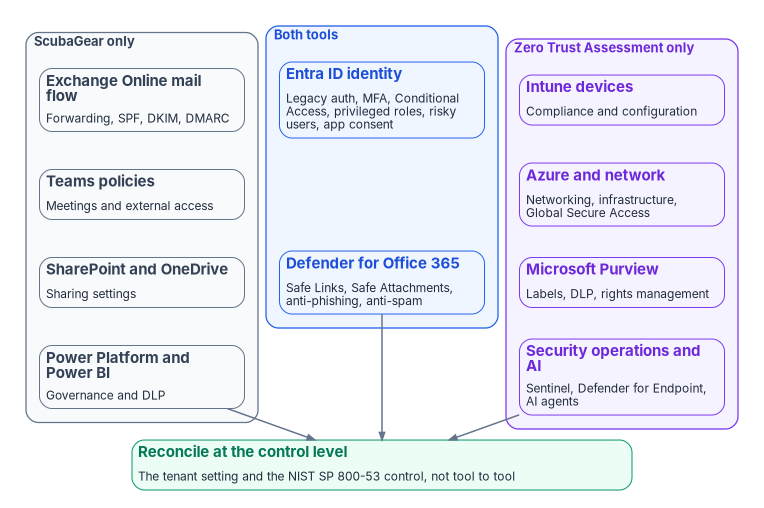
Where they overlap, and where they don’t
| ScubaGear only | Both | Zero Trust Assessment only |
|---|---|---|
| Exchange Online mail flow: external forwarding, SPF, DKIM, DMARC, SMTP AUTH | Entra ID identity: legacy authentication, MFA, Conditional Access, privileged roles, risky users, application consent | Intune device compliance and configuration |
| Teams meeting and external-access policies | Defender for Office 365 threat policies: Safe Links, Safe Attachments, anti-phishing, anti-spam (SCuBA’s Security Suite baseline from 2.0.0; the Zero Trust Assessment’s Security Operations tests in 3.1.0) | Azure networking and infrastructure; Global Secure Access |
| SharePoint and OneDrive sharing | Microsoft Purview labels, data loss prevention, rights management | |
| Power Platform and Power BI governance | Security operations (Sentinel, Defender for Endpoint) and AI agents |
The left column is the content of the SCuBA baselines that has no Zero Trust Assessment test in 3.1.0: none of its tests checks SPF, DKIM, external forwarding, SharePoint sharing settings or Power Platform governance.3435 The middle row on threat policies is new. The source paper for this chapter said SCuBA’s Defender baseline, now its Security Suite baseline, had essentially no Zero Trust Assessment counterpart; release 3.1.0 tests Safe Links, Safe Attachments, anti-phishing and anti-spam policies and Teams protection policies.3637 The overlap will keep moving as both tools release.
An earlier analysis of Microsoft’s public demo report, with 295 checks, put about 47% of the Zero Trust Assessment’s checks (140) in an area a SCuBA baseline also covers, almost all of it Identity, and about 53% (155) in areas with no SCuBA baseline. Those figures predate release 3.1.0, which has 364 tests and adds threat-protection checks that change the split. Your tenant’s split comes from running both tools against it; Chapter 09 shows how the program ingests both reports, and Chapter 10 shows how it reconciles them at the control level.
Two caveats matter more than any percentage.
- Shared surface isn’t duplicate checks. SCuBA’s Entra ID baseline has 34 policies in ScubaGear 2.0.0. Twenty of them are on CISA’s BOD 25-01 list, and ScubaGear marks 22 as required; the Zero Trust Assessment has 135 identity tests.383940 “Shared” means the same area, not the same check. Only a subset have a true one-to-one counterpart (legacy authentication, MFA, Conditional Access basics, privileged-role hygiene, risky users, application consent). The rest is the Zero Trust Assessment going deeper than the federal baseline.
- The inverse gap. SCuBA’s Exchange Online, Teams, SharePoint and Power Platform baselines still have no Zero Trust Assessment counterpart, and 22 of BOD 25-01’s 50 mandatory Microsoft 365 policies sit in those four products (26 of the 56 that ScubaGear 2.0.0 marks as required).4142 Dropping ScubaGear because “the Zero Trust Assessment covers identity” would leave mandatory policies unassessed, and it would stop the reporting BOD 25-01 requires. The Zero Trust Assessment isn’t a BOD 25-01 tool; the directive names CISA’s SCuBA assessment tools.43
What this means for an agency
- Keep ScubaGear for BOD 25-01. It is the tool aligned to the federal Microsoft 365 baseline, including the workloads the Zero Trust Assessment doesn’t touch, and its JSON output is what CISA receives.44
- Add the Zero Trust Assessment for breadth. It extends coverage to devices, Azure infrastructure, network, data and security operations, and its risk levels help put the findings in order.
- Reconcile at the control level. The two tools use different identifiers and different frameworks, so match their findings through a common spine: the tenant setting itself, and the NIST SP 800-53 control it supports. CISA maps each SCuBA policy to NIST SP 800-53 Rev. 5 controls, “limited to controls found within the FedRAMP High baseline.”45 The High baseline contains every Moderate control, so the mapping serves a Moderate system too (inference). The program holds that mapping as data, SCuBA policy ID to control to typed remediation task; the operating model is in Control Compliance Automation: Microsoft 365 and Azure (Vol VII Book 02 of the Federal Compliance series), and Appendix A maps pillars to controls.
- Treat all output as sensitive. Each report is a map of where the tenant is weak. Microsoft warns that the report and export folder contain information attackers could use and should be shared only with authorized staff, and advises deleting the local folder once the report is stored securely.46 Keep both tools’ output inside the authorization boundary and remediate through normal change control.
What neither tool does
Both tools read configuration and score it, against a prescriptive baseline in ScubaGear’s case and against a maturity-oriented test set in the Zero Trust Assessment’s. Neither writes to the tenant, and neither can design the Conditional Access set, the legacy-authentication retirement or the device-identity layer that a finding depends on. A score is a reading, not a treatment plan. Chapter 08 puts the two tools where they belong in the sequence, and Chapter 10 turns their findings into a program.
Cybersecurity and Infrastructure Security Agency, Binding Operational Directive 25-01, Implementing Secure Practices for Cloud Services, December 17, 2024, https://www.cisa.gov/news-events/directives/bod-25-01-implementing-secure-practices-cloud-services (accessed Oct 21, 2026).↩︎
Microsoft Learn, “What is the Zero Trust Assessment?,” https://learn.microsoft.com/security/zero-trust/assessment/overview (accessed Oct 21, 2026).↩︎
PowerShell Gallery, “ScubaGear,” version history (2.0.0, October 22, 2026, latest stable), https://www.powershellgallery.com/packages/ScubaGear; Cybersecurity and Infrastructure Security Agency, ScubaGear release v2.0.0, release notes, “BOD 25-01 required configuration policy changes,” https://github.com/cisagov/ScubaGear/releases/tag/v2.0.0; CISA, BOD 25-01 Required Configurations page, https://www.cisa.gov/resources-tools/services/bod-25-01-implementing-secure-practices-cloud-services-required-configurations (all accessed Oct 26, 2026).↩︎
Microsoft, Zero Trust Assessment release 3.1.0, published October 20, 2026 (release notes: PowerShell 7.6 or later; new Security Operations tests for directory, email and collaboration, endpoint protection and Sentinel), https://github.com/microsoft/zerotrustassessment/releases (accessed Oct 21, 2026).↩︎
Cybersecurity and Infrastructure Security Agency, ScubaGear README, release v2.0.0 (baselines, PowerShell 5 installation,
Invoke-SCuBA), https://github.com/cisagov/ScubaGear/blob/v2.0.0/README.md (accessed Oct 26, 2026).↩︎Microsoft Learn, “Get started with the Zero Trust Assessment,” https://learn.microsoft.com/security/zero-trust/assessment/get-started (accessed Oct 21, 2026).↩︎
Microsoft, Zero Trust Assessment source code, tag 3.1.0: test definitions in
src/powershell/tests/(364Test-Assessment.*.ps1files;Pillar,RiskLevel,ServiceandTestIdattributes counted by the writer) andsrc/powershell/public/Connect-ZtAssessment.ps1(-Environment,-ExchangeEnvironmentName), https://github.com/microsoft/zerotrustassessment/tree/3.1.0/src/powershell (accessed Oct 21, 2026).↩︎Cybersecurity and Infrastructure Security Agency, ScubaGear README, release v2.0.0 (baselines, PowerShell 5 installation,
Invoke-SCuBA), https://github.com/cisagov/ScubaGear/blob/v2.0.0/README.md (accessed Oct 26, 2026).↩︎Microsoft Learn, “Get started with the Zero Trust Assessment,” https://learn.microsoft.com/security/zero-trust/assessment/get-started (accessed Oct 21, 2026).↩︎
Cybersecurity and Infrastructure Security Agency, ScubaGear README, release v2.0.0 (baselines, PowerShell 5 installation,
Invoke-SCuBA), https://github.com/cisagov/ScubaGear/blob/v2.0.0/README.md (accessed Oct 26, 2026).↩︎Microsoft Learn, “Get started with the Zero Trust Assessment,” https://learn.microsoft.com/security/zero-trust/assessment/get-started (accessed Oct 21, 2026).↩︎
Cybersecurity and Infrastructure Security Agency, ScubaGear, Microsoft Entra ID secure configuration baseline (
aad.md), release v2.0.0 (34 policies, 22 with the BOD 25-01 requirement indicator), https://github.com/cisagov/ScubaGear/blob/v2.0.0/PowerShell/ScubaGear/baselines/aad.md (accessed Oct 26, 2026).↩︎Microsoft, Zero Trust Assessment source code, tag 3.1.0: test definitions in
src/powershell/tests/(364Test-Assessment.*.ps1files;Pillar,RiskLevel,ServiceandTestIdattributes counted by the writer) andsrc/powershell/public/Connect-ZtAssessment.ps1(-Environment,-ExchangeEnvironmentName), https://github.com/microsoft/zerotrustassessment/tree/3.1.0/src/powershell (accessed Oct 21, 2026).↩︎Cybersecurity and Infrastructure Security Agency, “BOD 25-01: Implementing Secure Practices for Cloud Services Required Configurations,” https://www.cisa.gov/resources-tools/services/bod-25-01-implementing-secure-practices-cloud-services-required-configurations (accessed Oct 21 and Oct 26, 2026).↩︎
Microsoft, Zero Trust Assessment source code, tag 3.1.0: test definitions in
src/powershell/tests/(364Test-Assessment.*.ps1files;Pillar,RiskLevel,ServiceandTestIdattributes counted by the writer) andsrc/powershell/public/Connect-ZtAssessment.ps1(-Environment,-ExchangeEnvironmentName), https://github.com/microsoft/zerotrustassessment/tree/3.1.0/src/powershell (accessed Oct 21, 2026).↩︎Cybersecurity and Infrastructure Security Agency, ScubaGear README, release v2.0.0 (baselines, PowerShell 5 installation,
Invoke-SCuBA), https://github.com/cisagov/ScubaGear/blob/v2.0.0/README.md (accessed Oct 26, 2026).↩︎Microsoft Learn, “Get started with the Zero Trust Assessment,” https://learn.microsoft.com/security/zero-trust/assessment/get-started (accessed Oct 21, 2026).↩︎
Cybersecurity and Infrastructure Security Agency, ScubaGear README, release v2.0.0 (baselines, PowerShell 5 installation,
Invoke-SCuBA), https://github.com/cisagov/ScubaGear/blob/v2.0.0/README.md (accessed Oct 26, 2026).↩︎Cybersecurity and Infrastructure Security Agency, ScubaGear, “Parameters” (
M365Environment,ProductNames), release v2.0.0, https://github.com/cisagov/ScubaGear/blob/v2.0.0/docs/configuration/parameters.md (accessed Oct 26, 2026).↩︎Cybersecurity and Infrastructure Security Agency, ScubaGear release v2.0.0, October 22, 2026, release notes (“Dynamically determine M365Environment during non-interactive authentication”), https://github.com/cisagov/ScubaGear/releases/tag/v2.0.0 (accessed Oct 26, 2026).↩︎
Cybersecurity and Infrastructure Security Agency, ScubaGear, “Interactive Permissions,” release v2.0.0, https://github.com/cisagov/ScubaGear/blob/v2.0.0/docs/prerequisites/interactive.md (accessed Oct 26, 2026).↩︎
Cybersecurity and Infrastructure Security Agency, “BOD 25-01 Implementation Guidance: Implementing Secure Practices for Cloud Services,” updated July 27, 2026, https://www.cisa.gov/news-events/directives/bod-25-01-implementation-guidance-implementing-secure-practices-cloud-services (accessed Oct 21, 2026).↩︎
Cybersecurity and Infrastructure Security Agency, ScubaGear, Microsoft Entra ID secure configuration baseline (
aad.md), release v2.0.0 (34 policies, 22 with the BOD 25-01 requirement indicator), https://github.com/cisagov/ScubaGear/blob/v2.0.0/PowerShell/ScubaGear/baselines/aad.md (accessed Oct 26, 2026).↩︎Cybersecurity and Infrastructure Security Agency, “BOD 25-01: Implementing Secure Practices for Cloud Services Required Configurations,” https://www.cisa.gov/resources-tools/services/bod-25-01-implementing-secure-practices-cloud-services-required-configurations (accessed Oct 21 and Oct 26, 2026).↩︎
PowerShell Gallery, “ScubaGear,” version history (2.0.0, October 22, 2026, latest stable), https://www.powershellgallery.com/packages/ScubaGear; Cybersecurity and Infrastructure Security Agency, ScubaGear release v2.0.0, release notes, “BOD 25-01 required configuration policy changes,” https://github.com/cisagov/ScubaGear/releases/tag/v2.0.0; CISA, BOD 25-01 Required Configurations page, https://www.cisa.gov/resources-tools/services/bod-25-01-implementing-secure-practices-cloud-services-required-configurations (all accessed Oct 26, 2026).↩︎
Microsoft Learn, “What is the Zero Trust Assessment?,” https://learn.microsoft.com/security/zero-trust/assessment/overview (accessed Oct 21, 2026).↩︎
Microsoft Learn, “The Microsoft Zero Trust Workshop,” https://learn.microsoft.com/security/zero-trust/workshop-zero-trust-overview (accessed Oct 21, 2026).↩︎
Microsoft Learn, “Get started with the Zero Trust Assessment,” https://learn.microsoft.com/security/zero-trust/assessment/get-started (accessed Oct 21, 2026).↩︎
Microsoft, Zero Trust Assessment release 3.1.0, published October 20, 2026 (release notes: PowerShell 7.6 or later; new Security Operations tests for directory, email and collaboration, endpoint protection and Sentinel), https://github.com/microsoft/zerotrustassessment/releases (accessed Oct 21, 2026).↩︎
Microsoft Learn, “Get started with the Zero Trust Assessment,” https://learn.microsoft.com/security/zero-trust/assessment/get-started (accessed Oct 21, 2026).↩︎
Microsoft, Zero Trust Assessment source code, tag 3.1.0: test definitions in
src/powershell/tests/(364Test-Assessment.*.ps1files;Pillar,RiskLevel,ServiceandTestIdattributes counted by the writer) andsrc/powershell/public/Connect-ZtAssessment.ps1(-Environment,-ExchangeEnvironmentName), https://github.com/microsoft/zerotrustassessment/tree/3.1.0/src/powershell (accessed Oct 21, 2026).↩︎Microsoft, Zero Trust Assessment source code, tag 3.1.0: test definitions in
src/powershell/tests/(364Test-Assessment.*.ps1files;Pillar,RiskLevel,ServiceandTestIdattributes counted by the writer) andsrc/powershell/public/Connect-ZtAssessment.ps1(-Environment,-ExchangeEnvironmentName), https://github.com/microsoft/zerotrustassessment/tree/3.1.0/src/powershell (accessed Oct 21, 2026).↩︎Microsoft Learn, “Get started with the Zero Trust Assessment,” https://learn.microsoft.com/security/zero-trust/assessment/get-started (accessed Oct 21, 2026).↩︎
Cybersecurity and Infrastructure Security Agency, ScubaGear baseline documents, release v2.0.0 (policies marked with the BOD 25-01 requirement indicator: Exchange Online 10, Teams 4, SharePoint 8, Power Platform 4), https://github.com/cisagov/ScubaGear/tree/v2.0.0/PowerShell/ScubaGear/baselines (accessed Oct 26, 2026).↩︎
Microsoft, Zero Trust Assessment source code, tag 3.1.0: test definitions in
src/powershell/tests/(364Test-Assessment.*.ps1files;Pillar,RiskLevel,ServiceandTestIdattributes counted by the writer) andsrc/powershell/public/Connect-ZtAssessment.ps1(-Environment,-ExchangeEnvironmentName), https://github.com/microsoft/zerotrustassessment/tree/3.1.0/src/powershell (accessed Oct 21, 2026).↩︎Microsoft, Zero Trust Assessment release 3.1.0, published October 20, 2026 (release notes: PowerShell 7.6 or later; new Security Operations tests for directory, email and collaboration, endpoint protection and Sentinel), https://github.com/microsoft/zerotrustassessment/releases (accessed Oct 21, 2026).↩︎
Microsoft, Zero Trust Assessment source code, tag 3.1.0: test definitions in
src/powershell/tests/(364Test-Assessment.*.ps1files;Pillar,RiskLevel,ServiceandTestIdattributes counted by the writer) andsrc/powershell/public/Connect-ZtAssessment.ps1(-Environment,-ExchangeEnvironmentName), https://github.com/microsoft/zerotrustassessment/tree/3.1.0/src/powershell (accessed Oct 21, 2026).↩︎Cybersecurity and Infrastructure Security Agency, ScubaGear, Microsoft Entra ID secure configuration baseline (
aad.md), release v2.0.0 (34 policies, 22 with the BOD 25-01 requirement indicator), https://github.com/cisagov/ScubaGear/blob/v2.0.0/PowerShell/ScubaGear/baselines/aad.md (accessed Oct 26, 2026).↩︎Cybersecurity and Infrastructure Security Agency, “BOD 25-01: Implementing Secure Practices for Cloud Services Required Configurations,” https://www.cisa.gov/resources-tools/services/bod-25-01-implementing-secure-practices-cloud-services-required-configurations (accessed Oct 21 and Oct 26, 2026).↩︎
Microsoft, Zero Trust Assessment source code, tag 3.1.0: test definitions in
src/powershell/tests/(364Test-Assessment.*.ps1files;Pillar,RiskLevel,ServiceandTestIdattributes counted by the writer) andsrc/powershell/public/Connect-ZtAssessment.ps1(-Environment,-ExchangeEnvironmentName), https://github.com/microsoft/zerotrustassessment/tree/3.1.0/src/powershell (accessed Oct 21, 2026).↩︎Cybersecurity and Infrastructure Security Agency, “BOD 25-01: Implementing Secure Practices for Cloud Services Required Configurations,” https://www.cisa.gov/resources-tools/services/bod-25-01-implementing-secure-practices-cloud-services-required-configurations (accessed Oct 21 and Oct 26, 2026).↩︎
Cybersecurity and Infrastructure Security Agency, ScubaGear baseline documents, release v2.0.0 (policies marked with the BOD 25-01 requirement indicator: Exchange Online 10, Teams 4, SharePoint 8, Power Platform 4), https://github.com/cisagov/ScubaGear/tree/v2.0.0/PowerShell/ScubaGear/baselines (accessed Oct 26, 2026).↩︎
Cybersecurity and Infrastructure Security Agency, Binding Operational Directive 25-01, Implementing Secure Practices for Cloud Services, December 17, 2024, https://www.cisa.gov/news-events/directives/bod-25-01-implementing-secure-practices-cloud-services (accessed Oct 21, 2026).↩︎
Cybersecurity and Infrastructure Security Agency, “BOD 25-01 Implementation Guidance: Implementing Secure Practices for Cloud Services,” updated July 27, 2026, https://www.cisa.gov/news-events/directives/bod-25-01-implementation-guidance-implementing-secure-practices-cloud-services (accessed Oct 21, 2026).↩︎
Cybersecurity and Infrastructure Security Agency, ScubaGear v2.0.0 documentation, “Mappings,” https://github.com/cisagov/ScubaGear/blob/v2.0.0/docs/misc/mappings.md (accessed Oct 26, 2026).↩︎
Microsoft Learn, “Get started with the Zero Trust Assessment,” https://learn.microsoft.com/security/zero-trust/assessment/get-started (accessed Oct 21, 2026).↩︎