Federal Modernization Workbook · Book 17 · How
Chapter 10 — Evidence and Authorization for AI Systems
An AI system earns its authorization the way every other system does; what’s new is that the package has to show who the system is when it signs in, who answers for it, and when its access ends.
Why there is no AI-specific authorization to operate, and what the federal rules say instead. Where an AI system sits in the agency’s authorization boundaries, and which package carries its identity evidence. The evidence an authorizing official needs about an AI system’s identity in five areas, and the controls each area answers. The seven high-impact practices as evidence rather than inventory answers. The cadence that keeps it current: the annual inventory, compliance plans, waivers, FISMA testing and ongoing authorization. How to carry AI identity in OSCAL 1.2.3, with an illustrative fragment. And the state of NIST’s SP 800-53 overlays for AI systems.
Everything in this book ends here. The identity record of Chapter 05, the credential and access rules of Chapter 06, the monitoring and findings of Chapter 07, the roles of Chapter 08 and the scan of Chapter 09 all produce records. The authorizing official reads none of them directly. They read an authorization package, and they accept, or decline to accept, the risk it describes. This chapter is about getting AI identity into that package in a form the official can rely on.
Book 14, Chapter 11 already describes the package: its four parts, the OSCAL model for each, the plan of action and milestones, continuous monitoring and ongoing authorization. This chapter doesn’t repeat it. It adds what is particular to AI systems.
Where the AI sits decides which package carries it
Before asking what evidence the package needs, the ISSO asks a simpler question: whose authorization boundary does the AI system run in? The answer decides which package carries its identity evidence.
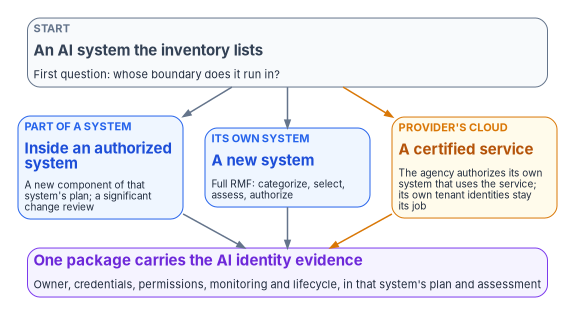
| Where it runs | What the agency does | Where the identity evidence goes |
|---|---|---|
| Inside a system that is already authorized (an AI feature added to a case system, an agent built on an existing platform) | Treat the AI as a new component, and assess whether its addition is a change that needs an event-driven review | The existing system’s security plan, assessment and plan of action and milestones |
| As a new system of its own | The full Risk Management Framework, starting with registration and categorization | A new package |
| On a provider’s FedRAMP-certified service | Authorize the agency’s own system that uses the service as an external service, reading the provider’s certification; govern the identities the service creates or uses in the agency’s own tenant | The package for the agency’s own system, with the provider’s certification as an attachment (Book 10, Chapter 11) |
The third row is easy to get wrong. A provider’s certification covers the provider’s side. The service principals, agent identities, consent grants and delegated permissions an AI service creates in the agency’s tenant are the agency’s to govern, and they belong in the agency’s package. A certified AI service that a user consented to with broad delegated permissions is a certified service holding an uncertified grant.
Two RMF tasks bracket an AI system’s life in the package. SP 800-37’s Task P-18 registers the system “with organizational program or management offices”; Task M-7 implements “a system disposal strategy” when a system is removed from operation.7 For an AI system, the identity record’s creation and its removal are those two tasks in identity form, and the program ties them together: the record exists from registration, and disposal isn’t complete until the identities are gone.
The high-impact practices as evidence
For a high-impact use case, M-25-21 requires seven minimum practices: pre-deployment testing, an AI impact assessment (with an independent review and the signature of the person accepting the risk), ongoing monitoring, human training and assessment, human oversight and intervention with a fail-safe where practicable, remedies and appeals, and feedback from end users and the public.16 Agencies had 365 days from April 3, 2025 to document implementation and “be prepared to report them to OMB,” and a high-impact use case that doesn’t comply must be safely discontinued.17
The 2025 inventory reports a status for every practice in nine hi_* fields, but a status isn’t evidence (Chapter 03).18 The package needs the artifacts. The program’s design puts them where an assessor would look, and draws the identity program’s contribution into three of them:
| Practice (M-25-21 Section 4(b)) | Evidence the package carries | Where it sits in the package | Identity contribution |
|---|---|---|---|
| (i) Pre-deployment testing | Test plan, results and risk mitigation plan | Assessment plan and results, as tests of the AI functionality | The test ran under the identity and permissions the system will have in production, not an administrator’s |
| (ii) AI impact assessment | The signed assessment, the independent reviewer’s comments, the risk acceptor’s signature | Attachment to the security plan; referenced in the authorization decision | The identity record points to the signed assessment that names the risk acceptor, so the signature can be checked against a person |
| (iii) Ongoing monitoring | Monitoring results for performance and adverse impacts | Continuous monitoring reports | Yes: sign-in, audit and risk records for the system’s own identities, and the drift findings (Chapter 07) |
| (iv) Human training and assessment | Training records for the system’s operators | Continuous monitoring, training evidence (Book 16) | Yes: the identity record names the operators’ group, so completion is checked against its members |
| (v) Human oversight, intervention and fail-safe | Who can intervene; the fail-safe and its test | Security plan narrative and assessment results | Yes: the named people who can disable the identity, and a tested disable |
| (vi) Remedies and appeals | The appeal process and case records | Attachment; privacy and program records | — |
| (vii) End-user and public feedback | The feedback channel and how feedback changed the system | Attachment; program records | — |
Two provisions change what the package shows. A Chief AI Officer may waive one or more practices for a specific system after a written, system-specific risk assessment, must certify each waiver’s validity annually, and must report a waiver to OMB within 30 days of granting or revoking it; agencies were to publish waiver summaries by April 3, 2026.1920 A pilot is exempt from the practices only if it is limited in scale and duration and the Chief AI Officer has certified it, with the certification tracked centrally.21 Both are attachments the authorizing official should see, because each is a decision that a practice won’t be evidenced, and a waiver or a pilot certification with no end date is an exception with no expiry. The program records both as governed exceptions with the expiry the Book 14 POA&M lifecycle requires.
The cadence
AI governance adds three clocks to the authorization cycle the package already runs on. None of them replaces FISMA’s annual floor, and all of them should feed the same continuous monitoring stream.
| Cadence | What happens | Source | What it means for the package |
|---|---|---|---|
| At least annually | AI use case inventory submitted to OMB and published; the 2025 cycle’s deadlines were December 22, 2025 and January 28, 2026 | M-25-21 Section 3(b)(v); OMB 2025 guidance2223 | The vintage comparison of Chapter 09 runs; new AI systems become new components, retired ones start disposal |
| 180 days after the memo, then every two years until 2036 | Compliance plan submitted to OMB and posted, or a written determination that the agency doesn’t use covered AI | M-25-21 Section 3(b)(ii)24 | The plan states how the agency intends to comply with the memo; the package shows whether a given system does |
| Annually, and within 30 days of a change | Waiver certification; waiver grant or revocation reported to OMB | M-25-21 Section 4(a)(ii)–(iii)25 | Each waiver’s governed exception is reviewed and its expiry reset or lapsed |
| No less than annually | Testing and evaluation of the effectiveness of security policies, procedures and practices | FISMA, 44 U.S.C. § 3554(b)(5)26 | The independent assessment covers the AI controls, including tailored-in IA-9 |
| Time- or event-driven | Ongoing authorization once eligible and approved by the authorizing official | OMB Circular A-130, Appendix I27 | AI identity evidence is part of what the official reviews at each frequency |
M-25-21’s 180-day mark fell at the end of September 2025, so the next compliance plans fall due in 2027. The compliance plan and the inventory are distinct obligations on distinct clocks; an agency that tracks only the inventory will miss the plan.
The annual refresh is also the event that most often changes the package. When a new vintage arrives, the program’s design applies the vintage comparison’s results to the security plan: a new piloted or deployed entry becomes a new component with status under development or operational; an entry moved to Retired moves its component to disposition until Task M-7’s evidence shows its identities removed; and a changed authorization answer is reconciled before the next monthly report. An agency on ongoing authorization treats a new agentic AI system inside an authorized boundary as an event worth an event-driven review, which is a design choice, not a federal rule.
The NIST AI Risk Management Framework, which is voluntary guidance rather than a requirement, says the same thing in its own terms: GOVERN 1.6 asks for “mechanisms … to inventory AI systems,” GOVERN 1.7 for processes to decommission AI systems “safely,” and MANAGE 4.1 for post-deployment monitoring plans that include “decommissioning, incident response, recovery, and change management.”28 Appendix A maps them.
Carrying AI identity in OSCAL
The package should be machine-readable, for the reasons Book 14, Chapter 11 gives. The current OSCAL release is 1.2.3, published August 7, 2026.29 Nothing in OSCAL is specific to AI, and nothing needs to be. The system security plan’s system-implementation already has the structures an AI system’s identity needs: components, each with a required type, title, description and status whose state is one of under-development, operational, disposition or other; users, each of which can carry role-ids and authorized-privileges with the functions-performed; and inventory-items that point to the components they implement.30 Agency-specific facts go in properties under the agency’s own namespace.
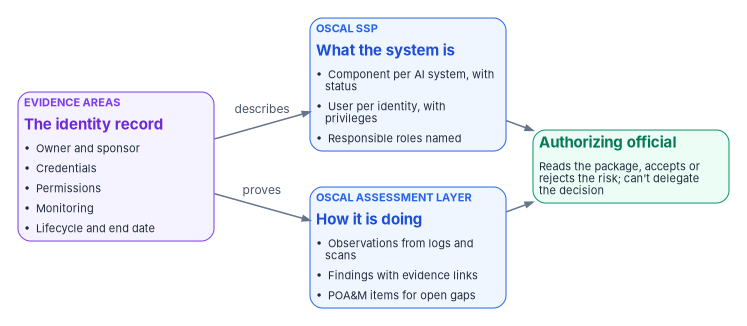
The program’s mapping, which is design, is:
| AI identity fact | OSCAL structure |
|---|---|
| The AI system | A component of type software (or service for a provider-hosted service), with the inventory use case ID as a property |
| Its stage | The component’s status.state: pre-deployment and pilot map to under-development or operational by whether it touches production data; retired maps to disposition |
| Sponsor and technical owner | The component’s responsible-roles, pointing to parties in the plan’s metadata |
| Each identity it uses | A user with the system’s role, its authorized-privileges and the credential type and review date as properties |
| Monitoring results and findings | observations and findings in the assessment results, keyed to the identity record as in Chapter 07 |
| Open gaps, waivers and pilot certifications | poam-items and risks, with governed exceptions carrying their acceptance and expiry |
The fragment below is part of an OSCAL 1.2.3 system security plan’s system-implementation, not a complete document. Names, identifiers and the namespace are examples. The two objects were checked against the system-user and system-component definitions in NIST’s published 1.2.3 SSP JSON schema; validate the full plan against the schema for the release you target before relying on it.
{
  "users": [
    {
      "uuid": "6f1c2a9e-3b7d-4e21-9a0c-2d5e8f71b304",
      "title": "Case triage agent (agent identity)",
      "description": "Non-person identity used by the case triage agent when it acts on its own behalf.",
      "props": [
        { "name": "identity-kind", "ns": "https://agency.example.gov/ns/ai-identity", "value": "agent-identity" },
        { "name": "inventory-use-case-id", "ns": "https://agency.example.gov/ns/ai-identity", "value": "AGENCY-0042" },
        { "name": "credential-type", "ns": "https://agency.example.gov/ns/ai-identity", "value": "federated-no-stored-secret" },
        { "name": "access-review-due", "ns": "https://agency.example.gov/ns/ai-identity", "value": "2027-04-30" }
      ],
      "role-ids": ["ai-agent"],
      "authorized-privileges": [
        {
          "title": "Read case records",
          "functions-performed": ["Read open cases in the triage queue", "Write a triage recommendation field"]
        }
      ]
    }
  ],
  "components": [
    {
      "uuid": "0b8d4e1a-7c3f-4a52-8e19-5f2a6c9d7e40",
      "type": "software",
      "title": "Case triage agent",
      "description": "Agentic AI system listed in the agency AI use case inventory as AGENCY-0042.",
      "props": [
        { "name": "ai-classification", "ns": "https://agency.example.gov/ns/ai-identity", "value": "agentic" },
        { "name": "high-impact", "ns": "https://agency.example.gov/ns/ai-identity", "value": "no" }
      ],
      "status": { "state": "operational" },
      "responsible-roles": [
        { "role-id": "sponsor", "party-uuids": ["9a3e5c7b-1d2f-4b6a-8c0e-3f4a5b6c7d8e"] },
        { "role-id": "technical-owner", "party-uuids": ["2c4e6a8b-0d1f-4e3a-9b5c-7d9e1f3a5b7c"] }
      ]
    }
  ]
}
Two cautions. The authorized-privileges are a description for the assessor, not the permissions themselves; the evidence that they match is an observation from the directory, collected on the monitoring cadence, and a plan whose privileges were typed by hand and never compared drifts like any other narrative. And the role identifiers (sponsor, technical-owner, ai-agent) must be defined in the plan’s metadata roles, which the fragment omits.
NIST’s SP 800-53 overlays for AI systems
NIST is developing SP 800-53 control overlays for AI systems, but there are none to adopt yet. The project published a concept paper for comment on August 14, 2025, and on January 8, 2026 released an annotated outline, a discussion draft, of the overlay for using and fine-tuning predictive AI, with feedback requested by February 13, 2026 for the initial public draft.31 It proposes five use cases: adapting and using generative AI (assistants and large language models), using and fine-tuning predictive AI, single-agent systems, multi-agent systems, and security controls for AI developers.32 As of October 21, 2026 the project page lists no public draft of any overlay.
The project also has a new name. On October 20, 2026, NIST renamed it from Control Overlays for Securing AI Systems (COSAiS) to Control Overlays for Super Intelligence Systems (COSIS), citing Executive Order 14434 of September 29, 2026.33 That order directs agencies, “to the maximum extent permitted by law,” to use “Super Intelligence” and “SI” in place of “Artificial Intelligence” and “AI” in official correspondence, public communications, reports, policy documents and other non-statutory documents; it defines the new terms as the technologies covered by the existing statutory definition of artificial intelligence and doesn’t require changes to documents already issued.34 Federal guidance published after the order uses the new terms; CISA’s page for its May 2026 agentic AI guidance, for example, now describes “agentic super intelligence (SI) systems.”35 Nothing about the systems, the controls or the evidence changes. An agency writing a security plan after September 29, 2026 may need to follow the order’s terminology in its own documents, while the instruments it cites (M-25-21, M-25-22, the inventory guidance) keep the terms they were issued with. This workbook, which isn’t an executive branch document, keeps the terms its sources use.
Until an overlay is final, the program’s position is the one SP 800-53 already supports: select the baseline the system’s categorization requires, then tailor. For AI systems, the tailoring this book argues for is IA-9 added, AC-2 and IA-5 parameters set for non-person accounts, CM-8(4) adopted at Moderate where the baseline omits it (it is NIST High only, and FedRAMP Class D only), and AU-6 review frequencies that include the AI identities’ logs.3637 When an overlay is published, the agency compares its tailoring with it and records the differences, the same way it would for any overlay.
What changes, in one table
| Old habit | What replaces it |
|---|---|
| AI needs its own authorization, or none because it’s “just a feature” | AI goes through the agency’s existing authorization, before deployment, as a component or a system |
| The inventory’s Yes for authorization settles it | Yes points to a package; the package shows the AI system’s identities |
| A provider’s certification covers the AI service | It covers the provider; the identities and grants in the agency’s tenant are the agency’s |
| The baseline covers AI | IA-9 is tailored in, and AC-2 and IA-5 are written for non-person accounts |
| The inventory’s practice answers are the evidence | The practices are evidenced by artifacts; three come from the identity program |
| Waivers and pilots are standing exceptions | Each is a governed exception with an expiry |
| Wait for the AI overlays | Tailor the baseline now; compare with the overlay when it’s final |
Office of Management and Budget, M-25-21, Accelerating Federal Use of AI through Innovation, Governance, and Public Trust, April 3, 2025, Sections 3(b)(ii), 3(b)(iii) and 3(b)(v); Section 4(a)(i)–(iv) and 4(b)(i)–(vii); footnotes 11, 22 and 29; and the consolidated table of actions, https://www.whitehouse.gov/wp-content/uploads/2025/02/M-25-21-Accelerating-Federal-Use-of-AI-through-Innovation-Governance-and-Public-Trust.pdf (accessed Oct 21, 2026).↩︎
Office of Management and Budget, M-25-21, Accelerating Federal Use of AI through Innovation, Governance, and Public Trust, April 3, 2025, Sections 3(b)(ii), 3(b)(iii) and 3(b)(v); Section 4(a)(i)–(iv) and 4(b)(i)–(vii); footnotes 11, 22 and 29; and the consolidated table of actions, https://www.whitehouse.gov/wp-content/uploads/2025/02/M-25-21-Accelerating-Federal-Use-of-AI-through-Innovation-Governance-and-Public-Trust.pdf (accessed Oct 21, 2026).↩︎
Office of Management and Budget, M-25-22, Driving Efficient Acquisition of Artificial Intelligence in Government, April 3, 2025, Section 4(e)(i), “Authorization To Operate Compliance,” https://www.whitehouse.gov/wp-content/uploads/2025/02/M-25-22-Driving-Efficient-Acquisition-of-Artificial-Intelligence-in-Government.pdf (accessed Oct 21, 2026).↩︎
National Institute of Standards and Technology, SP 800-37 Rev. 2, Risk Management Framework for Information Systems and Organizations: A System Life Cycle Approach for Security and Privacy, December 2018, Tasks P-18, R-4 (discussion) and M-7, https://nvlpubs.nist.gov/nistpubs/SpecialPublications/NIST.SP.800-37r2.pdf (accessed Oct 21, 2026).↩︎
Office of Management and Budget,
Validation/data_dictionary.md, 2025 Federal Agency AI Use Case Inventory, columns 19 (have_ato) and 28–36 (hi_*), https://github.com/ombegov/2025-Federal-Agency-AI-Use-Case-Inventory/blob/main/Validation/data_dictionary.md (accessed Oct 21, 2026).↩︎FedRAMP, “FedRAMP AI,” 2025 AI Prioritization Initiative and its criteria, https://www.fedramp.gov/ai/ (accessed Oct 21, 2026).↩︎
National Institute of Standards and Technology, SP 800-37 Rev. 2, Risk Management Framework for Information Systems and Organizations: A System Life Cycle Approach for Security and Privacy, December 2018, Tasks P-18, R-4 (discussion) and M-7, https://nvlpubs.nist.gov/nistpubs/SpecialPublications/NIST.SP.800-37r2.pdf (accessed Oct 21, 2026).↩︎
National Institute of Standards and Technology, SP 800-53 Rev. 5, Security and Privacy Controls for Information Systems and Organizations, controls AC-2, AC-2(3), AC-2(12), AC-3, AC-6, AC-6(7), AU-6, AU-12, CA-7, CM-8, CM-8(4), IA-4, IA-5, IA-9 and PM-5; statements read from the release 5.2.0 OSCAL catalog (last modified May 11, 2026), https://github.com/usnistgov/oscal-content/blob/main/nist.gov/SP800-53/rev5/json/NIST_SP-800-53_rev5_catalog.json (accessed Oct 21, 2026).↩︎
National Institute of Standards and Technology, SP 800-53 Rev. 5, Security and Privacy Controls for Information Systems and Organizations, controls AC-2, AC-2(3), AC-2(12), AC-3, AC-6, AC-6(7), AU-6, AU-12, CA-7, CM-8, CM-8(4), IA-4, IA-5, IA-9 and PM-5; statements read from the release 5.2.0 OSCAL catalog (last modified May 11, 2026), https://github.com/usnistgov/oscal-content/blob/main/nist.gov/SP800-53/rev5/json/NIST_SP-800-53_rev5_catalog.json (accessed Oct 21, 2026).↩︎
National Institute of Standards and Technology, SP 800-53B control baselines, release 5.2.0 OSCAL Low, Moderate, High and Privacy baseline profiles (IA-9 and PM-5 in none of the Low, Moderate or High baselines; CM-8(4) High only), https://github.com/usnistgov/oscal-content/tree/main/nist.gov/SP800-53/rev5/json (accessed Oct 21, 2026).↩︎
FedRAMP, “Full Rev5 Control Reference,” FedRAMP Consolidated Rules for 2026, Identification and Authentication family (IA-09 shows no FedRAMP Rev5 baseline class) and Configuration Management family (CM-08(04) Class D), https://www.fedramp.gov/2026/reference/controls/ (accessed Oct 21, 2026).↩︎
National Institute of Standards and Technology, SP 800-53 Rev. 5, Security and Privacy Controls for Information Systems and Organizations, controls AC-2, AC-2(3), AC-2(12), AC-3, AC-6, AC-6(7), AU-6, AU-12, CA-7, CM-8, CM-8(4), IA-4, IA-5, IA-9 and PM-5; statements read from the release 5.2.0 OSCAL catalog (last modified May 11, 2026), https://github.com/usnistgov/oscal-content/blob/main/nist.gov/SP800-53/rev5/json/NIST_SP-800-53_rev5_catalog.json (accessed Oct 21, 2026).↩︎
National Institute of Standards and Technology, SP 800-53 Rev. 5, Security and Privacy Controls for Information Systems and Organizations, controls AC-2, AC-2(3), AC-2(12), AC-3, AC-6, AC-6(7), AU-6, AU-12, CA-7, CM-8, CM-8(4), IA-4, IA-5, IA-9 and PM-5; statements read from the release 5.2.0 OSCAL catalog (last modified May 11, 2026), https://github.com/usnistgov/oscal-content/blob/main/nist.gov/SP800-53/rev5/json/NIST_SP-800-53_rev5_catalog.json (accessed Oct 21, 2026).↩︎
National Institute of Standards and Technology, SP 800-53 Rev. 5, Security and Privacy Controls for Information Systems and Organizations, controls AC-2, AC-2(3), AC-2(12), AC-3, AC-6, AC-6(7), AU-6, AU-12, CA-7, CM-8, CM-8(4), IA-4, IA-5, IA-9 and PM-5; statements read from the release 5.2.0 OSCAL catalog (last modified May 11, 2026), https://github.com/usnistgov/oscal-content/blob/main/nist.gov/SP800-53/rev5/json/NIST_SP-800-53_rev5_catalog.json (accessed Oct 21, 2026).↩︎
National Institute of Standards and Technology, SP 800-53B control baselines, release 5.2.0 OSCAL Low, Moderate, High and Privacy baseline profiles (IA-9 and PM-5 in none of the Low, Moderate or High baselines; CM-8(4) High only), https://github.com/usnistgov/oscal-content/tree/main/nist.gov/SP800-53/rev5/json (accessed Oct 21, 2026).↩︎
Office of Management and Budget, M-25-21, Accelerating Federal Use of AI through Innovation, Governance, and Public Trust, April 3, 2025, Sections 3(b)(ii), 3(b)(iii) and 3(b)(v); Section 4(a)(i)–(iv) and 4(b)(i)–(vii); footnotes 11, 22 and 29; and the consolidated table of actions, https://www.whitehouse.gov/wp-content/uploads/2025/02/M-25-21-Accelerating-Federal-Use-of-AI-through-Innovation-Governance-and-Public-Trust.pdf (accessed Oct 21, 2026).↩︎
Office of Management and Budget, M-25-21, Accelerating Federal Use of AI through Innovation, Governance, and Public Trust, April 3, 2025, Sections 3(b)(ii), 3(b)(iii) and 3(b)(v); Section 4(a)(i)–(iv) and 4(b)(i)–(vii); footnotes 11, 22 and 29; and the consolidated table of actions, https://www.whitehouse.gov/wp-content/uploads/2025/02/M-25-21-Accelerating-Federal-Use-of-AI-through-Innovation-Governance-and-Public-Trust.pdf (accessed Oct 21, 2026).↩︎
Office of Management and Budget,
Validation/data_dictionary.md, 2025 Federal Agency AI Use Case Inventory, columns 19 (have_ato) and 28–36 (hi_*), https://github.com/ombegov/2025-Federal-Agency-AI-Use-Case-Inventory/blob/main/Validation/data_dictionary.md (accessed Oct 21, 2026).↩︎Office of Management and Budget, M-25-21, Accelerating Federal Use of AI through Innovation, Governance, and Public Trust, April 3, 2025, Sections 3(b)(ii), 3(b)(iii) and 3(b)(v); Section 4(a)(i)–(iv) and 4(b)(i)–(vii); footnotes 11, 22 and 29; and the consolidated table of actions, https://www.whitehouse.gov/wp-content/uploads/2025/02/M-25-21-Accelerating-Federal-Use-of-AI-through-Innovation-Governance-and-Public-Trust.pdf (accessed Oct 21, 2026).↩︎
Office of Management and Budget, Guidance on 2025 Agency Artificial Intelligence Reporting, Section 1 (deadlines of December 22, 2025 and January 28, 2026) and Section 2 (waiver reporting within 30 days; public waiver summaries by April 3, 2026), in the 2025 Federal Agency AI Use Case Inventory repository, https://github.com/ombegov/2025-Federal-Agency-AI-Use-Case-Inventory/tree/main/Reporting%20Instructions (accessed Oct 21, 2026).↩︎
Office of Management and Budget, M-25-21, Accelerating Federal Use of AI through Innovation, Governance, and Public Trust, April 3, 2025, Sections 3(b)(ii), 3(b)(iii) and 3(b)(v); Section 4(a)(i)–(iv) and 4(b)(i)–(vii); footnotes 11, 22 and 29; and the consolidated table of actions, https://www.whitehouse.gov/wp-content/uploads/2025/02/M-25-21-Accelerating-Federal-Use-of-AI-through-Innovation-Governance-and-Public-Trust.pdf (accessed Oct 21, 2026).↩︎
Office of Management and Budget, M-25-21, Accelerating Federal Use of AI through Innovation, Governance, and Public Trust, April 3, 2025, Sections 3(b)(ii), 3(b)(iii) and 3(b)(v); Section 4(a)(i)–(iv) and 4(b)(i)–(vii); footnotes 11, 22 and 29; and the consolidated table of actions, https://www.whitehouse.gov/wp-content/uploads/2025/02/M-25-21-Accelerating-Federal-Use-of-AI-through-Innovation-Governance-and-Public-Trust.pdf (accessed Oct 21, 2026).↩︎
Office of Management and Budget, Guidance on 2025 Agency Artificial Intelligence Reporting, Section 1 (deadlines of December 22, 2025 and January 28, 2026) and Section 2 (waiver reporting within 30 days; public waiver summaries by April 3, 2026), in the 2025 Federal Agency AI Use Case Inventory repository, https://github.com/ombegov/2025-Federal-Agency-AI-Use-Case-Inventory/tree/main/Reporting%20Instructions (accessed Oct 21, 2026).↩︎
Office of Management and Budget, M-25-21, Accelerating Federal Use of AI through Innovation, Governance, and Public Trust, April 3, 2025, Sections 3(b)(ii), 3(b)(iii) and 3(b)(v); Section 4(a)(i)–(iv) and 4(b)(i)–(vii); footnotes 11, 22 and 29; and the consolidated table of actions, https://www.whitehouse.gov/wp-content/uploads/2025/02/M-25-21-Accelerating-Federal-Use-of-AI-through-Innovation-Governance-and-Public-Trust.pdf (accessed Oct 21, 2026).↩︎
Office of Management and Budget, M-25-21, Accelerating Federal Use of AI through Innovation, Governance, and Public Trust, April 3, 2025, Sections 3(b)(ii), 3(b)(iii) and 3(b)(v); Section 4(a)(i)–(iv) and 4(b)(i)–(vii); footnotes 11, 22 and 29; and the consolidated table of actions, https://www.whitehouse.gov/wp-content/uploads/2025/02/M-25-21-Accelerating-Federal-Use-of-AI-through-Innovation-Governance-and-Public-Trust.pdf (accessed Oct 21, 2026).↩︎
44 U.S.C. § 3554(b)(5), Federal agency responsibilities (Federal Information Security Modernization Act of 2014), https://www.law.cornell.edu/uscode/text/44/3554 (accessed Oct 21, 2026).↩︎
Office of Management and Budget, Circular A-130, Managing Information as a Strategic Resource, July 2016, Appendix I, §4.d, items 3 and 4, https://www.whitehouse.gov/wp-content/uploads/legacy_drupal_files/omb/circulars/A130/a130revised.pdf (accessed Oct 21, 2026).↩︎
National Institute of Standards and Technology, AI 100-1, Artificial Intelligence Risk Management Framework (AI RMF 1.0), January 2023, Tables 1 and 4 (GOVERN 1.6, GOVERN 1.7, MANAGE 4.1), https://nvlpubs.nist.gov/nistpubs/ai/NIST.AI.100-1.pdf (accessed Oct 21, 2026).↩︎
National Institute of Standards and Technology, OSCAL release v1.2.3 (published August 7, 2026), https://github.com/usnistgov/OSCAL/releases/tag/v1.2.3;
oscal_ssp_schema.jsondefinitionssystem-implementation,system-component(required properties;typeandstatus.statevalues),system-userandauthorized-privilege(both accessed Oct 21, 2026).↩︎National Institute of Standards and Technology, OSCAL release v1.2.3 (published August 7, 2026), https://github.com/usnistgov/OSCAL/releases/tag/v1.2.3;
oscal_ssp_schema.jsondefinitionssystem-implementation,system-component(required properties;typeandstatus.statevalues),system-userandauthorized-privilege(both accessed Oct 21, 2026).↩︎National Institute of Standards and Technology, Computer Security Resource Center, “SP 800-53 Control Overlays for Super Intelligence Systems” (formerly Control Overlays for Securing AI Systems), Recent Updates of October 20, 2026, January 8, 2026 and August 14, 2025, and project description, https://csrc.nist.gov/projects/cosis (accessed Oct 21, 2026).↩︎
National Institute of Standards and Technology, Computer Security Resource Center, “SP 800-53 Control Overlays for Super Intelligence Systems” (formerly Control Overlays for Securing AI Systems), Recent Updates of October 20, 2026, January 8, 2026 and August 14, 2025, and project description, https://csrc.nist.gov/projects/cosis (accessed Oct 21, 2026).↩︎
National Institute of Standards and Technology, Computer Security Resource Center, “SP 800-53 Control Overlays for Super Intelligence Systems” (formerly Control Overlays for Securing AI Systems), Recent Updates of October 20, 2026, January 8, 2026 and August 14, 2025, and project description, https://csrc.nist.gov/projects/cosis (accessed Oct 21, 2026).↩︎
Executive Order 14434 of September 29, 2026, “Inaugurating the Era of Super Intelligence,” 91 FR 63129 (October 2, 2026), Sections 1–3, https://www.federalregister.gov/documents/2026/10/02/2026-20321/inaugurating-the-era-of-super-intelligence (accessed Oct 21, 2026).↩︎
Cybersecurity and Infrastructure Security Agency, “Careful Adoption of Agentic AI Services,” publish date May 1, 2026, https://www.cisa.gov/resources-tools/resources/careful-adoption-agentic-si-services (page retitled “Careful Adoption of Agentic SI Services” by November 9, 2026; accessed Oct 21, 2026).↩︎
National Institute of Standards and Technology, SP 800-53B control baselines, release 5.2.0 OSCAL Low, Moderate, High and Privacy baseline profiles (IA-9 and PM-5 in none of the Low, Moderate or High baselines; CM-8(4) High only), https://github.com/usnistgov/oscal-content/tree/main/nist.gov/SP800-53/rev5/json (accessed Oct 21, 2026).↩︎
FedRAMP, “Full Rev5 Control Reference,” FedRAMP Consolidated Rules for 2026, Identification and Authentication family (IA-09 shows no FedRAMP Rev5 baseline class) and Configuration Management family (CM-08(04) Class D), https://www.fedramp.gov/2026/reference/controls/ (accessed Oct 21, 2026).↩︎