Federal Modernization Workbook · Book 14 · What
Chapter 04 — Closure: A Control Closes Only With Its Proof
A control isn’t closed because someone planned it, bought it or ticked a box. It is closed when the mechanism that supports it is running and the record shows it working.
What “closed” means in this book, as two tests: the mechanism that supports the control exists, and its proof is recorded. Why the program states some closures as necessity claims, and why those claims are about mechanism classes, never products. The rule that no closure counts without its proof, the rule that a vendor roadmap is not a commitment, and the rule that every operation travels the authorized path, each stated plainly and linked to the Book 13 chapters that carry them in full. Then the federal controls these rules help an agency show, a sample mapping of Zero Trust implementation evidence to SP 800-53 control families with the caveats an assessor will raise, and where the rules stop.
What “closed” has to mean
Chapter 03 ended on a question the crosswalk can’t answer: is a control closed? A compliance program that can’t answer it precisely ends up answering it loosely. A control gets called closed when the product that would close it has been purchased, when a vendor has announced the feature, when a change ticket has been marked complete, or when a document describes how it will work. None of those is the control operating.
Federal assessment asks something harder. SP 800-53 has the assessor determine “the extent to which the controls are implemented correctly, operating as intended, and producing the desired outcome.”1 Weaknesses found that way go into a plan of action and milestones that documents the planned remediation, and that plan is updated from assessments, audits and continuous monitoring.2 An authorizing official reading a plan of action needs to know which items are genuinely done. A program that closes items without proof makes that impossible.
The program’s answer is two tests, applied in order. Both are program design.
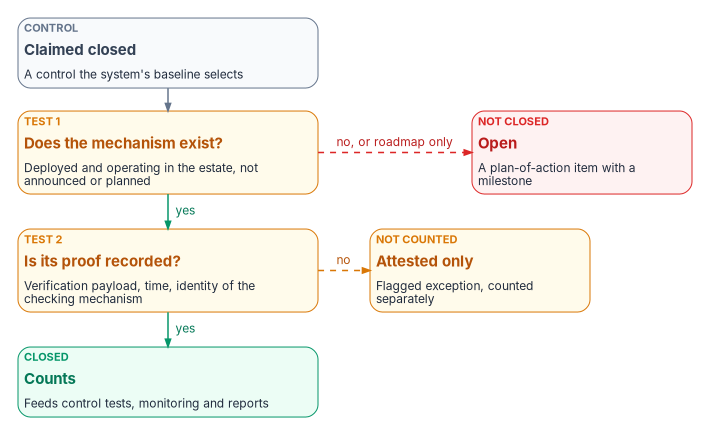
- The mechanism exists. The mechanism that supports the control is deployed and operating in the estate. A purchase order, a pilot that ended, or a feature on a roadmap fails this test. So does a mechanism that exists but can’t reach the part of the estate the control covers.
- Its proof is recorded. The closure carries a machine-readable verification, a time and the identity of what checked it. A closure without that payload is an assertion, however honest.
A control that fails the first test is open, and it belongs in the plan of action with a milestone. A control that passes the first test but fails the second is something worse than open: it looks closed and can’t be shown to be. The rest of this chapter is the rules that keep each test honest.
A control closes only when the mechanism that supports it exists
The series states some of its closures as necessity claims: for a named set of controls, a named class of mechanism is the only way to support them. The claim is stronger than a recommendation, and it is meant to be falsifiable. Every “required” in it has to pair with the control text, the protocol behavior or the physics that rules the alternatives out, never with an adjective.
The series states three such anchors. Each is the program’s own argument, not a federal requirement; the corrections below come from checking the controls it names.
| Mechanism class | Controls the program says it supports | Why the program says there is no alternative | Checked against the control text |
|---|---|---|---|
| An authoritative naming and addressing plane (IPAM and DDI) | SC-20, SC-21, SC-22; CM-8, CM-8(1); IA-9 | You can’t attest authoritative name resolution without an authoritative resolver, and you can’t inventory what you can’t enumerate. A scanner measures drift from a source of truth; it can’t create one | SC-20 asks the system to return data origin and integrity artifacts with its authoritative answers; CM-8 asks for an inventory that accurately reflects the system and includes every component. The source also cited SC-20(1), which NIST has withdrawn and folded into SC-20. IA-9 is in no NIST baseline and FedRAMP lists no class for it, so it is a design choice, not a baseline obligation34 |
| An encrypted, application-aware transport overlay (SD-WAN) | SC-8, SC-8(1) on direct internet circuits; SC-5; SI-4 | A circuit has no encryption, path intelligence or telemetry of its own. Validated TLS provides SC-8’s transmission protection for the flow that negotiates it; a network-layer overlay provides it for every flow on the circuit at once, including the DNS queries and legacy protocols TLS doesn’t reach | SC-8(1) asks for cryptographic mechanisms and names no protocol, so TLS per flow and an overlay per circuit are both valid mechanisms. The claim is about completeness, not exclusivity, and other overlays (plain IPsec, zero-trust tunnels) also encrypt every flow. SC-5 is denial-of-service protection; treating traffic-class separation as part of it is the program’s reading5 |
| Distributed policy enforcement for local breakout (TIC 3.0 enforcement points) | SC-7, SC-7(7); AC-4 | Breaking out locally removes the old central access point; an ungoverned local circuit is a boundary finding, not a modernization | SC-7(7) asks that split tunneling be prevented unless securely provisioned with defined safeguards; AC-4 asks for information flow enforcement. Book 09, Chapter 05 carries what TIC 3.0 asks of the branch edge6 |
The transport argument behind the second and third rows is Book 09, Chapter 02: local breakout solves a latency problem, provides none of the protection controls by itself, and without a governed edge it loses the boundary protection the old hairpin provided. The naming argument behind the first row is Book 08. This chapter needs only the shape of the argument: a necessity claim names the mechanism, says why no other mechanism can support the control, and shows the control text that makes it so.
Mechanism, not product
“No alternate closure path” is a claim about mechanism classes, never about vendors. “Only port-based authentication supports IA-3 for unmanaged network ports” names a protocol behavior. It doesn’t name a product. Every product the series names is a deployed example of its mechanism, and for each layer there are certified alternatives that implement the same mechanism.
The program’s design follows from that: many compliant paths exist before the agency chooses, and exactly one exists after. The agency selects one implementation per layer, and once chosen it becomes the governed path. Two implementations of the same truth plane (two IPAM systems, two inventories, two identity sources) recreate the fragmented-truth problem the program exists to end (Book 13, Chapter 03). The choice is a decision with an owner (Chapter 10), not a default that drifts.
No closure counts without its proof
The second test has its own rule, and Book 13, Chapter 04 states it in full. In short: a remediation task, a daily check, a plan-of-action milestone or a control test closed by a person clicking “complete”, with no machine-readable verification attached, is prose, not evidence. It asserts that work happened. It proves nothing an assessor can consume.
The rule has three requirements, all program design:
- Every closure carries provenance. The closing update carries the verification that justified it (the probe result, the posture query, the re-test output) with a timestamp and the identity of the checking mechanism. A closure record without that payload doesn’t validate.
- Human-only closure is an exception state, not a path. Operations need an escape hatch, so it stays possible. It is visibly flagged, counted separately and never folded into control tests, continuous-monitoring evidence or service-level figures.
- Reports are derivations, never compilations. Continuous-monitoring roll-ups, plan-of-action aging and patch service levels are generated from the closure records by something that can be re-run and compared. A report that can’t be regenerated from closure records is an artifact of effort, not of state.
For a compliance program the consequence is direct. Manual closure doesn’t just fail to prove a single item; it poisons everything built on it. A dashboard, a service-level report or a monthly continuous-monitoring summary assembled from manually closed tasks is a compilation of assertions, every row unverified. Reporting isn’t something added after closure. It is something a well-formed closure emits. Book 13, Chapter 07 builds the evidence model on that point, and Book 12, Chapter 02 defines the record every source emits: an asset identity and a time.
Proof is a read, so it can be automated fully
Verifying a closure is a read: probe the estate, attach the result, gate the close. That matters because the program caps how far automation may write to the estate (Book 01, Chapter 11). The cap doesn’t apply to proof. Where an estate change needs a human approver, the change still happens under that approval; checking that it happened and closing the coordination record with the result needs none. Closure verification is the one place a capped deployment can run at full automation.
The program holds itself to the same rule
The series applies the rule to its own documents. Each series volume’s book has a table of controls closed that is generated from the closure record and checked for drift, because hand-maintained numbers silently go wrong (Chapter 03). Beyond that, the program’s design binds each closure claim to a named test that would disprove it, and it reports the share of claims that have one. That share is the program’s own measure of how much of its closure story is proven rather than asserted. It is expected to rise, and it is published while it is low.
What “closed” means when the evidence is continuous
The series tied this rule to FedRAMP 20x, saying a control is “closed” under the 2026 rules when its evidence is generated automatically, machine-readable, continuously updated and validated against a published indicator schema. FedRAMP doesn’t define closure that way, and its indicators bind cloud providers, not agencies (Chapter 03). What FedRAMP does say points the same direction. It tells providers that indicators “aren’t one-time requirements” and that the processes fulfilling them should continuously collect evidence, detect configuration drift, monitor control effectiveness over time and alert on deviations from baselines.7 It publishes its rules, including the indicators, as a machine-readable dataset with schemas.8 And it requires agencies to make sure their governance, risk, compliance and inventory tools can produce and ingest machine-readable artifacts, including at least OSCAL JSON.9
The program therefore adopts the series’ four properties as its own design for agency evidence: generated by the systems rather than assembled by staff, machine-readable, current on a defined cadence, and checkable by a program. They describe proof that passes the second test. They aren’t a FedRAMP definition.
A vendor roadmap is not a commitment
The first test fails quietly when a plan treats a vendor’s announcement as a mechanism. The series names real products on purpose, because a necessity claim has to name a real mechanism, not a category: “the cloud provider’s configuration remediation actions,” not “some posture tool.” That specificity has a cost. The market the series describes moves in weeks, not review cycles. In the program’s own drafting, a workflow-platform capability documented as not yet built shipped within weeks, and native integrations treated as missing turned out to exist already. Neither statement was wrong when it was written; both were dated, sourced and stale within a month.
Authorization status moves the same way. FedRAMP stopped accepting FedRAMP Ready submissions after July 28, 2026, and on October 21, 2026 its Marketplace data listed 53 offerings as “Legacy FedRAMP Ready.”1011 A status read from the Marketplace in the spring can be wrong by the fall without anyone having made a mistake.
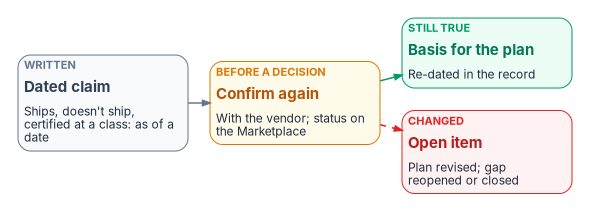
The rule, stated once for every book in the series, is program design:
- Every vendor capability claim is dated, not permanent. A document’s date code marks when its vendor claims were last verified. It never asserts that they are still current.
- Confirm before you commit. Before a claim becomes the basis of a project plan, a procurement action or an acquisition decision, confirm the current state directly with the vendor and, for authorization status, on the FedRAMP Marketplace. Don’t assume it from the series’ snapshot.
- Gaps move both ways. A closed gap can reopen and an open gap can close between two drafting sessions. Treat every “not yet built” and every “ships natively” as equally perishable.
Two federal hooks make the rule practical rather than a slogan. SA-4 asks an agency to put security and privacy functional requirements, assurance requirements and acceptance criteria in the acquisition contract, so a capability the plan depends on can be written into the contract rather than left in a roadmap slide. SA-4 is in all three NIST baselines and in FedRAMP Classes B, C and D.1213 And the plan of action is where a roadmap item belongs until it ships: an open weakness with a milestone, not a closed control with a footnote. Chapter 07 carries the supplier side of the same discipline.
How the rules line up with the controls
The rules are the program’s design, not federal requirements. They are built to make the following controls easy to show. Statements are summarized from SP 800-53 Rev. 5, release 5.2.0; baselines are NIST SP 800-53B and FedRAMP’s 2026 Rev5 control reference, cited separately.161718
| Control | What it asks, in short | NIST SP 800-53B | FedRAMP 2026 classes | Where the rules support it |
|---|---|---|---|---|
| CA-2 Control Assessments | Assess whether controls are implemented correctly, operating as intended and producing the desired outcome | Low, Moderate, High | B, C, D | The two closure tests; the proof attached to every closure is what an assessor reads |
| CA-5 Plan of Action and Milestones | Document planned remediation of weaknesses; update it from assessments, audits and continuous monitoring | Low, Moderate, High | none listed on the page | Every control failing the first test, and every roadmap item, is a plan-of-action entry with a milestone |
| CA-7 Continuous Monitoring | A system-level strategy with metrics, frequencies, ongoing assessment, correlation, response and status reporting | Low, Moderate, High | B, C, D | Closure records stream into monitoring; reports are derived from them |
| CM-8 System Component Inventory | An inventory that accurately reflects the system and includes every component | Low, Moderate, High | B, C, D | The authoritative inventory as the source of truth for assets; consoles and the configuration database as projections |
| AC-6 Least Privilege | Allow only the access necessary for assigned tasks | Moderate, High | C, D | Clause 3: just-in-time, scoped elevation recorded in the closure |
| SA-4 Acquisition Process | Put security and privacy requirements, assurance requirements and acceptance criteria in acquisition contracts | Low, Moderate, High | B, C, D | A capability the plan depends on goes into the contract, not a roadmap |
| PM-4 Plan of Action and Milestones Process | An organization-level process that keeps plans of action developed, maintained and reported, and reviews them for consistency | none (organization level) | none | Plan-of-action aging derived from closure records, not compiled |
The CA-5 row repeats the anomaly Chapter 03 noted: FedRAMP’s 2026 reference page shows no class line for CA-5. Keep a plan of action anyway. It is in every NIST baseline, and it is where every rule in this chapter sends an unfinished closure.
Zero Trust evidence, by control family
A Zero Trust assessment reports by pillar: identity, devices, networks, data, infrastructure, security operations. An authorization package is organized by SP 800-53 control. The two don’t line up one to one, and a package that pretends they do invites the wrong conclusion in both directions: that a passed Zero Trust test settles a control, or that a control with no Zero Trust test has no evidence. NIST’s own Zero Trust practice guide, SP 1800-35, maps Zero Trust principles and technologies to commonly used security standards and guidelines rather than treating Zero Trust as a control set of its own,19 and SP 800-53 Rev. 5 has no Zero Trust control or family (Book 11, Appendix A).
The table below is a sample of how the program carries Zero Trust implementation evidence into a package, family by family. Each row names the family’s intent in a phrase, the Zero Trust implementation that supports part of it, the evidence that implementation produces, and the caveat an assessor will raise. It is program design, a starting point for an agency’s own mapping, not a crosswalk to adopt as written. The control-level list of what a Zero Trust program supports is Book 11, Appendix A; this book’s Appendix A gives each control’s baselines and the chapter that carries it.
| Family | Control intent, in short | Zero Trust implementation that supports part of it | Implementation evidence | Assessor caveat |
|---|---|---|---|---|
| Access Control (AC) | Accounts managed, access enforced as authorized, least privilege, information flow and remote access controlled (AC-2, AC-3, AC-6, AC-4, AC-17) | Conditional Access policy set, PIM eligible assignments, emergency access design, consent governance (Book 04) | Policy and role-setting exports with their enforcing state; the exclusion register; PIM activation records; emergency access alert and drill records (Book 12, Appendix B) | The exports cover the Entra tenant. Least privilege also covers Azure RBAC, on-premises directories, databases and applications, which need their own evidence; a standing emergency access assignment is a documented exception, not a gap |
| Identification and Authentication (IA) | Users, devices and authenticators identified and authenticated; multifactor for privileged and non-privileged accounts (IA-2, IA-2(1), IA-2(2), IA-5) | Phishing-resistant authentication strength for administrators, authentication methods policy, device identity (Book 04, Book 07) | Authentication strength and methods policy exports; sign-in records showing the method used; registration coverage | A policy shows what is required, not who is covered; registration coverage and the sign-in sample show it. Systems that don’t authenticate through Entra ID need their own evidence |
| Audit and Accountability (AU) | Events selected for logging, records generated, reviewed and retained (AU-2, AU-6, AU-11, AU-12) | Diagnostic settings for every plane, the evidence contract, detections with synthetic tests (Book 12) | Diagnostic-setting and retention exports; the synthetic event found in the workspace; alert and review records | A log that exists isn’t a log that is reviewed. AU-2’s event selection and AU-11’s retention period are the agency’s own parameters, set in the system security plan |
| Configuration Management (CM) | Baselines and settings, change control, component inventory (CM-2, CM-3, CM-6, CM-8) | Device compliance and configuration baselines, SCuBA tenant baselines, configuration drift rules (Book 05, Book 13) | Compliance and configuration policy exports; ScubaGear and Zero Trust Assessment results; device inventory with ownership and encryption state | A baseline result is evidence for the settings it tests, at the time it ran. Settings outside the tool’s scope, and the change record behind each difference, are still needed |
| System and Communications Protection (SC) | Boundaries and flows, transmission protection, cryptographic keys, information at rest (SC-7, SC-8, SC-12, SC-28) | Compliant network and private access, encryption at rest on managed devices, sensitivity labels with encryption (Book 09, Book 12, Chapter 09) | Traffic and access logs; device encryption state; label and protection policy exports with a labeled sample | Device encryption covers devices, not every store of the information; SC-28 is scoped to the information the agency specifies, and SC-12 needs the key management evidence beside it |
| System and Information Integrity (SI) | Monitoring for attacks and unauthorized use, malicious code protection, flaw remediation (SI-4, SI-3, SI-2) | Defender for Endpoint onboarding and prevention, detection rules, vulnerability and patch pipelines (Book 12) | Sensor onboarding and health coverage; alert history; detection test records; remediation records | Coverage is measured against the inventory, not the console’s own device list; an asset the console doesn’t know is invisible to both |
| Incident Response (IR) | Incident handling, monitoring and reporting, a tested plan (IR-4, IR-5, IR-6, IR-8) | Response playbooks, automatic attack disruption decisions, incident queue (Book 12, Chapter 11) | Incident records with actions, approvers and times; exercise records | Tooling isn’t the plan; IR-8 is assessed on the plan document, its review and its distribution |
| Assessment, Authorization and Monitoring (CA) | Control assessments, plans of action, continuous monitoring (CA-2, CA-5, CA-7) | The Zero Trust assessment itself, run on a cadence with a normalized result register (Book 11, Chapter 10) | Tool output with each result’s disposition; the closure chain per finding; plan-of-action entries | A tool’s pass is an input to the assessor, not a determination; a skipped or unlicensed test is a disposition, not a failure |
Assessor caveats that apply to every row
- The assessor determines, the mapping doesn’t. SP 800-53A has the assessor reach each determination by examining, interviewing and testing; the evidence above is what the assessor examines and what a test produces, not the determination itself.20
- One capability, several controls; one control, several capabilities. Conditional Access supports parts of AC-3, AC-17 and IA-2 at once, and AC-6 needs evidence from more systems than Entra ID. A row is not an implementation statement; the system security plan writes one per control.
- Organization-defined parameters come first. Many controls ask the organization to define a frequency, a set of events or a time period. Evidence is read against those parameters, so they belong in the plan before the evidence is collected.
- Shared responsibility. For a cloud service, part of a control is the provider’s, evidenced in its FedRAMP package, and part is the agency’s configuration, evidenced here (Book 10).
- Evidence has a date. Configuration exports, assessment output and coverage figures are true at the time they were taken; Chapter 11 sets how fresh each must be.
- The Zero Trust pillars aren’t families. CISA’s maturity model has five pillars and three cross-cutting capabilities;21 a family can draw on several pillars, and a pillar’s evidence can serve several families. Report both views; don’t fold one into the other.
Honest limits
- Proof is only as good as the probe. A closure that carries a payload from a weak check proves little. Checks are reviewed like any other rule (Book 13, Chapter 05).
- A necessity claim can be wrong. It is written to be falsifiable, so test it. If an alternative mechanism also supports the control, the claim narrows; the SC-8 row above already has.
- Dated claims still need someone to re-date them. The vendor rule works only if a named owner re-verifies before each decision (Chapter 10).
- The authorizing official still decides. Closure with proof makes residual risk visible. It doesn’t accept it; only the authorizing official does (Book 13, Chapter 09).
Key takeaways
- A control is closed when the mechanism that supports it exists in the estate and its proof is recorded. Otherwise it is open, or attested only.
- Necessity claims name mechanism classes and show the control text behind them. Products are examples.
- No closure counts without its proof, and reports are derived from closure records, never compiled.
- A vendor roadmap is not a commitment. Date every claim and confirm it before a plan or contract rests on it.
- Every operation travels the authorized path, starting from a source of truth that names an owner.
National Institute of Standards and Technology, SP 800-53 Rev. 5, Security and Privacy Controls for Information Systems and Organizations, release 5.2.0 (planning note of August 27, 2025), https://csrc.nist.gov/pubs/sp/800/53/r5/upd1/final; control statements read from the OSCAL catalog (version 5.2.0, last modified May 11, 2026), https://github.com/usnistgov/oscal-content/blob/main/nist.gov/SP800-53/rev5/json/NIST_SP-800-53_rev5_catalog.json, and identifiers and titles checked against the CSRC Cybersecurity and Privacy Reference Tool export for SP_800_53_5_2_0 (accessed Oct 21, 2026). Controls cited: AC-2, AC-3, AC-4, AC-6, AC-17, AU-2, AU-6, AU-11, AU-12, CA-2, CA-5, CA-7, CM-2, CM-3, CM-6, CM-8, CM-8(1), IA-2, IA-2(1), IA-2(2), IA-5, IA-9, IR-4, IR-5, IR-6, IR-8, PM-4, SA-4, SC-5, SC-7, SC-7(7), SC-8, SC-8(1), SC-12, SC-20, SC-20(1) (withdrawn, incorporated into SC-20), SC-21, SC-22, SC-28, SI-2, SI-3, SI-4 (the family-mapping controls read Nov 11, 2026).↩︎
National Institute of Standards and Technology, SP 800-53 Rev. 5, Security and Privacy Controls for Information Systems and Organizations, release 5.2.0 (planning note of August 27, 2025), https://csrc.nist.gov/pubs/sp/800/53/r5/upd1/final; control statements read from the OSCAL catalog (version 5.2.0, last modified May 11, 2026), https://github.com/usnistgov/oscal-content/blob/main/nist.gov/SP800-53/rev5/json/NIST_SP-800-53_rev5_catalog.json, and identifiers and titles checked against the CSRC Cybersecurity and Privacy Reference Tool export for SP_800_53_5_2_0 (accessed Oct 21, 2026). Controls cited: AC-2, AC-3, AC-4, AC-6, AC-17, AU-2, AU-6, AU-11, AU-12, CA-2, CA-5, CA-7, CM-2, CM-3, CM-6, CM-8, CM-8(1), IA-2, IA-2(1), IA-2(2), IA-5, IA-9, IR-4, IR-5, IR-6, IR-8, PM-4, SA-4, SC-5, SC-7, SC-7(7), SC-8, SC-8(1), SC-12, SC-20, SC-20(1) (withdrawn, incorporated into SC-20), SC-21, SC-22, SC-28, SI-2, SI-3, SI-4 (the family-mapping controls read Nov 11, 2026).↩︎
National Institute of Standards and Technology, SP 800-53 Rev. 5, Security and Privacy Controls for Information Systems and Organizations, release 5.2.0 (planning note of August 27, 2025), https://csrc.nist.gov/pubs/sp/800/53/r5/upd1/final; control statements read from the OSCAL catalog (version 5.2.0, last modified May 11, 2026), https://github.com/usnistgov/oscal-content/blob/main/nist.gov/SP800-53/rev5/json/NIST_SP-800-53_rev5_catalog.json, and identifiers and titles checked against the CSRC Cybersecurity and Privacy Reference Tool export for SP_800_53_5_2_0 (accessed Oct 21, 2026). Controls cited: AC-2, AC-3, AC-4, AC-6, AC-17, AU-2, AU-6, AU-11, AU-12, CA-2, CA-5, CA-7, CM-2, CM-3, CM-6, CM-8, CM-8(1), IA-2, IA-2(1), IA-2(2), IA-5, IA-9, IR-4, IR-5, IR-6, IR-8, PM-4, SA-4, SC-5, SC-7, SC-7(7), SC-8, SC-8(1), SC-12, SC-20, SC-20(1) (withdrawn, incorporated into SC-20), SC-21, SC-22, SC-28, SI-2, SI-3, SI-4 (the family-mapping controls read Nov 11, 2026).↩︎
FedRAMP, “Full Rev5 Control Reference,” FedRAMP Consolidated Rules for 2026, family pages for AC, CA, CM, IA, PM, SA, SC and SI (“FedRAMP Rev5 Baselines” per control; IA-09, CA-05 and PM-04 show no class line), https://www.fedramp.gov/2026/reference/controls/ (accessed Oct 21, 2026).↩︎
National Institute of Standards and Technology, SP 800-53 Rev. 5, Security and Privacy Controls for Information Systems and Organizations, release 5.2.0 (planning note of August 27, 2025), https://csrc.nist.gov/pubs/sp/800/53/r5/upd1/final; control statements read from the OSCAL catalog (version 5.2.0, last modified May 11, 2026), https://github.com/usnistgov/oscal-content/blob/main/nist.gov/SP800-53/rev5/json/NIST_SP-800-53_rev5_catalog.json, and identifiers and titles checked against the CSRC Cybersecurity and Privacy Reference Tool export for SP_800_53_5_2_0 (accessed Oct 21, 2026). Controls cited: AC-2, AC-3, AC-4, AC-6, AC-17, AU-2, AU-6, AU-11, AU-12, CA-2, CA-5, CA-7, CM-2, CM-3, CM-6, CM-8, CM-8(1), IA-2, IA-2(1), IA-2(2), IA-5, IA-9, IR-4, IR-5, IR-6, IR-8, PM-4, SA-4, SC-5, SC-7, SC-7(7), SC-8, SC-8(1), SC-12, SC-20, SC-20(1) (withdrawn, incorporated into SC-20), SC-21, SC-22, SC-28, SI-2, SI-3, SI-4 (the family-mapping controls read Nov 11, 2026).↩︎
National Institute of Standards and Technology, SP 800-53 Rev. 5, Security and Privacy Controls for Information Systems and Organizations, release 5.2.0 (planning note of August 27, 2025), https://csrc.nist.gov/pubs/sp/800/53/r5/upd1/final; control statements read from the OSCAL catalog (version 5.2.0, last modified May 11, 2026), https://github.com/usnistgov/oscal-content/blob/main/nist.gov/SP800-53/rev5/json/NIST_SP-800-53_rev5_catalog.json, and identifiers and titles checked against the CSRC Cybersecurity and Privacy Reference Tool export for SP_800_53_5_2_0 (accessed Oct 21, 2026). Controls cited: AC-2, AC-3, AC-4, AC-6, AC-17, AU-2, AU-6, AU-11, AU-12, CA-2, CA-5, CA-7, CM-2, CM-3, CM-6, CM-8, CM-8(1), IA-2, IA-2(1), IA-2(2), IA-5, IA-9, IR-4, IR-5, IR-6, IR-8, PM-4, SA-4, SC-5, SC-7, SC-7(7), SC-8, SC-8(1), SC-12, SC-20, SC-20(1) (withdrawn, incorporated into SC-20), SC-21, SC-22, SC-28, SI-2, SI-3, SI-4 (the family-mapping controls read Nov 11, 2026).↩︎
FedRAMP, “Key Security Indicators,” Cloud Service Providers, FedRAMP 20x Certification Rules, FedRAMP Consolidated Rules for 2026, section “Encouraging Improvement,” https://www.fedramp.gov/2026/providers/20x/key-security-indicators/ (accessed Oct 21, 2026).↩︎
FedRAMP, FedRAMP Consolidated Rules for 2026, machine-readable rules repository (
fedramp-consolidated-rules.json, the canonical rules dataset, with schemas), https://github.com/FedRAMP/rules (accessed Oct 21, 2026).↩︎FedRAMP, “Agency Use of FedRAMP Certified Cloud Services,” FedRAMP Consolidated Rules for 2026, rule AGU-AGC-GRC, https://www.fedramp.gov/2026/reference/agency-use/ (accessed Oct 21, 2026).↩︎
FedRAMP, “Important Dates for the Consolidated Rules for 2026” (July 28, 2026: FedRAMP Ready goes legacy), https://www.fedramp.gov/2026/timeline/ (accessed Oct 21, 2026).↩︎
FedRAMP Marketplace product data, https://www.fedramp.gov/marketplace/products.json, dataset last changed October 21, 2026 (
statusfield; 53 listings “Legacy FedRAMP Ready” of 781) (accessed Oct 21, 2026).↩︎National Institute of Standards and Technology, SP 800-53 Rev. 5, Security and Privacy Controls for Information Systems and Organizations, release 5.2.0 (planning note of August 27, 2025), https://csrc.nist.gov/pubs/sp/800/53/r5/upd1/final; control statements read from the OSCAL catalog (version 5.2.0, last modified May 11, 2026), https://github.com/usnistgov/oscal-content/blob/main/nist.gov/SP800-53/rev5/json/NIST_SP-800-53_rev5_catalog.json, and identifiers and titles checked against the CSRC Cybersecurity and Privacy Reference Tool export for SP_800_53_5_2_0 (accessed Oct 21, 2026). Controls cited: AC-2, AC-3, AC-4, AC-6, AC-17, AU-2, AU-6, AU-11, AU-12, CA-2, CA-5, CA-7, CM-2, CM-3, CM-6, CM-8, CM-8(1), IA-2, IA-2(1), IA-2(2), IA-5, IA-9, IR-4, IR-5, IR-6, IR-8, PM-4, SA-4, SC-5, SC-7, SC-7(7), SC-8, SC-8(1), SC-12, SC-20, SC-20(1) (withdrawn, incorporated into SC-20), SC-21, SC-22, SC-28, SI-2, SI-3, SI-4 (the family-mapping controls read Nov 11, 2026).↩︎
FedRAMP, “Full Rev5 Control Reference,” FedRAMP Consolidated Rules for 2026, family pages for AC, CA, CM, IA, PM, SA, SC and SI (“FedRAMP Rev5 Baselines” per control; IA-09, CA-05 and PM-04 show no class line), https://www.fedramp.gov/2026/reference/controls/ (accessed Oct 21, 2026).↩︎
National Institute of Standards and Technology, SP 800-53 Rev. 5, Security and Privacy Controls for Information Systems and Organizations, release 5.2.0 (planning note of August 27, 2025), https://csrc.nist.gov/pubs/sp/800/53/r5/upd1/final; control statements read from the OSCAL catalog (version 5.2.0, last modified May 11, 2026), https://github.com/usnistgov/oscal-content/blob/main/nist.gov/SP800-53/rev5/json/NIST_SP-800-53_rev5_catalog.json, and identifiers and titles checked against the CSRC Cybersecurity and Privacy Reference Tool export for SP_800_53_5_2_0 (accessed Oct 21, 2026). Controls cited: AC-2, AC-3, AC-4, AC-6, AC-17, AU-2, AU-6, AU-11, AU-12, CA-2, CA-5, CA-7, CM-2, CM-3, CM-6, CM-8, CM-8(1), IA-2, IA-2(1), IA-2(2), IA-5, IA-9, IR-4, IR-5, IR-6, IR-8, PM-4, SA-4, SC-5, SC-7, SC-7(7), SC-8, SC-8(1), SC-12, SC-20, SC-20(1) (withdrawn, incorporated into SC-20), SC-21, SC-22, SC-28, SI-2, SI-3, SI-4 (the family-mapping controls read Nov 11, 2026).↩︎
Office of Management and Budget, M-25-21, Accelerating Federal Use of AI through Innovation, Governance, and Public Trust, April 3, 2025, introduction (“updating their annual AI use case inventory”) and the Chief AI Officer responsibilities, item E (“maintain the agency’s AI Use Case Inventory”), https://www.whitehouse.gov/wp-content/uploads/2025/02/M-25-21-Accelerating-Federal-Use-of-AI-through-Innovation-Governance-and-Public-Trust.pdf (accessed Oct 21, 2026).↩︎
National Institute of Standards and Technology, SP 800-53 Rev. 5, Security and Privacy Controls for Information Systems and Organizations, release 5.2.0 (planning note of August 27, 2025), https://csrc.nist.gov/pubs/sp/800/53/r5/upd1/final; control statements read from the OSCAL catalog (version 5.2.0, last modified May 11, 2026), https://github.com/usnistgov/oscal-content/blob/main/nist.gov/SP800-53/rev5/json/NIST_SP-800-53_rev5_catalog.json, and identifiers and titles checked against the CSRC Cybersecurity and Privacy Reference Tool export for SP_800_53_5_2_0 (accessed Oct 21, 2026). Controls cited: AC-2, AC-3, AC-4, AC-6, AC-17, AU-2, AU-6, AU-11, AU-12, CA-2, CA-5, CA-7, CM-2, CM-3, CM-6, CM-8, CM-8(1), IA-2, IA-2(1), IA-2(2), IA-5, IA-9, IR-4, IR-5, IR-6, IR-8, PM-4, SA-4, SC-5, SC-7, SC-7(7), SC-8, SC-8(1), SC-12, SC-20, SC-20(1) (withdrawn, incorporated into SC-20), SC-21, SC-22, SC-28, SI-2, SI-3, SI-4 (the family-mapping controls read Nov 11, 2026).↩︎
National Institute of Standards and Technology, SP 800-53B, Control Baselines for Information Systems and Organizations, release 5.2.0, https://csrc.nist.gov/pubs/sp/800/53/b/upd1/final; baseline membership read from the OSCAL Low, Moderate and High baseline profiles, https://github.com/usnistgov/oscal-content/tree/main/nist.gov/SP800-53/rev5/json (accessed Oct 21, 2026).↩︎
FedRAMP, “Full Rev5 Control Reference,” FedRAMP Consolidated Rules for 2026, family pages for AC, CA, CM, IA, PM, SA, SC and SI (“FedRAMP Rev5 Baselines” per control; IA-09, CA-05 and PM-04 show no class line), https://www.fedramp.gov/2026/reference/controls/ (accessed Oct 21, 2026).↩︎
National Institute of Standards and Technology, SP 1800-35, Implementing a Zero Trust Architecture: High-Level Document, June 2025 (the guide includes mappings “of ZTA principles and technologies to commonly used security standards and guidelines”), https://csrc.nist.gov/pubs/sp/1800/35/final (accessed Nov 11, 2026).↩︎
National Institute of Standards and Technology, SP 800-53A Rev. 5, Assessing Security and Privacy Controls in Information Systems and Organizations, January 2022, §2.4.2 (assessment methods: examine, interview and test) and §3.3 (each determination produces a finding of satisfied or other than satisfied), https://doi.org/10.6028/NIST.SP.800-53Ar5 (accessed Nov 11, 2026).↩︎
Cybersecurity and Infrastructure Security Agency, Zero Trust Maturity Model, Version 2.0, April 2023, §5 (pillars) and §5.6 (cross-cutting capabilities), https://www.cisa.gov/sites/default/files/2023-04/zero_trust_maturity_model_v2_508.pdf (accessed Nov 11, 2026).↩︎