Federal Modernization Workbook · Book 18 · What
Chapter 02 — Triaging the Portfolio
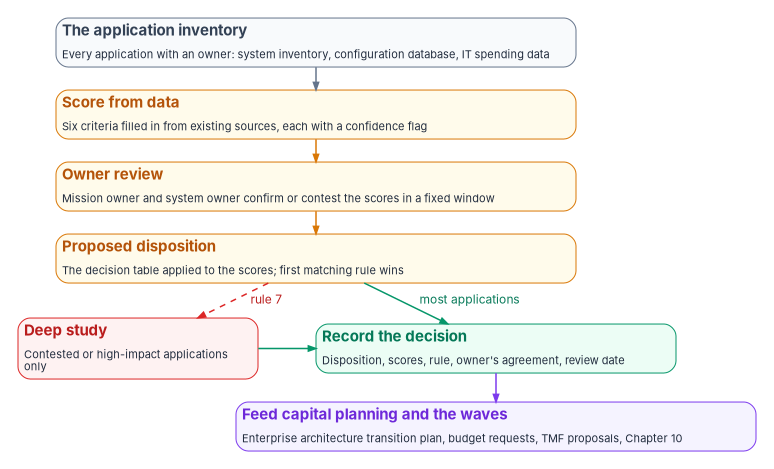
Triage is a scored, repeatable decision for every application, made from data the agency mostly already holds, with deep study kept for the few applications where the score and the owner disagree.
The six dispositions this book uses, and how they line up with Gartner’s original five options, AWS’s 7 Rs and the Microsoft Cloud Adoption Framework’s eight strategies. The six criteria a triage weighs, and an evidence map that turns the dependency criterion from a guess into a sourced, dated record. A scored rubric and a decision table that turn the criteria into a disposition for thousands of applications at once. How the result feeds capital planning and Technology Modernization Fund proposals. Book 06 applies the same discipline to SQL Server instances.
Chapter 01 argued that the unit of modernization is the application. This chapter is about deciding what each one becomes. In a portfolio of thousands, that can’t be a separate study per application: a three-month assessment of each would take longer than most applications have left to live. It has to be a rubric applied to data, with judgment kept for the exceptions.
The six dispositions
| Disposition | What it means here | The signals that point to it | What it ends with |
|---|---|---|---|
| Retire | Switch the application off. Its records are kept, transferred or destroyed under the records schedule, and its function is dropped, absorbed by another system or replaced by a commercial or shared service | Few users; duplicates another system; function no longer needed; a commercial or shared service already does it | No running application; a records disposition; the hosting and license cost stops |
| Retain | Keep it as it is, on purpose, for a stated period | Stable, supported, meets its mission need; or too risky to move before something else moves first | A documented reason and a review date |
| Rehost | Move it to new infrastructure with no code change | Sound application on a platform being exited (a data center, aging hardware) | Same application, new hosting |
| Replatform | Move it with limited change: a new database engine, a managed runtime, a container | Application logic is sound; the platform under it is unsupported or expensive | Same application logic on a supported platform |
| Refactor | Restructure it onto the target architecture incrementally, behind a stable interface | Valuable, changing often, and blocked by its structure or language | Services on the target architecture, legacy pieces retired one by one |
| Rebuild | Write it again on the target architecture, still delivered in increments | Valuable, but the code can’t be salvaged or the requirements have changed beyond it | A new application on the target architecture |
The dispositions are listed in rising order of cost and risk. That ordering is the rubric’s first rule: an application gets the cheapest disposition that meets its mission need, and every step up the list has to be justified by the scores.
Two of them are decisions rather than projects. Retire and retain need a decision process, an owner’s agreement and, for retire, a decommissioning checklist, but no engineering team. In most portfolios they are where the early savings are, which is why Book 06’s treatment of SQL Server instances also starts with them.
Where the names come from
The vocabulary is older than this book, and the major cloud providers each use a slightly different list. An agency will meet all of them in vendor proposals, so it helps to know how they line up.
- Gartner’s five options. Gartner described five ways to move applications to the cloud, reported at the time as rehost, refactor, revise, rebuild and replace; AWS dates them to 2011.12 Gartner’s research note is behind a paywall and wasn’t consulted for this chapter. As reported, Gartner’s “refactor” meant running the application on a provider’s platform, closer to what later lists call replatform, and “revise” meant modifying the code before moving it.
- AWS’s 7 Rs. AWS Prescriptive Guidance lists retire, retain, rehost, relocate, repurchase, replatform, and refactor or re-architect.3 Relocate moves servers to a cloud version of the same platform without changing the application; repurchase, also called “drop and shop,” replaces the application with a different product, typically SaaS. AWS adds a warning worth taking seriously: refactoring is the most complex strategy and isn’t recommended for large migrations, so it advises rehosting, relocating or replatforming first and modernizing afterward.
- Microsoft’s Cloud Adoption Framework. The framework’s planning guidance lists eight strategies: retire, retain, rehost, replatform, refactor, rearchitect, rebuild and replace, each tied to a business driver.4 It cautions against rehosting problematic workloads, since rehosting doesn’t fix existing performance, reliability or architectural problems, and suggests rehosting only when a workload won’t need modernization for at least two years. Microsoft’s separate application modernization guidance uses six: rehost, replatform, refactor, rebuild, retire and retain.5
| This book | Gartner (five options) | AWS (7 Rs) | Microsoft CAF (eight strategies) |
|---|---|---|---|
| Retire | — | Retire | Retire |
| Retire, function moved to a product or service | Replace | Repurchase | Replace |
| Retain | — | Retain | Retain |
| Rehost | Rehost | Rehost; Relocate | Rehost |
| Replatform | Refactor (on a provider platform) | Replatform | Replatform |
| Refactor | Revise | Refactor or re-architect | Refactor; Rearchitect |
| Rebuild | Rebuild | Refactor or re-architect | Rebuild |
This book uses the same six as Microsoft’s application modernization guidance, with two choices made deliberately.
- Replace is a form of retire. When a commercial or shared service takes over an application’s function, the agency’s own application is retired; the new service is an acquisition with its own authorization, not a modernization of the old code. Treating it as retire keeps the decommissioning work, the records disposition and the data migration in view. It also follows federal policy: Circular A-130 says custom development to improve or replace a system should start “only when no existing alternative private sector or governmental source can efficiently meet the need.”6 The rubric therefore tests “could a product or shared service do this?” before it allows refactor or rebuild.
- Relocate is a form of rehost. Both move an application without changing it. The distinction matters to the hosting team, not to the portfolio decision.
The six triage criteria
The criteria come from what GAO, federal policy and the providers’ own guidance say drives modernization risk and value. Each is scored for every application.
| Criterion | What it asks | Where the data comes from | Grounding |
|---|---|---|---|
| Mission criticality | How much does the mission depend on it, and what happens if it fails or is wrong? | Business impact analysis; the system’s FIPS 199 availability and integrity impact; high value asset designation | FIPS 199 impact levels; GAO’s “unmet mission needs” risk78 |
| Technical condition | Is it supported, patchable and changeable? | Configuration database; vulnerability scans; vendor support dates; age of hardware and software | A-130 requires unsupported components be “phased out as rapidly as possible”; GAO found seven of eleven critical systems with vulnerabilities that couldn’t be fixed without modernization910 |
| Data sensitivity | What data does it hold, and how hard is moving it? | FIPS 199 confidentiality impact; the PII inventory and privacy impact assessments; database engine and size | FIPS 199; A-130’s inventory of systems holding PII1112 |
| Cost | What does it cost to run, and what would each disposition cost? | IT spending data; hosting, license and support contracts; staff time | 40 U.S.C. 11312 risk-adjusted return on investment13 |
| Skills | Can the agency staff it today and in five years? | Workforce data; contracts; the languages in the code base (COBOL, PL/I, assembly, PL/SQL, proprietary 4GLs) | GAO on the shortage of COBOL and assembly skills14 |
| Dependencies | What does it call, what calls it, and what shares its data? | Network flows; interface agreements; database links and shared schemas; batch schedules | AWS lists unmigrated dependencies as a reason to retain15 |
A few notes on using them.
- FIPS 199 does a lot of the work. Every federal system already has a security categorization: low, moderate or high potential impact for confidentiality, integrity and availability, with the system taking the “high water mark” of the information types it holds.16 Availability and integrity impact are a defensible proxy for mission criticality, and confidentiality impact for data sensitivity, for the first pass.
- Skills are about the future, not the present. An application maintained today by one contractor team in a language few people still learn scores badly even if it runs well. GAO’s point is that the cost of those skills rises as the pool shrinks.17
- Dependencies decide sequence, not disposition. A heavily connected application may still be refactored, but not first. Chapter 10 uses the dependency score to build waves.
- PL/SQL and stored procedures count twice. Business logic in the database raises both the skills score and the data migration effort, and it makes a rehost or replatform harder than it looks. Chapter 04 covers converting it.
- Sign-in code counts under technical condition. Three Microsoft identity retirements turn an application’s authentication library into part of its condition, so the inventory asks three questions of every application that signs users in or calls Microsoft APIs:
- Which authentication library, and which version? All Microsoft support for the Azure Active Directory Authentication Library (ADAL), including security fixes, ended on June 30, 2023. ADAL applications keep working but get no fixes, and the replacement, the Microsoft Authentication Library (MSAL), gets tokens from AD FS only on AD FS 2019 or later.18 Once sign-in logs flow to Azure Monitor, the Sign-ins workbook in the Entra admin center lists the ADAL applications active in the last 30 days, with sign-in counts and ADAL versions, which is measured evidence for this question.19
- Does it call Azure AD Graph? Microsoft’s timeline ended extended access to Azure AD Graph on August 31, 2025, and any application still using it stops working once the API is retired; the migration target is Microsoft Graph.20 Microsoft Entra recommendations list the registered applications and the consented third-party service principals that still call it, and the second list usually means a vendor upgrade, not a code change.21
- Does its single-page front end still use the implicit grant? Microsoft says the implicit grant is no longer a suitable authentication method, because browsers that block third-party cookies break its silent sign-on; MSAL.js 2.x doesn’t support it, and the move is to the authorization code flow with PKCE: switch the registration’s redirect URIs to the single-page application platform, update the code, and only then turn implicit grant off, because turning it off disables it for every application sharing that registration.2223
Identity and access intake fields
An application in the portfolio is also an identity in the tenant: an app registration, a service principal, sometimes a managed identity, with owners, permissions and credentials of its own. A Zero Trust assessment looks at those, and the findings it raises (ownerless privileged apps, long-lived secrets, redirect URIs on domains nobody controls) are attack paths whatever the application’s disposition is. So intake records nine identity fields beside the six criteria. They don’t change the disposition the rubric proposes. They rank each application by the attack paths its identity opens, and that rank sends it to the identity remediation factory on its own schedule: a retained application with an exposed secret is fixed now, not at its review date.
| Intake field | What it records | Source |
|---|---|---|
| Owners | The business owner and the two technical owners, and whether each is still in that role | The governance record of Book 13, Chapter 14 |
| Graph and API permissions | Each application permission and tenant-wide delegated grant, whether it is on the high-privilege list, and its justification | Same; the risk tiers in Book 04, Chapter 06 |
| Secrets and certificates | Credential type (managed identity, federated, certificate, client secret), count and next expiry, and any secret exception | Same; Book 13’s secrets rules |
| Redirect URIs | Every redirect URI on the app registration, with three flags: wildcard, http other than loopback, and a host on a domain the agency can’t show it controls |
The app registration; the agency’s domain ownership record (Book 08) |
| Assignment requirement | Whether Assignment required? is on, so only assigned users and client apps get tokens | The service principal’s appRoleAssignmentRequired |
| Conditional Access compatibility | Whether Conditional Access can govern sign-in to it: a modern protocol (OpenID Connect, OAuth 2.0, SAML, or published through Application Proxy), or a legacy one that can’t be targeted; and for an app that calls APIs as itself, whether it is a single-tenant service principal that workload identity Conditional Access can reach | The app’s protocol from the sign-in logs; Chapter 03 for publishing |
| Last activity | The most recent sign-in as client or resource | The service principal sign-in activity report, or sign-in logs where the report isn’t available |
| Data sensitivity | The FIPS 199 confidentiality impact, already scored as a criterion | The triage record |
| Retirement candidate | Yes when the disposition is retire, or when there has been no activity for 90 days (design guidance, settled as WD-148) | The triage record and last activity |
Microsoft’s guidance on redirect URIs is to maintain ownership of every one, monitor their DNS records, avoid wildcards and insecure schemes, and keep the list small; a lapse in ownership of one redirect URI can lead to compromise of the application.24 Wildcards are accepted only for apps that sign in work or school accounts and only through the manifest, and Microsoft strongly recommends absolute URIs instead.25 An abandoned domain, or a CNAME left pointing at a deprovisioned cloud resource, can be taken over, and whoever takes it can receive what the application sends there, OAuth credentials included.26
The attack-path rank. The program’s design is a simple additive score, calibrated the way the rubric is (Calibrating the rubric). Points accumulate:
| Signal | Points |
|---|---|
| A high-privilege application permission | 3 |
| Any other application permission, or a tenant-wide delegated grant | 1 |
| A client secret | 2, plus 1 if it has no exception |
| No business owner, or no technical owner | 3 |
| Fewer than two technical owners | 1 |
| A redirect URI on a domain the agency can’t show it controls | 3 |
A wildcard or non-loopback http redirect URI |
2 |
| Assignment not required | 1 |
| Multitenant, or Conditional Access can’t govern its sign-in | 1 |
| Confidentiality impact high or moderate | 2 or 1 |
| A retirement candidate that still holds a credential or permission | 1 |
An application scoring 8 or more goes into the next factory wave whatever its disposition; 4 to 7 joins a wave within the planning horizon; below 4 is fixed with its own modernization or retirement. Ties go to the higher data sensitivity. The score and its thresholds are the program’s settled starting point (WD-148), not a standard, and change after calibration.
Rank the portfolio. Run Book 13, Chapter 14, Step 1 first; it writes app-governance-tenant-<date>.csv. The ranking below also reads <record.csv>, the governance record, which carries Confidentiality, BusinessOwner, Disposition, SecretException (the secret’s exception ID) and CaCompatible (No where Conditional Access can’t govern the app) for each AppId; <owned-domains.txt>, the agency’s list of domains it controls, one per line; and <out-dir>, the evidence folder.
$tenant = Import-Csv '<out-dir>\app-governance-tenant-<date>.csv'
$record = @{}; Import-Csv '<record.csv>' | ForEach-Object { $record[$_.AppId] = $_ }
$owned  = Get-Content '<owned-domains.txt>' | ForEach-Object { $_.Trim().ToLower() } | Where-Object { $_ }
function Test-Owned($uriText) { try { $h = ([uri]$uriText).Host.ToLower() } catch { return $false }
    if ($h -in 'localhost','127.0.0.1') { return $true }
    [bool]($owned | Where-Object { $h -eq $_ -or $h.EndsWith(".$_") }) }
function Test-Resolves($uriText) { try { [void][System.Net.Dns]::GetHostAddresses(([uri]$uriText).Host); $true } catch { $false } }

$ranked = foreach ($t in $tenant) {
    $r = $record[$t.AppId]; $uris = $t.RedirectUris -split ' ' | Where-Object { $_ }
    $notOwned = @($uris | Where-Object { -not (Test-Owned $_) }); $noDns = @($uris | Where-Object { -not (Test-Resolves $_) })
    $score = 0
    if ($t.HighPrivilege -eq 'True') { $score += 3 } elseif ($t.AppPermissions -or $t.TenantWideDelegated) { $score += 1 }
    if ([int]$t.Secrets -gt 0) { $score += 2; if (-not $r -or -not $r.SecretException) { $score += 1 } }
    if (-not $r -or -not $r.BusinessOwner -or ($t.HomeTenant -eq 'this tenant' -and [int]$t.OwnerCount -eq 0)) { $score += 3 }
    elseif ($t.HomeTenant -eq 'this tenant' -and [int]$t.OwnerCount -lt 2) { $score += 1 }
    if ($notOwned.Count) { $score += 3 }
    if ($t.WildcardOrHttpRedirect -eq 'True') { $score += 2 }
    if ($t.AssignmentRequired -ne 'True') { $score += 1 }
    if ($t.HomeTenant -ne 'this tenant' -or ($r -and $r.CaCompatible -eq 'No')) { $score += 1 }
    if ($r -and $r.Confidentiality -eq 'High') { $score += 2 } elseif ($r -and $r.Confidentiality -eq 'Moderate') { $score += 1 }
    $retire = ($r -and $r.Disposition -eq 'Retire') -or ($t.LastActivity -and [datetime]$t.LastActivity -lt (Get-Date).AddDays(-90))
    if ($retire -and ($t.AppPermissions -or [int]$t.Secrets -or [int]$t.Certificates)) { $score += 1 }
    [pscustomobject]@{ AppId = $t.AppId; DisplayName = $t.DisplayName; Score = $score
        Wave = if ($score -ge 8) { 'next factory wave' } elseif ($score -ge 4) { 'within horizon' } else { 'with its disposition' }
        RetirementCandidate = [bool]$retire; RedirectsNotOwned = $notOwned -join ' '; RedirectsNoDns = $noDns -join ' '
        Confidentiality = $r.Confidentiality; Disposition = $r.Disposition }
}
$ranked | Sort-Object Score, Confidentiality -Descending | Export-Csv '<out-dir>\portfolio-identity-rank.csv' -NoTypeInformation
The output is one row per application with its score, its wave, and the redirect URIs that fail the ownership or DNS check, which feed Appendix A’s redirect cleanup work package. A name that doesn’t resolve isn’t proof of a takeover risk, and one that resolves isn’t proof of ownership: both are leads for the domain owner to confirm. The rank is evidence for the triage record the same way the six scores are, with the measured flag.
Recording dependencies as an evidence map
Dependencies are the criterion a scoring sheet handles worst. A single score doesn’t say what an application is connected to, on whose evidence, or which of those connections a move would break. The program’s design is to record dependencies as an evidence map, a list of typed entities joined by typed, directed relationships, each relationship carrying its source. The dependency score is then computed from the map rather than estimated by the owner.
What goes on the map
| Entity type | What it covers | Examples |
|---|---|---|
| Application | Software people or other systems use | A case management system; a public web service; a batch reporting job |
| Data store | Where records live, including master records | The person or account master file; a payments database; a document repository |
| Data element | A single field that something else relies on | A status code, a date of death, an indicator flag |
| Data exchange | An interface with another organization | A file feed to a state, a verification service another agency calls, a matching agreement |
| Process | A business or batch process that reads or writes the data | Nightly reconciliation; a correction workflow; an annual statistical extract |
| Rule | A business, eligibility or data-quality rule, wherever it lives | A rule in a COBOL paragraph, a stored procedure or a procedure manual |
| Governance document | Something that authorizes or constrains a relationship | A system of records notice, an interface agreement, a policy |
| Finding | An audit or oversight finding about the entity | An inspector general recommendation; a GAO finding |
Each relationship records six things:
| Field | What it holds |
|---|---|
| From, to and kind | The two entities and what the link does: reads, writes, feeds, governs, replaces |
| Basis | Observed (seen in flows, logs or code), documented (in an agreement, notice or manual), planned or historical |
| Evidence | The document, log extract or code reference, with its revision date |
| Observed | When someone last confirmed the link |
| Confidence | The same measured, attested or assumed flag the rubric uses |
| Status | Current, retired, or planned with a target date |
Rules for keeping it honest
- A link is a claim, not a deployment fact. A documented link says two things are connected by policy or design. It doesn’t prove data flows between them today, and the absence of a link doesn’t prove nothing does. Label the basis on every link, and let observed evidence override documented evidence when they disagree.
- Keep open questions on the map. When the evidence doesn’t settle a link, record the question, who can answer it and when it was asked. Don’t drop the link and don’t guess it into existence. An open question on a high-impact system is a reason for rule 7, below.
- Count what points at each master record. Rank data stores by incoming relationships: applications, processes, rules and outside exchanges that read them. A master record with a hundred or more incoming links is where migration risk concentrates. Retiring or replatforming it isn’t one decision but one per dependent, and the map lists them.
- Count outside partners separately. Each exchange with another organization is a commitment the agency can’t change alone: an agreement with a term, a published notice, a partner’s own schedule. Under the Privacy Act, a system of records notice lists the system’s routine uses and the categories of sources of its records, and a computer matching agreement runs for up to 18 months, renewable without a new review for no more than one additional year.27 Those dates belong on the map, because a move has to fit inside them or wait for the next renewal.
- Map fields, not only systems. Rules depend on individual data elements, such as a code value that means “deceased” or “do not pay.” A replatform that preserves every table but changes one code’s meaning breaks every rule that reads it. Chapter 04 covers carrying the data across.
- Date everything. Each piece of evidence carries the revision date of its source and the date it was last checked. A map without dates can’t show which parts have gone stale.
Where the evidence comes from
The observed basis comes from the sources in the criteria table: network flows, database links, batch schedules and the code itself. The documented basis is often already published or on file: system of records notices, privacy impact assessments, interface and matching agreements, procedure manuals and oversight reports. Starting from the documents gives a first map in weeks; the observed evidence then confirms, corrects or adds to it. Book 01, Chapter 10 collects the infrastructure side of the same picture (directory, DNS, certificates, service accounts) as committed, provenance-bound streams, and the two should share identifiers so an application’s map can point at its infrastructure dependencies.
How the map feeds triage
- The dependency score is computed. It weighs incoming and outgoing relationships, the number of outside exchanges and the share of links that are only assumed. As on every criterion, 5 is the best outcome, so many links, many outside exchanges or many assumed links pull the score down. The confidence flag for the criterion is the weakest flag among the links that drive the score.
- High-stakes cases are visible. A master record with many outside exchanges, or a high-impact system with open questions, is a case for deep study under rule 7.
- Sequencing has its input. Chapter 10 builds waves from the map: dependents move before or with what they depend on, and a master record moves last, or behind a stable interface, as Chapter 03 describes.
- The map is the authoritative record of dependencies. Diagrams, spreadsheets and wave plans are derived from it, not maintained beside it. Book 13, Chapter 03 explains why.
A scored rubric, not a study per application
The program’s design is a two-axis score, a set of decision rules and an override.
Step 1: score two axes
Each criterion is scored from 1 to 5, with 5 the best outcome on every criterion. Five of the six combine into two axes; the dependency score doesn’t enter either axis and is used for sequencing:
| Axis | Criteria | How it reads |
|---|---|---|
| Mission value | Mission criticality and cost | High: the agency needs this function, in this form or another |
| Technical health | Technical condition, skills and data sensitivity (as migration difficulty) | High: the application can be run and changed safely as it is |
Weights are the agency’s choice; the program’s starting point is equal weights within each axis, adjusted after the calibration set below. Each score also carries a confidence flag: measured (from system data), attested (from the owner) or assumed (no data). An application with mostly assumed scores can’t get a final disposition; it goes to owner review first.
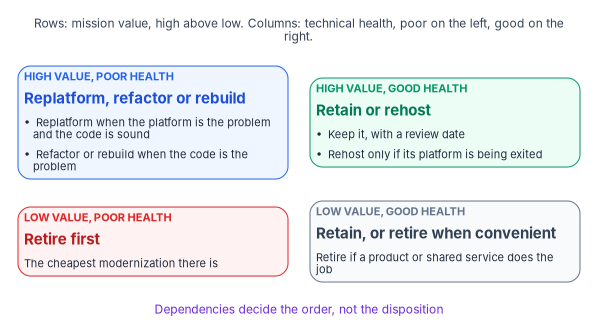
Step 2: apply the decision table
The decision table turns scores into a proposed disposition. Rules 1 to 6 are applied in order, and the first match wins. Rule 7 is an override: it is checked afterward, against the disposition rules 1 to 6 proposed.
| # | Condition | Proposed disposition | Why |
|---|---|---|---|
| 1 | Mission value low (≤ 2) and technical health not high (< 4), or a commercial or shared service already provides the function | Retire | Cheapest outcome; A-130 prefers existing alternatives to custom development. Low value with high health falls to rule 2: retain, with a review date at which retirement is reconsidered |
| 2 | Technical health high (≥ 4) and no platform exit is forcing a move | Retain, with a review date | Don’t spend money on an application that works and is supported |
| 3 | Technical health high, but the hosting platform is being exited | Rehost | The application is sound; only its location changes |
| 4 | Code sound (condition and skills ≥ 3), but the platform, runtime or database is unsupported or costly | Replatform | Fix what is broken, keep what works |
| 5 | Mission value high, code hard to change or staff, and the application can be intercepted behind an interface | Refactor | Incremental replacement keeps the mission running (Chapter 03) |
| 6 | Mission value high, and the code can’t be salvaged or requirements have outgrown it | Rebuild, in increments | Only after rules 1–5 have been ruled out |
| 7 | Any high-impact system whose proposed disposition is refactor or rebuild; any high-impact system with open questions on its dependency map; any application that holds a master record with many outside exchanges; or any application where the owner contests the result | Deep study before the decision | Spend analysis where the stakes or the disagreement are |
Rule 7 is how a rubric covers thousands of applications without becoming careless: most applications get a disposition from rules 1–4 at the cost of a scoring exercise, and the expensive analysis goes to the dozens that need it.
Step 3: owner review and the record
The proposed disposition goes to the application owner for a fixed review window. The application owner is the person accountable for the application as a business capability; where the application is, or sits inside, an authorized system, the system owner of Book 14, Chapter 10 is the role that owns its compliance, and the two may be the same person. The application owner can agree, or contest with evidence; a contested score is corrected, not argued around. The triage record holds the disposition, the six scores and their confidence flags, the rule that produced the disposition, the owner’s agreement and a review date. It is the artifact the enterprise architecture’s transition plan, the capital planning process and an auditor will ask for. Chapter 07 places the record under the architecture review board.
Calibrating the rubric
Before applying the rubric to the portfolio, the program’s design is to run it on a calibration set of thirty to fifty applications that experienced architects already know well, and to compare the rubric’s answers with theirs. Where they disagree, the weights or thresholds change, not the architects’ judgment of those applications. The calibration is repeated after the first wave, when the agency has real costs for each disposition.
Keeping it honest
- Score what is measured before what is believed. Utilization data, connection logs and support dates beat questionnaires. AWS, for example, suggests using utilization and connection data to find applications nobody uses: no inbound connection for 90 days, or very low average CPU and memory use.28
- Don’t let the rubric pick the technology. The disposition says how much an application changes. The target architecture in Chapter 03 says what it changes into.
- Retain is not a failure. It is a decision with a date. A portfolio where nothing is retained has usually not been triaged.
Book 06 Chapter 05 shows the same approach, utilization, versions and dependencies weighed from discovery data, applied to SQL Server instances, and Chapter 06 its retain, consolidate and retire decision. An agency that has run that analysis already has much of the data this rubric needs for applications on SQL Server.
Where capital planning and the TMF fit
Triage produces decisions; capital planning funds them. The two have to connect, or the dispositions stay on paper.
- Capital planning. The Clinger-Cohen Act’s capital planning provision requires each agency head to “design and implement” a process for maximizing the value and managing the risk of IT acquisitions, integrated with budget decisions, with minimum criteria that include “a quantitatively expressed projected net, risk-adjusted return on investment” and ways to compare and rank alternatives.29 A-130 asks agencies to weigh IT investments against others in the portfolio, and to incorporate migration planning and resourcing for unsupported systems into planning and budgeting.30 The rubric’s scores and dispositions are the comparison and ranking the statute asks for; the triage record is the evidence for it.
- The CIO’s approval. A-130 requires the CIO to approve the IT components of agency plans, through a process the agency head defines.31 A disposition that commits money is one of those components. The current FITARA memorandum and the rest of the federal framework status are summarized in the workbook’s federal framework crosswalk.
- The Technology Modernization Fund. The TMF’s published criteria say proposals “must improve, retire, or replace existing federal IT systems,” that competitive projects are “typically less than $25M,” that agencies should aim to repay the full amount on a five-year repayment timeline, and that projects should demonstrate measurable outcomes, ideally within 12 months.32 Its 2026 call for proposals kept legacy modernization and cybersecurity as priorities and asked for initial project proposals by October 20, 2026.33 The rubric points to the applications that fit: a high-value refactor or a cluster of retirements whose savings can repay the fund. Its triage records supply the baseline costs a proposal needs.
- Working capital funds. The Modernizing Government Technology Act authorizes covered agencies to establish IT working capital funds for transitioning from legacy systems, alongside the TMF.34 Savings from retirements are the natural source; Chapter 10 covers funding the waves.
Honest limits
- The rubric is the program’s design. Federal policy requires capital planning, an inventory, an enterprise architecture with a transition plan and the phase-out of unsupported systems. It doesn’t prescribe this rubric, these thresholds or these six names.
- Scores are only as good as the inventory. GAO notes that the extent of legacy IT across the government is unknown.35 Many agencies will find their inventory is the first thing triage fixes.
- Vendor lists are written for cloud migration. AWS’s and Microsoft’s strategies describe moving workloads into their clouds. The dispositions here are about the application’s future regardless of where it runs, and an agency should read vendor guidance with that difference in mind.
What leadership should take from this
- Approve the rubric, not each decision. Leadership’s job is to agree the criteria, weights and rules once, and then to rule on the contested cases rule 7 sends up.
- Expect most early savings from retire and retain. They need decisions and owners, not engineering. Fund the decommissioning work that makes retirements real.
- Make the triage record the currency. Capital planning reviews, TMF proposals and the enterprise architecture’s transition plan should all draw on the same records.
Chapter 03 describes the target the refactored and rebuilt applications are built on.
Stephen Orban, “6 Strategies for Migrating Applications to the Cloud,” AWS Cloud Enterprise Strategy Blog, November 1, 2016, https://aws.amazon.com/blogs/enterprise-strategy/6-strategies-for-migrating-applications-to-the-cloud/ (accessed Oct 28, 2026).↩︎
Help Net Security, “Five ways to migrate applications to the cloud,” May 16, 2011, reporting Gartner research by Richard Watson, https://www.helpnetsecurity.com/2011/05/16/five-ways-to-migrate-applications-to-the-cloud/ (search-result summary; the page refused automated retrieval, accessed Oct 28, 2026). Gartner’s own research note requires a subscription and was not consulted.↩︎
AWS Prescriptive Guidance, Guide for AWS large migrations, “About the migration strategies,” https://docs.aws.amazon.com/prescriptive-guidance/latest/large-migration-guide/migration-strategies.html (accessed Oct 28, 2026).↩︎
Microsoft Learn, Cloud Adoption Framework for Azure, “Select your cloud migration strategies,” migration strategy overview and “Select the right migration strategy,” https://learn.microsoft.com/azure/cloud-adoption-framework/plan/select-cloud-migration-strategy (accessed Oct 28, 2026).↩︎
Microsoft Learn, Application modernization guidance, “The 6 Rs of application modernization,” https://learn.microsoft.com/azure/app-modernization-guidance/plan/the-6-rs-of-application-modernization (accessed Oct 28, 2026).↩︎
Office of Management and Budget, Circular A-130, Managing Information as a Strategic Resource (2016 revision), §5.a(1)(a), §5.a(3)(c)–(d) and (f), and §5.d(1)(e), https://www.whitehouse.gov/wp-content/uploads/legacy_drupal_files/omb/circulars/A130/a130revised.pdf (accessed Oct 28, 2026).↩︎
National Institute of Standards and Technology, FIPS 199, Standards for Security Categorization of Federal Information and Information Systems, February 2004, Sections 3 and 4, https://nvlpubs.nist.gov/nistpubs/FIPS/NIST.FIPS.199.pdf; publication page https://csrc.nist.gov/pubs/fips/199/final (accessed Oct 28, 2026).↩︎
U.S. Government Accountability Office, GAO-25-107795, Information Technology: Agencies Need to Plan for Modernizing Critical Decades-Old Legacy Systems, July 17, 2025, Highlights and pages 4–7, 11–12 and 20, https://www.gao.gov/assets/gao-25-107795.pdf (accessed Oct 28, 2026).↩︎
Office of Management and Budget, Circular A-130, Managing Information as a Strategic Resource (2016 revision), §5.a(1)(a), §5.a(3)(c)–(d) and (f), and §5.d(1)(e), https://www.whitehouse.gov/wp-content/uploads/legacy_drupal_files/omb/circulars/A130/a130revised.pdf (accessed Oct 28, 2026).↩︎
U.S. Government Accountability Office, GAO-25-107795, Information Technology: Agencies Need to Plan for Modernizing Critical Decades-Old Legacy Systems, July 17, 2025, Highlights and pages 4–7, 11–12 and 20, https://www.gao.gov/assets/gao-25-107795.pdf (accessed Oct 28, 2026).↩︎
National Institute of Standards and Technology, FIPS 199, Standards for Security Categorization of Federal Information and Information Systems, February 2004, Sections 3 and 4, https://nvlpubs.nist.gov/nistpubs/FIPS/NIST.FIPS.199.pdf; publication page https://csrc.nist.gov/pubs/fips/199/final (accessed Oct 28, 2026).↩︎
Office of Management and Budget, Circular A-130, Managing Information as a Strategic Resource (2016 revision), §5.a(1)(a), §5.a(3)(c)–(d) and (f), and §5.d(1)(e), https://www.whitehouse.gov/wp-content/uploads/legacy_drupal_files/omb/circulars/A130/a130revised.pdf (accessed Oct 28, 2026).↩︎
40 U.S.C. §11312, “Capital planning and investment control,” subsections (a) and (b) (2023 edition), https://www.govinfo.gov/content/pkg/USCODE-2023-title40/html/USCODE-2023-title40-subtitleIII-chap113-subchapII-sec11312.htm (accessed Oct 28, 2026).↩︎
U.S. Government Accountability Office, GAO-25-107795, Information Technology: Agencies Need to Plan for Modernizing Critical Decades-Old Legacy Systems, July 17, 2025, Highlights and pages 4–7, 11–12 and 20, https://www.gao.gov/assets/gao-25-107795.pdf (accessed Oct 28, 2026).↩︎
AWS Prescriptive Guidance, Guide for AWS large migrations, “About the migration strategies,” https://docs.aws.amazon.com/prescriptive-guidance/latest/large-migration-guide/migration-strategies.html (accessed Oct 28, 2026).↩︎
National Institute of Standards and Technology, FIPS 199, Standards for Security Categorization of Federal Information and Information Systems, February 2004, Sections 3 and 4, https://nvlpubs.nist.gov/nistpubs/FIPS/NIST.FIPS.199.pdf; publication page https://csrc.nist.gov/pubs/fips/199/final (accessed Oct 28, 2026).↩︎
U.S. Government Accountability Office, GAO-25-107795, Information Technology: Agencies Need to Plan for Modernizing Critical Decades-Old Legacy Systems, July 17, 2025, Highlights and pages 4–7, 11–12 and 20, https://www.gao.gov/assets/gao-25-107795.pdf (accessed Oct 28, 2026).↩︎
Microsoft Learn, “Migrate applications to the Microsoft Authentication Library (MSAL),” and section “Active Directory Federation Services (AD FS) support in MSAL,” https://learn.microsoft.com/entra/identity-platform/msal-migration (accessed Nov 9, 2026).↩︎
Microsoft Learn, “Get a complete list of apps using ADAL in your tenant,” Steps 1 to 4, https://learn.microsoft.com/entra/identity-platform/howto-get-list-of-all-auth-library-apps (accessed Nov 9, 2026).↩︎
Microsoft Learn, “Migrate your apps from Azure AD Graph to Microsoft Graph,” retirement timeline, https://learn.microsoft.com/graph/migrate-azure-ad-graph-overview (accessed Nov 9, 2026).↩︎
Microsoft Learn, “Microsoft Entra recommendation: Migrate from Azure AD Graph APIs to Microsoft Graph,” Description, https://learn.microsoft.com/entra/identity/monitoring-health/recommendation-migrate-to-microsoft-graph-api (accessed Nov 9, 2026).↩︎
Microsoft Learn, “Migrate a JavaScript single-page app from implicit grant to auth code flow,” https://learn.microsoft.com/entra/identity-platform/migrate-spa-implicit-to-auth-code (accessed Nov 9, 2026).↩︎
Microsoft Learn, “Microsoft identity platform and OAuth 2.0 implicit grant flow,” https://learn.microsoft.com/entra/identity-platform/v2-oauth2-implicit-grant-flow (accessed Nov 9, 2026).↩︎
Microsoft Learn, “Security best practices for application properties in Microsoft Entra ID,” section “Redirect URIs,” https://learn.microsoft.com/entra/identity-platform/security-best-practices-for-app-registration (accessed Nov 11, 2026).↩︎
Microsoft Learn, “Redirect URI (reply URL) outline and restrictions,” section “Restrictions on wildcards in redirect URIs,” https://learn.microsoft.com/entra/identity-platform/reply-url (accessed Nov 11, 2026).↩︎
Microsoft Learn, “Prevent dangling DNS entries and avoid subdomain takeover” (a DNS record pointing at a deprovisioned resource can be taken over; secrets such as OAuth credentials sent to a dangling subdomain might be exposed), https://learn.microsoft.com/azure/security/fundamentals/subdomain-takeover (accessed Nov 11, 2026).↩︎
5 U.S.C. §552a (Privacy Act of 1974, as amended), subsections (e)(4)(D) and (I) and (o)(1)–(2), Legal Information Institute, https://www.law.cornell.edu/uscode/text/5/552a (accessed Oct 30, 2026).↩︎
AWS Prescriptive Guidance, Guide for AWS large migrations, “About the migration strategies,” https://docs.aws.amazon.com/prescriptive-guidance/latest/large-migration-guide/migration-strategies.html (accessed Oct 28, 2026).↩︎
40 U.S.C. §11312, “Capital planning and investment control,” subsections (a) and (b) (2023 edition), https://www.govinfo.gov/content/pkg/USCODE-2023-title40/html/USCODE-2023-title40-subtitleIII-chap113-subchapII-sec11312.htm (accessed Oct 28, 2026).↩︎
Office of Management and Budget, Circular A-130, Managing Information as a Strategic Resource (2016 revision), §5.a(1)(a), §5.a(3)(c)–(d) and (f), and §5.d(1)(e), https://www.whitehouse.gov/wp-content/uploads/legacy_drupal_files/omb/circulars/A130/a130revised.pdf (accessed Oct 28, 2026).↩︎
Office of Management and Budget, Circular A-130, Managing Information as a Strategic Resource (2016 revision), §5.a(1)(a), §5.a(3)(c)–(d) and (f), and §5.d(1)(e), https://www.whitehouse.gov/wp-content/uploads/legacy_drupal_files/omb/circulars/A130/a130revised.pdf (accessed Oct 28, 2026).↩︎
Technology Modernization Fund, “Agency and project fit,” https://tmf.cio.gov/fit/ (accessed Oct 28, 2026).↩︎
Technology Modernization Fund, “2026 Call for Proposals,” https://tmf.cio.gov/2026-call-for-proposals/ (accessed Oct 28, 2026).↩︎
U.S. Government Accountability Office, GAO-25-107795, Information Technology: Agencies Need to Plan for Modernizing Critical Decades-Old Legacy Systems, July 17, 2025, Highlights and pages 4–7, 11–12 and 20, https://www.gao.gov/assets/gao-25-107795.pdf (accessed Oct 28, 2026).↩︎
U.S. Government Accountability Office, GAO-25-107795, Information Technology: Agencies Need to Plan for Modernizing Critical Decades-Old Legacy Systems, July 17, 2025, Highlights and pages 4–7, 11–12 and 20, https://www.gao.gov/assets/gao-25-107795.pdf (accessed Oct 28, 2026).↩︎