Federal Modernization Workbook
Effective Meetings — Purpose, Agenda, Roles, and Follow-Through
A meeting is a tool for deciding and coordinating; if it ends without decisions and owners, it was a status report that cost an hour of everyone’s time.
Why a modernization program lives or dies by its meetings, the three kinds of meeting and what each one is for, the roles every meeting needs, and a before / during / after routine with an agenda template, a notes template, and a one-page checklist. The practices come from public guidance, chiefly GSA’s 18F team, and from facilitation training used in industry and academia.
Narrated briefing (about 14 minutes, captions): the whole guide as a Why / What / Who / How deck, on the Presentations page, or ▶ watch it in the browser.
Why meetings matter to a modernization program
A modernization program is coordinated through meetings: change advisory boards, cutover go/no-go calls, architecture reviews, vendor working sessions, steering committees. Most of the program’s decisions are made in one of them, and most of its slippage starts in one that ended without a clear decision or a named owner.
The habits in this guide are not new. Intel made a course on effective meetings mandatory for new employees, and it was often taught by Andy Grove himself while he was CEO.1 The federal government’s own digital-services team at GSA, 18F, published a short public guide built on the same ideas: a clear purpose, a complete agenda, assigned roles, and written next steps.2 University faculty-development and engineering programs teach the same structure.34 The pattern is consistent because it works.
Is a meeting needed at all?
Ask this first. 18F’s test is whether the meeting is a better use of the attendees’ time than not meeting.5 A faculty-development session at UPMC Children’s Hospital of Pittsburgh lists the usual reasons for a meeting, from giving information and working a problem to simply “satisfying requirements” and “tradition,” and asks whether some of those goals can be met another way.6
As a working rule for the Federal Modernization Program:
- Information only, one way → send a written update. Hold a meeting only if questions need live discussion.
- A problem to work or a decision to make → meet, with the right people in the room.
- A recurring meeting → re-check its purpose each quarter. A recurring meeting that no longer decides anything should be cancelled or turned into a written report.
The three kinds of meeting
Engineering-education guidance from Portland State University, drawing on Cameron Herold’s Meetings Suck, sorts meeting work into three types.7 One meeting can contain more than one, but each agenda item should be one of them, and the agenda should say which.
| Type | What happens | What it needs | What it produces |
|---|---|---|---|
| Information sharing | Mostly one-way reporting, with clarifying questions | Material sent in advance; focus on what others need to know; no rehashing past decisions | Shared understanding |
| Problem solving | Open discussion among many people | A time limit, a note-taker, a divergent phase (generate ideas), then a convergent phase (narrow them) | Options, criteria, and the questions still open |
| Decision making | The group commits to one option | What is being decided, stated in advance; the decision method agreed in advance (consensus, majority, or deferral to an owner); everyone has the information | A recorded decision, an owner, and next steps |
Two warnings from the same source apply directly to technical programs:
- Don’t do the work in the meeting. When a group starts doing detailed analysis together, stop, agree on who will do it, by when, and what they’ll deliver, then go back to the agenda.8
- Name the shift. When a discussion moves from reporting to problem solving, or from problem solving to deciding, the facilitator should say so out loud. It keeps the group on the same task.9
The agenda: more than a list of topics
The agenda defines the meeting’s content and tells everyone when it is over: when the agenda is done, the meeting is done.10 A list of topic names (“Identity,” “Network,” “AOB”) does not do that. A real agenda gives, for each item:
| Field | Why |
|---|---|
| Item, written as a question or outcome | “Which three pilot sites go first?” focuses discussion better than “Pilot sites.”11 |
| Type | Information sharing, problem solving, or decision making, so people know how to take part.12 |
| Owner | The person who leads that item. |
| Time | Minutes allowed for the item. |
| Preparation | What to read or bring beforehand. |
Above the items, the agenda states the meeting’s purpose and expected outcomes, where the notes will be kept, and the call-in or room details.13 Its title should be specific: “Cutover go/no-go, wave 2,” not “Weekly sync.”14 Keep it to one page and put the detail in attachments.15
Send the agenda early enough for people to prepare (at least a day ahead), at a consistent time for recurring meetings, and let attendees propose changes before the meeting rather than debating the agenda at its start.1617
Scheduling. 18F suggests 15- or 45-minute meetings instead of the default 30 or 60, which leaves room between meetings and spare time if an item runs over. It also suggests asking whether everyone needs to attend once a meeting reaches double digits, and keeping meetings to about a dozen people.18
Roles
Every meeting needs named roles, and every attendee should know which one they hold. 18F calls failing to assign a note-taker the most common meeting mistake; any attendee can ask, “Who’s taking notes?”19
| Role | Responsibilities |
|---|---|
| Leader / facilitator | Convenes and runs the meeting; keeps discussion on the agenda; draws out quieter people and stops one voice dominating; ends the meeting when the agenda is done. Focuses on process; need not be the person who called the meeting.202122 Have a backup.23 |
| Timekeeper | Tracks time on each item, warns when an item will run over, and calls for the group to re-prioritize. Supports the facilitator but doesn’t replace them.24 |
| Note-taker | Records decisions, action items, open questions, and parking-lot items, not a transcript. Checks the record for accuracy and publishes it.2526 |
| Decision-maker | The person (or people) with authority to decide. If they aren’t in the room, a “decide” item can’t be decided.27 |
| Participants | Arrive on time and prepared; listen; keep disagreement about ideas, not people; accept the group’s decision.28 |
| Closer (optional) | Runs the close: summarizes outcomes, confirms every action item has an owner and a date, and sets up the next meeting. Often the facilitator.29 |
In small or recurring meetings one person can hold more than one role (the facilitator as closer, the note-taker as timekeeper), and rotating roles across the team spreads the skill.30
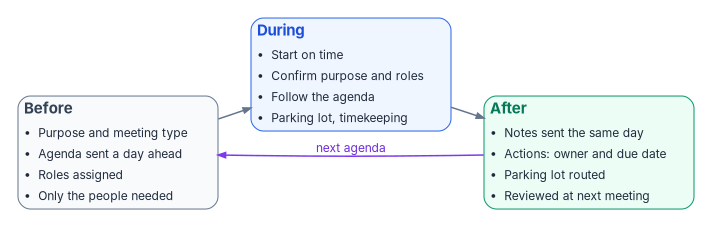
Running the meeting
Before
- Confirm the meeting is needed and its type.
- Write and send the agenda, with preparation material attached.
- Assign the roles and invite only the people the items need: those affected by a decision, and those with the knowledge, resources, or authority it requires.31
- Shortly before, send a reminder with the agenda; arrive early and test the equipment.32
During
Start. Start on time, every time.33 Open by stating the purpose, confirming the agenda, and naming the roles. Point to the notes, slides, and chat in use. Agree or restate ground rules; examples include sharing air time (“take space, make space”) and treating different perspectives as valuable.34
Stay on track. Follow the agenda and leave it only deliberately, for a set time.35 Summarize as you go.36 Point latecomers to the agenda and notes instead of recapping for them.37
Use a parking lot. Topics that are off the agenda, or can’t be settled in the time available, go into a visible parking lot: a section of the notes or a corner of the whiteboard.38 Give each entry an action (send to another group, add to a future agenda, assign to a small team), and review the parking lot before the meeting ends. Following up on it is what keeps people willing to park topics.39
Take useful notes. Capture meaning, not dialogue; prioritize decisions and assigned tasks; leave gaps during fast discussion and fill them in the same day.40
Close
Reserve the last few minutes on the agenda for the close, and aim to end early.4142
After
- Send the notes and action items in writing, with owners and dates, the same day.46
- Store the notes where the team keeps its records, and make any correction visible to everyone who attended.47
- Open the next meeting by reviewing the previous action items.48
- Avoid the “meeting after the meeting.” Decisions made in the hallway exclude remote attendees and never reach the notes.49
Templates
Agenda
MEETING: <specific title, e.g. "Wave 2 cutover go/no-go">
Date / time / length:   <date>  <start>-<end>  (<15 | 45 | ...> min)
Location / bridge:      <room, link, dial-in>
Purpose:                <one sentence>
Expected outcomes:      <decisions to make, outputs to produce>
Notes kept at:          <link>

Roles   Facilitator: <name>   Timekeeper: <name>   Note-taker: <name>
        Decision-maker(s): <name(s)>

#  Item (as a question)                     Type                 Owner   Min  Prep
1  Review open action items                 Information sharing  <name>   5   Last notes
2  <question>?                              Decision making      <name>  15   <doc link>
3  <question>?                              Problem solving      <name>  10   -
4  Close: decisions, actions, parking lot   -                    Fac.     5   -
Notes and action items
MEETING: <title>                  DATE: <date>
Attendees: <names>                Absent: <names>
Facilitator / Timekeeper / Note-taker: <names>

DECISIONS
D1  <decision>  (decided by <name/method>)

ACTION ITEMS
#   What                         Owner     Due        Status
A1  <deliverable>                <name>    <date>     Open

PARKING LOT
Item                             Route to (group / future agenda / owner)

OPEN QUESTIONS
<question>  -> <who will answer, by when>

NEXT MEETING: <date>   Facilitator: <name>
One-page checklist
| Phase | Check |
|---|---|
| Before | Is a meeting needed? · Type of each item set · Agenda with owners, times, prep sent ≥ 1 day ahead · Roles assigned · Decision-maker attending · Only needed people invited |
| Start | On time · Purpose, agenda, roles confirmed · Ground rules · Notes and parking lot visible |
| During | Agenda followed · Time tracked per item · Quiet voices drawn in · No work done in the room · Off-topic items parked |
| Close | Decisions read back · Every action has an owner and a date · Parking lot routed · “What would we change?” · Ended on time or early |
| After | Notes sent same day · Stored in the team record · Actions reviewed at the next meeting |
Further reading
- Andrew S. Grove, High Output Management (Vintage, 1995 edition). Grove’s own account of managing at Intel, including a chapter on meetings.
- Cameron Herold, Meetings Suck (Lioncrest Publishing, 2016), the source of the roles and meeting types in Portland State’s toolbox.50
This is a companion guide, not part of a numbered book. ← The Workbook Books
Version and revision history
Version 2.0, in edition 2026.11.5 (November 8, 2026). Every edition is kept on the Archive page; every change between editions is in the commit history.
| Version | Edition | Date | Changes |
|---|---|---|---|
| 2.0 | 2026.11.5 | 2026-11-08 | Release 2.0, the baseline: checked against every other book; Draft becomes Baseline; Edition 2026.11.4: record the edition and point deck links at it (#362); Guides A: fix 14 inconsistency findings (#441); Approve 116 gated pages (Nov 7); fix RMF map stale-review test (#457); Release 2.0: Draft becomes Baseline (#491) |
| 1.4 | 2026.11.4 | 2026-11-05 | Deck and audio links point at edition 2026.11.4 |
| 1.3 | 2026.11.3 | 2026-11-05 | Review gate: Mike’s approval of the 15 implementation guides gated on November 3 (#348) |
| 1.2 | 2026.11.1 | 2026-11-01 | Edition 2026.11: record the edition, and publish the four gate-level decks and videos (#282) |
| 1.1 | 2026.11 | 2026-11-01 | Move the decks and narration audio out of git, onto edition 2026.10 (#260) |
| 1.0 | 2026.10 | 2026-10-31 | First edition (3 merged changes since the guide began) |
Footnotes
Nagesh Belludi, “How to … Deal with Meetings That Get Derailed,” Right Attitudes, January 26, 2023, https://www.rightattitudes.com/2023/01/26/dealing-with-meetings-that-get-derailed/ (accessed Oct 21, 2026).↩︎
18F, U.S. General Services Administration, “How to run an efficient meeting,” December 14, 2016, archived on the 18F blog, https://blog.18f.org/2016/12/14/how-to-run-an-efficient-meeting/ (accessed Oct 21, 2026).↩︎
Dianna Ploof, EdD, “Making Meetings More Effective,” Department of Pediatrics Faculty Development, UPMC Children’s Hospital of Pittsburgh, August 4, 2016, https://www.chp.edu/-/media/chp/healthcare-professionals/documents/faculty-development/making-meetings-effective-handout.pdf (accessed Oct 21, 2026).↩︎
Gerald Recktenwald, “Supplemental Notes: A Meeting Toolbox,” Portland State University, January 4, 2018, https://web.cecs.pdx.edu/~gerry/class/ME492/notes/pdf/meeting_toolbox.pdf (accessed Oct 21, 2026).↩︎
Gerald Recktenwald, “Supplemental Notes: A Meeting Toolbox,” Portland State University, January 4, 2018, https://web.cecs.pdx.edu/~gerry/class/ME492/notes/pdf/meeting_toolbox.pdf (accessed Oct 21, 2026).↩︎
Gerald Recktenwald, “Supplemental Notes: A Meeting Toolbox,” Portland State University, January 4, 2018, https://web.cecs.pdx.edu/~gerry/class/ME492/notes/pdf/meeting_toolbox.pdf (accessed Oct 21, 2026).↩︎
18F, U.S. General Services Administration, “How to run an efficient meeting,” December 14, 2016, archived on the 18F blog, https://blog.18f.org/2016/12/14/how-to-run-an-efficient-meeting/ (accessed Oct 21, 2026).↩︎
Dianna Ploof, EdD, “Making Meetings More Effective,” Department of Pediatrics Faculty Development, UPMC Children’s Hospital of Pittsburgh, August 4, 2016, https://www.chp.edu/-/media/chp/healthcare-professionals/documents/faculty-development/making-meetings-effective-handout.pdf (accessed Oct 21, 2026).↩︎
18F, U.S. General Services Administration, “How to run an efficient meeting,” December 14, 2016, archived on the 18F blog, https://blog.18f.org/2016/12/14/how-to-run-an-efficient-meeting/ (accessed Oct 21, 2026).↩︎
18F, U.S. General Services Administration, “How to run an efficient meeting,” December 14, 2016, archived on the 18F blog, https://blog.18f.org/2016/12/14/how-to-run-an-efficient-meeting/ (accessed Oct 21, 2026).↩︎
Gerald Recktenwald, “Supplemental Notes: A Meeting Toolbox,” Portland State University, January 4, 2018, https://web.cecs.pdx.edu/~gerry/class/ME492/notes/pdf/meeting_toolbox.pdf (accessed Oct 21, 2026).↩︎
Gerald Recktenwald, “Supplemental Notes: A Meeting Toolbox,” Portland State University, January 4, 2018, https://web.cecs.pdx.edu/~gerry/class/ME492/notes/pdf/meeting_toolbox.pdf (accessed Oct 21, 2026).↩︎
18F, U.S. General Services Administration, “How to run an efficient meeting,” December 14, 2016, archived on the 18F blog, https://blog.18f.org/2016/12/14/how-to-run-an-efficient-meeting/ (accessed Oct 21, 2026).↩︎
Gerald Recktenwald, “Supplemental Notes: A Meeting Toolbox,” Portland State University, January 4, 2018, https://web.cecs.pdx.edu/~gerry/class/ME492/notes/pdf/meeting_toolbox.pdf (accessed Oct 21, 2026).↩︎
18F, U.S. General Services Administration, “How to run an efficient meeting,” December 14, 2016, archived on the 18F blog, https://blog.18f.org/2016/12/14/how-to-run-an-efficient-meeting/ (accessed Oct 21, 2026).↩︎
18F, U.S. General Services Administration, “How to run an efficient meeting,” December 14, 2016, archived on the 18F blog, https://blog.18f.org/2016/12/14/how-to-run-an-efficient-meeting/ (accessed Oct 21, 2026).↩︎
18F, U.S. General Services Administration, “How to run an efficient meeting,” December 14, 2016, archived on the 18F blog, https://blog.18f.org/2016/12/14/how-to-run-an-efficient-meeting/ (accessed Oct 21, 2026).↩︎
Dianna Ploof, EdD, “Making Meetings More Effective,” Department of Pediatrics Faculty Development, UPMC Children’s Hospital of Pittsburgh, August 4, 2016, https://www.chp.edu/-/media/chp/healthcare-professionals/documents/faculty-development/making-meetings-effective-handout.pdf (accessed Oct 21, 2026).↩︎
Gerald Recktenwald, “Supplemental Notes: A Meeting Toolbox,” Portland State University, January 4, 2018, https://web.cecs.pdx.edu/~gerry/class/ME492/notes/pdf/meeting_toolbox.pdf (accessed Oct 21, 2026).↩︎
18F, U.S. General Services Administration, “How to run an efficient meeting,” December 14, 2016, archived on the 18F blog, https://blog.18f.org/2016/12/14/how-to-run-an-efficient-meeting/ (accessed Oct 21, 2026).↩︎
Gerald Recktenwald, “Supplemental Notes: A Meeting Toolbox,” Portland State University, January 4, 2018, https://web.cecs.pdx.edu/~gerry/class/ME492/notes/pdf/meeting_toolbox.pdf (accessed Oct 21, 2026).↩︎
Gerald Recktenwald, “Supplemental Notes: A Meeting Toolbox,” Portland State University, January 4, 2018, https://web.cecs.pdx.edu/~gerry/class/ME492/notes/pdf/meeting_toolbox.pdf (accessed Oct 21, 2026).↩︎
Gerald Recktenwald, “Supplemental Notes: A Meeting Toolbox,” Portland State University, January 4, 2018, https://web.cecs.pdx.edu/~gerry/class/ME492/notes/pdf/meeting_toolbox.pdf (accessed Oct 21, 2026).↩︎
Dianna Ploof, EdD, “Making Meetings More Effective,” Department of Pediatrics Faculty Development, UPMC Children’s Hospital of Pittsburgh, August 4, 2016, https://www.chp.edu/-/media/chp/healthcare-professionals/documents/faculty-development/making-meetings-effective-handout.pdf (accessed Oct 21, 2026).↩︎
18F, U.S. General Services Administration, “How to run an efficient meeting,” December 14, 2016, archived on the 18F blog, https://blog.18f.org/2016/12/14/how-to-run-an-efficient-meeting/ (accessed Oct 21, 2026).↩︎
18F, U.S. General Services Administration, “How to run an efficient meeting,” December 14, 2016, archived on the 18F blog, https://blog.18f.org/2016/12/14/how-to-run-an-efficient-meeting/ (accessed Oct 21, 2026).↩︎
Dianna Ploof, EdD, “Making Meetings More Effective,” Department of Pediatrics Faculty Development, UPMC Children’s Hospital of Pittsburgh, August 4, 2016, https://www.chp.edu/-/media/chp/healthcare-professionals/documents/faculty-development/making-meetings-effective-handout.pdf (accessed Oct 21, 2026).↩︎
18F, U.S. General Services Administration, “How to run an efficient meeting,” December 14, 2016, archived on the 18F blog, https://blog.18f.org/2016/12/14/how-to-run-an-efficient-meeting/ (accessed Oct 21, 2026).↩︎
18F, U.S. General Services Administration, “How to run an efficient meeting,” December 14, 2016, archived on the 18F blog, https://blog.18f.org/2016/12/14/how-to-run-an-efficient-meeting/ (accessed Oct 21, 2026).↩︎
Dianna Ploof, EdD, “Making Meetings More Effective,” Department of Pediatrics Faculty Development, UPMC Children’s Hospital of Pittsburgh, August 4, 2016, https://www.chp.edu/-/media/chp/healthcare-professionals/documents/faculty-development/making-meetings-effective-handout.pdf (accessed Oct 21, 2026).↩︎
Gerald Recktenwald, “Supplemental Notes: A Meeting Toolbox,” Portland State University, January 4, 2018, https://web.cecs.pdx.edu/~gerry/class/ME492/notes/pdf/meeting_toolbox.pdf (accessed Oct 21, 2026).↩︎
Dianna Ploof, EdD, “Making Meetings More Effective,” Department of Pediatrics Faculty Development, UPMC Children’s Hospital of Pittsburgh, August 4, 2016, https://www.chp.edu/-/media/chp/healthcare-professionals/documents/faculty-development/making-meetings-effective-handout.pdf (accessed Oct 21, 2026).↩︎
Gerald Recktenwald, “Supplemental Notes: A Meeting Toolbox,” Portland State University, January 4, 2018, https://web.cecs.pdx.edu/~gerry/class/ME492/notes/pdf/meeting_toolbox.pdf (accessed Oct 21, 2026).↩︎
18F, U.S. General Services Administration, “How to run an efficient meeting,” December 14, 2016, archived on the 18F blog, https://blog.18f.org/2016/12/14/how-to-run-an-efficient-meeting/ (accessed Oct 21, 2026).↩︎
18F, U.S. General Services Administration, “How to run an efficient meeting,” December 14, 2016, archived on the 18F blog, https://blog.18f.org/2016/12/14/how-to-run-an-efficient-meeting/ (accessed Oct 21, 2026).↩︎
Gerald Recktenwald, “Supplemental Notes: A Meeting Toolbox,” Portland State University, January 4, 2018, https://web.cecs.pdx.edu/~gerry/class/ME492/notes/pdf/meeting_toolbox.pdf (accessed Oct 21, 2026).↩︎