Federal Modernization Workbook · Book 11 · How
Chapter 10 — Evidence, Not Verdicts: From Findings to a Program
An assessment tool can tell an agency what its configuration looked like on the day it ran; only the agency can decide what that means, what to fix first, and what risk it is willing to carry, and a program that lets the score make those decisions has handed its governance to a report.
How to read the two tools’ results before counting them, the seven normalized results the program counts, which results are findings and which are absence of evidence, how the program scores, weighs and ranks findings, and where exceptions belong. It then turns the worklist into a program: plans of action and milestones and the closure chain each finding carries, the pillar-by-pillar contribution of a shared evidence substrate, the evidence properties Advanced and Optimal maturity need, drift as continuous verification, re-assessment, and what an agency can do this quarter.
Chapter 09 ends with sealed evidence: each tool’s unaltered output wrapped in provenance and emitted as OSCAL. This chapter is what the agency does with it. The book’s argument shapes the answer. Zero Trust maturity is a property of the whole agency (Chapter 01); Governance is the cross-cutting capability programs shortchange (Chapter 02); and each tool is an evidence input reconciled at the control level, not a verdict (Chapter 05). A Zero Trust Assessment overview isn’t a maturity stage, and a clean ScubaGear report isn’t an authorization. Both are inputs to decisions that belong to named people (Chapter 07).
The program’s assessment method has five steps, whatever tools feed it:
- Collect signals from directory, endpoint, network and application telemetry, and from the assessment tools.
- Map each signal to a pillar and a maturity stage.
- Identify gaps where evidence is missing or contradictory.
- Prioritize remediation by residual risk and dependency.
- Re-assess on a defined cadence.
The value is in the evidence trail, not the score alone.
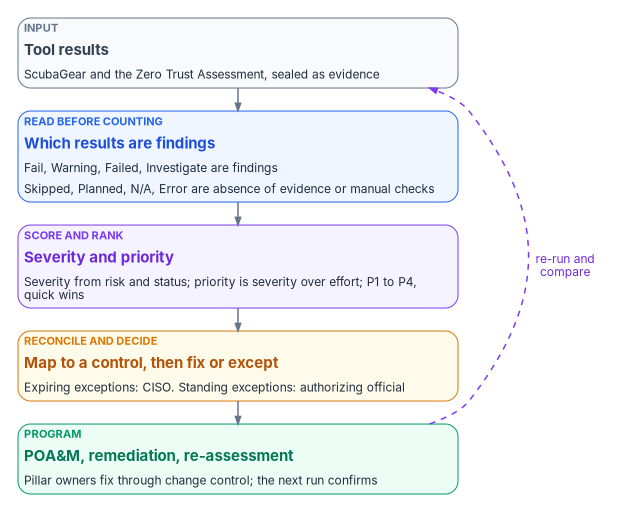
Read the result before counting it
The two tools use different words for the same outcomes, and some of their outcomes aren’t findings at all.
ScubaGear. Each policy result is one of Pass, Fail, Warning, N/A, Omitted, Incorrect Result or Error, and each policy’s criticality is SHALL or SHOULD, with variants for policies that can be met by a third-party service or aren’t yet implemented in the tool.1 The summary counts make the split explicit: Failures counts failed SHALL policies, Warnings counts failed SHOULD policies, and Manual counts checks the tool couldn’t assess automatically.2
| ScubaGear result | What it means | How the program treats it |
|---|---|---|
| Fail | A SHALL policy isn’t met | A finding; if the policy is on BOD 25-01’s mandatory list, a directive gap first (Chapter 08) |
| Warning | A SHOULD policy isn’t met | A finding at lower default priority |
| N/A | Typically a manual check | A work item for the pillar owner to verify by hand; not a pass |
| Omitted | Excluded by the configuration file | Not a finding, but the omission itself is a decision with an owner and an expiry |
| Incorrect Result | Marked wrong by the configuration file | Not a finding, but a reviewed claim that the tool is wrong, with the original result kept |
| Error | The tool couldn’t evaluate the policy | Absence of evidence; fix the run and re-run |
| Pass | The policy is met | Evidence of conformance for that interval |
Zero Trust Assessment. Each check returns Passed, Failed, Investigate, Skipped, Planned or Error.3 Skipped covers checks that couldn’t run because a service wasn’t connected, a license wasn’t present, a feature wasn’t supported, the check didn’t apply or it timed out; Planned is a check marked as still under construction.4
| Zero Trust Assessment status | How the program treats it |
|---|---|
| Failed | A finding |
| Investigate | A finding that needs manual review before it is confirmed or dismissed |
| Skipped | Not a gap and not a pass: absence of evidence, recorded with the reason |
| Planned | A check Microsoft hasn’t implemented yet; ignored |
| Error | Absence of evidence; fix the connection or permission and re-run |
| Passed | Evidence of conformance for that run |
The program’s dashboard recomputes outcomes from the per-check results rather than reading the report’s own summary block, because in the program’s testing the summary didn’t reconcile with the checks beneath it.
A normalized result taxonomy
The two tools’ words don’t line up, and an assessment register that mixes them can’t be counted honestly. The program records every result twice: the tool’s own value, unchanged, and one of seven normalized results. The normalized result is what the register, the dashboard and any report count.
| Normalized result | Meaning | Zero Trust Assessment 3.1.0 | ScubaGear 2.0.0 | Counted as |
|---|---|---|---|---|
| Pass | The check ran and the configuration matched | Passed | Pass | Evidence of conformance for that run |
| Fail | The check ran and the configuration didn’t match | Failed; Investigate, until the manual review confirms or dismisses it | Fail (a SHALL policy); Warning (a SHOULD policy) | A finding |
| Planned | The tool hasn’t implemented the check yet | Planned (skip reason UnderConstruction) |
A policy whose criticality is Shall/Not-implemented or Should/Not-implemented |
Neither; ignored until the tool implements it |
| Skipped-Licensing | The check needs a license the tenant doesn’t hold | Skipped, with NotLicensedEntraIDP1, NotLicensedEntraIDP2, NotLicensedEntraIDGovernance, NotLicensedEntraWorkloadID, NotLicensedIntune or NoCompatibleLicenseFound |
No equivalent result; ScubaGear’s Power Platform and Power BI runs need their licenses before they run at all | Neither; a licensing decision |
| Skipped-Disconnected | The tool wasn’t connected to the service the check reads | Skipped, with NotConnectedAzure, NotConnectedExchange, NotConnectedSecurityCompliance, NotConnectedToService or NoAzureAccess |
No equivalent result; a product left out of -ProductNames isn’t in the report |
Neither; fix the run’s scope and re-run |
| Skipped-Not-Applicable | The check doesn’t apply to this tenant, or the feature isn’t supported where it runs | Skipped, with NotApplicable, NotDotGovDomain or NotSupported |
No equivalent result | Neither; record the reason, and treat a feature unsupported in a government cloud as a boundary finding |
| Unable-to-Evaluate | The check should have produced a result and didn’t | Error; Skipped with TimeoutReached |
Error; N/A (typically a manual check the tool can’t assess) | Neither; fix the run, or verify by hand and record the manual result |
The status values and skip reasons are those in the Zero Trust Assessment’s 3.1.0 source,5 and ScubaGear’s result and criticality values those in its 2.0.0 output schema.6 Both change with releases, so the mapping is versioned with the tool pin (Chapter 09). ScubaGear’s Omitted and Incorrect Result aren’t results of the check: they are exception records from the configuration file, and the output keeps the original result beside them. The register normalizes the original result and carries the exception separately, with its approver and expiry (Exceptions belong in the configuration file).
The rule that follows is the one the tool’s own guide states: a skipped check is not a failed control, and it isn’t a pass either.7 Planned, the three Skipped results and Unable-to-Evaluate are never added to the failures or to the passes. They are reported in their own columns, each with its reason, so that a report can’t turn a missing license or a disconnected service into a control failure, or quietly drop it from the count.
Absence of evidence is a different claim
A skipped check is the easiest result to misread. The Zero Trust Assessment’s guide says that missing prerequisites can produce skipped checks, not evidence that the tenant meets a recommendation, and that permission errors should be investigated rather than treated as security failures.8 Many checks need premium licenses, flagged in the dashboard’s applicability column. In a government-cloud tenant some of those capabilities may not be available or authorized, since feature availability there is defined by its differences from the commercial service.9 So a “skipped” or “failed” premium check may not be a real gap. Confirm the license applies in the boundary before scoring it as one.
The same discipline applies when results go into any authorization package. Scoring an unavailable capability as a failed control overstates the gap; scoring it as a pass overstates the posture. The program records it as what it is: absence of evidence, with the boundary or licensing reason attached, which is a boundary finding for Book 10 rather than a control failure.
Score and rank the findings
Only the findings (ScubaGear Fail and Warning; Zero Trust Assessment Failed and Investigate) get scored. The scoring is the program’s method, documented on the dashboard’s Methodology sheet so anyone can check it.
- Severity, 0 to 100, is the check’s risk weighted by its status, so a failed high-risk check outranks an Investigate item of the same risk.
- Priority is severity divided by effort, so a high-severity, low-effort check (a quick win) outranks a high-severity, high-effort one.
- Buckets are P1 at 50 or above, P2 at 30 or above, P3 at 15 or above, and P4 above zero. These priority buckets are a separate scale from the P1 to P4 drift severities later in this chapter and in Chapter 09, which carry fixed responses.
The Zero Trust Assessment supplies the inputs. Microsoft rates each recommendation on three scales: Risk Level (High means potential environment-wide exposure until mitigated; Low means defense in depth or an operational optimization), User Impact (how many non-privileged users have to act or be told) and Implementation Cost (from targeted actions to programs that need ongoing commitment).10 The program uses Risk Level for severity and Implementation Cost for effort. User Impact doesn’t change the rank; it changes the communications plan and the change window.
Weigh the finding, not the pass rate
The tool’s risk level is a starting point. It doesn’t know the agency’s estate, so the program weighs each finding on six factors before it sets the order of work, and writes the rationale into the finding’s register entry:
| Factor | The question | Where the answer comes from |
|---|---|---|
| Exploitability | How easily could an attacker use the gap, and is it being used in attacks now? | The tool’s risk level; threat intelligence from security operations (Book 12) |
| Blast radius | What would an attacker reach through it: one application, a tier, the tenant? | The privileged-access tiers (Book 04) and the affected identities and resources |
| Exposure | Is the affected surface reachable from the internet, by guests or partners, or only from managed devices inside the boundary? | Conditional Access scope; network paths (Book 09) |
| Compensating controls | Does another control already reduce the risk, and is its evidence registered? | The exception record and the compensating control’s own evidence |
| Implementation effort | How much change, testing and user impact does the fix need? | The tool’s implementation cost and user impact; the change-safety plan (Book 00, Appendix D) |
| Dependency order | Does the fix need another fix first, or unblock others? | The closure chain’s dependency field (The closure chain) |
The severity and priority score above stays the program’s default sort. The weighting moves a finding up or down from it, and the register says why: an exposed, tenant-wide gap with no compensating control goes first even at high effort; a gap that depends on another fix waits for it, however quick it looks on its own. RA-7 asks organizations to respond to findings in accordance with their risk tolerance,11 and a written rationale is how a reviewer sees that the response did.
A pass percentage is never the maturity score on its own. Its denominator moves with licensing, connections and the tool’s version (release 3.1.0 holds 364 tests, and a later release will hold a different number), every test counts the same whatever its risk, and a high percentage can sit beside one exposed, tenant-wide gap. Report the counts by normalized result and by pillar, the weighted backlog, and the maturity stage per pillar in CISA’s model, which describes maturity per pillar and per cross-cutting capability rather than as one number.12
The dashboard workbook lays the worklist out for a team:
| Sheet or output | What it holds |
|---|---|
| Dashboard | Four charts: status, findings by pillar, a pillar-by-risk heatmap, and a severity-by-effort remediation quadrant |
| Findings | The worklist, sorted P1 first, color-scaled by severity |
| By Pillar | Findings grouped by pillar |
| All Tests | Every check, including passes and skips |
| Methodology | The scoring, written out |
| Power BI CSV | One row per check with severity, priority, applicability and license columns |
The remediation quadrant splits findings into quick wins (high severity, low effort, top left) and major projects (high severity, high effort, top right). Quick wins go into the next change window. Major projects go into a pillar owner’s roadmap with a funded milestone.
Power BI. In Power BI Desktop, choose Get Data, then Text/CSV, and select the CSV. It is already one row per check, so visuals build directly: a matrix of Pillar by Status, a bar of PriorityBucket, or a card counting rows where IsFinding is yes. Useful measures are the count of findings, average SeverityScore by Pillar, and P1 count by Pillar. The CSV is assessment output and gets the same Controlled handling as the report.
Reconcile at the control, not tool to tool
The two tools use different identifiers (ScubaGear policy IDs such as MS.AAD.1.1v1; Zero Trust Assessment numeric test IDs) and different severity models (SHALL and SHOULD; risk levels). Matching one tool’s output to the other’s directly doesn’t work. The program reconciles both against a common spine: the specific tenant setting and the NIST SP 800-53 control. CISA publishes a mapping of every SCuBA policy to SP 800-53 Rev. 5 controls in the FedRAMP High baseline,13 which contains every Moderate control (inference), and the program’s mapping table carries the Zero Trust Assessment checks onto the same controls. When a ScubaGear Fail and a Zero Trust Assessment Failed land on the same control and setting, they are one finding with two pieces of evidence, routed to one pillar owner. Chapter 05 covers where the two tools overlap and where they don’t.
Exceptions belong in the configuration file, with an owner
Some findings won’t be fixed on the schedule the worklist implies, and a few won’t be fixed at all. The program’s rule is that an exception is a governed artifact, not a sentence in a Word document.
ScubaGear already provides the mechanism. Its configuration file can annotate a policy with a comment and a remediation date, and ScubaGear warns about any failing control that isn’t documented this way unless the warning is silenced; it can mark a result incorrect, with a comment; and it can omit a policy with a rationale and an optional expiration date, after which the policy returns to the report.14 CISA’s BOD 25-01 implementation guidance treats this as the federal mechanism: operationally required deviations appear as Omitted in the output with their rationale, omissions must be approved within the organization’s security risk management process, and agencies coordinate deviations with CISA.15 The directive lets authorizing officials accept risk for deviations from mandatory policies under agency policy, and agencies explain deviations when they report.16
The program adds three rules on top.
- The configuration file is canon. It lives in the program’s repository, changes by reviewed pull request, and its hash is recorded with every run. A schema check catches an omission whose policy no longer exists or whose expiration has passed.
- Time decides the approver. An omission or incorrect-result marking with an expiration date is a CISO decision. One without an end date is a standing risk acceptance and goes to the authorizing official (Chapter 07).
- Observation isn’t enforcement. ScubaGear observes; it doesn’t enforce. Where a finding is accepted because a compensating control covers it, that control is registered as its own adapter and its evidence flows beside ScubaGear’s, so the exception points at evidence rather than at a promise.
ScubaGear’s documentation warns that both omitting policies and marking results incorrect can introduce blind spots.17 The Zero Trust Assessment has no equivalent exception file, so the program records accepted Zero Trust Assessment findings in the same repository, against the same control spine, with the same approval rule.
From findings to plans of action and milestones
Every finding that isn’t fixed in the next change window and isn’t covered by an approved exception becomes a plan of action and milestones item. SP 800-53 requires a plan of action and milestones for each system that documents planned remediation of weaknesses found in control assessments, updated from assessments, audits and continuous monitoring,18 and the authorizing official approves it.19 RA-7 asks organizations to respond to assessment and monitoring findings in accordance with their risk tolerance,20 which is the decision the worklist exists to inform.
Three outputs seed it. ScubaGear’s ActionPlan.csv lists only failing SHALL controls, with fields for the reason and the remediation timeline.21 The Zero Trust Assessment playbook’s tracker has blank status, owner and notes columns for each failed check. And the OSCAL bundle from Chapter 09 can emit plan of action and milestones items directly, since OSCAL’s POA&M model exists to track findings from periodic or continuous assessments that the system owner must address.22 Each item names the pillar owner who will fix it, the control it bears on, the evidence that will show it closed, and the re-assessment that will test that evidence.
The closure chain
A plan of action and milestones item says what will be fixed and by when. The program’s assessment register keeps, for every finding, the whole chain from the tool’s result to the reassessment that confirms the fix, so that nothing between them is assumed. Every field is filled in, or marked not applicable with a reason.
| Field | What it records |
|---|---|
finding |
The finding’s register ID; the tool, its version, the test or policy ID and the run date; the raw result and the normalized result |
attack_path |
The attack the gap enables, in plain words, and the pillar (Book 00, Appendix D) |
owner |
The pillar owner accountable for the fix (Chapter 07) |
dependency |
The findings or capabilities that must be in place first, by register ID or book chapter |
change |
The change record that carries the fix through change control |
pilot |
The pilot or report-only scope, dates and result |
enforcement |
The date and scope the control was enforced, and its approved exclusions |
test |
The test that shows the control works: expected and observed outcome, date, tester |
evidence |
Where the configuration, operational, test and exception evidence is kept (Book 00, Appendix D) |
residual_risk |
What risk remains after the fix or the exception, and who accepted it (the CISO for an expiring exception, the authorizing official for a standing one) |
reassessment |
The run that re-tested the finding: tool version, date and normalized result |
weighting |
The six factors and the rationale for the finding’s place in the backlog |
The fields follow the five control states in Book 00, Appendix D: owner, dependency and attack_path belong to Designed; change and pilot to Configured; enforcement to Enforced; test and evidence to Evidenced; and reassessment, with the drift checks below, to Operated. A finding is ready for closure when every applicable field has evidence and the reassessment shows a Pass. Closing it is the authorizing official’s decision for a plan of action and milestones item, or the assessor’s for an assessment finding, and the register records who decided and when. A copy-ready register entry:
- finding: ZTA-<test-id>-<run-date>      # or SCUBA-<policy-id>-<run-date>
  tool: {name: "<Zero Trust Assessment | ScubaGear>", version: "<x.y.z>", test: "<test or policy ID>"}
  result: {raw: "<tool value>", normalized: "<Pass | Fail | Planned | Skipped-Licensing | Skipped-Disconnected | Skipped-Not-Applicable | Unable-to-Evaluate>", reason: "<skip or error reason>"}
  attack_path: "<the attack the gap enables>"
  pillar: {microsoft: "<pillar>", cisa: "<pillar>"}
  owner: "<role>"
  dependency: ["<register ID or book chapter>"]
  change: "<change record>"
  pilot: {scope: "<group or ring>", from: "<date>", to: "<date>", result: "<observed>"}
  enforcement: {date: "<date>", scope: "<scope>", exclusions: "<exclusion register entry>"}
  test: {expected: "<outcome>", observed: "<outcome>", date: "<date>", tester: "<role>"}
  evidence: ["<configuration>", "<operational>", "<test>", "<exception>"]
  residual_risk: {statement: "<what remains>", accepted_by: "<CISO | authorizing official | none>", expires: "<date>"}
  reassessment: {tool_version: "<x.y.z>", date: "<date>", normalized: "<result>"}
  weighting: {exploitability: "<H|M|L>", blast_radius: "<H|M|L>", exposure: "<H|M|L>", compensating: "<control or none>", effort: "<H|M|L>", rationale: "<why this place in the backlog>"}
  closure: {ready: false, decided_by: "<authorizing official | assessor>", date: "<date>"}
Microsoft’s Zero Trust Workshop is an optional planning aid. The Zero Trust Assessment writes a ZeroTrustWorkshop.json file that imports mapped findings into the workshop’s task notes; the integration is experimental, skipped checks are left out, and imported tasks start as not reviewed, so the import doesn’t mark anything complete.23
From a worklist to a pillar program
A ranked worklist is still a list of tool findings. A Zero Trust program has to answer a different question: why do most programs stall below Advanced maturity, and what moves them? Chapter 02 gives the governance answer. Pillars are administered rather than governed; evidence is shaped by each tool rather than by the claim it supports; and drift is found at audit time rather than continuously. CISA’s maturity model describes Zero Trust as five pillars operated through three cross-cutting capabilities, Visibility and Analytics, Automation and Orchestration, and Governance, and says each pillar can mature in those capabilities and each capability can mature independently of the pillars.24 None of the three failures is fixed by buying another pillar tool.
The program doesn’t replace pillar tooling. It supplies the shared evidence substrate beneath all five pillars: one authoritative record per object, a provenance envelope on every claim, the drift taxonomy as continuous verification, and OSCAL-native evidence. Each pillar keeps its tools; the substrate is what makes their output verifiable in one form an assessor can read.
| ZTMM pillar | What the shared substrate contributes | In practice |
|---|---|---|
| Identity | One identity record that the other pillars resolve against | A stale service-principal credential is one finding visible to every pillar that uses the principal, not two findings someone correlates by hand |
| Devices | Device claims in the same provenance envelope, keyed to the identity plane | Intune compliance and the Conditional Access device signal arrive from two adapters but filter by device, identity or pillar without re-querying either tool |
| Networks | Addressing computed from identity context rather than administered in parallel | Access and path decisions can be emitted as claims with provenance (Book 09) |
| Applications and workloads | Workload controls mapped onto the program’s control rules | Application findings join the same plan of action and milestones as identity findings |
| Data | The same hashed provenance chain as identity and device claims | Confirming that a sensitivity label hasn’t drifted since the last package uses the same bundle re-execution as any other claim |
The program’s own status per pillar, stated plainly:
| Pillar | Substrate posture today |
|---|---|
| Identity | Identity as the root namespace ships; the identity-plane record is enforced by schema gates |
| Devices | Device claims in the provenance envelope and cross-pillar correlation ship; per-device runtime drift is target state |
| Networks | The addressing-plane record ships; identity-derived addressing is canonical and partly shipped |
| Applications and workloads | The adapter taxonomy and control mapping ship; workload-side enforcement runtime is library-only |
| Data | The provenance envelope and deterministic evidence chain ship; continuous event-time capture is target state |
For each pillar the structural floor is in place. The gap to Optimal is engineering at the runtime layer, not an architectural redesign.
What Advanced and Optimal evidence looks like
CISA describes the Optimal stage as fully automated, with dynamic policies driven by automated or observed triggers, cross-pillar interoperability with continuous monitoring, and centralized visibility.25 In the program’s reading, getting to Advanced and Optimal requires evidence with three properties.
- Continuous. Emitted as state changes, not periodically.
- Cross-pillar. One evidence record carries identity, device and workload context.
- Reproducible. An assessor can re-execute it without the operator’s help.
The program’s evidence chain delivers the second and third today. Cross-pillar evidence is structural, because every claim carries the full provenance envelope, so a bundle spans pillars. Reproducibility is structural, because the same canon and the same inputs produce a byte-identical bundle. Continuous emission is target state: the envelope and bundle lifecycle support it, and the remaining work is wiring every adapter for continuous capture.
Neither maturity stage is mandatory. CISA calls the model a general guide rather than a strict set of requirements,26 and the program’s targets per pillar are its own design choices (Chapter 03).
Drift is continuous verification
The program detects drift in five classes, each mapped to a Zero Trust concern.
| Drift class | Zero Trust concern |
|---|---|
DRIFT-IDENTITY |
An identity assertion no longer resolves. A P1 finding routed for governed remediation; the provider’s own enforcement plane denies access, and the program is the governing record |
DRIFT-AUTHZ |
An action was emitted outside its consent envelope. It alerts and suspends autonomous remediation; enforcement stays with the provider’s data plane |
DRIFT-PROVENANCE |
A claim chain is broken, so that pillar’s evidence is no longer trustworthy |
DRIFT-SCHEMA |
Declared and observed state don’t match structurally |
DRIFT-SEMANTIC |
State is structurally valid but stale |
Schema and provenance drift run in continuous integration today. Runtime detection of drift is defined in the program’s drift standard, and its status differs by class (Book 13, Chapter 06): semantic drift is partly built, for the adapters that implement the runtime contract, while identity and authorization drift are design only.
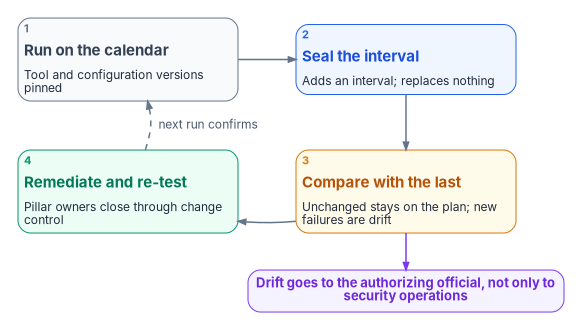
Drift findings go to the authorizing official, not only to security operations. A control that passed every interval and fails one is a change to an authorized system, and the authorizing official decides whether it is significant.27 Treating interval-to-interval drift as an artifact the authorizing official sees is the cheapest adoption step in this chapter.
One distinction keeps this honest. Drift detection is continuity of evidence and posture, not of sessions or tokens. Revoking a session when a critical event occurs (which can take up to 15 minutes to propagate) is the job of Microsoft Entra’s Continuous Access Evaluation and token protection (Book 04, Book 09, Chapter 06), and how well that works inside a given government cloud is a separate question from anything an assessment tool reports.
Re-assess on a cadence
The program re-runs both tools on a calendar the program lead owns, and after each remediation wave, so that a closed finding is closed by evidence rather than by a ticket status. BOD 25-01’s reporting routes set the floor for ScubaGear: at least quarterly for manual and agency-hosted reporting,28 and new tenants must meet the mandatory baselines and begin continuous monitoring before they receive an authorization to operate.29 SP 800-53’s continuous monitoring control asks for a system-level strategy with defined monitoring and assessment frequencies, ongoing assessments, correlation and analysis of the results, response actions, and reporting.30
Because ScubaGear’s adapter is interval-class (Chapter 09), each re-run adds an interval rather than replacing a report, and the bundle can state windowed conformance: a policy passed in every interval of the quarter but one, and that interval is tracked as a plan of action and milestones item. ScubaGear 2.0.0 adds Invoke-SCuBADiff, an offline command that compares two ScubaResults JSON files without contacting the tenant and writes the delta as JSON, CSV and HTML.31 The program uses it as a cross-check; the drift engine’s comparison remains the one the bundle records. A Zero Trust Assessment score is compared across runs only when the tool version is the same, or after a review of what changed between versions.
The boundary as a governed finding
Programs in government clouds meet one more structural constraint. Some platform signals that commercial tenants use for Zero Trust analytics aren’t available, or aren’t authorized, inside a given government boundary. The program handles this as a governed object rather than an assumption. A boundary probe records which features work on each side of the boundary. In-boundary telemetry adapters emit claims marked source_classification: derived where they substitute for an unavailable feature. Compensating-enforcement adapters provide agency-side enforcement for controls the platform can’t deliver. And the authorization documentation treats the boundary as a first-class object. The operational work of inventorying boundary impacts and building compensating mechanisms is per agency. Book 10 covers it.
What an agency can do this quarter
None of these is a procurement. Each is a decision with an owner from Chapter 07.
- Inventory which pillar evidence is reproducible. For each pillar, ask whether the evidence pipeline can be re-run without the operator’s help. Where it can’t, that is the adoption boundary. (Program lead.)
- Name a cross-pillar correlation owner and an agency-level owner of the Zero Trust posture separate from any cloud provider relationship. (CIO.)
- Bring one adapter under the canonical taxonomy. Pick the highest-leverage tool in any pillar, declare it in the registry, and emit its findings as OSCAL beside the existing evidence. ScubaGear is the usual first choice. (Program lead, with the pillar owner.)
- Move exceptions into the configuration file and the repository, with expirations, and route every standing one to the authorizing official. (CISO.)
- Stand up drift detection as a governance function. Run the substrate’s schema and provenance checks in continuous integration, and surface interval-to-interval drift to the authorizing official. (Program lead and security operations.)
- Model the cloud boundary explicitly. In a government cloud, record platform feature gaps as governed findings rather than implicit constraints. (CISO and ISSO.)
- Reconcile asset identity first. Reconcile Network, every cloud and the virtualization estate to one authoritative source before scoring any of them (Chapter 06). (Identity-plane owner.)
- Convert one detective control to preventive, and time-box privileged access, including the assessment accounts. (CISO, with identity engineering.)
None needs a year-long program. Each is a structural step that compounds.
Honest limits
- Optimal maturity needs continuous, automated, cross-pillar policy evaluation. The program supplies the substrate that makes it tractable; it doesn’t supply every pillar’s runtime today.
- Semantic drift is detected at runtime only by adapters that implement the runtime contract, and that coverage is partial. Identity and authorization drift detection at runtime is design only.
- The scoring method is the program’s. It is documented and repeatable, but it isn’t a federal standard, and a P1 priority bucket is a priority, not a risk acceptance (drift severities P1 to P4 are a separate scale).
- The boundary model is structural; inventorying a particular agency’s boundary impacts is that agency’s work.
- No tool, and no number of tools, certifies Zero Trust maturity. The evidence supports the decisions; named people make them.
Cybersecurity and Infrastructure Security Agency, ScubaGear v2.0.0 documentation, “Tool Output Schema,” Summary and Control objects, https://github.com/cisagov/ScubaGear/blob/v2.0.0/docs/misc/tooloutputschema.md (accessed Oct 26, 2026).↩︎
Cybersecurity and Infrastructure Security Agency, ScubaGear v2.0.0 documentation, “Tool Output Schema,” Summary and Control objects, https://github.com/cisagov/ScubaGear/blob/v2.0.0/docs/misc/tooloutputschema.md (accessed Oct 26, 2026).↩︎
Microsoft, Zero Trust Assessment repository,
Get-ZtTestResultStatus.ps1,Get-ZtTestStatus.ps1andAdd-ZtTestResultDetail.ps1(status values and skip reasons), https://github.com/microsoft/zerotrustassessment/tree/main/src/powershell/private/core (accessed Oct 21, 2026).↩︎Microsoft, Zero Trust Assessment repository,
Get-ZtTestResultStatus.ps1,Get-ZtTestStatus.ps1andAdd-ZtTestResultDetail.ps1(status values and skip reasons), https://github.com/microsoft/zerotrustassessment/tree/main/src/powershell/private/core (accessed Oct 21, 2026).↩︎Microsoft, Zero Trust Assessment source code, tag 3.1.0 (still the latest release on Nov 11, 2026),
src/powershell/private/core/Get-ZtTestStatus.ps1(Passed, Failed, Planned forUnderConstruction, Skipped, and the custom statuses Investigate and Error),Get-ZtTestResultStatus.ps1andAdd-ZtTestResultDetail.ps1(theSkippedBecausevalues), https://github.com/microsoft/zerotrustassessment/tree/3.1.0/src/powershell/private/core (accessed Nov 11, 2026).↩︎Cybersecurity and Infrastructure Security Agency, ScubaGear v2.0.0 documentation, “Tool Output Schema,” Summary and Control objects, https://github.com/cisagov/ScubaGear/blob/v2.0.0/docs/misc/tooloutputschema.md (accessed Oct 26, 2026).↩︎
Microsoft, Zero Trust Assessment repository, “Run the Zero Trust Assessment” (PowerShell guide), sections “Prerequisites,” “Permissions and roles” and “Import Zero Trust Assessment results into Zero Trust Workshop,” https://github.com/microsoft/zerotrustassessment/blob/main/src/powershell/doc/readme.md (accessed Oct 21, 2026).↩︎
Microsoft, Zero Trust Assessment repository, “Run the Zero Trust Assessment” (PowerShell guide), sections “Prerequisites,” “Permissions and roles” and “Import Zero Trust Assessment results into Zero Trust Workshop,” https://github.com/microsoft/zerotrustassessment/blob/main/src/powershell/doc/readme.md (accessed Oct 21, 2026).↩︎
Microsoft Learn, “Office 365 GCC,” section “How to use this service description,” https://learn.microsoft.com/office365/servicedescriptions/office-365-platform-service-description/office-365-us-government/gcc (accessed Oct 21, 2026).↩︎
Microsoft Learn, “Zero Trust assessment terminology,” https://learn.microsoft.com/security/zero-trust/assessment/glossary (accessed Oct 21, 2026).↩︎
National Institute of Standards and Technology, SP 800-53 Rev. 5, Security and Privacy Controls for Information Systems and Organizations, controls CA-5, CA-7 and RA-7, checked against the release 5.2.0 OSCAL catalog, https://github.com/usnistgov/oscal-content/blob/main/nist.gov/SP800-53/rev5/json/NIST_SP-800-53_rev5_catalog.json (accessed Oct 21, 2026).↩︎
Cybersecurity and Infrastructure Security Agency, Zero Trust Maturity Model, Version 2.0, April 2023, §4, §5 (maturity stages and “general guide” statement) and §5.6 (Cross-Cutting Capabilities), https://www.cisa.gov/sites/default/files/2023-04/zero_trust_maturity_model_v2_508.pdf (accessed Oct 21, 2026).↩︎
Cybersecurity and Infrastructure Security Agency, ScubaGear v2.0.0 documentation, “Mappings,” https://github.com/cisagov/ScubaGear/blob/v2.0.0/docs/misc/mappings.md (accessed Oct 26, 2026).↩︎
Cybersecurity and Infrastructure Security Agency, ScubaGear v2.0.0 documentation, “Configuration File,” sections “Annotate Policies” and “Omit Policies,” https://github.com/cisagov/ScubaGear/blob/v2.0.0/docs/configuration/configuration.md (accessed Oct 26, 2026).↩︎
Cybersecurity and Infrastructure Security Agency, BOD 25-01 Implementation Guidance: Implementing Secure Practices for Cloud Services, reporting options and deviations, https://www.cisa.gov/news-events/directives/bod-25-01-implementation-guidance-implementing-secure-practices-cloud-services (accessed Oct 21, 2026).↩︎
Cybersecurity and Infrastructure Security Agency, BOD 25-01, Implementing Secure Practices for Cloud Services, December 17, 2024, “Required Actions” and “Implementation Guidance and Clarifications,” https://www.cisa.gov/news-events/directives/bod-25-01-implementing-secure-practices-cloud-services (accessed Oct 21, 2026).↩︎
Cybersecurity and Infrastructure Security Agency, ScubaGear v2.0.0 documentation, “Configuration File,” sections “Annotate Policies” and “Omit Policies,” https://github.com/cisagov/ScubaGear/blob/v2.0.0/docs/configuration/configuration.md (accessed Oct 26, 2026).↩︎
National Institute of Standards and Technology, SP 800-53 Rev. 5, Security and Privacy Controls for Information Systems and Organizations, controls CA-5, CA-7 and RA-7, checked against the release 5.2.0 OSCAL catalog, https://github.com/usnistgov/oscal-content/blob/main/nist.gov/SP800-53/rev5/json/NIST_SP-800-53_rev5_catalog.json (accessed Oct 21, 2026).↩︎
National Institute of Standards and Technology, SP 800-37 Rev. 2, Risk Management Framework for Information Systems and Organizations: A System Life Cycle Approach for Security and Privacy, December 2018, Appendix D, “Authorizing Official,” https://nvlpubs.nist.gov/nistpubs/SpecialPublications/NIST.SP.800-37r2.pdf (accessed Oct 21, 2026).↩︎
National Institute of Standards and Technology, SP 800-53 Rev. 5, Security and Privacy Controls for Information Systems and Organizations, controls CA-5, CA-7 and RA-7, checked against the release 5.2.0 OSCAL catalog, https://github.com/usnistgov/oscal-content/blob/main/nist.gov/SP800-53/rev5/json/NIST_SP-800-53_rev5_catalog.json (accessed Oct 21, 2026).↩︎
Cybersecurity and Infrastructure Security Agency, ScubaGear v2.0.0 documentation, “Reports,” https://github.com/cisagov/ScubaGear/blob/v2.0.0/docs/execution/reports.md (accessed Oct 26, 2026).↩︎
National Institute of Standards and Technology, OSCAL, “Layers and Models Reference,” Assessment layer, https://pages.nist.gov/OSCAL/learn/concepts/layer/ (accessed Oct 21, 2026).↩︎
Microsoft, Zero Trust Assessment repository, “Run the Zero Trust Assessment” (PowerShell guide), sections “Prerequisites,” “Permissions and roles” and “Import Zero Trust Assessment results into Zero Trust Workshop,” https://github.com/microsoft/zerotrustassessment/blob/main/src/powershell/doc/readme.md (accessed Oct 21, 2026).↩︎
Cybersecurity and Infrastructure Security Agency, Zero Trust Maturity Model, Version 2.0, April 2023, §4, §5 (maturity stages and “general guide” statement) and §5.6 (Cross-Cutting Capabilities), https://www.cisa.gov/sites/default/files/2023-04/zero_trust_maturity_model_v2_508.pdf (accessed Oct 21, 2026).↩︎
Cybersecurity and Infrastructure Security Agency, Zero Trust Maturity Model, Version 2.0, April 2023, §4, §5 (maturity stages and “general guide” statement) and §5.6 (Cross-Cutting Capabilities), https://www.cisa.gov/sites/default/files/2023-04/zero_trust_maturity_model_v2_508.pdf (accessed Oct 21, 2026).↩︎
Cybersecurity and Infrastructure Security Agency, Zero Trust Maturity Model, Version 2.0, April 2023, §4, §5 (maturity stages and “general guide” statement) and §5.6 (Cross-Cutting Capabilities), https://www.cisa.gov/sites/default/files/2023-04/zero_trust_maturity_model_v2_508.pdf (accessed Oct 21, 2026).↩︎
National Institute of Standards and Technology, SP 800-37 Rev. 2, Risk Management Framework for Information Systems and Organizations: A System Life Cycle Approach for Security and Privacy, December 2018, Appendix D, “Authorizing Official,” https://nvlpubs.nist.gov/nistpubs/SpecialPublications/NIST.SP.800-37r2.pdf (accessed Oct 21, 2026).↩︎
Cybersecurity and Infrastructure Security Agency, BOD 25-01 Implementation Guidance: Implementing Secure Practices for Cloud Services, reporting options and deviations, https://www.cisa.gov/news-events/directives/bod-25-01-implementation-guidance-implementing-secure-practices-cloud-services (accessed Oct 21, 2026).↩︎
Cybersecurity and Infrastructure Security Agency, BOD 25-01, Implementing Secure Practices for Cloud Services, December 17, 2024, “Required Actions” and “Implementation Guidance and Clarifications,” https://www.cisa.gov/news-events/directives/bod-25-01-implementing-secure-practices-cloud-services (accessed Oct 21, 2026).↩︎
National Institute of Standards and Technology, SP 800-53 Rev. 5, Security and Privacy Controls for Information Systems and Organizations, controls CA-5, CA-7 and RA-7, checked against the release 5.2.0 OSCAL catalog, https://github.com/usnistgov/oscal-content/blob/main/nist.gov/SP800-53/rev5/json/NIST_SP-800-53_rev5_catalog.json (accessed Oct 21, 2026).↩︎
Cybersecurity and Infrastructure Security Agency, ScubaGear v2.0.0 documentation, “Invoke-SCuBADiff” (offline; outputs
DiffResults.json,DiffResults.csvandDiffReport.html), https://github.com/cisagov/ScubaGear/blob/v2.0.0/docs/execution/diff.md, and release v2.0.0 notes (“Implement Invoke-SCuBADiff to diff two ScubaResults.json runs”), https://github.com/cisagov/ScubaGear/releases/tag/v2.0.0 (both accessed Oct 26, 2026).↩︎