Federal Modernization Workbook
Chapter 03 — The SailPoint Client and Its Scopes
An identity governance API client that can read every identity is already a sensitive account. One that can also change them is a second administrator nobody named.
How the kit’s clients authenticate to SailPoint Identity Security Cloud (ISC) and read identities and accounts, how they read Microsoft Graph, and the scopes each task needs. You add the ISC and Graph rows to Chapter 02’s call list and use kit_calls.py --granted to compare an API client’s scopes, or an app registration’s Graph permissions, with that list. The workflow-creation scope gets its own client, because none of the kit’s clients needs it. Lab 1 runs on a laptop; Lab 2 creates the API clients in a SailPoint sandbox tenant.
Jump to a slide (16)
Deck · Narrated deck (about 10 minutes, captions) · Script · Captions. Recorded on November 1, 2026 from the approved chapter.
Goal and audience
Goal. By the end of this chapter you can say which ISC scope and which Graph permission each kit component needs, what a client-credentials token can’t do in ISC, and prove from a test and a comparison that the drift and re-read clients hold read scopes only.
Audience. Developers and identity engineers who own the SailPoint side, and the ISSO who approves API clients. You should read Python. You don’t need a tenant until Lab 2.
The code: examples/servicenow-sailpoint
What exists
clients/python/kit_common.py:
- The base URL.
https://{tenant}.api.identitynow.com, orSAILPOINT_API_BASEfor any other domain. A tenant with a vanity URL finds its API details athttps://{tenant}.api.identitynow.com/oauth/info.1 - The token.
isc_headersuses a token from a vault if one is set; otherwise the client-credentials grant at/oauth/token. A personal access token’s client ID and secret work the same way.2 - Search.
isc_search_allposts to/v3/searchsorted onidand pages withsearchAfter, the way SailPoint documents for paging past 10,000 results.3 - Lists.
isc_list_allpages/v3/accountswithlimitandoffset, 250 at a time, which is the API’s default and maximum.4 - Graph.
graph_headersgets a token by client credentials with a certificate assertion (a secret only as a fallback) from the cloud’s own authority, andgraph_get_allfollows@odata.nextLink.GRAPH_CLOUDisGlobalfor worldwide and GCC.5
What each client reads is in the implementation example: the drift client reads ISC identities (accounts nested on each) and uncorrelated accounts, and Graph users and, optionally, the directory audit; the re-read client reads one account (GET /v3/accounts/{id}), one identity (Search, id:"...") or one Graph user. ISC Search has no accounts index, which is why a single account is re-read through the Accounts API.6
What this chapter adds
The ISC and Graph rows of config/calls.json:
| Call | Tasks | Least privilege | Source |
|---|---|---|---|
POST /oauth/token (ISC) |
drift, reread | An API client, or a personal access token for a least-privileged user | 7 |
POST /v3/search |
drift, reread | sp:search:read |
8 |
GET /v3/accounts |
drift | idn:accounts:read |
9 |
GET /v3/accounts/{id} |
reread | idn:accounts:read |
10 |
POST /v2025/workflows |
workflows | sp:workflow:manage |
11 |
GET /v1.0/users (Graph) |
drift | User.Read.All (application) |
12 |
GET /v1.0/users/{id} (Graph) |
reread | User.Read.All (application) |
13 |
GET /v1.0/auditLogs/directoryAudits (Graph) |
drift, optional | AuditLog.Read.All (application) |
14 |
The Accounts endpoints accept idn:accounts:read or idn:accounts:manage; the call list names the read scope, and the comparison flags manage as extra. Creating workflows needs sp:workflow:manage; no client in the kit creates them, so that scope belongs to a separate client used once, by hand or by a reviewed pipeline, and then removed (design guidance).
kit_calls.py --system isc --granted "..." compares the scopes an API client was given with what a task needs; --system graph does the same for an app registration’s application permissions. --required-only leaves out optional calls, so an app registration without AuditLog.Read.All still passes for a drift run that doesn’t read the audit.
The tests
Chapter 02’s test_kit_calls.py covers the ISC and Graph calls too: the drift client and the re-read client run against a fake session, and every request they make must match an ISC or Graph row for their task. It also asserts that no task asks ISC or Graph for a scope ending in :manage or ReadWrite.All, except workflow creation. The kit’s original ISC tests in test_kit_common.py (token by client credentials, token from a vault, Search paging, list paging) pass unchanged.
The commands below run against a fake session. They show what the code asks for, not that an ISC tenant answers a client-credentials token with data rather than 403. Run Lab 2 in a sandbox tenant first.
Lab 1: fixtures, no tenant
Work in examples/servicenow-sailpoint, with Python 3.10 or later, pytest and requests.
Every command in this lab, in order, from examples/servicenow-sailpoint. Each step below says what it does and what to look for.
# Step 1: Run the ISC client tests
python -m pytest tests/python/test_kit_common.py -q -k isc

# Step 2: List what the drift client needs from ISC
python clients/python/kit_calls.py --task drift --system isc

# Step 3: Catch a manage scope on a read client
python clients/python/kit_calls.py --task drift --system isc --granted "sp:search:read,idn:accounts:read,idn:accounts:manage"

# Step 4: Keep the workflow scope on its own client
python clients/python/kit_calls.py --task workflows --system isc --granted "sp:search:read,idn:accounts:read"

# Step 5: Check the Graph app registration
python clients/python/kit_calls.py --task drift --system graph --granted "User.Read.All"
python clients/python/kit_calls.py --task drift --system graph --required-only --granted "User.Read.All"
Run the ISC client tests:
python -m pytest tests/python/test_kit_common.py -q -k isc
What the terminal shows, run on the kit’s fixtures (the same output as text) 4 passed, 15 deselected.List what the drift client needs from ISC:
python clients/python/kit_calls.py --task drift --system iscTask drift: identity_drift.py: read Graph users, the Entra audit, ISC identities and uncorrelated accounts isc POST /oauth/token API client (client credentials) or a personal access token POST /v3/search sp:search:read GET /v3/accounts idn:accounts:read needs: idn:accounts:read, sp:search:read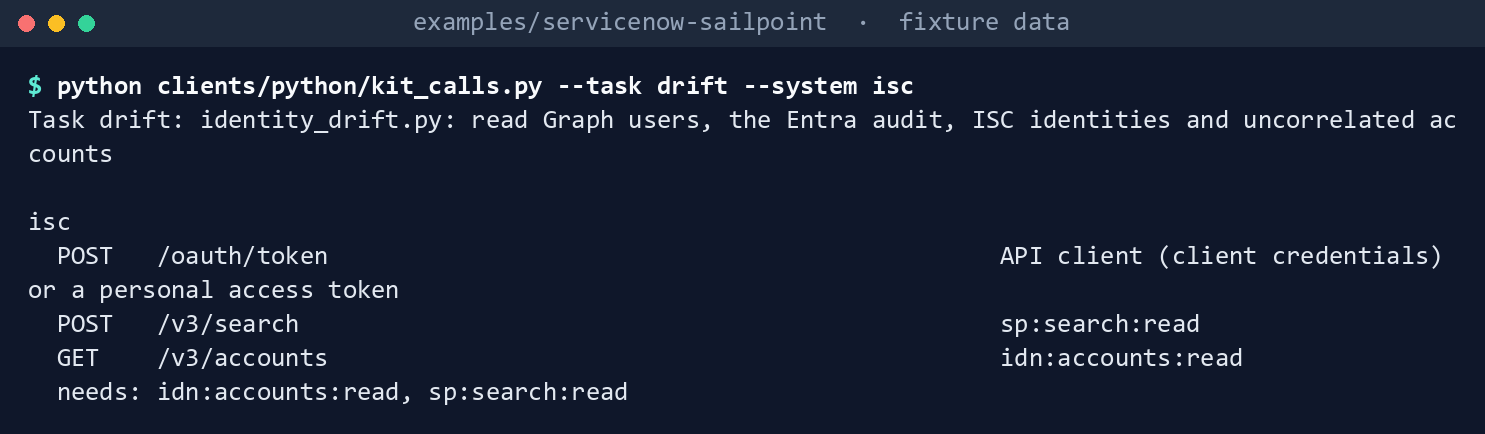
What the terminal shows, run on the kit’s fixtures (the same output as text) Catch a manage scope on a read client:
python clients/python/kit_calls.py --task drift --system isc --granted "sp:search:read,idn:accounts:read,idn:accounts:manage"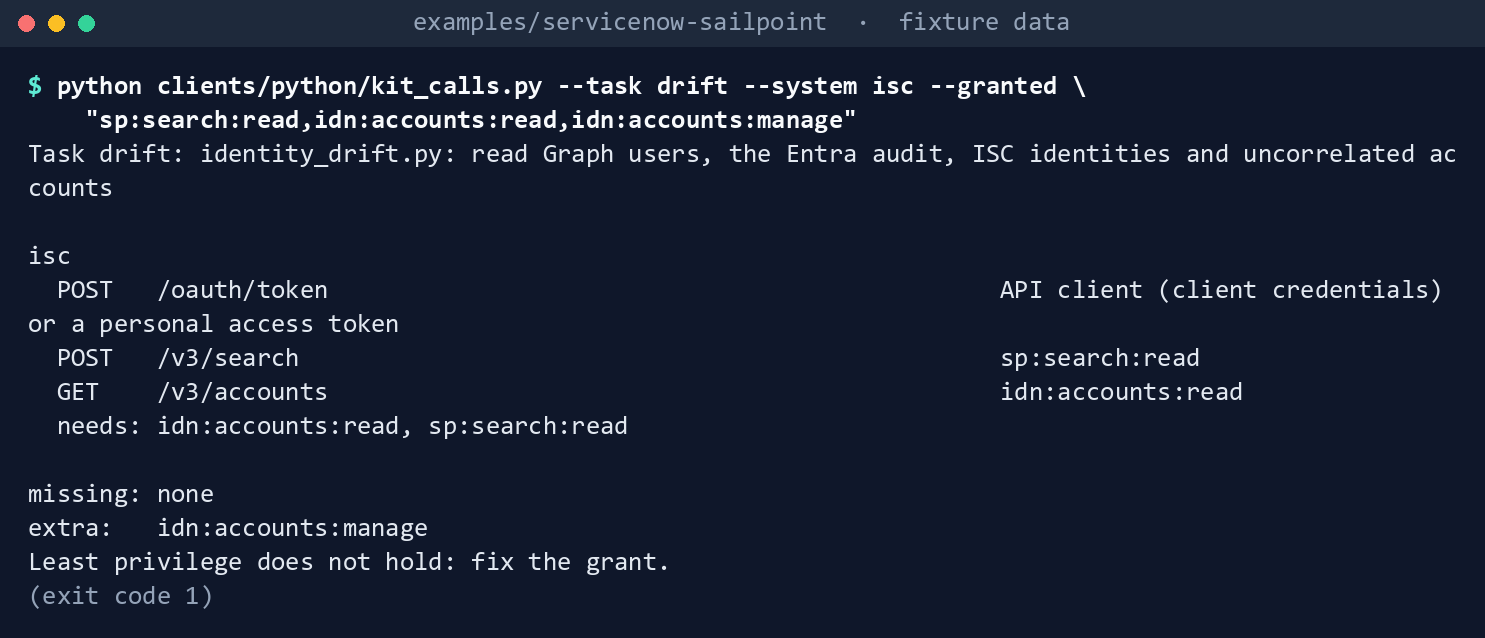
What the terminal shows, run on the kit’s fixtures (the same output as text) missing: none,extra: idn:accounts:manage,Least privilege does not hold: fix the grant., exit 1.Keep the workflow scope on its own client. Check the drift client’s scopes against the workflow task:
python clients/python/kit_calls.py --task workflows --system isc --granted "sp:search:read,idn:accounts:read"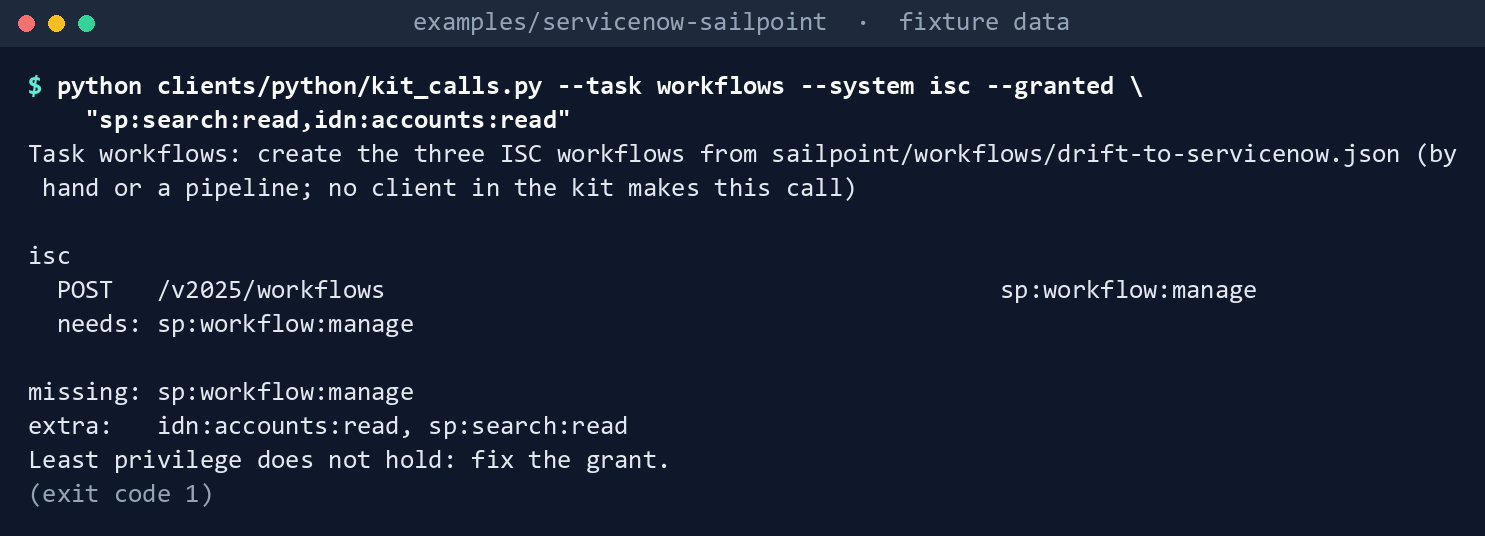
What the terminal shows, run on the kit’s fixtures (the same output as text) missing: sp:workflow:manage,extra: idn:accounts:read, sp:search:read, exit 1: the two jobs need two clients.Check the Graph app registration, first for a drift run that reads the audit, then for one that doesn’t:
python clients/python/kit_calls.py --task drift --system graph --granted "User.Read.All"
python clients/python/kit_calls.py --task drift --system graph --required-only --granted "User.Read.All"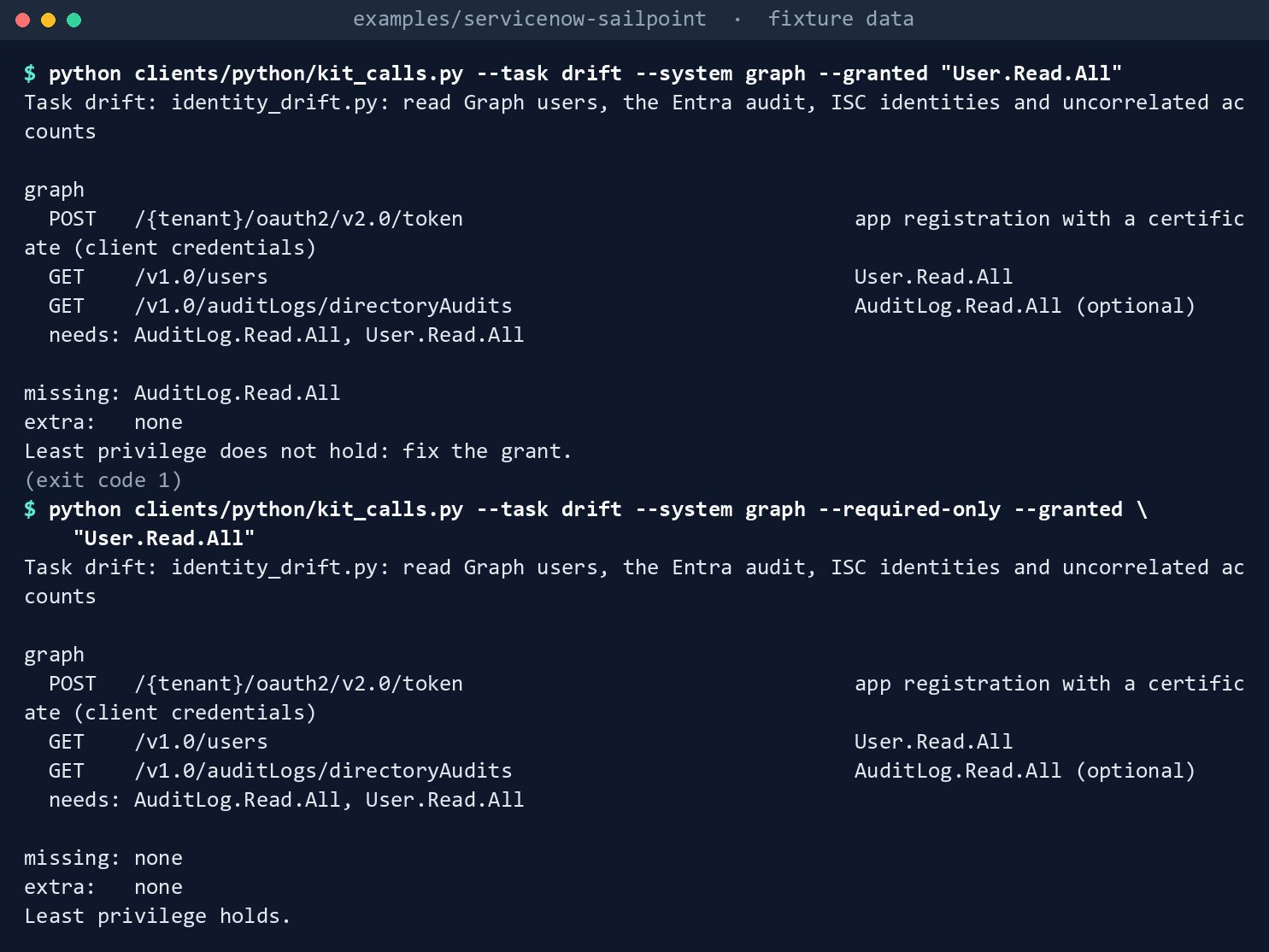
What the terminal shows, run on the kit’s fixtures (the same output as text) The first reports
missing: AuditLog.Read.Alland exits 1; the second reportsLeast privilege holds.and exits 0.
Lab 2: a SailPoint sandbox tenant
Not run by the authors. Use a SailPoint sandbox tenant, never production. How an agency gets one is between it and SailPoint; the public documentation doesn’t say (research gaps, row 21). Work in examples/servicenow-sailpoint. You’ll replace: <tenant> (your sandbox tenant’s name), <reader-scopes> and <workflow-scopes> (the scopes each API client shows, comma-separated), <reader-client-id> and <reader-client-secret> (the reader API client), <pat-client-id> and <pat-client-secret> (a personal access token, only if step 3 needs one) and <employee-id-attribute> (what step 4 finds).
Every command in this lab, in order, from examples/servicenow-sailpoint. Each step below says what it does and what to look for.
# Step 1: Find the API base
curl -s "https://<tenant>.api.identitynow.com/oauth/info"

# Step 1: Find the API base
export SAILPOINT_API_BASE="https://<tenant>.api.identitynow.com"

# Step 2: Create two API clients
python clients/python/kit_calls.py --task drift --system isc --granted "<reader-scopes>"
python clients/python/kit_calls.py --task workflows --system isc --granted "<workflow-scopes>"

# Step 3: Try the reader
export SAILPOINT_ACCESS_TOKEN=$(curl -s -X POST "$SAILPOINT_API_BASE/oauth/token" -d grant_type=client_credentials -d client_id="<reader-client-id>" -d client_secret="<reader-client-secret>" | python -c "import json,sys; print(json.load(sys.stdin)['access_token'])")
python clients/python/identity_drift.py --hr-csv tests/fixtures/hr_extract.csv --skip-graph --out-json out/sandbox.json --out-csv out/sandbox.csv

# Step 3: Try the reader
export SAILPOINT_ACCESS_TOKEN=$(curl -s -X POST "$SAILPOINT_API_BASE/oauth/token" -d grant_type=client_credentials -d client_id="<pat-client-id>" -d client_secret="<pat-client-secret>" | python -c "import json,sys; print(json.load(sys.stdin)['access_token'])")
python clients/python/identity_drift.py --hr-csv tests/fixtures/hr_extract.csv --skip-graph --out-json out/sandbox.json --out-csv out/sandbox.csv

# Step 4: Check the employee ID attribute
curl -s -X POST "$SAILPOINT_API_BASE/v3/search?limit=1" -H "Authorization: Bearer $SAILPOINT_ACCESS_TOKEN" -H "Content-Type: application/json" -H "Accept: application/json" --data '{"indices": ["identities"], "query": {"query": "*"}}'

# Step 4: Check the employee ID attribute
export ISC_EMPLOYEE_ID_ATTRIBUTE="<employee-id-attribute>"

# Step 5: Back it out
rm -rf out
unset SAILPOINT_ACCESS_TOKEN
Find the API base. Read your tenant’s OAuth information:
curl -s "https://<tenant>.api.identitynow.com/oauth/info"Set
SAILPOINT_API_BASEto the API base. If you use a vanity domain, or the response names a different base, put that base in place of the default one below.15export SAILPOINT_API_BASE="https://<tenant>.api.identitynow.com"Create two API clients. A reader with
sp:search:readandidn:accounts:read, for the drift and re-read clients; a workflow client withsp:workflow:manage, used only to create the three workflows. Compare each with the call list:python clients/python/kit_calls.py --task drift --system isc --granted "<reader-scopes>" python clients/python/kit_calls.py --task workflows --system isc --granted "<workflow-scopes>"Try the reader. Put its token in
SAILPOINT_ACCESS_TOKENand run the drift client against the sandbox, skipping Graph. The fixture HR extract is enough here: the step tests the reader’s access, not the findings.export SAILPOINT_ACCESS_TOKEN=$(curl -s -X POST "$SAILPOINT_API_BASE/oauth/token" -d grant_type=client_credentials -d client_id="<reader-client-id>" -d client_secret="<reader-client-secret>" | python -c "import json,sys; print(json.load(sys.stdin)['access_token'])") python clients/python/identity_drift.py --hr-csv tests/fixtures/hr_extract.csv --skip-graph --out-json out/sandbox.json --out-csv out/sandbox.csvSailPoint warns that client-credentials tokens have no user context and that calling most admin APIs with one often returns 403.16 If Search or Accounts returns 403, use a personal access token for a dedicated user at the lowest user level those endpoints list (for Accounts:
ORG_ADMIN,SOURCE_ADMIN,SOURCE_SUBADMINorHELPDESK), and record which one worked.1718 With the personal access token:export SAILPOINT_ACCESS_TOKEN=$(curl -s -X POST "$SAILPOINT_API_BASE/oauth/token" -d grant_type=client_credentials -d client_id="<pat-client-id>" -d client_secret="<pat-client-secret>" | python -c "import json,sys; print(json.load(sys.stdin)['access_token'])") python clients/python/identity_drift.py --hr-csv tests/fixtures/hr_extract.csv --skip-graph --out-json out/sandbox.json --out-csv out/sandbox.csvCheck the employee ID attribute. Search one identity:
curl -s -X POST "$SAILPOINT_API_BASE/v3/search?limit=1" -H "Authorization: Bearer $SAILPOINT_ACCESS_TOKEN" -H "Content-Type: application/json" -H "Accept: application/json" --data '{"indices": ["identities"], "query": {"query": "*"}}'Find where your HR key lives (
employeeNumberorattributes.employeeId), and setISC_EMPLOYEE_ID_ATTRIBUTEto match:export ISC_EMPLOYEE_ID_ATTRIBUTE="<employee-id-attribute>"Back it out. Delete both API clients (or the personal access tokens and the dedicated user), and delete anything the drift run wrote under
out:rm -rf out unset SAILPOINT_ACCESS_TOKEN
The verified facts
| Item | Value | Source |
|---|---|---|
| ISC token | POST https://{tenant}.api.identitynow.com/oauth/token; client credentials, authorization code and refresh token grants; personal access tokens, up to 10 per user |
19 |
| Client-credentials limits | No user context (user_id and identity_id unset); most admin APIs often return 403 with such a token |
20 |
| Access token | A JWT; the example payload carries a scope claim |
21 |
| Search | POST /v3/search, sp:search:read; searchAfter to page past 10,000 records; user levels ORG_ADMIN, CERT_ADMIN, REPORT_ADMIN, SOURCE_ADMIN, SOURCE_SUBADMIN, ROLE_ADMIN, ROLE_SUBADMIN |
22 |
| Search indices | accessprofiles, accountactivities, entitlements, events, identities, roles, workflowsummaries; no accounts index |
23 |
| List accounts | GET /v3/accounts, idn:accounts:read or idn:accounts:manage; uncorrelated filter with eq; limit default and maximum 250 |
24 25 |
| Get an account | GET /v3/accounts/{id}, idn:accounts:read or idn:accounts:manage; user levels ORG_ADMIN, SOURCE_ADMIN, SOURCE_SUBADMIN, HELPDESK |
26 |
| Workflows | Create needs sp:workflow:manage; list accepts sp:workflow:read or sp:workflow:manage; both name user level ORG_ADMIN |
27 |
| Graph: list users, get a user | User.Read.All (application), the least privileged for both; Get a user is available in US Government L4 and L5 |
28 29 |
| Graph: list directory audits | AuditLog.Read.All (application), least privileged; available in US Government L4 and L5 |
30 |
| Graph: list manager | Application permissions not supported on GET /users/{id}/manager; GET /users?$expand=manager documented as a way to get the chain |
31 |
| GCC endpoints | Microsoft 365 GCC uses https://graph.microsoft.com; GCC High graph.microsoft.us; DoD dod-graph.microsoft.us |
32 |
| SailPoint Identity Security Cloud | FedRAMP Certified, Moderate, agency path, authorized June 5, 2024 | 33 |
What couldn’t be verified
- The API domain of an ISC FedRAMP tenant. The authentication page documents only
{tenant}.api.identitynow.comand vanity domains. Kit README verify list, item 6; research gaps, row 22. - Whether a client-credentials token gets data from Search and Accounts. SailPoint says most admin APIs often return 403; it doesn’t list which. Verify list, item 8.
- Whether
$expand=managerworks under an application permission. Learn’s “List manager” page says application permissions aren’t supported for that endpoint and shows$expand=manageron the users list. Verify list, item 14. - Feature parity in the ISC FedRAMP environment for Search, Workflows and the Accounts API. Ask SailPoint; verify list, item 19.
Federal requirements and evidence
| What the output proves | Requirement it supports | KSI | Who keeps it |
|---|---|---|---|
| The drift and re-read clients hold read scopes only, and the workflow client holds one scope, removed after use | NIST SP 800-53 AC-6 (least privilege) and AC-2 (account management) at Moderate34 | KSI-IAM-ELP; KSI-IAM-SNU | The kit_calls.py --granted output with the API client’s approval |
The Graph app registration holds User.Read.All and, only if the audit is read, AuditLog.Read.All, with a certificate |
AC-6; IA-5 (authenticator management) for the certificate | KSI-IAM-ELP; KSI-IAM-APM | The app registration’s permissions and credential, reviewed with the call list |
| No component of Pass 1 can write to ISC, Entra ID or Active Directory | AC-6; Book 13’s rule that the coordination layer never writes the configuration itself | KSI-IAM-ELP | The call list and its test |
| Lab 1, step 1: the ISC client handles tokens, paging and the search cursor as tested | SA-11 (developer testing) at Moderate35 | KSI-SCR-MIT | The pytest tests/python/test_kit_common.py -k isc run, in the pull request’s checks |
| Lab 1, step 2: the scopes the drift client needs from ISC, each with the vendor page that says so | AC-6 | KSI-IAM-ELP | The kit_calls.py --task drift --system isc output, attached to the API client request |
| Lab 1, step 3: a manage scope on a read client is named, and the command exits 1 | AC-6 | KSI-IAM-ELP | The kit_calls.py --granted output that lists extra:, kept until the grant is fixed |
| Lab 1, step 4: the workflow scope needs its own client | AC-6; AC-5 (separation of duties) at Moderate36 | KSI-IAM-ELP; KSI-IAM-JIT | The kit_calls.py --task workflows --granted output |
Lab 1, step 5: the Graph app registration needs AuditLog.Read.All only when the drift run reads the audit |
AC-6 | KSI-IAM-ELP | The two kit_calls.py --system graph outputs, kept with the app registration’s approval |
| Lab 2, step 1: the tenant’s API base, the end of the flow from the kit to ISC | CA-3 (information exchange) at Moderate37 | KSI-SCR-MON | The /oauth/info response, kept with the data-flow record |
| Lab 2, step 2: a reader client and a separate workflow client, each matching the call list | AC-2; AC-6; IA-5 for each client secret | KSI-IAM-SNU; KSI-IAM-ELP | The two kit_calls.py --granted outputs, kept with the API client approvals |
| Lab 2, step 3: the reader’s scopes are enough for the drift client to read ISC | AC-6 | KSI-IAM-ELP | The terminal output, with any 403 recorded. out/sandbox.json and out/sandbox.csv hold fixture HR data and are deleted in step 5 |
| Lab 2, step 4: the attribute that holds the HR key, so accounts correlate to one person | CM-8 (system component inventory) at Moderate, read for identities (inference)38 | KSI-PIY-GIV | The ISC_EMPLOYEE_ID_ATTRIBUTE value, recorded in the deployment’s configuration |
| Lab 2, step 5: no test API client, token or output is left | AC-2; IA-5 | KSI-IAM-SNU | The tenant’s API client list; rm -rf out and unset SAILPOINT_ACCESS_TOKEN clear the laptop |
| Production runs on SailPoint Identity Security Cloud, which the verified facts list as FedRAMP Certified, not on a sandbox | FedRAMP authorization of the cloud services used; SA-9 (external system services) at Moderate39 | KSI-SCR-MIT; KSI-SCR-MON | The ISSO, with the authorization package and the Marketplace listing with its read date |
The KSI column names the FedRAMP 20x Key Security Indicators whose related SP 800-53 controls include the row’s control.40 KSIs are indicators for cloud service providers: the agency authorizes its own system and lines its own evidence up with what its providers report against them; it doesn’t report KSIs itself.
Dangers
| Danger | What happens | The guard |
|---|---|---|
| A manage scope on a read client | A stolen token can change accounts | --granted flags idn:accounts:manage as extra |
| The workflow scope left on a standing client | Anyone with that token can add or change workflows that call out of SailPoint | A separate client, used once; the call list shows no client needs it |
| A personal access token for an administrator | The kit runs as ORG_ADMIN |
A dedicated user at the lowest user level that works, recorded in Lab 2 |
| Offset paging past 10,000 search results | Results stop silently | searchAfter sorted on id; tested |
| The wrong Graph cloud | Tokens and data from the wrong cloud, or none | GRAPH_CLOUD has three values and refuses others; GCC is Global |
| A client secret for Graph | A long-lived secret in a pipeline | Certificate assertion first; the secret is a fallback |
Checklist
Footnotes
SailPoint Developer, “Authentication” (token endpoint, grant types, personal access tokens, client-credentials limits,
/oauth/info, JWT access tokens), https://developer.sailpoint.com/docs/api/authentication (read November 1, 2026).↩︎SailPoint Developer, “Authentication” (token endpoint, grant types, personal access tokens, client-credentials limits,
/oauth/info, JWT access tokens), https://developer.sailpoint.com/docs/api/authentication (read November 1, 2026).↩︎SailPoint, Identity Security Cloud OpenAPI specification, v3,
searchPost(sp:search:read, user levels,searchAfter), https://github.com/sailpoint-oss/api-specs/blob/main/idn/v3/paths/search-post.yaml (read November 1, 2026, at commit7f6741e).↩︎SailPoint, Identity Security Cloud OpenAPI specification, v3,
limitparameter (default 250, maximum 250), https://github.com/sailpoint-oss/api-specs/blob/main/idn/v3/parameters/limit.yaml (read November 1, 2026).↩︎Microsoft Learn, “Microsoft Graph national cloud deployments,” service root endpoints, https://learn.microsoft.com/graph/deployments (read November 1, 2026).↩︎
SailPoint, Identity Security Cloud OpenAPI specification, v3, search
Indexenumeration, https://github.com/sailpoint-oss/api-specs/blob/main/idn/v3/schemas/search/Index.yaml (read November 1, 2026).↩︎SailPoint Developer, “Authentication” (token endpoint, grant types, personal access tokens, client-credentials limits,
/oauth/info, JWT access tokens), https://developer.sailpoint.com/docs/api/authentication (read November 1, 2026).↩︎SailPoint, Identity Security Cloud OpenAPI specification, v3,
searchPost(sp:search:read, user levels,searchAfter), https://github.com/sailpoint-oss/api-specs/blob/main/idn/v3/paths/search-post.yaml (read November 1, 2026, at commit7f6741e).↩︎SailPoint, Identity Security Cloud OpenAPI specification, v3,
listAccounts(scopes, user levels, filters), https://github.com/sailpoint-oss/api-specs/blob/main/idn/v3/paths/accounts.yaml (read November 1, 2026).↩︎SailPoint, Identity Security Cloud OpenAPI specification, v3,
getAccount(scopes, user levels), https://github.com/sailpoint-oss/api-specs/blob/main/idn/v3/paths/account.yaml (read November 1, 2026).↩︎SailPoint, Identity Security Cloud OpenAPI specification, v2025,
createWorkflowandlistWorkflows(scopes; user levelORG_ADMIN, added at commit2a1f293), https://github.com/sailpoint-oss/api-specs/blob/main/idn/v2025/paths/workflows/workflows.yaml (read November 1, 2026; re-read November 9, 2026).↩︎Microsoft Learn, “List users,” permissions, https://learn.microsoft.com/graph/api/user-list?view=graph-rest-1.0 (read November 1, 2026).↩︎
Microsoft Learn, “Get a user,” national cloud availability and permissions, https://learn.microsoft.com/graph/api/user-get?view=graph-rest-1.0 (read November 1, 2026).↩︎
Microsoft Learn, “List directoryAudits,” national cloud availability and permissions, https://learn.microsoft.com/graph/api/directoryaudit-list?view=graph-rest-1.0 (read November 1, 2026).↩︎
SailPoint Developer, “Authentication” (token endpoint, grant types, personal access tokens, client-credentials limits,
/oauth/info, JWT access tokens), https://developer.sailpoint.com/docs/api/authentication (read November 1, 2026).↩︎SailPoint Developer, “Authentication” (token endpoint, grant types, personal access tokens, client-credentials limits,
/oauth/info, JWT access tokens), https://developer.sailpoint.com/docs/api/authentication (read November 1, 2026).↩︎SailPoint, Identity Security Cloud OpenAPI specification, v3,
getAccount(scopes, user levels), https://github.com/sailpoint-oss/api-specs/blob/main/idn/v3/paths/account.yaml (read November 1, 2026).↩︎SailPoint, Identity Security Cloud OpenAPI specification, v3,
searchPost(sp:search:read, user levels,searchAfter), https://github.com/sailpoint-oss/api-specs/blob/main/idn/v3/paths/search-post.yaml (read November 1, 2026, at commit7f6741e).↩︎SailPoint Developer, “Authentication” (token endpoint, grant types, personal access tokens, client-credentials limits,
/oauth/info, JWT access tokens), https://developer.sailpoint.com/docs/api/authentication (read November 1, 2026).↩︎SailPoint Developer, “Authentication” (token endpoint, grant types, personal access tokens, client-credentials limits,
/oauth/info, JWT access tokens), https://developer.sailpoint.com/docs/api/authentication (read November 1, 2026).↩︎SailPoint Developer, “Authentication” (token endpoint, grant types, personal access tokens, client-credentials limits,
/oauth/info, JWT access tokens), https://developer.sailpoint.com/docs/api/authentication (read November 1, 2026).↩︎SailPoint, Identity Security Cloud OpenAPI specification, v3,
searchPost(sp:search:read, user levels,searchAfter), https://github.com/sailpoint-oss/api-specs/blob/main/idn/v3/paths/search-post.yaml (read November 1, 2026, at commit7f6741e).↩︎SailPoint, Identity Security Cloud OpenAPI specification, v3, search
Indexenumeration, https://github.com/sailpoint-oss/api-specs/blob/main/idn/v3/schemas/search/Index.yaml (read November 1, 2026).↩︎SailPoint, Identity Security Cloud OpenAPI specification, v3,
listAccounts(scopes, user levels, filters), https://github.com/sailpoint-oss/api-specs/blob/main/idn/v3/paths/accounts.yaml (read November 1, 2026).↩︎SailPoint, Identity Security Cloud OpenAPI specification, v3,
limitparameter (default 250, maximum 250), https://github.com/sailpoint-oss/api-specs/blob/main/idn/v3/parameters/limit.yaml (read November 1, 2026).↩︎SailPoint, Identity Security Cloud OpenAPI specification, v3,
getAccount(scopes, user levels), https://github.com/sailpoint-oss/api-specs/blob/main/idn/v3/paths/account.yaml (read November 1, 2026).↩︎SailPoint, Identity Security Cloud OpenAPI specification, v2025,
createWorkflowandlistWorkflows(scopes; user levelORG_ADMIN, added at commit2a1f293), https://github.com/sailpoint-oss/api-specs/blob/main/idn/v2025/paths/workflows/workflows.yaml (read November 1, 2026; re-read November 9, 2026).↩︎Microsoft Learn, “List users,” permissions, https://learn.microsoft.com/graph/api/user-list?view=graph-rest-1.0 (read November 1, 2026).↩︎
Microsoft Learn, “Get a user,” national cloud availability and permissions, https://learn.microsoft.com/graph/api/user-get?view=graph-rest-1.0 (read November 1, 2026).↩︎
Microsoft Learn, “List directoryAudits,” national cloud availability and permissions, https://learn.microsoft.com/graph/api/directoryaudit-list?view=graph-rest-1.0 (read November 1, 2026).↩︎
Microsoft Learn, “List manager,” permissions and HTTP request, https://learn.microsoft.com/graph/api/user-list-manager?view=graph-rest-1.0 (read November 1, 2026).↩︎
Microsoft Learn, “Microsoft Graph national cloud deployments,” service root endpoints, https://learn.microsoft.com/graph/deployments (read November 1, 2026).↩︎
FedRAMP Marketplace data, https://www.fedramp.gov/marketplace/products.json (last change November 1, 2026): SailPoint Identity Security Cloud, FR2001938710A (read November 1, 2026).↩︎
National Institute of Standards and Technology, SP 800-53B Moderate baseline, release 5.2.0 OSCAL profile (includes AC-2, AC-5, AC-6, CA-3, CM-8, IA-5, SA-9 and SA-11), https://github.com/usnistgov/oscal-content/blob/main/nist.gov/SP800-53/rev5/json/NIST_SP-800-53_rev5_MODERATE-baseline_profile.json (read November 1, 2026).↩︎
National Institute of Standards and Technology, SP 800-53B Moderate baseline, release 5.2.0 OSCAL profile (includes AC-2, AC-5, AC-6, CA-3, CM-8, IA-5, SA-9 and SA-11), https://github.com/usnistgov/oscal-content/blob/main/nist.gov/SP800-53/rev5/json/NIST_SP-800-53_rev5_MODERATE-baseline_profile.json (read November 1, 2026).↩︎
National Institute of Standards and Technology, SP 800-53B Moderate baseline, release 5.2.0 OSCAL profile (includes AC-2, AC-5, AC-6, CA-3, CM-8, IA-5, SA-9 and SA-11), https://github.com/usnistgov/oscal-content/blob/main/nist.gov/SP800-53/rev5/json/NIST_SP-800-53_rev5_MODERATE-baseline_profile.json (read November 1, 2026).↩︎
National Institute of Standards and Technology, SP 800-53B Moderate baseline, release 5.2.0 OSCAL profile (includes AC-2, AC-5, AC-6, CA-3, CM-8, IA-5, SA-9 and SA-11), https://github.com/usnistgov/oscal-content/blob/main/nist.gov/SP800-53/rev5/json/NIST_SP-800-53_rev5_MODERATE-baseline_profile.json (read November 1, 2026).↩︎
National Institute of Standards and Technology, SP 800-53B Moderate baseline, release 5.2.0 OSCAL profile (includes AC-2, AC-5, AC-6, CA-3, CM-8, IA-5, SA-9 and SA-11), https://github.com/usnistgov/oscal-content/blob/main/nist.gov/SP800-53/rev5/json/NIST_SP-800-53_rev5_MODERATE-baseline_profile.json (read November 1, 2026).↩︎
National Institute of Standards and Technology, SP 800-53B Moderate baseline, release 5.2.0 OSCAL profile (includes AC-2, AC-5, AC-6, CA-3, CM-8, IA-5, SA-9 and SA-11), https://github.com/usnistgov/oscal-content/blob/main/nist.gov/SP800-53/rev5/json/NIST_SP-800-53_rev5_MODERATE-baseline_profile.json (read November 1, 2026).↩︎
FedRAMP, “Key Security Indicators,” FedRAMP Consolidated Rules for 2026, indicator titles and “Related SP 800-53 Controls,” https://www.fedramp.gov/2026/reference/key-security-indicators/ (read November 2, 2026).↩︎