Federal Modernization Workbook
Chapter 07 — Lifecycle Drift, Metrics and Evidence
Six gates set the lifecycle up. This one proves, every day, that it still runs the way the first six said, and leaves a record that outlives the accounts it describes.
The code behind the guide’s Gate 7: the lifecycle drift classes found and sent to the owner of the fact, the six metrics on the continuous monitoring cadence, and the evidence kept outside the directory. There is no Microsoft sample for lifecycle metrics, so this chapter starts from the program’s own pipeline, Book 19, Chapter 09, and builds what it leaves to you: lifecycle_drift.py in examples/hr-lifecycle, which writes one read-only run from the HR export, the directory, the card system and Chapters 01, 03, 04 and 06’s outputs, and hr_evidence.py in examples/drift-pipeline, which packages each run and assembles a period. Lab 1 runs on a laptop with no tenant; Lab 2 uses a test tenant.
Jump to a slide (18)
Deck · Narrated deck (about 11 minutes, captions) · Script · Captions. Recorded on November 2, 2026 from the approved chapter.
Goal and audience
Goal. By the end of this chapter you can produce, from code, one run that lists every lifecycle drift finding by fingerprint and every metric against its threshold, package it so an ISSO can check it with sha256sum alone, chain it to the run before, and hand over a period summary that maps what is still open to the controls and to Gate 7’s criteria. For each rule you can say whether it is Book 03’s design, the guide’s, or the program’s own.
Audience. Platform and pipeline engineers who own the scheduled checks, the identity engineers who close findings at the source, and the ISSOs who receive the evidence. You should read Python. You don’t need a tenant until Lab 2.
What the evidence has to show
Book 03 sets both halves of this gate, and this chapter doesn’t restate them. The drift classes, their detection signals and default severities are Book 03, Chapter 11, Drift between HR and the directory; the six metrics are its measured lifecycle. The guide’s Step 7 adds the order of work: run the classes, fix at the source, report the metrics, prove the sole source, keep the evidence outside the directory.
Two things are out of scope here on purpose. Attribute drift, a value that differs from HR, is the ADM implementation guide’s Gate 9: the validation kit’s VK-HR checks and the HCM correlation tool find it, and Book 19’s pipeline compares their runs. Schema drift is the middleware’s validation output (Book 19, Chapter 01). This chapter adds the classes and the metrics the lifecycle owns.
The evidence also has to survive. Entra’s own retention is short: 30 days for audit logs with P1 or P2, 30 days for provisioning logs with a premium edition, and up to 30 days of viewable Lifecycle Workflows history, none of it retroactive.1 The accounts are disposed of under the disposition rule; the record of what happened to them must outlive them (Book 03, Chapter 11, The evidence each event leaves).
Which cloud, for this read
The run’s only new Graph read is the workforce user list (graph_export.py --task drift-read): graph.microsoft.com for GCC, graph.microsoft.us for GCC High and dod-graph.microsoft.us for DoD.2 The other inputs are the outputs of Chapters 01, 02, 03, 04 and 06, the HR export and the card system’s status export, which carry no host. Learn’s feature availability page lists basic and advanced security and usage reports and SIEM connectivity as available in Azure Government; in GCC they are the commercial service.3 The pipeline that schedules the run signs in as Book 19, Chapter 09 describes, per cloud.
Start with Book 19, Chapter 09’s pipeline
What it gives you
Learn documents the pieces this gate relies on: how long each log is kept, and how to route audit, sign-in and provisioning logs to a workspace, a storage account or a SIEM (Book 03, Chapter 11 carries those pages). It publishes no sample that computes lifecycle metrics or joins HR, the directory and a card system into drift classes; those are the program’s design. So the nearest working start is the program’s own: examples/drift-pipeline, which Book 19, Chapter 09 builds on Learn’s federated sign-in samples. Its drift_pipeline.py compares two validation kit runs, keeps names out of the tracker, and writes an evidence package with a SHA-256 per file and a hash chain. The privileged access and non-person workbooks extended it the same way this chapter does.
What it leaves to you
Each row is pinned by a test: in examples/hr-lifecycle/tests/test_credentials_separation_drift.py (the run) or examples/drift-pipeline/tests/test_hr_evidence.py (the package and the period).
What drift_pipeline.py does |
Why it isn’t enough for this gate | What this chapter adds | Pinned by |
|---|---|---|---|
Reads a validation kit run (ValidationManifest.json) |
The lifecycle classes need the HR export, the contractor decisions, the card system and four chapters’ outputs, none of which is a kit run | lifecycle_drift.py run: the six classes in one run with its own run.json |
test_drift_run_folder_and_classes |
| Compares check rows | Book 03’s six metrics are numbers against thresholds, not rows | metrics.json: each metric’s value, threshold, direction and status; LD-07 and LD-08 |
test_drift_metrics |
| Hashes the files in one run | A metric is only as good as the chapter output it came from | run.json records the manifest SHA-256 of every chapter output read, and refuses one that fails its own manifest |
test_drift_refuses_a_tampered_chapter_output |
| Packages a kit run | It refuses a folder that isn’t one | hr_evidence.py package and verify, with the same rules: one tenant per chain, written once, nothing extra |
test_load_refuses_a_tampered_run, test_package_is_written_once_and_refuses_other_tenants, test_verify_catches_an_edit_after_packaging |
| One package at a time | The ISSO signs a period, not a day | hr_evidence.py period: chain, coverage, each metric’s series, controls, Gate 7 |
test_package_chain_verify_and_period, test_period_reports_a_gap_and_a_broken_chain |
The verdict. Keep Book 19’s pipeline as the scheduler, the sign-in and the hashing. Don’t feed it lifecycle data as if it were a kit run; give it a run shaped for the lifecycle, and a packager that knows that shape.
The code: what the run builds on and adds
The run
lifecycle_drift.py run reads:
- the HR export (
PersonNumber,AssignmentStatusType,TerminationDate) and Chapter 02’sdecisions.jsonfor contractors; - the workforce users (
graph_export.py --task drift-read), the validation kit’sexceptions.csv(an exception with no owner doesn’t count, as in VK-HR-01) and the card system’s status export; - optionally, Chapter 01’s scan, Chapter 03’s readiness, Chapter 04’s residual and Chapter 06’s timing folders, each checked against its own
manifest.jsonand task name before it is read; config/drift.json, the six metrics and their thresholds.
It writes the run folder once, and refuses a folder that already exists: run.json (schema fmp-hr-run/1, the tenant ID, cloud, mode, window, readOnly: true, the manifest SHA-256 of every chapter output read, and the SHA-256 of lifecycle/manifest.json), and lifecycle/ with findings.json, metrics.json and a manifest. --mode fixture or --mode tenant is required, so a lab run can’t pass for a tenant run.
The drift classes
| Rule | Severity | What it flags | Source |
|---|---|---|---|
| LD-01 | Finding | An active or suspended worker record with no account (missing identity) | Book 03, Chapter 11 |
| LD-02 | Finding | An enabled account for a worker terminated in HR, or a contractor past the earliest end (stale access) | Book 03, Chapter 11; Chapter 02 here |
| LD-03 | Finding | An enabled account that matches no worker or contractor record and no owned exception (orphan) | Book 03, Chapter 11 |
| LD-04 | Finding | A WS-01 or WS-04 finding from Chapter 01’s scan (unauthorized write), keeping Chapter 01’s object key so the fingerprint is the same | Book 03, Chapter 11; Chapter 01 here |
| LD-05 | Finding | An active PIV card for a separated worker (credential drift) | Book 03, Chapter 11 |
| LD-06 | Finding | An active PIV card for a person the contractor source doesn’t hold, or whose engagement ended (contractor credential drift) | Book 03, Chapter 11; the “engagement ended” limb is design guidance, since Book 03’s second limb is the reverse: a contractor record whose card was terminated or expired with the engagement still open |
Severities are Book 03’s defaults, which it says are the program’s, not an external standard. Credential drift here reads the card system only; Intune device certificates are a join the agency adds when its Intune report is in the evidence store (design guidance).
The metrics
| Metric | Value from | Rule when it fails |
|---|---|---|
| Separation-to-block, 90th percentile | Chapter 06 summary.json |
LD-07 Warn, over the threshold |
| Separation-to-revocation, 90th percentile | Chapter 06 summary.json |
LD-07 |
| Transfer-to-review | Chapter 04 summary.json; open while the review is open |
LD-08 Warn, not measured |
| Joiner readiness rate | Chapter 03 summary.json |
LD-07 |
| Correlation coverage | This run: enabled accounts that resolve to a current worker, contractor or owned exception | LD-07 |
| Derivation purity | This run: access-granting memberships by dynamic group or automatic assignment, over all | LD-07 |
The thresholds in config/drift.json are proposed starting values (design guidance); Book 03 is plain that choosing the metrics and thresholds is the agency’s CA-7 decision. A metric with no input is reported as not measured (LD-08), never as zero.
The package, the chain and the period
hr_evidence.py lives in examples/drift-pipeline/python beside pa_evidence.py and npi_evidence.py, and changes neither them nor drift_pipeline.py: it imports their hashing, JSON and metadata helpers.
packagechecks the run againstrun.jsonand the lifecycle manifest (every file, nothing extra, one tenant, cloud and mode, no request that isn’t a GET), copies it underrun/, and writessummary.md(fingerprints and object keys, no names),EVIDENCE-MANIFEST.json(the metrics, the open findings by fingerprint, what opened and closed since the previous package, the previous package’s manifest SHA-256) andSHA256SUMS. A previous package for another tenant, cloud or mode, or a run that isn’t later, is refused.verifyrechecks every file against the manifest andSHA256SUMS, and the run inside against its own manifests.periodverifies every package whose window falls in the period, reports breaks in the chain and gaps in coverage, gives each metric’s series, and maps what is open at the end to AC-2, AU-6, PS-4, PS-5 and CA-7. The mapping follows Book 03, Chapter 11’s control support table and its text on AU-6 and CA-7, and is design guidance: the assessor decides each control. It scores three of Gate 7’s criteria and reports the fourth, the sole-source proof (Book 03, Appendix C), as not decided by this code.
scripts/run_example_tests.py now lists hr-lifecycle with the kits whose changes also run the drift pipeline’s suite, because test_hr_evidence.py builds its runs with this kit’s code.
The tests
This chapter’s tests are the four test_drift_* tests in examples/hr-lifecycle/tests/test_credentials_separation_drift.py, which build every chapter output from the fixtures first, and the six in examples/drift-pipeline/tests/test_hr_evidence.py. The kit’s 57 tests and the drift pipeline’s 142 pass under Python 3.10 or later with no package beyond pytest, no tenant and no network.
The commands below run against fictional contoso.example fixtures. They show what the code does, not that a tenant, an HR system or a card system returns the same shapes. Review the code, and run Lab 2 in a test tenant, before any of it reaches production evidence.
Lab 1: fixtures, no tenant
You need Python 3.10 or later. Work in examples/hr-lifecycle.
Every command in this lab, in order, from examples/hr-lifecycle. Each step below says what it does and what to look for.
# Step 1: Write the chapter outputs the run reads
python python/writer_register.py scan --register config/writer-register.json --audit tests/fixtures/ch01/directory-audits.json --since 2026-10-01 --until 2026-10-31 --cloud gcc --out out/ch01
python python/contractor_source.py extract --register tests/fixtures/ch02/contractor-register.csv --cards tests/fixtures/ch02/cards.csv --sponsors tests/fixtures/ch02/hr-sponsors.csv --rules config/contractor-rules.json --as-of 2026-11-01 --out out/ch02/extract
python python/joiner_workflows.py readiness --hires tests/fixtures/ch03/hr-hires.csv --users tests/fixtures/ch03/hire-users.json --prehire-results tests/fixtures/ch03/prehire-results.json --assignments tests/fixtures/ch03/joiner-assignments.json --workflows config/workflows --as-of 2026-11-02T08:00:00Z --cloud gcc --out out/ch03/readiness
python python/access_assignment.py residual --mover tests/fixtures/ch04/mover.json --assignments tests/fixtures/ch04/mover-assignments.json --memberships tests/fixtures/ch04/mover-memberships.json --policies config/access --as-of 2026-11-01T12:00:00Z --cloud gcc --out out/ch04/residual
python python/separation_timing.py measure --separations tests/fixtures/ch06/hr-separations.csv --users tests/fixtures/ch06/leaver-users.json --audits tests/fixtures/ch06/separation-audits.json --results tests/fixtures/ch06/leaver-results.json --cards tests/fixtures/ch06/card-revocations.csv --devices tests/fixtures/ch06/device-actions.csv --role-holders tests/fixtures/ch06/role-holders.csv --config config/separation.json --as-of 2026-11-01T12:00:00Z --cloud gcc --out out/ch06

# Step 2: Write the first run
python python/lifecycle_drift.py run --hr tests/fixtures/ch07/hr-export.csv --contractors out/ch02/extract/decisions.json \
    --users tests/fixtures/ch07/workforce-users.json --exceptions tests/fixtures/ch07/exceptions.csv --cards tests/fixtures/ch07/cards.csv \
    --derivation tests/fixtures/ch07/derivation.json --writers out/ch01 --readiness out/ch03/readiness --residual out/ch04/residual \
    --timing out/ch06 --config config/drift.json --since 2026-10-01 --until 2026-11-01 --cloud gcc \
    --tenant-id 00000000-0000-4000-8000-00000000c0de --mode fixture --out out/ch07/runs/2026-11-01T0600Z

# Step 3: Read the findings
python -c "import json; [print(r['Rule'], r['Severity'], r['Object']) for r in json.load(open('out/ch07/runs/2026-11-01T0600Z/lifecycle/findings.json'))]"

# Step 4: Write the next day's run
python python/lifecycle_drift.py run --hr tests/fixtures/ch07/hr-export.csv --contractors out/ch02/extract/decisions.json \
    --users tests/fixtures/ch07/workforce-users.json --exceptions tests/fixtures/ch07/exceptions.csv --cards tests/fixtures/ch07/cards.csv \
    --derivation tests/fixtures/ch07/derivation.json --writers out/ch01 --readiness out/ch03/readiness --residual out/ch04/residual \
    --timing out/ch06 --config config/drift.json --since 2026-11-01 --until 2026-11-02 --cloud gcc \
    --tenant-id 00000000-0000-4000-8000-00000000c0de --mode fixture --out out/ch07/runs/2026-11-02T0600Z

# Step 5: Package both, chained, and verify
python ../drift-pipeline/python/hr_evidence.py package --run out/ch07/runs/2026-11-01T0600Z --out out/ch07/evidence
python ../drift-pipeline/python/hr_evidence.py package --run out/ch07/runs/2026-11-02T0600Z \
    --previous-manifest out/ch07/evidence/2026-11-01T0600Z/EVIDENCE-MANIFEST.json --out out/ch07/evidence
python ../drift-pipeline/python/hr_evidence.py verify out/ch07/evidence/2026-11-02T0600Z

# Step 5: Package both, chained, and verify
(cd out/ch07/evidence/2026-11-02T0600Z && sha256sum -c SHA256SUMS)

# Step 6: Assemble the period
python ../drift-pipeline/python/hr_evidence.py period --evidence out/ch07/evidence --since 2026-10-01 --until 2026-11-02 --out out/ch07/periods

# Step 7: Run the tests
python -m pytest tests -q
cd ../drift-pipeline && python -m pytest tests -q

# After the steps
cd ../hr-lifecycle && rm -rf out
Write the chapter outputs the run reads. These are Lab 1 of Chapters 01, 02, 03, 04 and 06, one command each:
python python/writer_register.py scan --register config/writer-register.json --audit tests/fixtures/ch01/directory-audits.json --since 2026-10-01 --until 2026-10-31 --cloud gcc --out out/ch01
python python/contractor_source.py extract --register tests/fixtures/ch02/contractor-register.csv --cards tests/fixtures/ch02/cards.csv --sponsors tests/fixtures/ch02/hr-sponsors.csv --rules config/contractor-rules.json --as-of 2026-11-01 --out out/ch02/extract
python python/joiner_workflows.py readiness --hires tests/fixtures/ch03/hr-hires.csv --users tests/fixtures/ch03/hire-users.json --prehire-results tests/fixtures/ch03/prehire-results.json --assignments tests/fixtures/ch03/joiner-assignments.json --workflows config/workflows --as-of 2026-11-02T08:00:00Z --cloud gcc --out out/ch03/readiness
python python/access_assignment.py residual --mover tests/fixtures/ch04/mover.json --assignments tests/fixtures/ch04/mover-assignments.json --memberships tests/fixtures/ch04/mover-memberships.json --policies config/access --as-of 2026-11-01T12:00:00Z --cloud gcc --out out/ch04/residual
python python/separation_timing.py measure --separations tests/fixtures/ch06/hr-separations.csv --users tests/fixtures/ch06/leaver-users.json --audits tests/fixtures/ch06/separation-audits.json --results tests/fixtures/ch06/leaver-results.json --cards tests/fixtures/ch06/card-revocations.csv --devices tests/fixtures/ch06/device-actions.csv --role-holders tests/fixtures/ch06/role-holders.csv --config config/separation.json --as-of 2026-11-01T12:00:00Z --cloud gcc --out out/ch06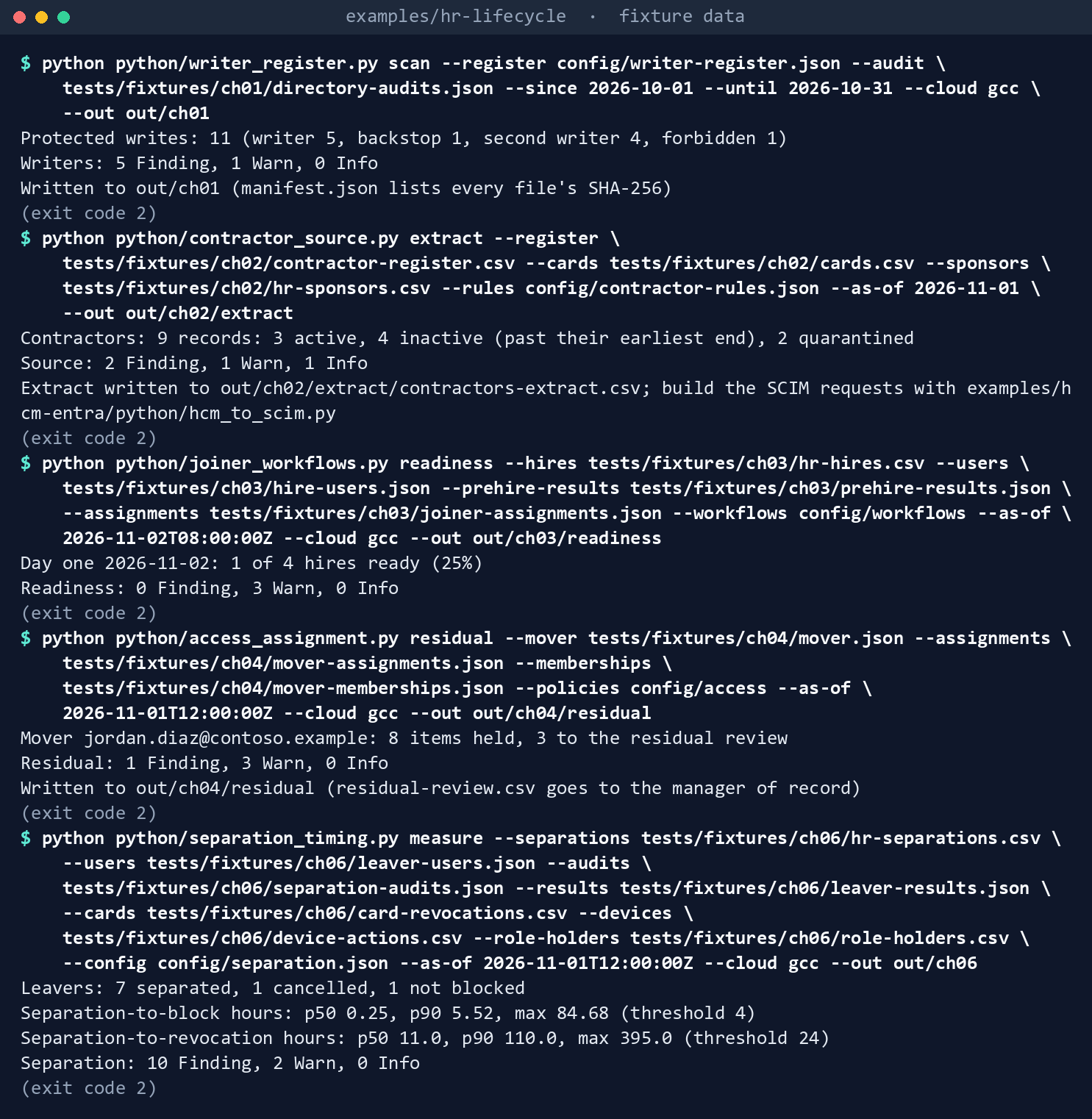
What the terminal shows, run on the kit’s fixtures (the same output as text) Each exits 2, because each fixture holds findings. Among the lines they print:
Day one 2026-11-02: 1 of 4 hires ready (25%)andSeparation-to-block hours: p50 0.25, p90 5.52, max 84.68 (threshold 4).Write the first run:
python python/lifecycle_drift.py run --hr tests/fixtures/ch07/hr-export.csv --contractors out/ch02/extract/decisions.json \
    --users tests/fixtures/ch07/workforce-users.json --exceptions tests/fixtures/ch07/exceptions.csv --cards tests/fixtures/ch07/cards.csv \
    --derivation tests/fixtures/ch07/derivation.json --writers out/ch01 --readiness out/ch03/readiness --residual out/ch04/residual \
    --timing out/ch06 --config config/drift.json --since 2026-10-01 --until 2026-11-01 --cloud gcc \
    --tenant-id 00000000-0000-4000-8000-00000000c0de --mode fixture --out out/ch07/runs/2026-11-01T0600Z
Run 2026-11-01T0600Z: 4 chapter outputs read (readiness, residual, timing, writers) separationToBlockHoursP90 5.52 max 4 out of bounds separationToRevocationHoursP90 110.0 max 24 out of bounds transferToReviewHours None max 240 not measured joinerReadinessRate 0.25 min 0.95 out of bounds correlationCoverage 0.5833 min 0.99 out of bounds derivationPurity 0.7637 min 0.8 out of bounds Lifecycle drift: 14 Finding, 6 Warn, 0 Info Run written to out/ch07/runs/2026-11-01T0600Z; package it with examples/drift-pipeline/python/hr_evidence.py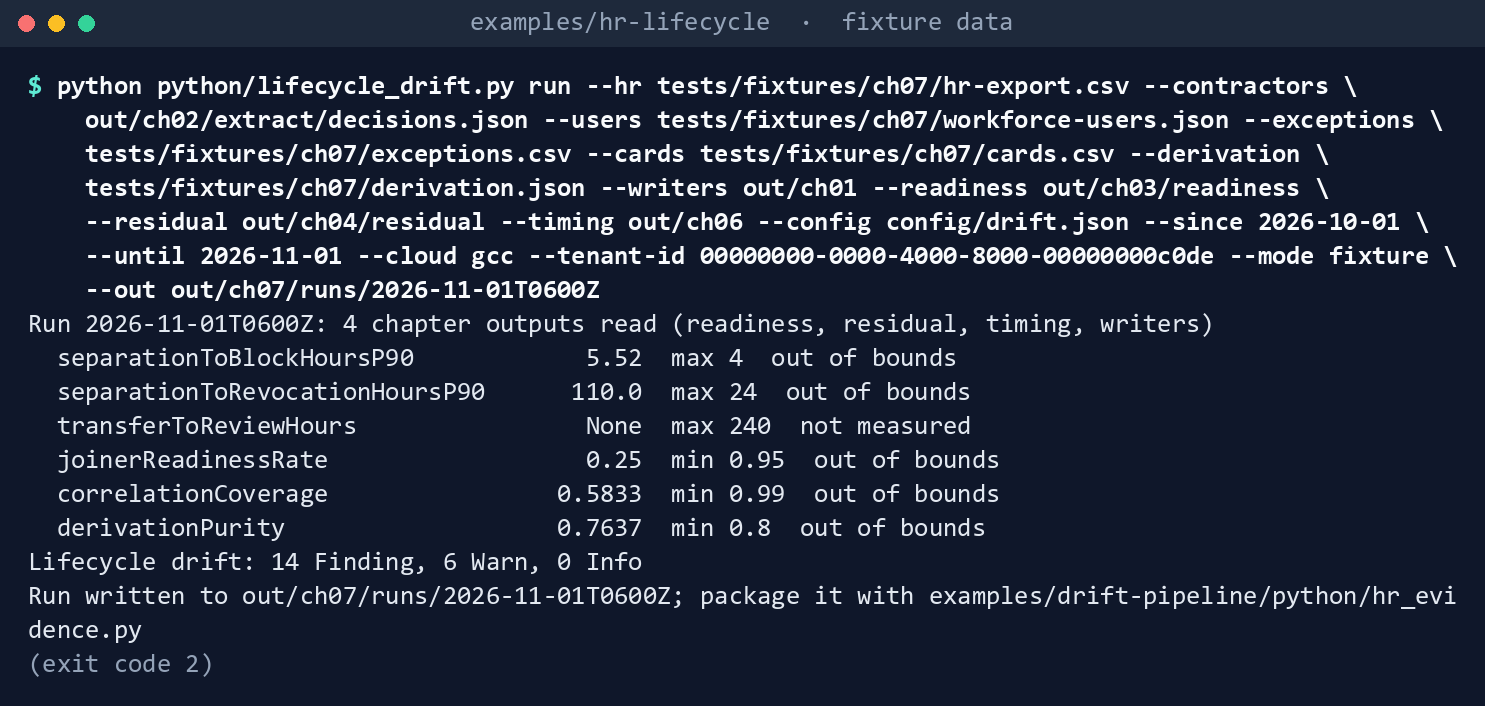
What the terminal shows, run on the kit’s fixtures (the same output as text) It exits 2.
Read the findings:
python -c "import json; [print(r['Rule'], r['Severity'], r['Object']) for r in json.load(open('out/ch07/runs/2026-11-01T0600Z/lifecycle/findings.json'))]"![Terminal window showing python -c 'import json; [print(r['Rule'], r['Severity'], r['Object']) for r i… and what it printed](captures/07-3.png)
What the terminal shows, run on the kit’s fixtures (the same output as text) out/ch07/runs/2026-11-01T0600Z/lifecycle/findings.jsonholds 14 Findings: LD-01 for worker100104, who has no account; LD-02 fordrew.parkandharper.vu, terminated in HR and enabled, and for contractorbailey.ortiz, past the earliest end; LD-03 forprint.kiosk(its exception has no owner) andold.temp, but not forsvc.scanner, whose exception has one; five LD-04, Chapter 01’s four second writers and its forbidden delete; LD-05 for card100303; LD-06 for cards900002and900011. The six Warns are five LD-07 and one LD-08 for the mover’s review, still open.run.jsonrecords the four chapter outputs by manifest SHA-256, for example"writers": {"manifestSha256": "a2e59910…", "task": "writers-scan"}.Write the next day’s run, with the same inputs and the window
--since 2026-11-01 --until 2026-11-02, intoout/ch07/runs/2026-11-02T0600Z:python python/lifecycle_drift.py run --hr tests/fixtures/ch07/hr-export.csv --contractors out/ch02/extract/decisions.json \ --users tests/fixtures/ch07/workforce-users.json --exceptions tests/fixtures/ch07/exceptions.csv --cards tests/fixtures/ch07/cards.csv \ --derivation tests/fixtures/ch07/derivation.json --writers out/ch01 --readiness out/ch03/readiness --residual out/ch04/residual \ --timing out/ch06 --config config/drift.json --since 2026-11-01 --until 2026-11-02 --cloud gcc \ --tenant-id 00000000-0000-4000-8000-00000000c0de --mode fixture --out out/ch07/runs/2026-11-02T0600Z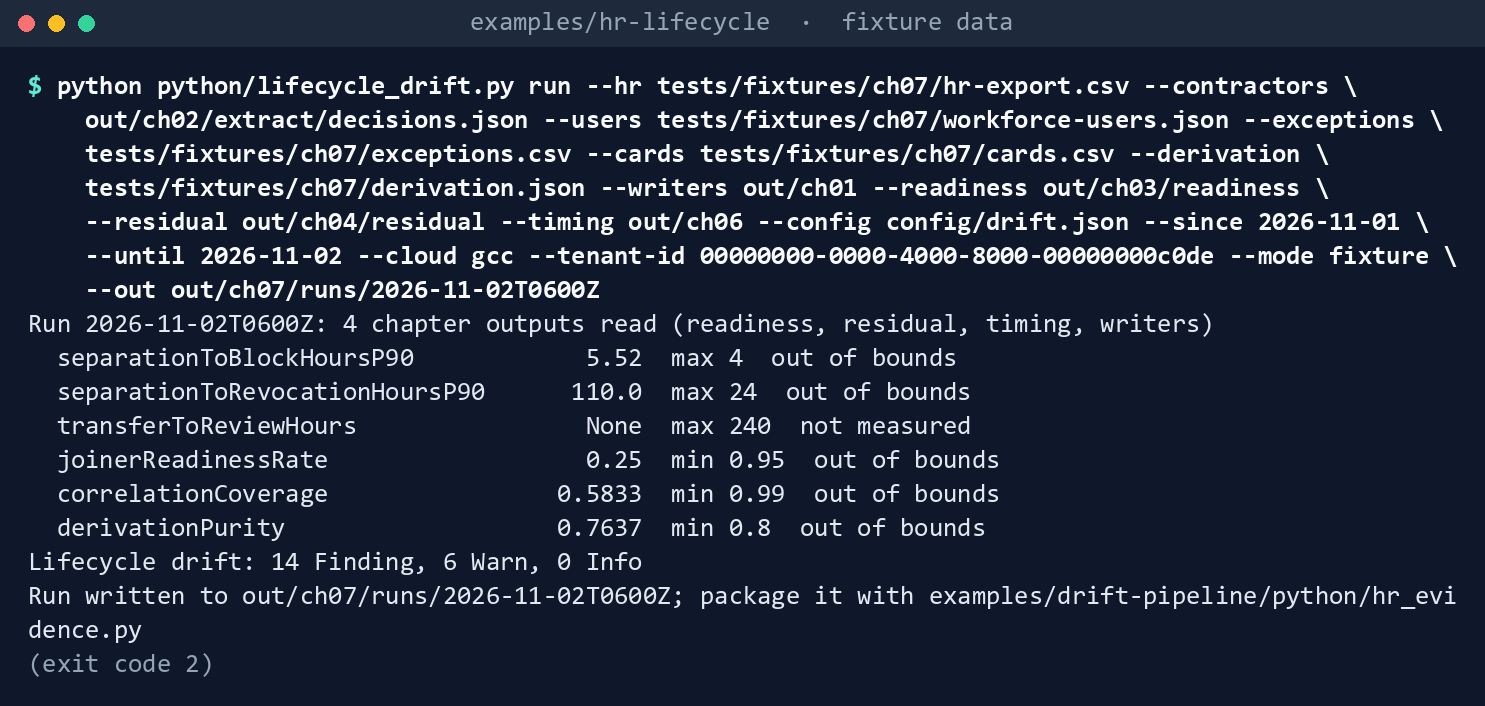
What the terminal shows, run on the kit’s fixtures (the same output as text) It prints the same metrics and
Lifecycle drift: 14 Finding, 6 Warn, 0 Info.Package both, chained, and verify:
python ../drift-pipeline/python/hr_evidence.py package --run out/ch07/runs/2026-11-01T0600Z --out out/ch07/evidence
python ../drift-pipeline/python/hr_evidence.py package --run out/ch07/runs/2026-11-02T0600Z \
    --previous-manifest out/ch07/evidence/2026-11-01T0600Z/EVIDENCE-MANIFEST.json --out out/ch07/evidence
python ../drift-pipeline/python/hr_evidence.py verify out/ch07/evidence/2026-11-02T0600Z
{"evidence_manifest_sha256": "342c65f7af3d61bdaeb7b5e17147400341f1145bb88c6fbc26fbef9b3418008e", "new": 20, "open": 20, "package": "2026-11-01T0600Z", "resolved": 0} {"evidence_manifest_sha256": "2892017a07f7214696c1048cfa40e6ccb14927f7c7bdc85cc23cac1a8be739c9", "new": 0, "open": 20, "package": "2026-11-02T0600Z", "resolved": 0} {"evidence_manifest_sha256": "2892017a07f7214696c1048cfa40e6ccb14927f7c7bdc85cc23cac1a8be739c9", "files": 6, "run_id": "2026-11-02T0600Z"}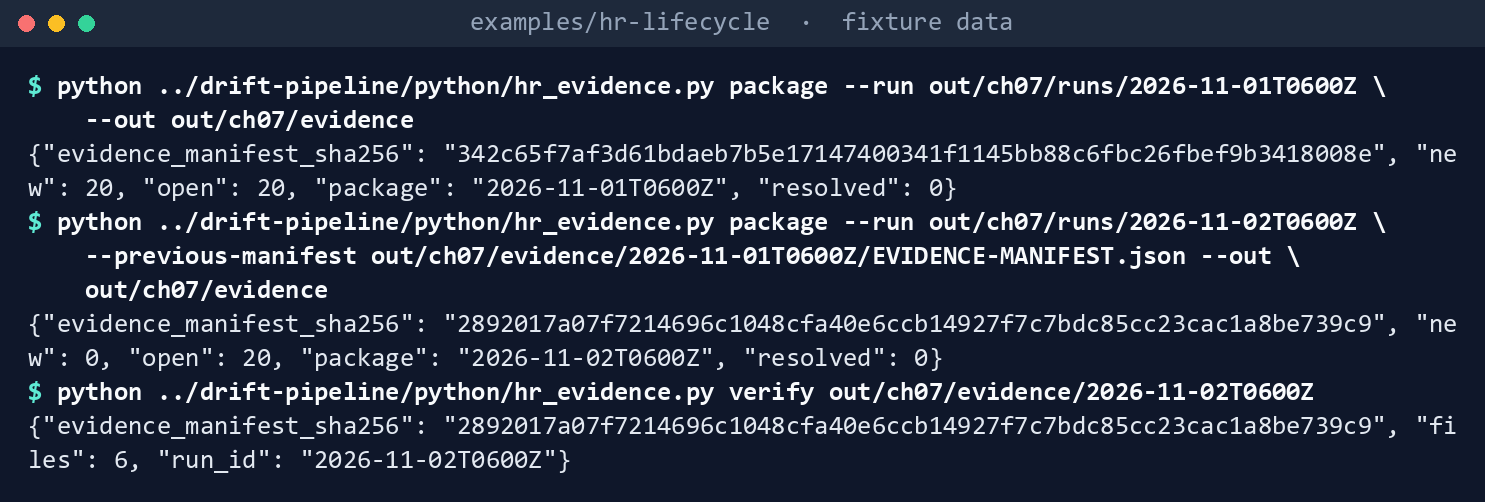
What the terminal shows, run on the kit’s fixtures (the same output as text) The first package opens all 20 counted findings; the second opens none and closes none, because the inputs didn’t change. Your hashes match these only if your fixtures are the committed ones. Check the second package’s files, which is the check the ISSO runs (the parentheses keep you in
examples/hr-lifecycle):(cd out/ch07/evidence/2026-11-02T0600Z && sha256sum -c SHA256SUMS)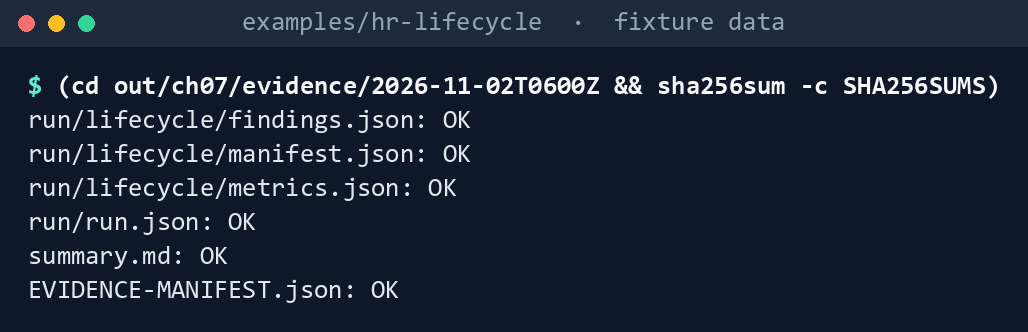
What the terminal shows, run on the kit’s fixtures (the same output as text) It reports every file
OK.Assemble the period:
python ../drift-pipeline/python/hr_evidence.py period --evidence out/ch07/evidence --since 2026-10-01 --until 2026-11-02 --out out/ch07/periods{"chain_breaks": 0, "complete": false, "coverage_gaps": 0, "open_at_end": 20, "packages": 2, "period": "period-2026-10-01_2026-11-02"}
What the terminal shows, run on the kit’s fixtures (the same output as text) It exits 2: the chain and the coverage are whole, but drift is open, five metrics are out of bounds and transfer-to-review isn’t measured, which the period lists separately from the five.
period-summary.mdshows AC-2 with 6 open findings, AU-6 with 5, PS-4 with 6, PS-5 with transfer-to-review unmeasured, and Gate 7’s criteria: drift classes not met, metrics not met, evidence unbroken met, sole source not decided by this code.Run the tests:
python -m pytest tests -q
cd ../drift-pipeline && python -m pytest tests -q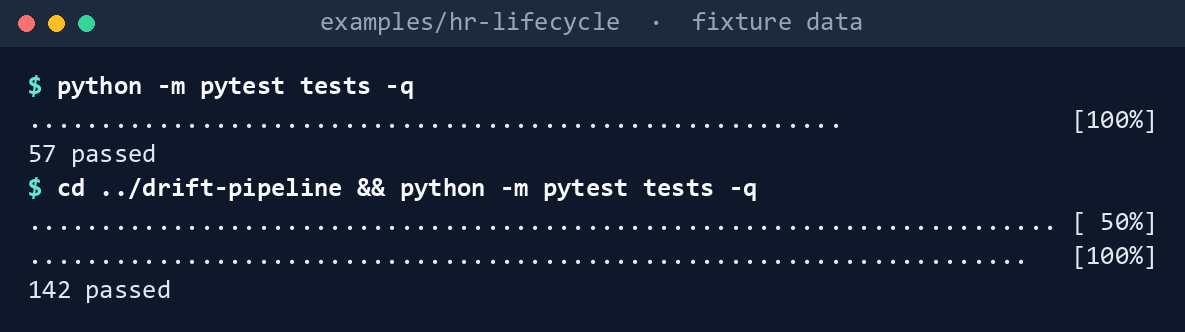
What the terminal shows, run on the kit’s fixtures (the same output as text)
Expected result: 57 passed, then 142 passed. Delete out when you’re done; it holds fictional names. The tests left you in examples/drift-pipeline:
cd ../hr-lifecycle && rm -rf out
Lab 2: test tenant
Not run by the authors. Use a test tenant in the worldwide or GCC cloud, never production. Work in examples/hr-lifecycle. You’ll replace: <graph-token> (a bearer token for graph.microsoft.com issued to the reader app), <tenant-id> (the test tenant’s ID), <hr-export-csv>, <exceptions-csv>, <cards-csv> and <derivation-json> (the test tenant’s HR export, exceptions, card export and derivation file, in the layouts of the files in tests/fixtures/ch07), <since> and <until> (the run’s window, yyyy-mm-dd) and <run-id> (the run’s name, such as 2026-11-05T0600Z).
Every command in this lab, in order, from examples/hr-lifecycle. Each step below says what it does and what to look for.
# Step 1: Export the workforce users
python python/graph_export.py --task drift-read --list

# Step 1: Export the workforce users
export HRLC_GRAPH_TOKEN='<graph-token>'
python python/graph_export.py --task drift-read --cloud gcc --out exports/drift

# Step 3: Write a run
python python/lifecycle_drift.py run --hr <hr-export-csv> --contractors out/ch02-test-extract/decisions.json \
    --users exports/drift/workforce-users.json --exceptions <exceptions-csv> --cards <cards-csv> \
    --derivation <derivation-json> --writers out/ch01-test --readiness out/ch03/readiness-test --residual out/ch04/residual-test \
    --timing out/separation-test --config config/drift.json --since <since> --until <until> --cloud gcc \
    --tenant-id <tenant-id> --mode tenant --out out/ch07-test/runs/<run-id>

# Step 3: Write a run
python -c "import json; [print(r['Rule'], r['Severity'], r['Object'], '|', r['Issue']) for r in json.load(open('out/ch07-test/runs/<run-id>/lifecycle/findings.json'))]"

# Step 6: Back it out
rm -rf exports out
Export the workforce users. Register a reader app with a certificate or a federated credential and grant only the two permissions this command prints, with admin consent:
python python/graph_export.py --task drift-read --listGet a token for
graph.microsoft.comand export:export HRLC_GRAPH_TOKEN='<graph-token>' python python/graph_export.py --task drift-read --cloud gcc --out exports/driftRun Chapters 01, 02, 03, 04 and 06 against the test tenant’s exports, as each chapter’s Lab 2 describes, each into its own new folder. Keep the folders those labs write (stop before their back-out steps): the next step reads
out/ch01-test,out/ch02-test-extract,out/ch03/readiness-test,out/ch04/residual-testandout/separation-test.Write a run with
--users exports/drift/workforce-users.json, the test tenant’s ID and--mode tenant:python python/lifecycle_drift.py run --hr <hr-export-csv> --contractors out/ch02-test-extract/decisions.json \ --users exports/drift/workforce-users.json --exceptions <exceptions-csv> --cards <cards-csv> \ --derivation <derivation-json> --writers out/ch01-test --readiness out/ch03/readiness-test --residual out/ch04/residual-test \ --timing out/separation-test --config config/drift.json --since <since> --until <until> --cloud gcc \ --tenant-id <tenant-id> --mode tenant --out out/ch07-test/runs/<run-id>Read every finding against the test tenant before going on:
python -c "import json; [print(r['Rule'], r['Severity'], r['Object'], '|', r['Issue']) for r in json.load(open('out/ch07-test/runs/<run-id>/lifecycle/findings.json'))]"Schedule it. Add the run,
packageand the upload to Book 19, Chapter 09’s workflow (its Lab 2), signing in with the federated credential and no secret. Write packages to a test storage container outside the directory with immutability set, and pass--previous-manifestfrom the last package each time (design guidance).Assemble a period after a few runs and check that a skipped day shows as a coverage gap.
Back it out. Remove the schedule, delete the reader app, its credential and its consent, and delete the test container if you created it for the lab. Then delete the local
exportsandoutfolders:rm -rf exports out
Verified facts
| Item | Value | US Government clouds | Stage | Source |
|---|---|---|---|---|
List users with employeeLeaveDateTime |
GET /users; User.Read.All with User-LifeCycleInfo.Read.All |
Available (user list) | v1.0 | Carried from the validation kit’s README, VK-HR-054 |
| Graph hosts | graph.microsoft.com (GCC), graph.microsoft.us (GCC High), dod-graph.microsoft.us (DoD) |
— | — | 5 |
| Audit log retention | 30 days with P1 or P2, 7 with Free; not retroactive | — | — | Carried from Book 03, Chapter 116 |
| Provisioning log retention | 30 days with a premium edition, 7 with Free | — | — | Carried from Book 03, Chapter 117 |
| Lifecycle Workflows history | Viewable up to 30 days; download it to keep it longer | — | — | Carried from Book 03, Chapter 118 |
| Reports and SIEM connectivity | Basic and advanced reports and SIEM connectivity listed as available in Azure Government | Available | GA | Carried from the guide9 |
| Lifecycle metrics, drift classes and severities | Book 03’s design; no Microsoft source sets them | — | — | Book 03, Chapter 11 |
One place where the sources leave a choice, recorded so a later edit doesn’t loosen the code: the guide’s Step 7 lists credential drift from the card system and Intune reports joined on the person. This run reads the card system only, and says so; the Intune join is open until the agency’s Intune report is in the evidence store.
Federal requirements and evidence
This chapter helps prove Gate 7. The guide’s Gate 7 table names the requirements: CA-7 for system-level metrics, AU-6 and AU-11 with SI-12 for the review and retention of audit records, and BOD 25-01 continuous reporting; the federal framework crosswalk lists their sources.
| Requirement | KSI | What the code gives | What the ISSO keeps |
|---|---|---|---|
| CA-7 | KSI-MLA-EVC | metrics.json per run, each metric’s series per period, thresholds in a reviewed file |
Every period’s PERIOD-MANIFEST.json, period-summary.md and SHA256SUMS, with the approved thresholds |
| AU-6 | KSI-MLA-RVL | LD-04 from Chapter 01’s scan of the audit log, by fingerprint | The packages, with each LD-04 finding’s closure at the source |
| AU-11, SI-12 | KSI-MLA-OSM (AU-11); none lists SI-12 | Packages written once, hash-chained, outside the directory | The storage container’s retention and immutability settings, set to the records schedule |
| BOD 25-01 continuous reporting | None: not an SP 800-53 control | Not this code: ScubaGear reports for the policies in Gates 4 and 5 | The ScubaGear results beside the period |
| AC-2, PS-4, PS-5 (from the other gates) | KSI-IAM-JIT (all three); KSI-IAM-ELP (PS-4, PS-5); KSI-IAM-SUS (AC-2, PS-4) | LD-01 to LD-03 and LD-05 to LD-06; the separation and transfer metrics | The period’s control table, which the assessor reads, not decides from |
Each scripted step in the labs, and each file the code writes, with the evidence it leaves:
| Lab step | What it runs or writes | Requirement | KSI | Evidence |
|---|---|---|---|---|
| Lab 1, step 1 | The Chapter 01, 02, 03, 04 and 06 commands, each into its own folder | As each chapter’s table says | As each chapter’s table says | Each folder’s manifest.json, whose SHA-256 the run records |
| Lab 1, steps 2 to 4 | lifecycle_drift.py run, writing lifecycle/findings.json (LD-01 to LD-06) |
AC-2, PS-4, PS-5; AU-6 for LD-04 | KSI-IAM-JIT, KSI-IAM-ELP, KSI-IAM-SUS; KSI-MLA-RVL | Each run’s lifecycle/findings.json, as step 3 prints it |
| Lab 1, steps 2 and 4 | lifecycle/metrics.json |
CA-7 | KSI-MLA-EVC | Each metric’s value, threshold and status, against config/drift.json |
| Lab 1, steps 2 and 4 | lifecycle/manifest.json and run.json |
AU-9; SI-7 | KSI-MLA-OSM; KSI-SVC-VRI | The run’s inputs by manifest SHA-256, written once |
| Lab 1, step 5 | hr_evidence.py package, twice and chained, writing run/, summary.md, EVIDENCE-MANIFEST.json and SHA256SUMS |
AU-9; SI-7; AU-11 once stored | KSI-MLA-OSM; KSI-SVC-VRI | Each package’s EVIDENCE-MANIFEST.json, chained to the one before |
| Lab 1, step 5 | hr_evidence.py verify; sha256sum -c SHA256SUMS |
SI-7; AU-9 | KSI-SVC-VRI; KSI-MLA-OSM | verify’s result and every OK line |
| Lab 1, step 6 | hr_evidence.py period, writing PERIOD-MANIFEST.json, period-summary.md and SHA256SUMS |
CA-7; AU-6 | KSI-MLA-EVC; KSI-MLA-RVL | The period folder under out/ch07/periods, which the ISSO signs |
| Lab 1, step 7 | python -m pytest tests -q in both kits |
CM-3(2) (design guidance) | KSI-CMT-VTD | Both kits’ pass counts, kept with the change |
| Lab 1, clean-up | rm -rf out |
None: fixture output isn’t evidence | — | — |
| Lab 2, step 1 | graph_export.py --task drift-read --list; export, writing workforce-users.json and export.json |
AC-6, least privilege: GET calls only | KSI-IAM-ELP | The printed list; exports/drift/export.json |
| Lab 2, step 3 | lifecycle_drift.py run --mode tenant; print the findings |
AC-2, PS-4, PS-5; AU-6; CA-7 | KSI-IAM-JIT, KSI-IAM-ELP, KSI-IAM-SUS; KSI-MLA-RVL; KSI-MLA-EVC | out/ch07-test/runs/<run-id>/run.json, lifecycle/findings.json and lifecycle/metrics.json |
| Lab 2, step 6 | Remove the schedule and the reader app; rm -rf exports out |
AC-6: no reader permissions left after the test | KSI-IAM-ELP | The app’s deletion in the directory audit log |
KSIs are FedRAMP 20x indicators for cloud service providers: the agency authorizes its own system and lines this evidence up with what its providers report against them, and it doesn’t report KSIs itself (Book 00, Appendix B). Each KSI shown lists the row’s control among its related SP 800-53 controls on FedRAMP’s page;10 which file supports which indicator is the program’s mapping (design guidance). Controls the guide’s table doesn’t name (AC-6, AU-9, CM-3(2), SI-7) are in the Moderate baseline (Book 13, Appendix A; Book 14, Appendix A).
Dangers
| Danger | What happens | The guard |
|---|---|---|
| A metric computed from an edited chapter output | The number looks fine and proves nothing | Each input is checked against its own manifest; run.json records its SHA-256 |
| A missing input read as zero | A metric looks met because nothing was measured | LD-08: not measured is a warning, never a value |
| A lab run filed as tenant evidence | Fiction in the authorization package | --mode is required and recorded; packages of different modes don’t chain |
| Two tenants in one chain | Evidence from the wrong tenant | package refuses a previous manifest for another tenant, cloud or mode |
| Names in the tracker or the summary | Personal data in a public issue | summary.md and the period carry fingerprints and object keys; names stay in the run, under access control |
| A skipped day | A gap nobody notices until the assessment | period reports coverage gaps and chain breaks, and isn’t complete with either |
| Findings fixed in the directory | Drift returns on the next feed | Gate 7’s rule: fix at the owner of the fact; the next run closes the finding only if the source changed |
| Logs that expired before export | Evidence that can’t be recovered | Route the logs out from the first day of the pilot (the guide’s interim path); package daily |
Checklist
Footnotes
Microsoft Learn, “Microsoft Entra data retention,” https://learn.microsoft.com/entra/identity/monitoring-health/reference-reports-data-retention, with the provisioning and Lifecycle Workflows history pages cited in Book 03, Chapter 11 (read November 1, 2026; carried from Book 03, Chapter 11).↩︎
Microsoft Learn, “Microsoft Graph national cloud deployments,” https://learn.microsoft.com/graph/deployments (read November 1, 2026; carried from Book 19, Chapter 02).↩︎
Microsoft Learn, “Microsoft Entra feature availability” (Azure for US Government: basic and advanced reports and SIEM connectivity available), https://learn.microsoft.com/entra/identity/authentication/feature-availability (read November 1, 2026; carried from the HR-driven identity implementation guide’s verification log).↩︎
Microsoft Learn, “List users,” https://learn.microsoft.com/graph/api/user-list?view=graph-rest-1.0, and the user resource (
employeeLeaveDateTimeneedsUser-LifeCycleInfo.Read.All), as read for the validation kit’s VK-HR-05 (read November 1, 2026; carried fromexamples/validation-kit/README.md).↩︎Microsoft Learn, “Microsoft Graph national cloud deployments,” https://learn.microsoft.com/graph/deployments (read November 1, 2026; carried from Book 19, Chapter 02).↩︎
Microsoft Learn, “Microsoft Entra data retention,” https://learn.microsoft.com/entra/identity/monitoring-health/reference-reports-data-retention, with the provisioning and Lifecycle Workflows history pages cited in Book 03, Chapter 11 (read November 1, 2026; carried from Book 03, Chapter 11).↩︎
Microsoft Learn, “Microsoft Entra data retention,” https://learn.microsoft.com/entra/identity/monitoring-health/reference-reports-data-retention, with the provisioning and Lifecycle Workflows history pages cited in Book 03, Chapter 11 (read November 1, 2026; carried from Book 03, Chapter 11).↩︎
Microsoft Learn, “Microsoft Entra data retention,” https://learn.microsoft.com/entra/identity/monitoring-health/reference-reports-data-retention, with the provisioning and Lifecycle Workflows history pages cited in Book 03, Chapter 11 (read November 1, 2026; carried from Book 03, Chapter 11).↩︎
Microsoft Learn, “Microsoft Entra feature availability” (Azure for US Government: basic and advanced reports and SIEM connectivity available), https://learn.microsoft.com/entra/identity/authentication/feature-availability (read November 1, 2026; carried from the HR-driven identity implementation guide’s verification log).↩︎
FedRAMP, “Key Security Indicators,” FedRAMP Consolidated Rules for 2026, indicator titles and “Related SP 800-53 Controls,” including the mapping updates of October 13, 2026, https://www.fedramp.gov/2026/reference/key-security-indicators/ (read November 2, 2026; the indicator IDs are carried from Book 13, Appendix A and Book 14, Chapter 03).↩︎