Federal Modernization Workbook
Chapter 02 — Contractor Sources and Enforced End Dates
A contractor’s end date in a spreadsheet nobody updates keeps access alive. The end date the code computes, from every fact that can end an engagement, doesn’t.
The code behind the guide’s Gate 2 and the plan’s decision D-I3 and task I5.2: contractors from a named source, an enforced earliest end, the contractor leaver shipped first, and sponsors recertified with remove-on-no-response. You start with Learn’s API-driven inbound provisioning contract (bulkUpload) and the review settings of an access package assignment policy. Then you use examples/hr-lifecycle for what they leave to you: the earliest end per contractor, an extract that examples/hcm-entra turns into SCIM requests, a read-only reconciliation, and the review settings as code. Lab 1 runs on a laptop with no tenant; Lab 2 uses a test tenant.
Jump to a slide (19)
Deck · Narrated deck (about 11 minutes, captions) · Script · Captions. Recorded on November 2, 2026 from the approved chapter.
Goal and audience
Goal. By the end of this chapter you can turn a contractor register into records the HR middleware sends, each carrying its earliest end as the leave date and an inactive status once that date has passed; refuse a record with no end or no sponsor; show every contractor account, card and record that disagree; and produce the sponsor review’s settings for review. For each rule you can say whether it is Learn’s contract, Book 03’s design or the program’s own guidance.
Audience. Developers who build the contractor source’s integration, the owner of the contractor register, and the identity engineers who run the provisioning app. You should read Python, CSV and JSON. You don’t need a tenant until Lab 2.
Why contractors need their own code
Contractors aren’t in Federal HR 2.0’s scope, so they come from an agency-owned register mapped into the same canonical record (Book 03, Chapter 06), as the contractor evaluation recommends. The guide’s Step 2 ships the contractor leaver first: the middleware computes the earliest end and sends the leave date and active false itself (Appendix A, Contractor leavers). This chapter is that computation, and the checks around it. The decision of which source to use is the governance body’s (D-I3); the code works with whichever register is named.
Which cloud, for these reads and writes
The records reach Entra ID through the contractor source’s own API-driven provisioning app, through the same middleware as employees. Learn’s feature availability page lists API-driven inbound provisioning, and provisioning agent registration for a US Government tenant, as available in Azure Government, and access reviews as available; GCC uses the commercial service.1 The Perform bulkUpload page itself carries no national cloud table (verification log, row 6). The middleware’s endpoint check accepts only graph.microsoft.com, graph.microsoft.us and dod-graph.microsoft.us (Book 19, Chapter 01). The reconciliation reads GET /users from the cloud you name; graph_export.py has no default.
Start with Microsoft’s procedure
What Microsoft gives you
Learn’s Perform bulkUpload page is the contract: POST /servicePrincipals/{servicePrincipalId}/synchronization/jobs/{jobId}/bulkUpload with Content-Type: application/scim+json, at most 50 user operations per request and a rate limit of 40 requests per second. The provisioning service matches on the attributes the job maps (externalId in the examples) to create, update, enable or disable the account, resolves manager.value as the manager’s externalId, and disables the user when a record sends active false. A successful call returns 202 Accepted with a Location header that points to the provisioning logs. The least-privileged application permission is SynchronizationData-User.Upload.OwnedBy; SynchronizationData-User.Upload is the higher one and the only delegated one, for a User Administrator.2
For recertification, the reviewSettings of an access package assignment policy carry isEnabled, primaryReviewers, fallbackReviewers, schedule and expirationBehavior, whose values are keepAccess, removeAccess and acceptAccessRecommendation.3 Learn’s procedure for a review of an access package offers monthly, quarterly, bi-annual and annual frequencies, Manager as reviewer with a fallback, and the no-response choices no change, remove access or take recommendations.4
What it leaves to you
Each row is pinned by a test in tests/test_writers_and_contractors.py.
| Learn gives | What it leaves to you | What examples/hr-lifecycle adds |
Test |
|---|---|---|---|
active false disables the account |
When a contractor’s engagement has ended | The earliest end: contract end, earlier completion date, suitability withdrawn, card terminated, revoked or expired, sponsor gone past the grace period, sponsor recertification due | test_earliest_end_takes_the_first_condition, test_an_expired_card_ends_the_engagement |
| Any record it’s sent | Refusing a contractor with no end or no sponsor | Quarantine: CS-01, CS-02 | test_no_end_date_or_no_sponsor_is_quarantined |
| A SCIM bulk request schema | Mapping the register into the canonical record | Rows in the examples/hcm-entra extract layout: worker type C, the sponsor as manager, organization from the sponsor, the earliest end as the termination date |
test_extract_matches_the_hcm_entra_layout_and_marks_past_ends_inactive |
| Provisioning results per record | A reconciliation before anything changes | CR-01 to CR-05 across the register, the card system and the directory | test_reconcile_finds_every_class |
| Review settings as properties | The settings the guide asks for, as a reviewed body | Bi-annual, the manager as reviewer, a named fallback, remove access on no response | test_review_settings_remove_access_when_no_one_responds |
| — | One record per person | A register with a key twice is refused | test_duplicate_person_keys_are_refused |
The verdict. Don’t write a second SCIM client. The middleware in examples/hcm-entra already validates, batches, paces and records provenance; this chapter feeds it the contractor population with dates it computed.
The code: what examples/hr-lifecycle adds
What exists already isn’t rebuilt. examples/hcm-entra builds and sends the SCIM bulk requests, with its own validation, quarantine and provenance manifest (Book 19, Chapter 01); its mapping already treats worker type C as a contractor with code CTR. The validation kit reports enabled member users with no employeeId (VK-HR-01) and the worker type fill rate (VK-HR-07). This chapter adds python/contractor_source.py, config/contractor-rules.json and the contractor-reconcile task.
The earliest end
extract computes, for each register row, every end condition that applies and takes the first. The conditions and their order are Book 03’s (Appendix A, Contractor leavers); the sponsor’s grace period and the 180-day recertification cycle in config/contractor-rules.json are design guidance the agency sets. The kit’s sample grace period is 30 days, where Book 03’s example is 14; its 180-day cycle matches. A record whose end is on or before the run date goes out INACTIVE, so the provisioning service disables the account; every record carries its end as the termination date, so the leaver workflow (Chapter 03) fires on that day.
| Rule | Severity | What it flags | Source |
|---|---|---|---|
| CS-01 | Finding | No contract end date; quarantined | The guide: an enforced earliest end |
| CS-02 | Finding | Sponsor not in the HR export; quarantined, no manager | The evaluation’s mapping: the sponsor as manager |
| CS-03 | Warn | Sponsor separated; access ends after the grace period unless a new sponsor is recorded | Appendix A |
| CS-04 | Info | An engagement ending within 14 days | Design guidance |
| CR-01 | Finding | An enabled account past its earliest end | Appendix A |
| CR-02 | Finding | An enabled contractor account with no register record (orphan) | Book 03, Chapter 11 |
| CR-03 | Finding | An active card for a person the register doesn’t hold | Book 03, Chapter 11: contractor credential drift |
| CR-04 | Warn | An active register record with no account | Design guidance |
| CR-05 | Finding | employeeLeaveDateTime that isn’t the earliest end |
Design guidance: the leaver fires on the wrong day |
The reconciliation is read only, joined on the enterprise person key in employeeId, as the guide’s step 2 asks before anything changes. Its one Graph call:
| Call | Least-privileged permission | Note |
|---|---|---|
GET /users filtered to employeeType eq 'Contractor', with employeeLeaveDateTime |
User.Read.All and User-LifeCycleInfo.Read.All |
Carried from the validation kit’s VK-HR-05 notes; the filter needs ConsistencyLevel: eventual and $count |
The sponsor review
review writes assignment-policy-review.json: the reviewSettings block for the contractor package’s assignment policy, bi-annual (absoluteMonthly, interval 6), the requestor’s manager as primary reviewer, a named fallback reviewer and removeAccess on no response, so a missed recertification ends access as the earliest-end rule says. Learn documents the requestorManager subject set for approval stages; its use as a reviewer in reviewSettings isn’t shown on Learn, and Lab 2 confirms it (verification log, row 10). The code sends nothing. Learn’s cmdlet for updating a policy in v1.0 is Set-MgEntitlementManagementAssignmentPolicy, which takes the whole policy as its body, with EntitlementManagement.ReadWrite.All;5 merge the block into the policy you read back and send that. The output’s own _target note names the same cmdlet.
The tests
This chapter’s tests are the seven Chapter 02 tests in tests/test_writers_and_contractors.py, with the shared tests in tests/test_core.py. All 57 tests in the kit pass, with no package, tenant or network.
The commands below run the example against a fictional register, card export and directory. They show what the code does, not that a tenant’s provisioning job maps the same attributes. Review the code and the rules, and run Lab 2 in a test tenant, before contractor records reach production.
Lab 1: fixtures, no tenant
You need Python 3.10 or later. Work in examples/hr-lifecycle.
Every command in this lab, in order, from examples/hr-lifecycle. Each step below says what it does and what to look for.
# Step 1: List the reconciliation's read and permissions
python python/graph_export.py --task contractor-reconcile --list

# Step 2: Compute the earliest ends and write the extract
python python/contractor_source.py extract --register tests/fixtures/ch02/contractor-register.csv --cards tests/fixtures/ch02/cards.csv \
    --sponsors tests/fixtures/ch02/hr-sponsors.csv --rules config/contractor-rules.json --as-of 2026-11-01 --out out/ch02/extract

# Step 3: Read the decisions
python -c "import json; [print(d['PersonKey'], d['Action'], d['EarliestEnd'], d['Reason']) for d in json.load(open('out/ch02/extract/decisions.json'))]"

# Step 4: Build the SCIM requests with the middleware
python ../hcm-entra/python/hcm_to_scim.py --extract out/ch02/extract/contractors-extract.csv --as-of 2026-11-01 --out out/ch02/scim

# Step 5: Reconcile the register, the cards and the directory
python python/contractor_source.py reconcile --register tests/fixtures/ch02/contractor-register.csv --cards tests/fixtures/ch02/cards.csv \
    --sponsors tests/fixtures/ch02/hr-sponsors.csv --accounts tests/fixtures/ch02/contractor-users.json --rules config/contractor-rules.json \
    --as-of 2026-11-01 --cloud gcc --out out/ch02/reconcile
python -c "import json; [print(r['Rule'], r['Severity'], r['Object'], '|', r['Issue']) for r in json.load(open('out/ch02/reconcile/findings.json'))]"

# Step 6: Write the sponsor review settings
python python/contractor_source.py review --rules config/contractor-rules.json --out out/ch02/review

# Step 7: Run the tests
python -m pytest tests -q

# After the steps
rm -rf out
List the reconciliation’s read and permissions:
python python/graph_export.py --task contractor-reconcile --listTask contractor-reconcile: User-LifeCycleInfo.Read.All, User.Read.All GET /users [User-LifeCycleInfo.Read.All, User.Read.All]
What the terminal shows, run on the kit’s fixtures (the same output as text) Compute the earliest ends and write the extract:
python python/contractor_source.py extract --register tests/fixtures/ch02/contractor-register.csv --cards tests/fixtures/ch02/cards.csv \
    --sponsors tests/fixtures/ch02/hr-sponsors.csv --rules config/contractor-rules.json --as-of 2026-11-01 --out out/ch02/extract
Contractors: 9 records: 3 active, 4 inactive (past their earliest end), 2 quarantined Source: 2 Finding, 1 Warn, 1 Info Extract written to out/ch02/extract/contractors-extract.csv; build the SCIM requests with examples/hcm-entra/python/hcm_to_scim.py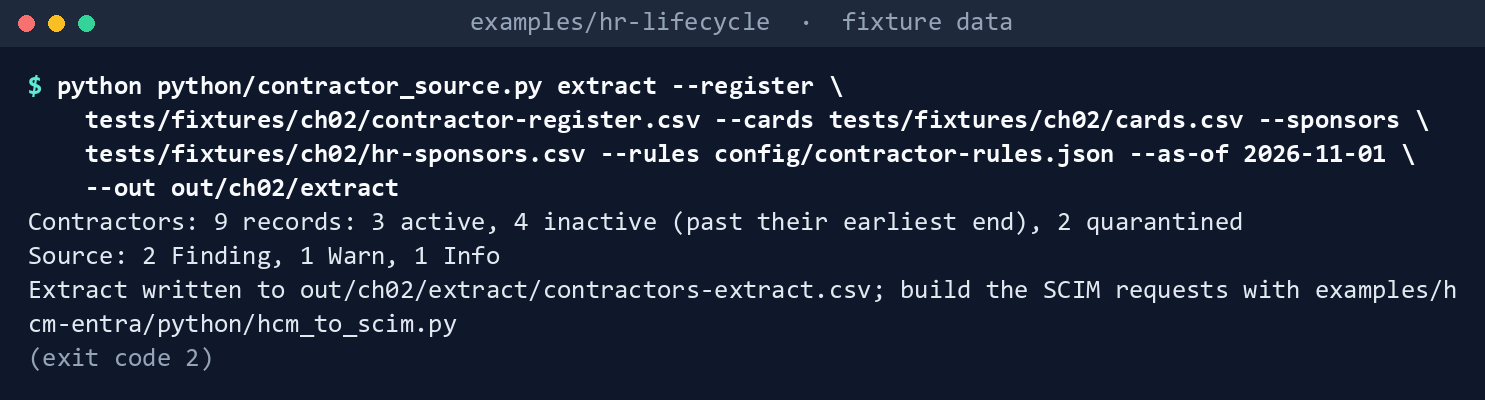
What the terminal shows, run on the kit’s fixtures (the same output as text) The exit code is 2, because the run has a Finding or a Warn; see the exit codes in the kit’s README.
Read the decisions:
python -c "import json; [print(d['PersonKey'], d['Action'], d['EarliestEnd'], d['Reason']) for d in json.load(open('out/ch02/extract/decisions.json'))]"900001 active 2027-01-11 contract end 900002 inactive 2026-10-15 completion date 900003 inactive 2026-10-20 suitability withdrawn 900004 inactive 2026-10-30 sponsor gone past the grace period 900005 inactive 2026-10-25 sponsor recertification due 900006 active 2026-11-10 contract end 900007 quarantine no contract end 900008 quarantine 2027-03-31 contract end 900009 active 2027-03-01 sponsor recertification due![Terminal window showing python -c 'import json; [print(d['PersonKey'], d['Action'], d['EarliestEnd'],… and what it printed](captures/02-3.png)
What the terminal shows, run on the kit’s fixtures (the same output as text) 900007 has no contract end (CS-01); 900008’s sponsor isn’t in the HR export (CS-02). 900004’s sponsor separated on September 30, so the 30-day grace period ends October 30 (CS-03). 900005’s card expired October 28, but its sponsor recertification was due October 25, which comes first.
Build the SCIM requests with the middleware:
python ../hcm-entra/python/hcm_to_scim.py --extract out/ch02/extract/contractors-extract.csv --as-of 2026-11-01 --out out/ch02/scim{"counts": {"ready": 7}, "batches": 1, "disables": 4, "held": false, "hold_reason": ""}
What the terminal shows, run on the kit’s fixtures (the same output as text) Seven records in one batch, four of them disables.
out/ch02/scim/bulk-request-001.jsonsends 900002, 900003, 900004 and 900005 withactivefalse. Nothing is sent: the middleware’s dry run is its default.Reconcile the register, the cards and the directory:
python python/contractor_source.py reconcile --register tests/fixtures/ch02/contractor-register.csv --cards tests/fixtures/ch02/cards.csv \
    --sponsors tests/fixtures/ch02/hr-sponsors.csv --accounts tests/fixtures/ch02/contractor-users.json --rules config/contractor-rules.json \
    --as-of 2026-11-01 --cloud gcc --out out/ch02/reconcile
python -c "import json; [print(r['Rule'], r['Severity'], r['Object'], '|', r['Issue']) for r in json.load(open('out/ch02/reconcile/findings.json'))]"
Reconciliation: 7 Finding, 1 Warn, 0 Info Written to out/ch02/reconcile (manifest.json lists every file's SHA-256) CR-01 Finding bailey.ortiz@contoso.example | enabled past its earliest end 2026-10-15 (completion date) CR-01 Finding cameron.wu@contoso.example | enabled past its earliest end 2026-10-20 (suitability withdrawn) CR-01 Finding devon.hale@contoso.example | enabled past its earliest end 2026-10-30 (sponsor gone past the grace period) CR-01 Finding ellis.ward@contoso.example | enabled past its earliest end 2026-10-25 (sponsor recertification due) CR-02 Finding temp.vendor@contoso.example | enabled contractor account with no register record (orphan) CR-03 Finding 900011 | active card for a person the contractor source doesn't hold (contractor credential drift) CR-05 Finding finley.moss@contoso.example | employeeLeaveDateTime 2026-12-10 isn't the earliest end 2026-11-10; the leaver workflow fires on the wrong day CR-04 Warn indy.shah@contoso.example | active register record with no account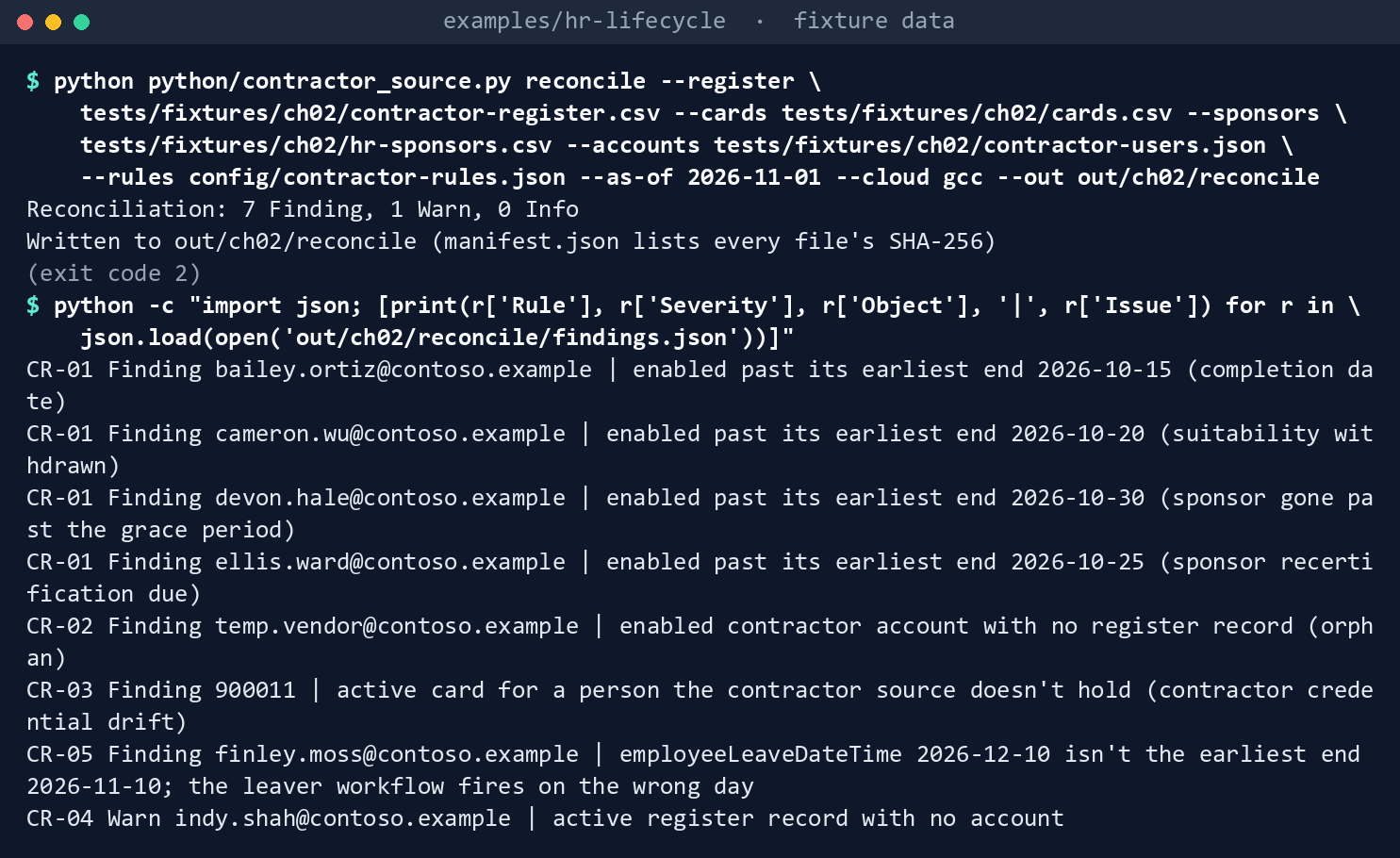
What the terminal shows, run on the kit’s fixtures (the same output as text) The four CR-01 accounts are the four disables in step 4: once the requests are sent, the next reconciliation shows none, which is the guide’s evidence for the gate.
Write the sponsor review settings:
python python/contractor_source.py review --rules config/contractor-rules.json --out out/ch02/review
What the terminal shows, run on the kit’s fixtures (the same output as text) Review settings written to out/ch02/review/assignment-policy-review.json for review; nothing was sent. The block hasexpirationBehaviorremoveAccess, the requestor’s manager at level 1 as primary reviewer, and anabsoluteMonthlyrecurrence with interval 6.Run the tests:
python -m pytest tests -q
What the terminal shows, run on the kit’s fixtures (the same output as text)
Expected result: 57 passed. Delete out when you’re done:
rm -rf out
Lab 2: test tenant
Not run by the authors. Use a test tenant in the worldwide or GCC cloud, never production. Work in examples/hr-lifecycle. You’ll need my-register.csv, my-cards.csv and my-sponsors.csv: your test contractors, their cards and their sponsors, in the layout of the files in tests/fixtures/ch02. You’ll replace: <today> (today’s date, yyyy-mm-dd), <provisioning-api-endpoint> (the Provisioning API Endpoint on the contractor provisioning app’s overview page), <scim-token> (a bearer token for graph.microsoft.com issued to the middleware’s identity), <graph-token> (a bearer token for graph.microsoft.com issued to the reader app), <tenant-id> (the test tenant’s ID) and <policy-id> (the ID of the test contractor package’s assignment policy).
Every command in this lab, in order, from examples/hr-lifecycle. Each step below says what it does and what to look for.
In a POSIX shell (Git Bash on Windows):
# Step 2: Send two test contractors
python python/contractor_source.py extract --register my-register.csv --cards my-cards.csv --sponsors my-sponsors.csv --rules config/contractor-rules.json --as-of <today> --out out/ch02-test-extract
cp ../hcm-entra/config/settings.example.json ../hcm-entra/config/settings.json
python -c "import json; p='../hcm-entra/config/settings.json'; d=json.load(open(p)); d['endpoint'] = '<provisioning-api-endpoint>'; json.dump(d, open(p, 'w'), indent=2)"
export HCM_ENTRA_BEARER_TOKEN='<scim-token>'
python ../hcm-entra/python/hcm_to_scim.py --extract out/ch02-test-extract/contractors-extract.csv --settings ../hcm-entra/config/settings.json --as-of <today> --out out/ch02-test-scim --apply
python -c "import json; [print(r['batch'], r['status'], r['provisioning_logs']) for r in json.load(open('out/ch02-test-scim/apply-results.json'))]"

# Step 3: Reconcile against the tenant
export HRLC_GRAPH_TOKEN='<graph-token>'
python python/graph_export.py --task contractor-reconcile --cloud gcc --out exports/ch02
python python/contractor_source.py reconcile --register my-register.csv --cards my-cards.csv --sponsors my-sponsors.csv \
    --accounts exports/ch02/contractor-users.json --rules config/contractor-rules.json --as-of <today> --cloud gcc --out out/ch02-test
In PowerShell 7:
# Step 4: Apply the review settings to a test contractor package
python python/contractor_source.py review --rules config/contractor-rules.json --out out/ch02-test-review
Connect-MgGraph -Environment Global -TenantId <tenant-id> -Scopes EntitlementManagement.ReadWrite.All
$uri = 'https://graph.microsoft.com/v1.0/identityGovernance/entitlementManagement/assignmentPolicies/<policy-id>'
$before = Invoke-MgGraphRequest -Method GET -Uri $uri
$before.Remove('@odata.context')
$before | ConvertTo-Json -Depth 20 | Set-Content policy-before.json
$body = Get-Content policy-before.json -Raw | ConvertFrom-Json -AsHashtable
$body['reviewSettings'] = (Get-Content out/ch02-test-review/assignment-policy-review.json -Raw | ConvertFrom-Json -AsHashtable)['reviewSettings']
$body | ConvertTo-Json -Depth 20 | Set-Content policy-new.json

# Step 4: Apply the review settings to a test contractor package
Set-MgEntitlementManagementAssignmentPolicy -AccessPackageAssignmentPolicyId <policy-id> -BodyParameter (Get-Content policy-new.json -Raw | ConvertFrom-Json -AsHashtable)
(Invoke-MgGraphRequest -Method GET -Uri $uri).reviewSettings.primaryReviewers | ConvertTo-Json -Depth 5

# Step 4: Apply the review settings to a test contractor package
Invoke-MgGraphRequest -Method GET -Uri $uri | ConvertTo-Json -Depth 20 | Set-Content policy-portal.json

# Step 5: Back it out
Set-MgEntitlementManagementAssignmentPolicy -AccessPackageAssignmentPolicyId <policy-id> -BodyParameter (Get-Content policy-before.json -Raw | ConvertFrom-Json -AsHashtable)
In a POSIX shell (Git Bash on Windows):
# Step 5: Back it out
rm -rf exports/ch02 out/ch02-test out/ch02-test-extract out/ch02-test-scim out/ch02-test-review policy-before.json policy-new.json policy-portal.json
Set up the contractor provisioning app as Learn’s API-driven inbound provisioning procedure describes, with the attribute mappings
examples/hcm-entradocuments, and grant the middleware’s identitySynchronizationData-User.Upload.OwnedByon that app only.6Send two test contractors through the middleware’s apply path, as Book 19, Chapter 01’s Lab 2 describes: one active, one past its end. The commands write the extract from your files, put the endpoint in the middleware’s settings, send the batch, and print each batch’s status and the
Locationheader it returned:python python/contractor_source.py extract --register my-register.csv --cards my-cards.csv --sponsors my-sponsors.csv --rules config/contractor-rules.json --as-of <today> --out out/ch02-test-extract cp ../hcm-entra/config/settings.example.json ../hcm-entra/config/settings.json python -c "import json; p='../hcm-entra/config/settings.json'; d=json.load(open(p)); d['endpoint'] = '<provisioning-api-endpoint>'; json.dump(d, open(p, 'w'), indent=2)" export HCM_ENTRA_BEARER_TOKEN='<scim-token>' python ../hcm-entra/python/hcm_to_scim.py --extract out/ch02-test-extract/contractors-extract.csv --settings ../hcm-entra/config/settings.json --as-of <today> --out out/ch02-test-scim --apply python -c "import json; [print(r['batch'], r['status'], r['provisioning_logs']) for r in json.load(open('out/ch02-test-scim/apply-results.json'))]"Read the provisioning log entry each
Locationheader points to, and confirm the second account is disabled and both carry the leave date.Reconcile against the tenant, with a token for
graph.microsoft.cominHRLC_GRAPH_TOKENfor an app holdingUser.Read.AllandUser-LifeCycleInfo.Read.All:export HRLC_GRAPH_TOKEN='<graph-token>' python python/graph_export.py --task contractor-reconcile --cloud gcc --out exports/ch02 python python/contractor_source.py reconcile --register my-register.csv --cards my-cards.csv --sponsors my-sponsors.csv \ --accounts exports/ch02/contractor-users.json --rules config/contractor-rules.json --as-of <today> --cloud gcc --out out/ch02-testThere should be no CR-01 for the account step 2 disabled.
Apply the review settings to a test contractor package. In PowerShell 7 with Graph PowerShell, the commands write the review settings, read the policy back into
policy-before.json(your read-back), and writepolicy-new.json: the read-back withreviewSettingsfromassignment-policy-review.jsonmerged in:python python/contractor_source.py review --rules config/contractor-rules.json --out out/ch02-test-review Connect-MgGraph -Environment Global -TenantId <tenant-id> -Scopes EntitlementManagement.ReadWrite.All $uri = 'https://graph.microsoft.com/v1.0/identityGovernance/entitlementManagement/assignmentPolicies/<policy-id>' $before = Invoke-MgGraphRequest -Method GET -Uri $uri $before.Remove('@odata.context') $before | ConvertTo-Json -Depth 20 | Set-Content policy-before.json $body = Get-Content policy-before.json -Raw | ConvertFrom-Json -AsHashtable $body['reviewSettings'] = (Get-Content out/ch02-test-review/assignment-policy-review.json -Raw | ConvertFrom-Json -AsHashtable)['reviewSettings'] $body | ConvertTo-Json -Depth 20 | Set-Content policy-new.jsonReview
policy-new.json, then send it withSet-MgEntitlementManagementAssignmentPolicy,7 and read the primary reviewers back:Set-MgEntitlementManagementAssignmentPolicy -AccessPackageAssignmentPolicyId <policy-id> -BodyParameter (Get-Content policy-new.json -Raw | ConvertFrom-Json -AsHashtable) (Invoke-MgGraphRequest -Method GET -Uri $uri).reviewSettings.primaryReviewers | ConvertTo-Json -Depth 5Confirm the reviewer is the manager. If the service refuses
requestorManageras a reviewer, set Manager as reviewer in the admin center as Learn’s procedure shows,8 export the policy, and record the subject set it uses:Invoke-MgGraphRequest -Method GET -Uri $uri | ConvertTo-Json -Depth 20 | Set-Content policy-portal.jsonBack it out. Restore the policy’s previous
reviewSettingsfrom your read-back:Set-MgEntitlementManagementAssignmentPolicy -AccessPackageAssignmentPolicyId <policy-id> -BodyParameter (Get-Content policy-before.json -Raw | ConvertFrom-Json -AsHashtable)Pause the provisioning job (a paused job keeps its state), delete the test contractors, and remove the permissions. Then delete
exports/ch02andout/ch02-test, with the lab’s other output folders and policy files:rm -rf exports/ch02 out/ch02-test out/ch02-test-extract out/ch02-test-scim out/ch02-test-review policy-before.json policy-new.json policy-portal.json
Verified facts
| Item | Value | US Government clouds | Stage | Source |
|---|---|---|---|---|
| Perform bulkUpload | POST /servicePrincipals/{id}/synchronization/jobs/{jobId}/bulkUpload; application/scim+json; 50 operations per request; 40 requests per second; 202 Accepted with a Location header to the provisioning logs |
No national cloud table on the page; API-driven inbound provisioning listed as available in Azure Government | v1.0 | 9 10 |
| bulkUpload permissions | Application: SynchronizationData-User.Upload.OwnedBy (least), SynchronizationData-User.Upload; delegated: SynchronizationData-User.Upload, for a User Administrator |
— | v1.0 | 11 |
| Matching and state | Matching attributes per the job’s mapping; active false disables; manager.value is the manager’s externalId |
— | v1.0 | 12 |
| Review settings | isEnabled, primaryReviewers, fallbackReviewers, schedule, expirationBehavior (keepAccess, removeAccess, acceptAccessRecommendation) |
Access reviews available in Azure Government | v1.0 | 13 14 |
| Access review of a package (procedure) | Monthly, quarterly, bi-annual or annual; Manager as reviewer with a fallback; no response: no change, remove access or take recommendations | — | GA | 15 |
| requestorManager | A subject set for a requestor’s manager, managerLevel 1 or 2, documented for approval stages |
— | v1.0 | 16 |
| Update an assignment policy | Set-MgEntitlementManagementAssignmentPolicy, EntitlementManagement.ReadWrite.All |
— | v1.0 | 17 |
| List users with leave date | User.Read.All with User-LifeCycleInfo.Read.All |
— | v1.0 | Carried from the validation kit’s VK-HR-05 |
Places Learn’s pages differ or say nothing:
requestorManageras a reviewer. Learn documents it for approvals, and the portal offers Manager as a reviewer, but no v1.0 page shows the subject set inreviewSettings. Lab 2 confirms it.- bulkUpload in the national clouds. The API page has no table; the feature availability page lists API-driven inbound provisioning in Azure Government. The program reads that as the API being available there.
Federal requirements and evidence
This chapter helps prove the guide’s Gate 2; its requirements table is the source, and the federal framework crosswalk lists every federal source.
| Requirement | KSI | What this code gives | What the ISSO keeps |
|---|---|---|---|
| NIST SP 800-53 AC-2 and PS-7, Moderate | KSI-IAM-JIT (AC-2); KSI-SCR-MON (PS-7) | The decisions with each earliest end and its reason; the read-only reconciliation, run before the contractor leaver ships and again after, with zero CR-01 | Both reconciliation output folders with their manifests; end-date-to-block intervals from Chapter 06 |
| IA-4(4) | KSI-IAM-AAM, KSI-IAM-ELP, KSI-IAM-JIT | Worker type C on every record, mapped to CTR by the middleware |
The extract and the middleware’s provenance manifest |
| OMB M-22-09 and M-19-17 | None: not SP 800-53 controls | The register as one named source per fact | The authority-per-fact table, signed by the governance body (not produced by code) |
| Privacy Act basis for each contractor record flow | None | — | The privacy office’s determination for the register and the card system |
| SA-9, external system services: FedRAMP use of the HR platform’s cloud service, which runs on Oracle Cloud Infrastructure | KSI-SCR-MIT, KSI-SCR-MON (reported by the provider) | — | The FedRAMP authorization the agency relies on for the HR platform, as the guide’s Gate 2 table says |
Each scripted step in the labs, and each file the code writes, with the evidence it leaves:
| Lab step | What it runs or writes | Requirement | KSI | Evidence |
|---|---|---|---|---|
| Lab 1, step 1 | graph_export.py --task contractor-reconcile --list |
AC-6, least privilege: GET calls only | KSI-IAM-ELP | The printed list, and config/calls.json as reviewed |
| Lab 1, step 2 | contractor_source.py extract, writing contractors-extract.csv |
PS-7; IA-4(4) for worker type C |
KSI-SCR-MON; KSI-IAM-AAM | out/ch02/extract/contractors-extract.csv, hashed in the folder’s manifest.json |
| Lab 1, steps 2 and 3 | decisions.json |
AC-2 and PS-7: each earliest end and its reason | KSI-IAM-JIT; KSI-SCR-MON | Each PersonKey with its Action, EarliestEnd and Reason, as step 3 prints them |
| Lab 1, step 2 | findings.json (CS-01 to CS-04) |
AC-2 | KSI-IAM-JIT | The quarantined records and their owners |
| Lab 1, steps 2, 5 and 6 | manifest.json in each output folder |
AU-9; SI-7 | KSI-MLA-OSM; KSI-SVC-VRI | A SHA-256 per file, written once |
| Lab 1, step 4 | hcm_to_scim.py, writing bulk-request-001.json, validation-report.json, quarantine.json and provenance.json |
IA-4(4): C mapped to CTR |
KSI-IAM-AAM, KSI-IAM-ELP, KSI-IAM-JIT | out/ch02/scim/provenance.json and validation-report.json |
| Lab 1, step 5 | contractor_source.py reconcile, writing decisions.json and findings.json (CR-01 to CR-05) |
AC-2 account review; PS-7 | KSI-IAM-JIT; KSI-SCR-MON | out/ch02/reconcile/findings.json, with zero CR-01 after the leaver ships |
| Lab 1, step 6 | contractor_source.py review, writing assignment-policy-review.json |
AC-2 account review: the sponsor recertifies, and no response removes access | KSI-IAM-JIT | out/ch02/review/assignment-policy-review.json, matched against the policy in the tenant |
| Lab 1, step 7 | python -m pytest tests -q |
CM-3(2) (design guidance) | KSI-CMT-VTD | 57 passed, kept with the change |
| Lab 1, clean-up | rm -rf out |
None: fixture output isn’t evidence | — | — |
| Lab 2, step 2 | extract from your files; set the endpoint; hcm_to_scim.py --apply, writing apply-results.json |
AC-2(1), automated account management; PS-7 | KSI-IAM-JIT; KSI-SCR-MON | out/ch02-test-scim/apply-results.json: each batch’s status and provisioning log link |
| Lab 2, step 3 | graph_export.py --task contractor-reconcile, writing contractor-users.json and export.json; reconcile into out/ch02-test |
AC-2 account review; PS-7; AC-6 for GET only | KSI-IAM-JIT; KSI-SCR-MON; KSI-IAM-ELP | out/ch02-test/findings.json and its manifest.json; exports/ch02/export.json |
| Lab 2, step 4 | review; read the policy into policy-before.json; write policy-new.json; Set-MgEntitlementManagementAssignmentPolicy; read back into policy-portal.json |
AC-2 account review; CM-3 for the change | KSI-IAM-JIT; KSI-CMT-LMC | policy-before.json, policy-new.json, the reviewers read back, and the directory audit record of the update |
| Lab 2, step 5 | Restore policy-before.json; rm -rf the lab files |
CM-3: the change backed out | KSI-CMT-LMC | The directory audit record of the restore |
KSIs are FedRAMP 20x indicators for cloud service providers: the agency authorizes its own system and lines this evidence up with what its providers report against them, and it doesn’t report KSIs itself (Book 00, Appendix B). Each KSI shown lists the row’s control among its related SP 800-53 controls on FedRAMP’s page;18 which file supports which indicator is the program’s mapping (design guidance). Controls the guide’s table doesn’t name (AC-2(1), AC-6, AU-9, CM-3, CM-3(2), SI-7) are in the Moderate baseline (Book 13, Appendix A; Book 14, Appendix A).
Dangers
| Danger | What happens | The guard |
|---|---|---|
| A trusted spreadsheet end date | Access outlives the engagement | The earliest end from every condition; CR-01 |
| An open-ended contractor | No leaver ever fires | CS-01 quarantines the record |
| A sponsor who left | Nobody is accountable for the contractor | CS-03, and the end after the grace period |
| A missed recertification | Access stays because no one answered | removeAccess on no response, and the recertification date as an end condition |
| A leave date in the directory that drifted | The leaver workflow fires on the wrong day | CR-05 |
| A card for someone the source doesn’t hold | A credential works for a person nobody sponsors | CR-03, and Chapter 07’s contractor credential drift |
| A second SCIM client | Two writers, two sets of validation | The extract goes through examples/hcm-entra; the register names one writer (Chapter 01) |
Checklist
Footnotes
Microsoft Learn, “Microsoft Entra feature availability,” https://learn.microsoft.com/entra/identity/authentication/feature-availability (read November 1, 2026; carried from the HR-driven identity implementation guide’s verification log).↩︎
Microsoft Learn, “Perform bulkUpload,” permissions, HTTP request, response and examples, https://learn.microsoft.com/graph/api/synchronization-synchronizationjob-post-bulkupload?view=graph-rest-1.0 (read November 1, 2026).↩︎
Microsoft Learn, “accessPackageAssignmentReviewSettings resource type,” https://learn.microsoft.com/graph/api/resources/accesspackageassignmentreviewsettings?view=graph-rest-1.0 (read November 1, 2026).↩︎
Microsoft Learn, “Create an access review of an access package in entitlement management,” https://learn.microsoft.com/entra/id-governance/entitlement-management-access-reviews-create (read November 1, 2026; carried from the HR-driven identity implementation guide’s verification log).↩︎
Microsoft Learn, “Set-MgEntitlementManagementAssignmentPolicy,” permissions and example, https://learn.microsoft.com/powershell/module/microsoft.graph.identity.governance/set-mgentitlementmanagementassignmentpolicy?view=graph-powershell-1.0 (read November 1, 2026).↩︎
Microsoft Learn, “Perform bulkUpload,” permissions, HTTP request, response and examples, https://learn.microsoft.com/graph/api/synchronization-synchronizationjob-post-bulkupload?view=graph-rest-1.0 (read November 1, 2026).↩︎
Microsoft Learn, “Set-MgEntitlementManagementAssignmentPolicy,” permissions and example, https://learn.microsoft.com/powershell/module/microsoft.graph.identity.governance/set-mgentitlementmanagementassignmentpolicy?view=graph-powershell-1.0 (read November 1, 2026).↩︎
Microsoft Learn, “Create an access review of an access package in entitlement management,” https://learn.microsoft.com/entra/id-governance/entitlement-management-access-reviews-create (read November 1, 2026; carried from the HR-driven identity implementation guide’s verification log).↩︎
Microsoft Learn, “Perform bulkUpload,” permissions, HTTP request, response and examples, https://learn.microsoft.com/graph/api/synchronization-synchronizationjob-post-bulkupload?view=graph-rest-1.0 (read November 1, 2026).↩︎
Microsoft Learn, “Microsoft Entra feature availability,” https://learn.microsoft.com/entra/identity/authentication/feature-availability (read November 1, 2026; carried from the HR-driven identity implementation guide’s verification log).↩︎
Microsoft Learn, “Perform bulkUpload,” permissions, HTTP request, response and examples, https://learn.microsoft.com/graph/api/synchronization-synchronizationjob-post-bulkupload?view=graph-rest-1.0 (read November 1, 2026).↩︎
Microsoft Learn, “Perform bulkUpload,” permissions, HTTP request, response and examples, https://learn.microsoft.com/graph/api/synchronization-synchronizationjob-post-bulkupload?view=graph-rest-1.0 (read November 1, 2026).↩︎
Microsoft Learn, “accessPackageAssignmentReviewSettings resource type,” https://learn.microsoft.com/graph/api/resources/accesspackageassignmentreviewsettings?view=graph-rest-1.0 (read November 1, 2026).↩︎
Microsoft Learn, “Microsoft Entra feature availability,” https://learn.microsoft.com/entra/identity/authentication/feature-availability (read November 1, 2026; carried from the HR-driven identity implementation guide’s verification log).↩︎
Microsoft Learn, “Create an access review of an access package in entitlement management,” https://learn.microsoft.com/entra/id-governance/entitlement-management-access-reviews-create (read November 1, 2026; carried from the HR-driven identity implementation guide’s verification log).↩︎
Microsoft Learn, “requestorManager resource type,” https://learn.microsoft.com/graph/api/resources/requestormanager?view=graph-rest-1.0 (read November 1, 2026).↩︎
Microsoft Learn, “Set-MgEntitlementManagementAssignmentPolicy,” permissions and example, https://learn.microsoft.com/powershell/module/microsoft.graph.identity.governance/set-mgentitlementmanagementassignmentpolicy?view=graph-powershell-1.0 (read November 1, 2026).↩︎
FedRAMP, “Key Security Indicators,” FedRAMP Consolidated Rules for 2026, indicator titles and “Related SP 800-53 Controls,” including the mapping updates of October 13, 2026, https://www.fedramp.gov/2026/reference/key-security-indicators/ (read November 2, 2026; the indicator IDs are carried from Book 13, Appendix A and Book 14, Chapter 03).↩︎